
Key Highlights
- What Are Medical Coding Jobs in Canada in 2026?
- Why Are Medical Coding Jobs in Canada Growing So Fast?
- Why Choose Medical Coding Jobs in Canada?
- What Are the Salary Trends for Medical Coding Jobs in Canada in 2026?
- What Certifications Are Required for Medical Coding Jobs in Canada?
- How Can Indians Get Medical Coding Jobs in Canada in 2026?
- Medical Coding Jobs in Canada for Indians in 2026
- What Are the Top Provinces and Cities for Medical Coding Jobs in Canada?
- What Are the Visa Pathways for Medical Coding Jobs in Canada?
- What are the requirements for Medical Billing and Coding Jobs in Canada?
- How Is AI Changing Medical Coding Jobs in Canada in 2026?
- What Are the Challenges in Getting Medical Coding Jobs in Canada for Indians?
- Conclusion
For those who have a keen eye for detail, a working knowledge of medical coding, and experience with medical records, medical coding careers in Canada are an excellent starting point for anyone looking to make a career in the healthcare industry. Hospitals, clinics, insurance companies, and outsourcing companies have steady demand for the field in 2026, and a lot of the jobs are also available remotely. The average salary for people in this job is approximately CAD 40,000 to CAD 65,000 a year and varies by province, employer, and certifications. There is no specific medical coding visa for international candidates; a valid work permit, employer sponsorship, or pathway into immigration programmes is the usual route. Medical coding can be a stable and promising career in Canada if you have the proper skills and experience.
What Are Medical Coding Jobs in Canada in 2026?

-
Medical coding is a Canadian occupation that requires an individual to review the patient's records and provide standardized codes for diagnosis, procedure, and billing.
-
These are typically located in hospitals, clinics, health record departments, insurance companies, or medical billing companies.
-
Throughout the major cities, demand will be steady in 2026, such as Toronto, Vancouver, Montreal, Calgary, and Ottawa.
-
Additionally, many employers have remote or hybrid positions.
-
Skills are generally ICD-10 coding, CPT coding, medical terminology, EHR systems, and attention to detail.
-
Average salaries can range from CAD 40,000 to CAD 65,000 annually, depending on experience and geographic location.
-
Job prospects are good, though there may be some entry-level positions available, and certification and experience will help job prospects.
-
Work permits, or sponsorship by the employer, are generally required for international workers.
Expert Advice: Canada uses ICD-10-CA, a Canadian modification of the international ICD-10 standard, so professionals trained on US-only coding systems must undergo additional training before entering the Canadian job market.
Also Read: How to Find the Best Medical Coding Jobs Abroad?
Why Are Medical Coding Jobs in Canada Growing So Fast?
-
Healthcare information is expanding rapidly, and hospitals require more coders to properly handle data.
-
As Canada's population gets older, so do the numbers of patient visits, adding more to the coding and documentation workload.
-
More medical services will result in more charts, procedures, and billing records to be coded properly.
-
The use of electronic health records (EHRs) and digital systems is driving a growing demand for skilled coding professionals.
-
Hospitals and clinics desire precise coding to aid in reporting, audits, and financing.
-
Working remotely and hybrid work have made the job more accessible and appealing.
-
Replacement hiring is also helping to support demand, as experienced coder turnover occurs with experienced coder retirements or promotions.
-
The field seems appealing to international laborers because of the opportunities it provides for stable employment in a field with health-related opportunities.
Pro Tip: The Canadian government's Canada Health Infoway initiative is accelerating the digitisation of health records nationwide, which directly increases demand for trained medical coders to ensure data accuracy and compliance.
Why Choose Medical Coding Jobs in Canada?

These are some reasons why you should choose medical coding jobs in Canada:
High Demand:
-
As the healthcare sector expands, so does the requirement for individuals who code medical information.
-
The increasing demands from hospitals, private clinics, and insurance firms continuously seek qualified specialists.
-
Medical coding positions will continue to increase until the end of 2030.
Attractive Salaries
-
The commercial prospects of this profession become more attractive because of its competitive earnings potential.
-
Medical coders with certification earn substantially higher compensation than those without accreditation.
-
Both experience in the field, specialisation of the role, and supplementary certifications result in salary growth for medical coders.
Career Growth:
-
New coders can transition to senior positions through adequate work experience.
-
Certifications like CPC (Certified Professional Coder) and CCS (Certified Coding Specialist) boost career opportunities.
-
Medical coders can earn better compensation through their work in risk adjustment coding and auditing or specialized medical fields.
Remote Work Opportunities:
-
Medical coding works now allow remote and hybrid employment opportunities, which have increased to more than 60% of all available positions.
-
Healthcare organizations enable their remote coding staff to access secure medical records online.
-
Remote workplace flexibility enables medical coders to achieve enhanced personal-professional separation.
Immigration-Friendly Policies:
-
The Canadian government encourages healthcare specialists who wish to relocate to their territory.
-
Immigration pathways like Express Entry and Provincial Nominee Programs (PNPs) favor medical coders.
-
Professional experience and required certifications strengthen the chances of obtaining work visas.
Also Read: Top 10 Benefits of Canadian Permanent Residency
What Are the Salary Trends for Medical Coding Jobs in Canada in 2026?
-
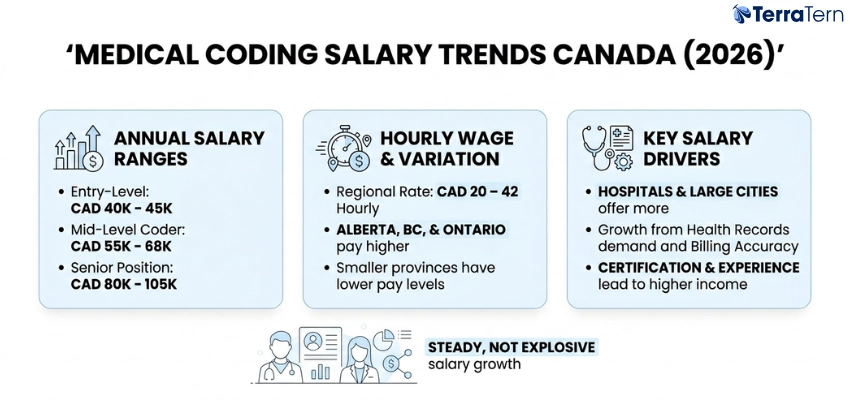
In Canada, the salary for entry-level medical coding positions generally ranges between CAD 40,000 and CAD 45,000 annually.
-
The median salary for mid-level coders is around CAD 55,000 to CAD 68,000 annually, which varies based on certification and experience.
-
In a more robust market or for senior positions, a highly experienced coder can earn CAD 80,000 to CAD 105,000 annually.
-
The hourly wages are generally in the CAD 20 to CAD 42 range, depending on the region.
-
Smaller provinces, as a rule, have lower pay levels than Alberta, British Columbia, and Ontario.
-
Generally, large cities and hospitals are going to pay more than smaller companies and entry-level outsourcing companies.
-
Demand for health records, billing accuracy, and digital healthcare systems is contributing to steady, not explosive, salary growth.
-
Over time, having certifications and experience can lead to higher income.
Key Note: Earning a CHIMA certification can increase a medical coder's annual salary by 15–20% in Canada, making it the single highest-ROI professional investment for anyone targeting this field.
What Certifications Are Required for Medical Coding Jobs in Canada?
-
The CHIM designation is the primary medical coding credential recognized in Canada.
-
You typically must have an accredited (Canadian) health information management programme to take the CHIM.
-
Those with certain credentials recognized internationally may be eligible through a reciprocal pathway but will still be required to pass the CHIM National Certification Examination.
-
The CCCS credential is also regarded as a good speciality designation for Canadian medical coding specialists, particularly those already working in the HIM field.
-
While some employers will hire candidates with a medical coding certificate, certification will increase the likelihood of a successful career.
-
Entry-to-practice coding certificates can be used to expand coding skills for entry-level coders or for individuals transitioning into coding from HIM studies.
-
Canadian employers typically prefer CHIM-related certifications for coding positions in Canada, though additional certifications from international organizations, like AAPC's CPC, can be beneficial for skills.
Advice by our Expert: While US-based CPC and CCS certifications are accepted by Canadian employers, investing in a CHIMA credential, even as an add-on, signals a commitment to the local market and significantly improves hiring rates in public healthcare organisations.
How Can Indians Get Medical Coding Jobs in Canada in 2026?
-
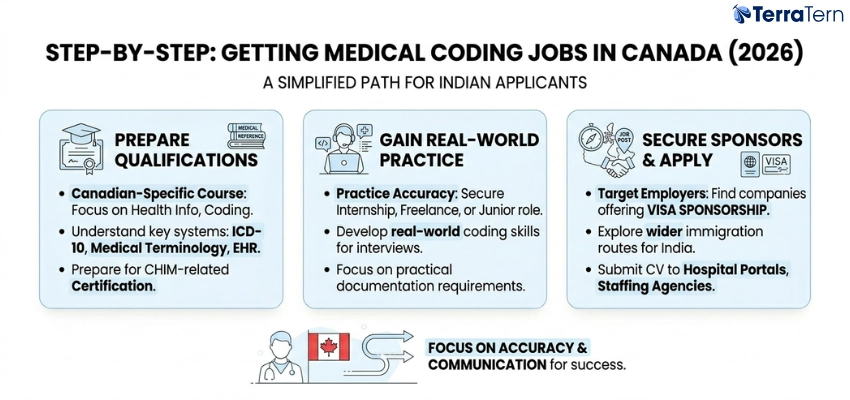
First, create the appropriate qualification, typically a course in health information, medical coding, or medical billing and coding, and ensure it meets the expectations of Canadian employers.
-
Understand the basic coding systems in use in Canada, particularly ICD-10, medical terminology, and electronic health record (EHR) software.
-
Get prepared for certification, as employers in Canada may prefer CHIM-related or other recognized coding certifications.
-
Practice coding in a real-world setting by doing an internship, freelancing, or working as a junior, as accuracy in the real world counts for much in a job interview.
-
Look for remote, contract, and employer-sponsored positions, as some Canadian opportunities state they are remote or offer visa sponsorship.
-
Post your resume on Canadian job boards and healthcare staffing agencies that post coding jobs. Submit your CV to Canadian job boards, hospital career portals, and healthcare staffing agencies that post coding jobs.
-
For those applying from India, rather than aiming for a special medical coding visa, look to employers that sponsor work permits, or to wider immigration routes.
-
Excellent oral and written communication skills and the ability to read and understand the documentation requirements of the Canadian healthcare sector will be beneficial.
Expert Advice: The biggest mistake Indian medical coders make when applying to Canadian jobs is using US-centric coding terminology on their resumes. Employers in Canada expect familiarity with ICD-10-CA and Canadian provincial billing frameworks; bridge this gap explicitly in your application.
Also Read: Apply Canada Work Visa: Types, Fees, Eligibility & More
Medical Coding Jobs in Canada for Indians in 2026

Here’s a step-by-step guide for medical coding jobs in Canada for Indians:
Step 1: Obtain a Medical Coding Certification:
-
Obtain certification through the CPC certification, CCS certification, or CHIMA (Canadian Health Information Management Association).
-
Canadian employers consider CHIMA certificates their preference but also accept CPC and CCS certifications.
-
Job opportunities and higher salaries have become more accessible through professional certification.
Step 2: Gain Experience in a Recognized Healthcare Facility:
-
The healthcare workforce in India can be found within hospitals, clinics, or medical billing organizations.
-
Practical work experience with ICD and CPT coding functions as a credibility enhancer.
-
Work experience of 1-2 years is the minimum requirement for employers seeking new medical coding staff.
Step 3: Apply for Credential Evaluation (If Required):
-
A few employers ask their candidates to present qualification equivalency assessment results.
-
WES (World Education Services) is an organization that evaluates foreign education credentials.
-
The Canadian Healthcare Information Management Association provides foreign applicants with a credential verification service.
Step 4: Research Job Openings on Trusted Platforms:
-
A candidate should include job searches on LinkedIn, Indeed, Glassdoor, and JobBank Canada.
-
Canadian medical coding communities provide networking opportunities to their members.
-
You should submit applications to healthcare facilities, insurance companies, and remote coding positions.
Step 5: Apply for a Work Visa or Permanent Residency (PR):
-
Canada maintains several entry paths for experienced healthcare specialists.
-
Express Entry and Provincial Nominee Program serve as the most suitable access points for migration.
-
Medical coding professionals who find employment in Canada usually get jobs before they apply for their work permissions.
Step 6: Secure Employment and Adapt to the Canadian System
-
Master Canadian healthcare regulatory rules as well as coding standards.
-
You must recognize the operation of OHIP (Ontario Health Insurance Plan) alongside all other provincial bill processing mechanisms.
-
You should adopt AI-based coding solutions Canada currently uses for software development.
Following these steps can help you easily secure medical coding jobs in Canada for Indians.
What Are the Top Provinces and Cities for Medical Coding Jobs in Canada?
Medical coding jobs in Canada in 2026 are dominated by the top provinces and cities based on their job posting activity and the demand for medical coding jobs.
|
Province |
Top cities |
Why it stands out |
|
Ontario |
The City of Toronto, City of Markham, and City of Richmond Hill are located in that area. |
Most opportunities with high volume and numerous hospital, clinic, and remote positions. |
|
British Columbia |
Vancouver |
Excellent healthcare market and availability of coding jobs. |
|
Quebec |
Rimouski, Montreal |
Has openings but fewer than Ontario and B.C. |
|
New Brunswick |
Moncton, Edmundston–Woodstock |
Fewer people are applying for these jobs, but these are live jobs. |
|
Manitoba |
Winnipeg |
One of the provinces where the demand for coders is good. |
The top three places to consider are Ontario, Vancouver, and Montreal, which all have the widest berth.
Pro Tip: Ontario's OHIP (Ontario Health Insurance Plan) billing system is unique and requires specific training. Indian professionals targeting Ontario roles should proactively learn OHIP billing protocols to stand out.
What Are the Visa Pathways for Medical Coding Jobs in Canada?
-
You typically require a work permit or permanent residence pathway to Canada, and there is no specific “medical coding visa.”
-
If an employer in Canada offers you a job opportunity, you may be able to apply for an employer-specific work permit, particularly if the job mentions that it requires you to get a work permit from the Canadian government.
-
If your education, work experience, and language scores qualify you for the skilled-worker stream, you might be able to apply through Express Entry.
-
A provincial nomination program (PNP) may be a good option if a province is looking for health or health information workers.
-
Depending on the specific role and NOC code, there may be some healthcare-related immigration policies that apply, so it is important to match the role accurately.
-
For individuals with Canadian work and/or study experience, pathways such as the Canadian Experience Class may be relevant.
-
There are some job boards that display jobs that are open to visa sponsorship for medical coding jobs, but it is not guaranteed.
-
The best strategy for Indian applicants is typically: become certified, apply for a job opening with a Canadian employer, receive an offer, and then apply for the corresponding work permit or PR process.
Key Note: Medical coding falls under NOC 31112 in Canada's updated TEER classification system. Ensuring you use the correct NOC code in your Express Entry profile is critical, as misclassification can lead to application rejection.
What are the requirements for Medical Billing and Coding Jobs in Canada?
-
Employers typically require a high school diploma, though some require a diploma or certificate in health information, medical billing, or medical coding.
-
Medical terminology and coding (ICD-10 & CPT) and a basic understanding of insurance billing procedures are important.
-
It requires good computer skills, attention to detail, and an ability to record and deal accurately with claims.
-
Familiarity with data entry, office administration, or health care support is desired by many employers.
-
Depending on the employer, certifications can enhance your odds of success, particularly AAPC's CPC or Canadian health information credentials.
-
Typing speed, communication skills, and organizational skills are usually assessed in the hiring process.
-
Certain positions may involve working in an office environment, screening, or understanding EMR/EHR.
-
In addition to the job qualifications, most countries will require applicants to hold a valid work permit or employer sponsorship.
Advice by our Expert: Canadian employers in public healthcare increasingly require PIPEDA compliance knowledge. Medical coders who can demonstrate familiarity with Canada's privacy law framework are hired faster and command higher salaries than those without it.
How Is AI Changing Medical Coding Jobs in Canada in 2026?
-
AI is beginning to automate repetitive aspects of coding, including missing documentation, code suggestions and recommendations, and chart review.
-
Despite the rise of AI, there are still situations that require human coding expertise, such as complex scenarios involving clinical judgment, sequencing, compliance, and context, which AI cannot fully replicate.
-
The tasks are becoming more review, audit, and quality control than data entry.
-
Healthcare code developers who grasp healthcare regulations and AI tools are increasingly valuable assets to employers.
-
When it comes to simple cases, AI can speed up the process and minimize errors, but it still requires human supervision for accuracy.
-
In Canada, the places will not be eliminated, but medical coding jobs will be transitioned to focus on technology skills.
-
Documentation improvement, compliance, analytics, and AI-driven revenue cycle opportunities are becoming available.
-
The safest career approach is to develop coding skills along with software, audit, and digital-health skills.
Expert Advice: Medical coders who proactively learn AI-assisted coding tools (like 3M and Nuance platforms) are being promoted to quality auditor roles, a position that pays 20 - 30% more than standard coding roles in Canada.
What Are the Challenges in Getting Medical Coding Jobs in Canada for Indians?
-
There are fewer medical coding positions in Canada than there are in the U.S., and so, it can be more difficult for new arrivals to compete.
-
The majority of positions are available within hospitals, so you may find that employment is limited and can be a bit slow.
-
Canadian health information credentials or experience gained in Canada may be preferred by employers; extra validation may be necessary for credentials from India.
-
Certain jobs will call for an understanding of Canadian coding habits, hospital workflows, and province-specific documentation guidelines.
-
Issuing of visas and work permits may be a challenge, as not all positions are sponsored.
-
The ability to speak English well, and in certain provinces, French as well, can help you a great deal.
-
Networking is critical, and many candidates end up failing due to the lack of local professional networks.
-
The job is also being transformed by AI and automation, meaning that employers might require more applicants to have the ability to be fast with accuracy, as well as tech skills.
Pro Tip: The single most effective way for Indian professionals to bypass the "Canadian experience" barrier is to target remote medical coding positions first. These roles accept international applicants and allow you to build a Canadian employment history from India.
Read More: Immigration To Canada From India: The Ultimate Guide
Conclusion
Medical coding careers in Canada are a great choice for healthcare professionals in 2025, as the demand continues to be stable, wages are expected to improve, and they can work in hospitals, clinics, insurance companies, and remote positions. The ideal way to build the right certification, acquire coding experience, and find the right provinces for employment opportunities is to get a valid work permit or an employer-sponsored path for Indians and other international applicants. Although AI is transforming the job, it's not taking the place of proficient coders; it's actually making things more critical to be accurate, compliant, and tech-savvy.
Contact TerraTern today to land your dream role in medical coding jobs in Canada!


 AI Summary