

Key Highlights
- Is MBBS in Switzerland for Indian Students a Good Option?
- What Are the Eligibility Requirements for MBBS in Switzerland for Indian Students?
- Do Swiss Medical Universities Offer MBBS in English?
- Which Are the Best Universities for MBBS in Switzerland?
- What Is the Numerus Clausus (NC) / EMS Entrance Exam for MBBS in Switzerland?
- What Documents Are Required to Apply for MBBS in Switzerland?
- How Do Indian Students Apply for MBBS in Switzerland?
- What Is the Fee Structure for MBBS in Switzerland for Indian Students?
- What Is the Switzerland Student Visa Process for Indian MBBS Aspirants?
- Are There Scholarships Available for Indian Students Pursuing MBBS in Switzerland?
- Is an MBBS Degree from Switzerland Valid in India?
- What Are the Career Prospects After MBBS in Switzerland?
- How Does MBBS in Switzerland Compare to Other Study-Abroad Destinations?
- What Is Student Life Like in Switzerland for Indian MBBS Students?
- 2026 Industry Context Section
- Conclusion
Thinking about going to Europe to study medicine? The route of pursuing a career in MBBS in Switzerland for Indian students in 2026 is a fantastic one that can help them get a medical education of excellent quality. Switzerland offers second-to-none clinical training as a result of highly selective medical faculties, renowned degrees and high-quality infrastructure. All you need to know about 2026 admission, fees and eligibility in the complete guide.
Is MBBS in Switzerland for Indian Students a Good Option?

It is not a typical route for Indian students; you need fluency in German or French, the financial capacity to fund roughly INR 1.2–1.6 crore over six years, and, if you are eligible at all, clear one of Europe’s most demanding aptitude tests to secure a seat at Switzerland’s highly selective public medical faculties (e.g., Zurich, Geneva, Basel, Bern).
For Indian citizens living in India without Swiss citizenship or residency, MBBS in Switzerland is generally not an accessible primary route, even with strong language skills and EMS preparation.
-
Real Benefits: Top 200 medical faculties of the world (blog) / Recognised Degree from WHO / Clinical education at highly respected teaching hospitals (such as the University Hospital Zürich, HUG Geneva or the Inselspital Bern) / unparalleled level of safety / first place in the Swiss Innovation Index (blog).
-
Honest Constraints: No English-medium options, the cost of living is ridiculously high, the Numerus Clausus (NC) is extremely difficult to pass, and only a few seats are available at public universities fornon-EUU/EFT candidatesA.
|
Switzerland MBBS is a fit if… |
Switzerland is NOT a fit if… |
|
You are fluent in German or French (B2/C1) |
You require an English-medium program |
|
Your budget can accommodate INR 1.2–1.6 crore |
You are seeking a budget-friendly degree |
|
You can clear the rigorous NC aptitude exam |
You want guaranteed admission based on 12th marks |
As per TerraTern Expert Divyansh, Switzerland rewards preparation over urgency; students who start German/French training 18–24 months before applying have dramatically better outcomes than those applying reactively after a NEET result.
Also Read: Top 15 Best Countries for Indian Doctors to Migrate
What Are the Eligibility Requirements for MBBS in Switzerland for Indian Students?
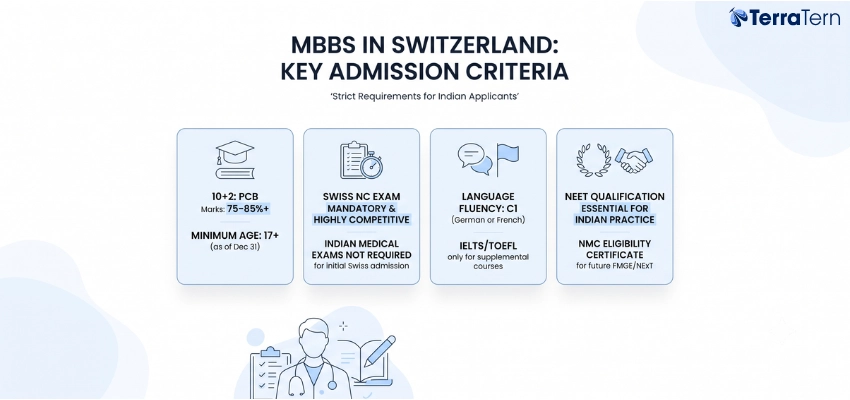
MBBS in Switzerland for Indian students has strict admission criteria set by the Swiss faculties:
-
What makes their admissions significantly different is that they do not take any Indian medical examinations when making their decision.
-
For academic requirements, it was mentioned that a student needed to have completed 10+2 with Physics, Chemistry and Biology with 75-85%+ (aggregate) marks. Others may also need a basic science bachelor's-level education option.
-
Minimum age 17 years as of Dec 31 of the year of enrolment.
-
Language fluency C1 (German or French) , IELTS/TOEFL only applies to supplemental English courses and not to the degree itself.
-
The Swiss Numerus Clausus (NC) entrance exam, mandatory for admission to Swiss universities and is highly competitive.
-
Under NMC’s FMGL Regulations, any Indian citizen or OCI who wants a foreign MBBS degree to be recognised in India must first qualify NEET. NEET is not required by Swiss universities for admission, but without a qualifying NEET score, you cannot obtain NMC’s Eligibility Certificate or later sit for FMGE/NExT, and your Swiss degree will never count for legal practice in India.
Important Tip: Don’t skip NEET even if a Swiss university doesn’t ask for it; students who go abroad without a qualifying NEET score are permanently barred from FMGE/NExT and can never legally practise in India, regardless of degree quality.
Do Swiss Medical Universities Offer MBBS in English?
No, there aren't any English-medium undergraduate MBBS programs in Switzerland for Indian students. The issue of misinformation is when people think that English-taught PhDs are the same as the core curriculum.
-
Depending on the region, Courses are taught in German (Zurich, Basel) or French ( Geneva, Lausanne, Fribourg).
-
Deadline: The C1 certification is required before clinicals.
-
Intensive Study Time: 12-18 months are required for preparation for C1 by means of the Goethe-Institut or Alliance Française.
-
English Options: Only for post-graduate study or for auxiliary subjects, NOT a medical degree.
Expert Advice: If an agent tells you "MBBS in Switzerland is available in English," ask them to name the specific university and faculty in writing; as of 2026, none of the public medical faculties can substantiate that claim for the undergraduate programme.
Which Are the Best Universities for MBBS in Switzerland?
It is crucial to assess the very best institutions before you decide to plan MBBS in Switzerland for Indian students. Medical students who are aspiring to join the medical field major in a comprehensive clinical training program at historic public universities
|
University |
QS 2026 Rank |
Language of Instruction |
Approx. Annual Tuition (CHF/INR) |
City |
|
University of Zurich (UZH) |
#100 |
German |
CHF 1,500 – 3,500 (~INR 1.4 – 3.3L) |
Zurich |
|
University of Geneva |
#155 |
French |
CHF 1,000 – 3,000 (~INR 90K – 2.8L) |
Geneva |
|
University of Basel |
#158 |
German |
CHF 1,700 – 3,500 (~INR 1.5 – 3.3L) |
Basel |
|
University of Bern |
#184 |
German |
CHF 1,800 – 3,500 (~INR 1.6 – 3.3L) |
Bern |
|
University of Lausanne |
#176 |
French |
CHF 1,200 – 3,000 (~INR 1.1 – 2.8L) |
Lausanne |
Expert Tip: Rank isn't the only variable; a German C1 speaker with strong sciences is often better served by Basel's smaller, more clinically integrated programme than by chasing ETH Zurich's global reputation alone.
What Is the Numerus Clausus (NC) / EMS Entrance Exam for MBBS in Switzerland?
The Numerus Clausus (EMS, Eignungstest für das Medizinstudium) is Switzerland’s standardised medical aptitude test, acting as the primary admission gate for the public medical faculties in German‑, French‑ and Italian‑speaking universities.
-
What it Tests: Scientific reasoning, pattern recognition, and quantitative logic, not PCB content like NEET.
-
Timeline: Conducted annually in early July; results are released by late July or early August.
-
Exam Fee: Approximately CHF 300 (~INR 28,000).
-
The Ultimate Hurdle: Clearing this highly competitive exam is the most critical step to securing an MBBS in Switzerland for Indian students.
Important Note: Because the NC tests reasoning speed under time pressure rather than memorised content, NEET coaching alone will not prepare a student for it; factor in dedicated NC preparation time separately.
What Documents Are Required to Apply for MBBS in Switzerland?
To successfully apply for MBBS in Switzerland for Indian students, ensure you submit the following documents via cantonal university portals between November and April:
-
Academic Records: 10+2 transcripts (and, where required, any basic‑science bachelor‑level coursework) with certified German/French translations. NEET scorecard (kept for NMC/India recognition; Swiss universities generally do not require it, but it is mandatory if you plan to practise in India later).
-
Language Proof: C1-level certification in German or French.
-
Identity & Finances: Valid passport and proof of financial means.
-
Application Essentials: Statement of Purpose (SOP) and Letters of Recommendation (LORs).
-
Note: Exact portal requirements frequently vary by canton.
As per TerraTern Expert: Start certified translations of Indian transcripts at least 3 months before the application deadline; German/French notarised translation backlogs are a common, avoidable delay.
How Do Indian Students Apply for MBBS in Switzerland?
The application timeline for MBBS in Switzerland for Indian students demands strict planning, primarily targeting the Fall (September) intake, though some cantons offer Spring (February) variations:
-
18 Months Prior: Shortlist universities and begin C1 language certification.
-
12 Months Prior: Register for and clear the NC/EMS exam.
-
9 Months Prior: Submit online applications with required documents; attend interviews.
-
6 Months Prior: Secure a conditional offer and apply for a Swiss Category B student permit.
-
Upon Arrival: Complete mandatory cantonal registration.
Pro Tip: Treat the application timeline as an 18-24-month project, not a single admissions season; language certification alone can take a year for a standing start.
What Is the Fee Structure for MBBS in Switzerland for Indian Students?
Public-university tuition runs roughly CHF 720–2,640 per year (~INR 65,000–INR 2.4 lakh), while living costs of CHF 2,000–3,000 per month push the realistic six-year total to approximately INR 1.2–1.6 crore. Consequently, living expenses, not the heavily subsidised tuition, are the dominant cost driver when calculating MBBS in Switzerland for Indian students' fees.
Annual Tuition by University
|
University |
Annual Tuition (CHF) |
Approx. Annual Tuition (INR) |
|
University of Geneva |
CHF 1,000 |
~INR 90,000 |
|
University of Lausanne |
CHF 1,160 |
~INR 1,04,000 |
|
University of Zurich |
CHF 1,440 |
~INR 1,30,000 |
|
University of Basel |
CHF 1,700 |
~INR 1,53,000 |
|
University of Bern |
CHF 1,900 |
~INR 1,71,000 |
Estimated Monthly Living Costs
|
Expense Category |
Monthly Cost (CHF) |
Approx. Monthly Cost (INR) |
|
Accommodation (Shared housing/Studierendenwerk) |
CHF 700 – 1,100 |
~INR 63,000 – INR 99,000 |
|
Food & Groceries |
CHF 500 – 700 |
~INR 45,000 – INR 63,000 |
|
Mandatory Health Insurance (KVG/LAMal) |
CHF 250 – 350 |
~INR 22,500 – INR 31,500 |
|
Public Transport (GA Travelcard/Half-Fare) |
CHF 100 – 150 |
~INR 9,000 – INR 13,500 |
|
Books & Study Materials |
CHF 150 – 200 |
~INR 13,500 – INR 18,000 |
|
Miscellaneous/Personal |
CHF 300 – 500 |
~INR 27,000 – INR 45,000 |
|
Total Monthly Average |
CHF 2,000 – 3,000 |
~INR 1.8L – INR 2.7L |
Cumulative 6-Year Total Cost Estimate
|
Cost Component |
Total over 6 Years (CHF) |
Total over 6 Years (INR) |
|
Total Tuition |
CHF 4,320 – 15,840 |
~INR 3.9L – INR 14.2L |
|
Total Living Expenses |
CHF 144,000 – 216,000 |
~INR 1.3Cr – INR 1.9Cr |
|
Total Visa & NC Exam Fees |
CHF 1,000 |
~INR 90,000 |
|
Total 6-Year Investment |
CHF 149,320 – 232,840 |
~INR 1.35Cr – INR 2.1Cr |
Key Note: Budget an additional 10–15% buffer above published living-cost estimates; Zurich and Geneva rents have outpaced most published averages in the last two admission cycles.
What Is the Switzerland Student Visa Process for Indian MBBS Aspirants?
Indian students need a Swiss Category B student residence permit, applied for at the Swiss Embassy in New Delhi with proof of admission, financial capacity (~CHF 2,000/month), language certification, and health insurance. Processing typically takes 6–10 weeks, followed by mandatory cantonal registration within 14 days of arrival. Securing this permit is a critical legal step for MBBS in Switzerland for Indian students. Step-by-Step Visa Checklist:
-
National Visa D Application forms (three completed copies).
-
Official letter of acceptance from a Swiss university.
-
Proof of financial resources (bank statements showing at least CHF 21,000–24,000 for the first year).
-
Language proficiency certificate (C1 German/French).
-
Comprehensive health insurance coverage.
-
Statement of Purpose and commitment to leave Switzerland post-studies (unless hired locally).
Important Tip: Apply for the Category B permit the moment your conditional offer arrives. Swiss student housing is oversubscribed, and permit delays can cost you your housing reservation window.
Are There Scholarships Available for Indian Students Pursuing MBBS in Switzerland?
Limited but genuine options exist to help fund an MBBS in Switzerland for Indian students. While programs like the Swiss Government Excellence Scholarships and university-specific grants offer substantial financial support, they predominantly target postgraduate or research scholars.
|
Scholarship Name |
Eligibility Level |
Approximate Value |
Application Window |
|
Swiss Government Excellence Scholarships |
Postgraduate / PhD / Postdoc |
Monthly stipend, tuition waiver, health insurance |
August – December |
|
EPFL Excellence Fellowships |
Master's Level |
CHF 10,000 per semester |
Mid-April |
|
University-Specific Grants (e.g., UZH) |
Varies (mostly Postgrad) |
Varies by canton/faculty |
Varies |
|
Swiss-European Mobility Programme (SEMP) |
Exchange Students |
Variable stipends |
Varies |
Expert Advice: Don't count on scholarships to offset living costs for undergraduate MBBS; budget as if self-funded, and treat any scholarship as a bonus, not a plan.
Is an MBBS Degree from Switzerland Valid in India?
Yes, but strictly under specific conditions. The WHO-listed degree obtained from an MBBS in Switzerland for Indian students is globally respected.
-
The India Practice Pathway: Pre-departure NEET Qualification → Swiss MBBS (54 months + 1-year clinical internship) → Clear FMGE/NExT (from 2027) → Secure NMC Registration → Practice legally in India.
-
Strict NMC Compliance Warning: You must verify that your specific Swiss program aligns perfectly with the NMC's minimum duration and structure guidelines; degrees falling short of the 54+12-month rule are invalid in India.
-
Dual Recognition Tracks: Note that MEBEKO (Swiss Federal Commission for Medical Professions) recognition grants you the right to pursue residency and practice within Switzerland, which is an entirely separate legal track from NMC recognition required for returning to India.
Expert Tip: "WHO-listed" and "valid to practise in India" are not the same claim; always verify both the NEET-qualification status and the FMGE/NExT pathway before assuming a foreign MBBS guarantees Indian licensure.
What Are the Career Prospects After MBBS in Switzerland?
Completing an MBBS in Switzerland for Indian students unlocks premier global pathways. Graduates can pursue Swiss residencies with starting salaries of CHF 100,000–130,000, leverage their training for USMLE/PLAB exams to enter the US or UK, or return to India via NExT.
|
Specialisation / Role |
Average Annual Salary (CHF) |
Typical Professional Setting |
|
First-Year Resident (Assistenzarzt) |
CHF 100,000 – 130,000 |
Public Cantonal / University Hospitals |
|
Medical Researcher |
CHF 85,000 – 120,000 |
University Labs (e.g., UZH, ETH) / Pharma |
|
Oncologist |
CHF 200,000 – 350,000+ |
Specialized Clinics / Cantonal Hospitals |
|
Cardiologist / Surgeon |
CHF 250,000 – 400,000+ |
Elite Teaching Hospitals / Private Practice |
Important Note: Swiss residency for non-EU/EFTA graduates is genuinely competitive; build a realistic Plan B (India via FMGE/NExT, or a third country via USMLE/PLAB) rather than assuming automatic Swiss residency placement.
How Does MBBS in Switzerland Compare to Other Study-Abroad Destinations?
Pursuing an MBBS in Switzerland for Indian students offers unmatched academic prestige and near-zero public tuition, yet involves the highest living costs and toughest language barriers among popular study-abroad destinations.
|
Destination |
Medium of Instruction |
Approx. 6-Year Total Cost |
Entry Difficulty |
NMC/FMGE Recognition Status |
|
Switzerland |
German / French |
INR 1.2Cr – INR 1.6Cr |
Extremely High (NC Exam) |
Yes (Subject to 54+12 rule) |
|
Germany / Austria |
German |
INR 80L – INR 1.1Cr |
Very High |
Yes (Subject to 54+12 rule) |
|
Georgia / Russia |
English |
INR 25L – INR 40L |
Low to Moderate |
Yes (Subject to 54+12 rule) |
|
Philippines |
English |
INR 30L – INR 45L |
Moderate |
Yes (Subject to 54+12 rule) |
Pro Tip: Choose Switzerland for the research ecosystem and European career optionality, not as a "safer" or "cheaper" alternative to Georgia or Russia, because on cost and ease of entry, it is neither.
What Is Student Life Like in Switzerland for Indian MBBS Students?
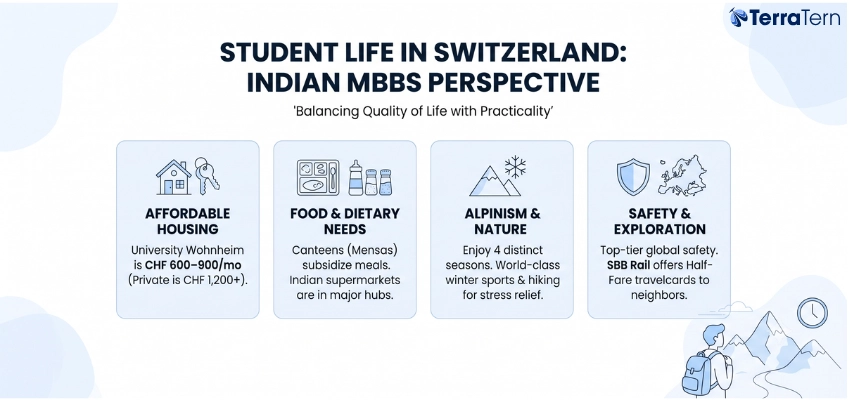
Student life during an MBBS in Switzerland for Indian students balances unparalleled quality of life with strict budgeting.
-
Accommodation Strategies: University student housing (Wohnheim) ranges from CHF 600–900 monthly, which is significantly more affordable than private studios that easily exceed CHF 1,200.
-
Food & Dietary Needs: Campus canteens (Mensas) provide heavily subsidised meals. Major hubs like Zurich, Basel, and Geneva feature Indian supermarkets, making vegetarian ingredients and familiar spices readily available.
-
Climate & Alpine Access: Students experience four distinct seasons, with immediate access to the Swiss Alps for world-class winter sports, summer hiking, and nature-based stress relief.
-
Unrivalled Safety: Switzerland consistently ranks in the global top 10 for safety and low crime rates, ensuring a highly secure environment for international students.
-
European Connectivity: The highly efficient SBB rail network offers Half-Fare travelcards for students, enabling seamless, discounted weekend exploration across Switzerland and into neighbouring France, Germany, and Italy.
Key Note: Cooking at home and using subsidised university canteens (CHF 8–12/meal) is the single biggest lever Indian students have over their monthly budget in Switzerland.
2026 Industry Context Section
Some of the latest facts are:
-
QS World University Rankings 2026: ETH Zurich holds 7th place globally (best in continental Europe); EPFL ranks 22nd; University of Zurich climbed to 100th; University of Geneva sits at 155th, Basel at 158th, and Bern at 184th.
-
NEET 2026 Mandate Reaffirmed: NMC guidance confirms NEET qualification (not a rank, just a qualifying percentile) remains a non-negotiable prerequisite for any Indian student wanting their foreign MBBS degree to count toward Indian practice.
-
Next Transition: The National Exit Test (NExT) is set to replace FMGE for foreign medical graduates from 2027 onward; 2026 applicants should plan for both exam formats.
-
Swiss Tuition Bands (2026): Public-university annual fees range roughly CHF 720–2,640 (~INR 65,000–INR 2.4 lakh), among the lowest in Western Europe.
-
Living Cost Reality: Zurich and Geneva rank among the world's three most expensive cities, with realistic monthly costs of CHF 2,000–3,000 (~INR 1.7–2.5 lakh).
-
Language Requirement: German C1 (Zurich, Basel) or French C1 (Geneva, Lausanne, Fribourg) is required before clinical-phase enrolment. There is no undergraduate English-medium public MBBS in Switzerland.
-
Total 6-Year Investment: The approximate all-in cost (tuition + living + insurance) ranges from INR 1.2–1.6 crore, comparable to that of a top private Indian medical college, but with a globally recognised degree.
As per TerraTern Expert Divyansh, Budget for Switzerland the way you would for a European Master's, not a "cheap MBBS abroad"; tuition is nearly free, but six years of Zurich/Geneva living costs are the real number families underestimate.
Conclusion
Securing admission for MBBS in Switzerland for Indian students in 2026 is undoubtedly challenging, but the reward is a world-class, globally respected medical degree. While the intense Numerus Clausus exam, high cost of living, and strict language requirements demand rigorous preparation, the unmatched clinical training and premium career pathways justify the effort.
With disciplined financial planning and early language certification, you can successfully navigate this elite European medical destination.
Contact TerraTern for more information on MBBS in Switzerland for Indian Students: Complete Guide.



 AI Summary