

Key Highlights
- What Is Malta Citizenship for Indians?
- Why Did Malta End Citizenship by Investment and What Replaced It in 2025–2026?
- What Are the Legal Pathways to Maltese Citizenship for Indians in 2026?
- What Is the Malta Permanent Residence Programme (MPRP) and How Is It Different From Citizenship?
- Who Is Eligible for Malta Citizenship or Residency as an Indian Citizen?
- What Documents Do Indian Applicants Need for Malta Citizenship or MPRP?
- How Much Does Malta Citizenship (and MPRP Residency) Cost for Indians in 2026?
- What Is the Step-by-Step Process to Apply for Maltese Citizenship or MPRP From India?
- How Long Does the Process Take for Indians?
- What Are the Key Benefits of Maltese Citizenship for Indian Passport Holders?
- Can Indians Legally Hold Dual Citizenship With Malta?
- How Does Malta Compare to Other European Options for Indian Applicants?
- How Can TerraTern Help With Your Malta Immigration Plan?
- Conclusion
Malta citizenship for Indian nationals is of interest for a variety of reasons, including the potential for an EU citizen's pass, residency flexibility and family citizenship. Each pathway has rigorous legal requirements and varying fees. The principal pathways to citizenship in 2026 will be: citizenship by descent, marriage, ordinary naturalisation, and the newer pathway of gaining citizenship by merit.
Following recent EU rulings, Malta has abolished its former citizenship-by-investment scheme and replaced it with stricter, residence- and merit-based routes.
Investment-linked options like the MPRP now lead to permanent residency, while citizenship is available only through merit, naturalisation by residence, or family registration. The investment-linked and merit-based pathways are the quickest in 2026. The family and ancestry cases are typically less expensive but tend to be document-intensive.
What Is Malta Citizenship for Indians?
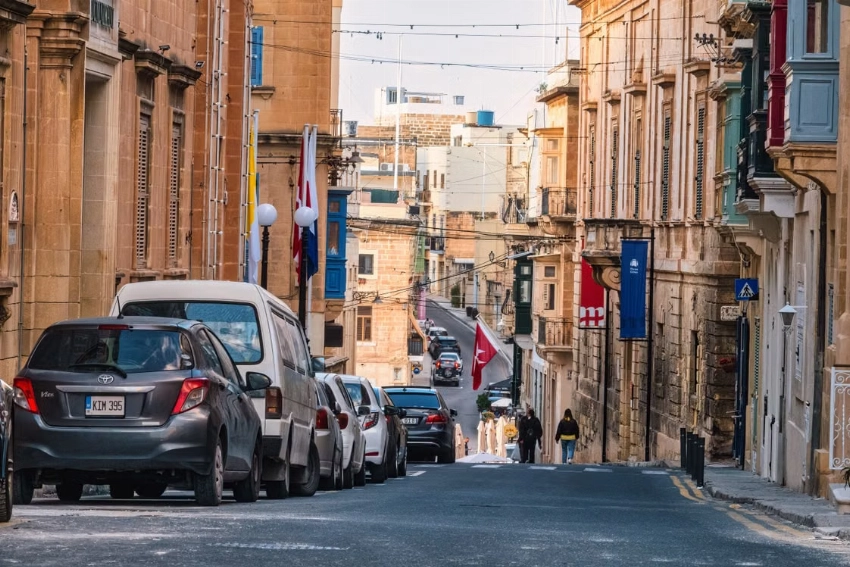
When an individual becomes a Maltese citizen for Indian nationals, this grants them EU citizenship rights and full Maltese nationality, enabling them to live, work, and study in the EU and Malta.
-
It can also indicate increased travel opportunities, with visa-free or visa-on-arrival access to approximately 190 destinations depending on passport requirements.
-
Malta is attractive to many Indians for its three main features: the presence of people of Indian origin, a warm climate, and left-hand traffic.
-
It is also considered reasonable for business professionals or families. Malta's tax system is relatively low and business-friendly.
-
The big change in 2025 has meant that the route is still very appealing, but the updated rules and information on eligibility and the process need to be taken more seriously.
According to our TerraTern Expert, Divyansh, Most Indians search for "Malta citizenship for Indian," expecting an investment shortcut. The single highest-value thing this article can do is correct that expectation immediately and redirect readers to what's actually achievable in 2026.
Also Read: Malta Job Vacancy for Indian: New Pay, Tips, Visa & More
Why Did Malta End Citizenship by Investment and What Replaced It in 2025–2026?
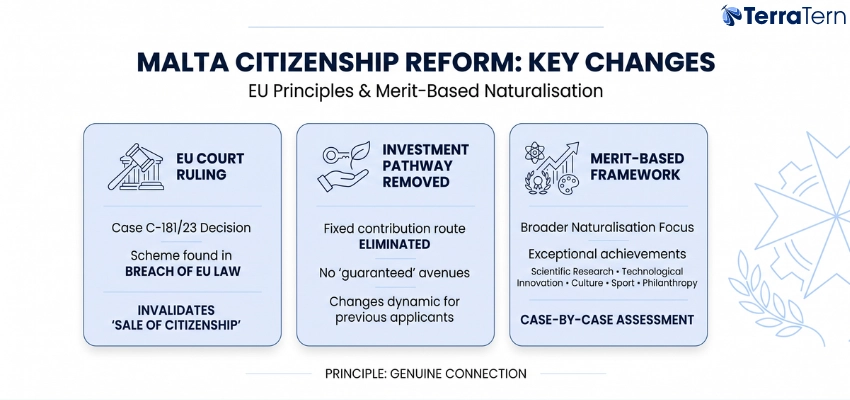
The change in Malta's citizenship for Indians in 2025 was significant because the previous Malta investor-citizenship scheme was found by the Court of Justice of the EU to be in breach of EU law for allowing nationality without a genuine connection to Malta.
-
On 29 April 2025, the Court of Justice of the EU, in Case C-181/23, issued a decision that stood out for its support for the fundamental EU principles regarding the sale of citizenship in exchange for a fixed payment.
-
Malta removed the fixed financial-contribution citizenship route under the 2025 amendments and replaced it with a broader, merit-based naturalisation framework.
-
For Citizenship by Merit in 2025-2026, the channels emphasise exceptional achievements in scientific research, technological innovation, culture, sport, and philanthropy as the main focus areas.
-
However, for those who previously tried to ‘buy a passport’ through Malta, this changes the dynamic, as there are no guaranteed “buy-a-passport” avenues anymore; only case-by-case merit is assessed.
Important Note: If any source is still quoting a fixed €600,000/€750,000 "investment amount" for Malta citizenship without a 2025 legislative caveat, that source is out of date; verify directly with a licensed Malta agent or the Community Malta Agency before acting on it.
What Are the Legal Pathways to Maltese Citizenship for Indians in 2026?
In 2026, “buying” Maltese citizenship through a simple investment is no longer possible for Indian applicants; the realistic routes are merit-based naturalisation, standard naturalisation by residence, or registration through marriage or descent. Where appropriate, the citizenship requirements for Malta now include contributions, residence or family relationship, rather than just paying to obtain approval.
Legal pathways in 2026
|
Pathway |
Basis |
Typical Timeline |
Investment Required? |
|
Citizenship by merit |
Exceptional contribution to Malta |
Case-by-case |
No fixed price |
|
Standard naturalisation |
Legal residence in Malta |
5 years |
No fixed price |
|
Citizenship by registration |
Marriage or descent |
Varies |
No fixed price |
Malta Citizenship by Merit (Discretionary Naturalisation)
Malta citizenship for indian applicants can be pursued only if they have exceptional value to Malta in science, technology, entrepreneurship, culture, sport, or philanthropy.
-
This is discretionary, so approval is never guaranteed.
-
The Minister decides whether the contribution is exceptional enough.
-
Due diligence and security checks remain strict.
-
This is not a hidden citizenship-by-investment program.
Standard Naturalisation After 5 Years of Residence
Indian residents can generally apply for Maltese citizenship by naturalisation after about 5 years of lawful residence, that is, 4 years in the previous 6 plus a final continuous 12-month period immediately before the application.
-
The structure is often read as 4 years within the previous 6, plus the final continuous 12 months before application.
-
Applicants must show good conduct, integration, and familiarity with English or Maltese.
-
Two qualifying sponsors are required, including at least one Maltese citizen who has known you for 2+ years and another sponsor from an approved professional category (such as a lawyer, doctor or senior official).
-
A police or good-conduct certificate is usually part of the file.
Citizenship by Registration (Marriage or Descent)
Malta citizenship for indian applicants may be obtained through marriage to a Maltese citizen after at least 5 years.
-
Widows and widowers may also have access in certain cases.
-
People with a Maltese parent or grandparent can apply through descent-based registration.
-
This route is generally more direct than naturalisation.
-
Documentation proving the family link is critical.
Expert Tip: For most Indian applicants without a Maltese spouse or ancestry, the realistic long-term path to citizenship is either five years of bona fide residence (often built via the MPRP, see next section) or a genuinely merit-qualifying professional/entrepreneurial profile, not a one-time payment.
What Is the Malta Permanent Residence Programme (MPRP) and How Is It Different From Citizenship?
Malta citizenship for Indian applicants should not be confused with the Malta Permanent Residence Programme (MPRP), which grants permanent residency but not a passport.
-
The Malta Golden Visa for indians label is often used for MPRP, but it still gives residency, not a passport.
-
Residency means you can live in Malta and travel within the Schengen area under the 90/180-day rule.
-
Citizenship means full EU nationality and a Maltese passport.
-
In 2026, MPRP applicants must show either €500,000 in total assets (including at least €150,000 in liquid financial assets) or €650,000 in assets (including at least €75,000 in liquid financial assets), according to the current regulations.
-
Property commitment is also required: rent from about €14,000 per year (slightly less in certain Gozo/southern areas) or buy from about €375,000, depending on location and current MPRP regulations.
-
The route also includes a government contribution under the 2025 framework plus a mandatory NGO donation of about €2,000.
-
Family inclusion is a major draw for Indian households, including spouses, dependent children, and, in some cases, parents or grandparents.
-
MPRP does not shortcut citizenship; it may support a later naturalisation case only once genuine residence has been established.
|
Route |
Outcome |
Cost |
Timeline |
Investment required? |
Passport granted? |
|
MPRP |
Permanent residency in Malta, not citizenship |
Roughly €169,000–€200,000+ depending on rent vs purchase and family size |
Varies by file and due diligence |
Yes, through assets, property, contributions, and donations |
No |
|
Citizenship by Merit |
Full Maltese nationality at discretion |
No fixed price |
Case-by-case |
No fixed investment threshold |
Yes |
|
Standard Naturalisation |
Full Maltese nationality after residence |
No fixed price |
Usually, 5 years of legal residence |
No fixed investment threshold |
Yes |
Expert Advice: If your goal is a genuine EU passport, the MPRP alone will not get you there any faster; it's a residency tool. If your goal is Schengen access, a European base, and optionality for a future naturalisation application built on real years lived in Malta, it's currently the most realistic investment-linked route available to Indians.
Who Is Eligible for Malta Citizenship or Residency as an Indian Citizen?
Malta citizenship for indian applicants is not automatic; it depends on the route and whether you meet the specific legal test.
-
For applicants to the Malta Permanent Residence Programme, the main question is whether you can demonstrate assets, property, and a clean due diligence profile.
-
The phrase Malta Golden Visa for indians usually refers to the residency route, not citizenship.
-
All routes generally require applicants to be 18+, have a clean criminal record, and pass Malta’s multi-layered screening.
-
Common disqualifiers include prior Schengen visa refusals, undisclosed earlier applications, and weak source-of-funds documentation.
-
For Indian applicants, incomplete financial records are especially risky because Malta closely scrutinises the origin of funds.
|
Pathway |
Eligible if |
Not Eligible if |
|
Citizenship by Merit |
You can prove exceptional contribution in an approved field such as science, technology, entrepreneurship, culture, sport, or philanthropy. |
You are only trying to qualify through wealth, or you cannot show a real record of achievement. |
|
Standard Naturalisation |
You have at least 5 years of legal residence, good conduct, integration, and the required supporting sponsors. |
You do not meet the residency requirement, lack evidence of integration, or have serious conduct issues. |
|
MPRP / Malta Golden Visa |
You can show qualifying assets, property commitment, a clean background, and strong source-of-funds evidence. |
You cannot properly document your wealth, fail due diligence, or have a problematic background. |
Important Note: Source-of-funds documentation is where Indian MPRP applicants most often stumble; bank statements alone rarely satisfy due diligence requirements; a clear, traceable income/asset history (salary, business ownership, inheritance, property sale) matters more than the total amount available.
What Documents Do Indian Applicants Need for Malta Citizenship or MPRP?
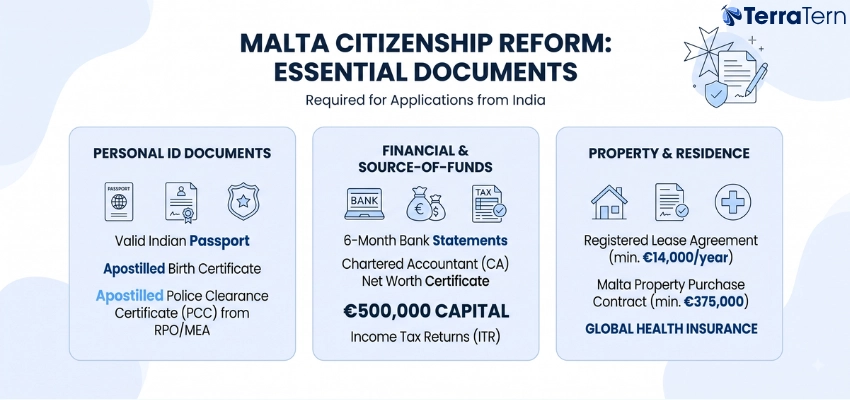
Core documents include a valid Indian passport, birth certificate, police clearance certificate (PCC) from India, verifiable proof of funds or income, and global medical insurance.
Depending on your specific route, you may also need marriage or descent certificates and MPRP-specific asset documentation.
-
Personal ID Documents: Valid passport copies, apostilled birth certificates, and a Police Clearance Certificate (PCC) obtained from the Regional Passport Office in India (apostilled via the MEA's e-Apostille portal).
-
Financial & Source-of-Funds: Minimum 6-month Indian bank statements, chartered accountant (CA) net worth certificates, and income tax returns (ITR) to prove the required €500,000 capital.
-
Property & Residence Documents: Registered lease agreement (€14,000/year minimum) or Malta property purchase contract (€375,000 minimum), along with global health insurance coverage.
-
Program-Specific Forms: Residency Malta Agency (RMA) official application forms, medical questionnaires, and biometrics declarations.
As per TerraTern Expert: Apostille and translation timelines from India are consistently underestimated; budget 4–6 weeks before submission for document legalisation alone, especially during Indian court/registrar holiday periods.
How Much Does Malta Citizenship (and MPRP Residency) Cost for Indians in 2026?
Standard naturalisation itself carries no government "price" beyond years of residence and the normal cost of living in Malta. Following 2025 rulings, the previous Citizenship by Investment program has ended. Citizenship by Merit is discretionary and does not have a transactional fee schedule. The actual cost of Malta citizenship for indian nationals depends heavily on whether one pursues standard naturalisation, Merit, or MPRP residency.
|
Expense Category |
MPRP (Lease Route) |
MPRP (Purchase Route) |
Citizenship by Merit / Naturalisation |
|
Real Estate (Minimum) |
€14,000/yr (5 years) |
€375,000 (Purchase) |
N/A (Standard living costs) |
|
Govt. Contribution |
€37,000 |
€37,000 |
Discretionary / Standard Admin Fees |
|
Admin Fee |
€60,000 |
€60,000 |
N/A |
|
NGO Donation |
€2000 |
€2000 |
N/A |
|
Estimated Total (EUR) |
~€169,000 over 5 yrs |
~€474,000+ |
Variable |
|
Indicative INR Equivalent |
~INR 1.55 Crore |
~INR 4.35 Crore |
Variable |
Pro Tip: Budget for professional/legal fees separately from statutory government costs, due diligence, legal representation, and document preparation for MPRP applications, which typically add well beyond the headline "starting from" figure quoted by most sources.
What Is the Step-by-Step Process to Apply for Maltese Citizenship or MPRP From India?
The process for Maltese citizenship for Indian applicants generally involves confirming eligibility, selecting the correct pathway, working with a licensed Maltese agent (mandatory for MPRP, and recommended but not legally required for standard naturalisation or merit-based applications), preparing and apostilling documents, completing due diligence, meeting investment or residence conditions, and, where applicable, taking the Oath of Allegiance in Malta.
-
Step 1: Check eligibility and choose the appropriate pathway (MPRP, Citizenship by Merit, or naturalisation).
-
Step 2: Appoint a licensed agent in Malta (mandatory for MPRP and Citizenship by Merit).
-
Step 3: Gather, notarise, and apostille all required documents.
-
Step 4: Submit the application and complete Malta's due diligence and background checks.
-
Step 5: Meet all investment, property, contribution, or residence requirements, depending on the route.
-
Step 6: Receive approval and complete the final formalities, including the Oath of Allegiance, if required for Malta citizenship by Indian applicants.
Key Note: A licensed agent is a legal requirement, not just a convenience, for MPRP and merit-based applications under the Maltese Citizenship Act. Verify any consultancy's licence with the Residency Malta Agency/Community Malta Agency before engaging them.
How Long Does the Process Take for Indians?
For Malta citizenship for Indian applicants, MPRP residence applications generally take 9–14 months from submission to residence card issuance in 2026. Citizenship by Merit has no published processing benchmark because each case is discretionary, while standard naturalisation requires at least 5 years of qualifying residence before an application can be submitted.
-
MPRP: Approximately 9–14 months from application to the issuance of a residence card.
-
Citizenship by Merit: No fixed processing timeline; assessed individually by the Maltese Government.
-
Standard Naturalisation: Requires at least 5 years of lawful qualifying residence before applying.
-
Processing times may vary based on document verification, due diligence, and application completeness.
-
Applying with Accurate Documentation helps avoid unnecessary delays in obtaining Maltese citizenship for Indian applicants.
As per our TerraTern Expert Shreya, built into a buffer beyond official processing estimates, Malta's own agencies acknowledge that real-world MPRP timelines commonly run longer than the published 4–6-month reference window.
What Are the Key Benefits of Maltese Citizenship for Indian Passport Holders?
Malta citizenship for Indian passport holders provides access to approximately 190 visa-free or visa-on-arrival destinations, EU-wide rights to live, work, and study, excellent healthcare and education systems, and a high quality of life with English as an official language.
-
Travel to around 190 destinations visa-free or with simplified entry as an EU citizen.
-
Live, work, study, and establish a business across all EU and EEA member states.
-
Access Malta's public healthcare system and quality education opportunities for eligible family members.
-
Benefit from an English-speaking environment, left-hand driving, and a well-established Indian community.
-
Eligible family members can often be included under applicable citizenship or residence provisions, making Maltese citizenship for Indian families an attractive long-term option.
Important Note: The mobility upgrade is real and significant, but it comes with a binding trade-off (see Section 11 below) that every Indian applicant needs to weigh before starting the process.
Can Indians Legally Hold Dual Citizenship With Malta?
No, while Malta permits dual citizenship, India does not recognise dual citizenship, so acquiring Maltese nationality requires surrendering an Indian passport. The Overseas Citizen of India (OCI) card is the closest alternative, offering lifelong visa-free entry and extensive residency rights, but not full citizenship privileges.
-
Malta allows dual citizenship, but India does not recognise dual citizenship for its citizens.
-
After obtaining Maltese citizenship, Indian applicants must surrender their Indian passports under Indian law.
-
Eligible former Indian citizens can apply for an OCI card.
-
OCI benefits include lifelong visa-free entry, unrestricted stay, and the right to live, work, and study in India.
-
OCI limitations include no voting rights, no eligibility for constitutional or most government jobs, and restrictions on purchasing agricultural or plantation land.
-
OCI does not restore Indian citizenship; it provides long-term residency and travel privileges only
Key Note: Don't treat OCI as "dual citizenship by another name"; model out specifically which rights matter to you (voting, agricultural land ownership, government jobs) before deciding whether surrendering Indian citizenship is the right trade-off.
How Does Malta Compare to Other European Options for Indian Applicants?
For Malta citizenship for Indian applicants, Malta's MPRP generally has a higher investment threshold than Portugal and Greece but grants permanent residence from the outset without a minimum stay requirement. Austria offers a strong economy but typically has higher living costs and a more limited route for investment-based migration.
|
Feature |
Malta (MPRP) |
Portugal |
Greece |
Austria |
|
Best for |
Malta citizenship for Indian applicants seeking permanent residence |
Flexible residency options |
Property investment |
Skilled professionals and high-net-worth individuals |
|
Entry Cost |
Higher |
Moderate to High |
Moderate |
High |
|
Residence Status |
Permanent Residence |
Renewable Residence Permit |
Renewable Residence Permit |
Residence Permit |
|
Path to Citizenship |
Through naturalisation (subject to legal requirements) |
Eligible after the qualifying residence period |
Eligible after the qualifying residence period |
Eligible after long-term lawful residence |
|
Physical Presence |
No minimum stay under MPRP |
Required for citizenship eligibility |
Required for citizenship eligibility |
Significant residence is generally required |
|
Family Inclusion |
Yes |
Yes |
Yes |
Yes |
Pro Tip: For Indian families prioritising a guaranteed, government-defined investment path to residency rather than a discretionary merit assessment, Portugal and Greece currently offer more procedural certainty than Malta's post-2025 framework, a genuinely balanced comparison point most single-country-focused competitor content won't make.
How Can TerraTern Help With Your Malta Immigration Plan?
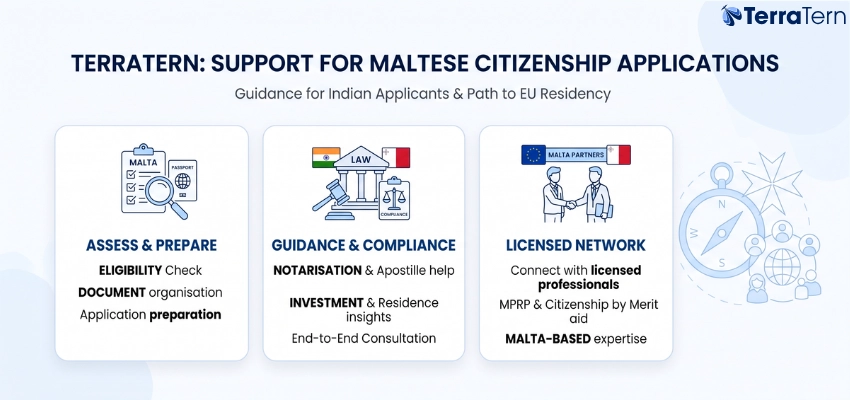
TerraTern supports Malta citizenship for Indian applicants by helping them understand eligibility, organise documentation, and prepare for the application process. Where required, applicants can be connected with licensed Malta-based professionals for regulated immigration services.
-
Assess your eligibility for Malta's residence and citizenship pathways.
-
Receive guidance on document collection, notarisation, and apostille requirements.
-
Get assistance in preparing a complete application package to minimise delays.
-
Understand investment, residence, and compliance requirements before applying.
-
Connect with licensed Malta-based partners for MPRP and Citizenship by Merit applications where legally required.
-
Receive end-to-end consultation to help you make informed decisions about Maltese citizenship for Indian applicants while remaining compliant with Maltese and Indian regulations.
Conclusion
Malta citizenship for Indian applicants offers significant long-term advantages, including EU mobility, a high standard of living, and strong education and healthcare systems. However, choosing the right pathway, understanding eligibility requirements, and complying with both Maltese and Indian laws are essential. Whether you pursue permanent residence or citizenship, careful planning and professional guidance can help make your journey smoother, compliant, and more successful.
Contact TerraTern for more information on Malta Citizenship for Indians: Routes, Costs & Rules (2026).




 AI Summary