



Key Highlights
- What Are the Jobs in Canada for Indians with Visa Sponsorship?
- Viability of the Canadian Job Market to Indians
- What Are the Best Jobs in Canada for Indian Freshers?
- Top Companies Offering Visa Sponsorship
- The Hottest Occupations Among Indians in Canada
- How Do You Get a Job in Canada from India Step by Step?
- Work Permit and Immigration Pathways for Jobs in Canada for Indians
- Job Search Strategies and Best Practices
- Salary Expectations and Cost of Living
- Which City in Canada Is Best for Indian Professionals?
- Success Stories and Case Studies
- Future Outlook and Trends
- 2026 Industry Context
- How TerraTern Can Help You with Jobs in Canada?
- Conclusion
What Are the Jobs in Canada for Indians with Visa Sponsorship?
Jobs in Canada for Indians with visa sponsorship are primarily accessed through LMIA-backed work permits, where Canadian employers prove no local candidate is available and formally sponsor a foreign worker's work permit application. Key sectors offering LMIA sponsorship include healthcare, construction, logistics, hospitality, and IT. A valid LMIA-backed job offer also adds 50–200 CRS points to an Express Entry profile, dramatically accelerating PR.
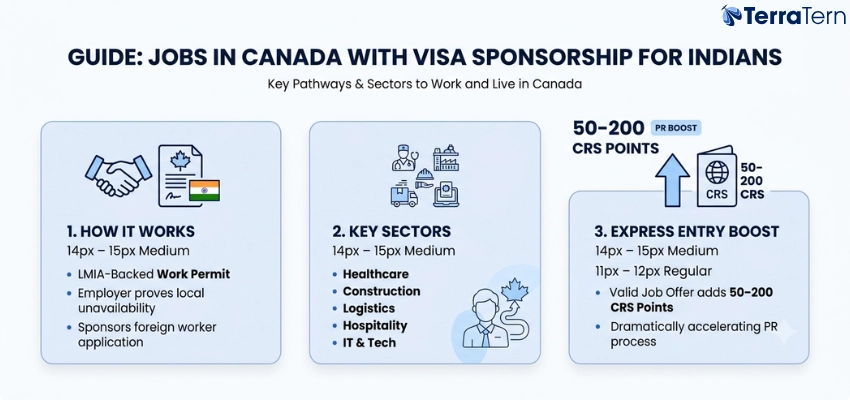
Getting hired within a company that has Jobs in Canada for Indians with visa sponsorship opportunities is an essential step in the process of work permit applications by many Indian professionals. The following section gives a step-by-step breakdown of how to seek and find such opportunities, and also how the process takes place.
-
The Visa Sponsorship Process: Since much of the process that is involved in sponsoring a visa is an international process, it is important to understand the procedure. Generally, there are cases of visa Jobs in Canada for Indians with visa sponsorship whereby an employer gets a Labour Market Impact Assessment (LMIA) from ESDC.
-
Labour Market Impact Assessment (LMIA): LMIA is a document that an employer in Canada might require on hiring a foreign worker. When the LMIA is positive, it suggests that this position should be performed by a foreign employee without any possibility of finding a Canadian employee. This is a time-consuming and lengthy process that has the employer needing to demonstrate that he or she has made reasonable attempts to employ a Canadian or permanent resident.
-
Employer Requirements: Employers that wish to provide such sponsorships must satisfy certain requirements, not least of which is being able to provide the foreign labourer with a minimum wage that is not less than the median wage of the same jobs in Canada for Indians in the region and to provide a safe work environment.
Although the employer is the proponent of the LMIA, the candidate must be able to satisfy the conditions of the jobs in Canada for Indians, such as level of education, work experience and language competency. Let’s explore more on jobs in Canada for Indians!
Viability of the Canadian Job Market to Indians
Porting into the Canadian job market demands clarity in the dynamics of the market, the regions with differences and, more importantly, the opportunities up for jobs in Canada for Indians. The market is now characterised by high demand for skilled labour and attention given to the economic alignment of immigration. The part has an overview of the main trends, pay expectations and growth projections that will rule career paths in 2026.
Regional Job Opportunities Across Canada
The Canadian labour situation is not consistent; it is very different by province, and each province is dominated by economic drivers and specific industries that it requires.
-
Ontario: Ontario, or the Greater Toronto Area (GTA), is a technology and financial hub and the economic engine of Canada. Toronto has a thriving IT market with high demand for IT workers. Ottawa has been noted to have more cybersecurity- and government-related jobs in Canada for Indians, whereas the Kitchener-Waterloo area is a growing tech startup hotbed.
-
British Columbia: British Columbia boasts a bustling jobs in Canada for Indians with a particular focus on the fields of technology, film and those within the creative field. Plenty of opportunity also lies in the province, focusing on clean energy and on trade and logistics.
-
Alberta: Alberta was usually called the region of oil and gas, although the economy of the province is growing, and it has more opportunities in terms of technology, healthcare, and engineering. Edmonton and Calgary are the cities where the professionals in these fields are actively sought.
-
Quebec: Quebec has been a Francophone province with a strong economy in aerospace, video game development and artificial intelligence. Although French language competency is an excellent asset, several companies in Montreal which are of international ownership conduct their operations in the English language, thus providing a chance to bilingual and English-speaking candidates.
Industry-Wise Demand Analysis
Some industries are growing with an explosion and facing a drastic shortage of qualified personnel, and they are excellent target choices for jobs in Canada for Indians.
-
Information Technology (IT): This is one of the sectors where demand is always high. There are open positions for software developers, data scientists, cloud architects, and cybersecurity specialists all over the country. The degree to which the Canadian government has committed to digital transformation and its Global Talent Stream programme has simplified the means through which tech companies can recruit international talent.
-
Healthcare: Population increases in age and pandemic concerns have meant the need for healthcare professionals is huge. Opportunities as registered nurses, licensed practical nurses, medical technologists and healthcare administrators abound, with the provinces actively recruiting overseas.
-
Canada: Infrastructure development and clean energy projects, as well as the manufacturing sector in Canada, have fuelled the demand for engineers. Engineers in civil, mechanical, electrical, and software are needed, as well as in the corporate world and government.
-
Finance and Accounting: To a great extent, Canada has a thriving financial sector, and this requires the employment of financial analysts, accountants and auditors, especially in the major financial centres such as Toronto.
Also Read: How to Get a Job in Canada from India? Experts Guide
What Are the Best Jobs in Canada for Indian Freshers?
The best jobs in Canada for Indian freshers are in IT support and software development, healthcare aide roles, logistics and warehouse operations, retail and customer service, and entry-level engineering
|
Role |
Annual Salary (CAD) |
Annual Salary (Rs.) |
Experience Needed |
|
IT Support / Helpdesk |
$45,000–$55,000 |
Rs. 27.2–33.2 lakh |
None–1 year |
|
Junior Software Developer |
$50,000–$65,000 |
Rs. 30.2–39.3 lakh |
Programming skills |
|
Customer Service Rep |
$38,000–$48,000 |
Rs. 22.9–29.0 lakh |
None |
|
Warehouse Associate |
$40,000–$50,000 |
Rs. 24.1–30.2 lakh |
None |
|
Healthcare Aide (PSW) |
$40,000–$50,000 |
Rs. 24.1–33.2 lakh |
PSW certificate |
|
Entry-Level Engineer |
$55,000–$70,000 |
Rs. 33.2–42.3 lakh |
Engineering degree |
|
Retail Sales Associate |
$35,000–$42,000 |
Rs. 21.1–25.4 lakh |
None |
|
Data Entry / Admin |
$35,000–$45,000 |
Rs. 21.1–27.2 lakh |
None |
Top Companies Offering Visa Sponsorship
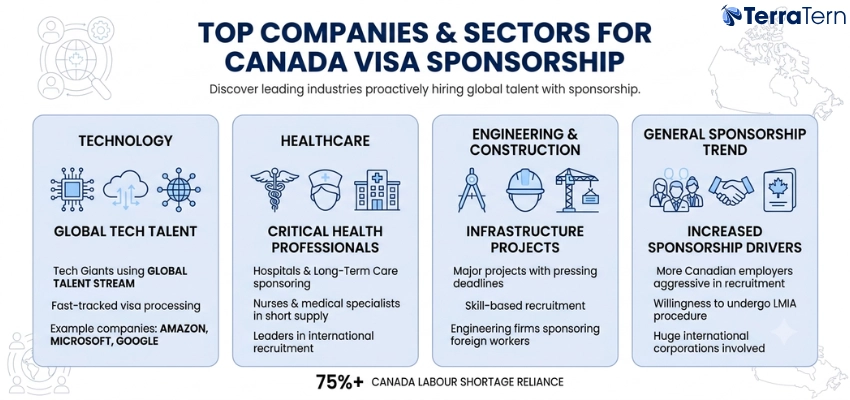
More Canadian employers are becoming aggressive in the recruitment of foreign labour and are ready to undergo the LMIA procedure. Such organisations are huge international corporations, healthcare facilities and technology companies. Though it is hard to maintain an exhaustive list because there are always changing hiring requirements, some industries and employers are notorious when it comes to developing international worker sponsorships.
-
Technology: Amazon, Microsoft, and Google, among other tech giants, as well as prominent Canadian companies, are using such programmes as the Global Talent Stream to facilitate the issuance of visas to skilled technology talent.
-
Healthcare: Nurses and other healthcare professionals are in short supply, and hospitals and long-term care facilities around the country are leaders in the effort to sponsor international nurses and other healthcare professionals.
-
Engineering and Construction: The engineering industries and construction companies are usually involved in major infrastructure projects that sometimes sponsor foreign workers to meet project-related deadlines and/or skill-based demands.
|
Industry |
Company Name(s) |
Typical Roles for Sponsorship |
Key Locations |
|
Technology |
Google Canada, Amazon, Microsoft Canada, Shopify, Hootsuite |
Software Engineers, Data Scientists, Cloud Architects, Cybersecurity Specialists, AI/ML Engineers |
Toronto, Vancouver, Ottawa, Montreal, Kitchener-Waterloo |
|
Healthcare |
The Care Group, Provincial Health Services Authorities (various), Major Hospitals |
Registered Nurses, Medical Technologists, Physiotherapists, Healthcare Administrators |
Across all provinces, particularly in rural and underserved areas |
|
Finance & Banking |
Royal Bank of Canada (RBC), TD Bank, Scotiabank, Manulife, KPMG |
Financial Analysts, Accountants, IT Specialists, Cybersecurity Professionals, Risk Managers |
Toronto, Montreal, Calgary, Vancouver |
|
Engineering & Construction |
SNC-Lavalin, Enbridge Inc., Stantec, Hazelwood Construction Services |
Civil Engineers, Mechanical Engineers, Electrical Engineers, Construction Managers |
Calgary, Edmonton, Montreal, Vancouver, Toronto |
|
Consulting |
Accenture Canada, Deloitte Canada |
Management Consultants, IT Consultants, Business Analysts, Strategy Specialists |
Toronto, Montreal, Vancouver, Calgary |
|
Agriculture |
Parrish and Heimbecker Limited (P&H Farming) |
Agricultural Engineers, Farm Managers, Farm Workers |
Rural and regional areas across the prairies and Ontario |
Also Read: Job Vacancy in Canada for Indians: Pay, Scope & More
The Hottest Occupations Among Indians in Canada
Knowing about the most in-demand professions is the key to successful jobs in Canada for Indians research. The high-priority occupations can be classified based on the Canadian National Occupational Classification (NOC).
|
NOC Code |
Occupation |
Average Annual Salary |
|
21231 |
Software Engineers and Designers |
85,000 to 130,000 |
|
21233 |
Web Developers and Programmers |
60,000 to 90,000 |
|
21232 |
Cybersecurity Specialists |
90,000 to 140,000 |
|
21223 |
Database Analysts and Data Administrators |
70,000 to 110,000 |
|
21234 |
Data Scientists and Data Analysts |
85,000 to 125,000 |
Healthcare Professionals
The demand for healthcare workers is a national priority, with specific roles being highly sought after.
|
NOC Code |
Occupation |
Average Annual Salary |
|
31301 |
Registered Nurses and Registered Psychiatric Nurses |
70,000 to 104,000 |
|
32101 |
Licensed Practical Nurses |
60,000 to 80,000 |
|
33102 |
Nurse Aides, Orderlies and Patient Service Associates |
35,000 to 55,000 |
|
31110 |
Dentists |
120,000 to 200,000 |
|
31120 |
Pharmacists |
90,000 to 120,000 |
Engineering Opportunities
From infrastructure projects to tech innovation, engineers are at the heart of Canada's economic growth.
|
NOC Code |
Occupation |
Average Annual Salary |
|
21301 |
Civil Engineers |
75,000 to 120,000 |
|
21302 |
Mechanical Engineers |
70,000 to 115,000 |
|
21303 |
Electrical and Electronics Engineers |
75,000 to 125,000 |
|
21321 |
Software Engineers and Designers |
85,000 to 130,000 |
|
21310 |
Computer and Information Systems Managers |
100,000 to 150,000 |
How Do You Get a Job in Canada from India Step by Step?
Getting a job in Canada from India usually involves seven core steps: identify your target occupation code, complete an educational credential assessment, meet the English requirement, build a Canadian-style resume, apply through official job portals, choose either the LMIA or Express Entry route, and then secure your work permit or PR.
1. Identify your NOC/TEER Code: Every Canadian job falls under the National Occupational Classification system, which groups roles into TEER levels from 0 to 5. Skilled immigration routes usually focus on TEER 0–3, so matching your occupation correctly is the first step. Using the wrong code can waste months and lead you toward the wrong pathway.
2. Get an Educational Credential Assessment (ECA): If you plan to use Express Entry, your Indian degree must be assessed by a designated organization, most commonly WES. This confirms your qualification is comparable to a Canadian credential. It is a non-negotiable step for most PR-based applications.
3. Take IELTS or CELPIP: Canadian immigration pathways usually require proof of English ability, and your score directly affects your eligibility and ranking. For Express Entry, stronger language scores improve your CRS points. Aim for at least CLB 7, and ideally higher, if you want a competitive profile.
4. Build a Canadian-format Resume: Keep it to 2 pages maximum, or 1 page if you are a fresher. Use reverse-chronological order, remove your photo, date of birth, gender, and marital status, and replace “Career Objective” with a short Professional Summary. Add measurable achievements and tailor each resume to the exact job description.
5. Apply Through Official Canadian Job Portals: Start with Job Bank, the Government of Canada’s official job board, then use LinkedIn, Indeed Canada, and Glassdoor for broader search and salary benchmarking. Filter for “visa sponsorship” or LMIA-approved listings where relevant. Use only verified sources to avoid scams.
6. Choose your Main Route: Express Entry is a self-driven PR pathway that does not require a job offer, but it usually needs a strong CRS score. LMIA-first is employer-driven, where a Canadian employer sponsors your work permit after proving no local candidate is available. For many applicants, PNP is another strong option because a provincial nomination can add 600 CRS points.
7. Apply for the Work Permit or PR: If you are using LMIA, you will apply for a work permit after the employer gets approval. If you receive an Express Entry Invitation to Apply, you move toward permanent residence after submitting medicals, biometrics, and supporting documents. After arrival, you will also need to complete basics like your SIN, bank account, and provincial health card.
Work Permit and Immigration Pathways for Jobs in Canada for Indians
Getting a job offer is not the only part of the process; having an idea of the immigration process is important also. The main streams of getting to Canada to work and live are described in this section.
Entry to Change System Guide
Express Entry is the most important system that manages the applications for permanent residency of skilled workers.
-
Comprehensive Ranking System (CRS): CRS gives scores to the candidate depending on variables such as age, education, work experience and language knowledge. The candidates who score high are issued an Invitation to Apply (ITA) to become permanent residents.
-
CRS Optimisation: To optimise your score, you can work on your English or French language proficiency, request a credential assessment of your studies or acquire more sufficient work experience.
Provincial Nominee Programs PNPs
Provinces and territories also have their own PNPs that could nominate candidates with the skills that address proportionate local labour demands. A good number of these streams are aligned to the Express Entry system, giving a fantastic avenue to Indian professionals. The Human Capital Priorities stream and Tech Pilot programme of Ontario and British Columbia, respectively, are especially popular.
Job Search Strategies and Best Practices
https://images.pexels.com/photos/4050319/pexels-photo-4050319.jpeg
To secure a jobs in Canada for Indians, sending out resumes is not the only solution, and one has to develop a strategy to achieve this.
Writing a Canadian-type Resume
The typical Canadian resume is a short, reverse-chronological and specific-to-jobs in Canada for Indians document that is written.
-
Resume Format: It should be one or two pages containing quantifiable accomplishments as opposed to duties.
-
Content: Do not add personal details such as age, marital status or photograph. Talk about your skills and experience, and use keywords from the jobs in Canada for Indians description.
Professional networking and personal development
-
Networking: It is the means of filling a significant number of occupations in Canada.
-
Use LinkedIn: build your network via other Canadian professionals in your industry, join the groups related to your industry, and follow the companies you research.
-
Professional Associations: Join associations related to your profession. They have events, frequent workshops and also good networking opportunities.
Top Job Search Websites and Platforms
Employing the proper tools may turn everything to your benefit in your job hunt.
Government and hands-on jobs in Canada for Indians board
These are credible resources for genuine job adverts and labour market information.
-
Job Bank Canada: It is the official government jobs in Canada for Indians board, and it is equally an obligatory platform used by employers who are required to apply and obtain LMIAs.
-
Provincial Portals: A lot of the provinces, including Ontario and British Columbia, have their own job portals with lists of specific jobs in Canada for Indians in the area.
In Private Platforms
These websites provide such a large number of job postings and connectivity. In fact, it is one of the biggest job boards in Canada, and the range of listings and company reviews is quite broad.
-
LinkedIn: A very useful site that can help you with networking and locating jobs, especially the hidden ones.
-
Monster and Glassdoor: These sites can also be utilised in finding a job, and they give details about company culture and the salary range.
Salary Expectations and Cost of Living
https://www.pexels.com/photo/hands-holding-us-dollar-bills-4968384/
It is important to carry out financial planning to move to Canada successfully.
Salary Comparison Province-wise
Wages may change a lot depending on the province and city. The salaries are normally at a higher rate in major cities like Toronto and Vancouver; however, the cost of living in major cities is also high.
|
Profession (IT) |
Toronto, ON |
Vancouver, BC |
Calgary, AB |
|
Software Developer |
90,000 |
85,000 |
80,000 |
|
Data Scientist |
105,000 |
100,000 |
95,000 |
|
Cybersecurity Specialist |
115,000 |
110,000 |
105,000 |
Living Expenses and Financial Planning
The cost of living, particularly housing, is a significant factor. A single person might budget for 2,500 to 3,500 per month, while a family of four might need 5,000 or more, depending on the city. It is important to factor in costs for housing, groceries, transportation, and health insurance.
Which City in Canada Is Best for Indian Professionals?
Toronto and Vancouver are the top choices for Indian professionals because they offer the largest job markets and the biggest Indian communities, but Calgary is often the smartest financial choice because salaries stretch further against rent and living costs.
|
City |
Best For |
Indian Community |
Cost of Living |
|
Toronto |
Maximum job opportunities |
Very large |
High |
|
Vancouver |
Tech and lifestyle |
Large |
Very high |
|
Calgary |
Savings and salary value |
Medium |
Moderate |
Success Stories and Case Studies
Many Indians have successfully navigated the challenges of moving and finding jobs in Canada for Indians. A software engineer from Bengaluru, for instance, used Express Entry to immigrate and found a job within two months of landing in Toronto. His success was attributed to a well-prepared resume, strong language skills, and active networking on LinkedIn. Similarly, a nurse from Kerala, after completing the credential recognition process, secured a position in a long-term care facility in rural Alberta, a region that provided her with a signing bonus and relocation assistance.
Common Challenges and Solutions
While the opportunities are vast, Indian job seekers may encounter obstacles.
Credential Recognition Process
Indian degrees and professional qualifications may not be automatically recognised in Canada.
-
Credential Assessment: Organisations like World Education Services (WES) provide an educational credential assessment (ECA) that verifies the equivalency of your degree to a Canadian one.
-
Professional Licensing: Regulated professions like engineering, nursing, and medicine require a formal licensing process, which can be time-consuming but is essential for practising.
Overcoming Experience Barriers
Canadian work experience is often a requirement, but there are ways to gain it.
-
Volunteer Work: Volunteering in a relevant field can help you gain a local reference and experience.
-
Informational Interviews: These are short meetings with professionals in your field to learn about their career path and the industry.
Also Read: Top 10 Most In Demand Jobs in Canada: Latest Update
Future Outlook and Trends
The future for Indian professionals in Canada looks exceptionally bright. The government's continued focus on economic immigration, combined with a sustained labour shortage, ensures that skilled workers will remain in high demand. Emerging industries like clean energy, artificial intelligence, and e-commerce are set to create new job markets, offering diverse career prospects. The move toward more targeted Express Entry draws for specific occupations will further align immigration with labour market needs, benefiting skilled workers from India.
2026 Industry Context
Latest Statistics & Developments:
-
Canada is projected to welcome over 395,000 new permanent residents in 2026, and employer-sponsored work permits remain one of the top immigration methods (IRCC, 2026)
-
Canada has 500,000+ unfilled job vacancies across critical sectors, driven by an aging population and skills gaps — particularly in healthcare, skilled trades, and technology (Statistics Canada, 2025–2026)
-
Over 700,000 skilled trades workers are expected to retire in Canada by 2028, creating a massive structural labour gap most beneficial to Indian tradespeople
-
India is consistently the largest source country for Express Entry applicants — Canada's primary skilled immigration pathway — with no per-country cap, giving Indians equal opportunity at every CRS draw
-
An LMIA-backed job offer adds 50 points (TEER 1–3) or 200 points (TEER 0) to an Express Entry CRS score — dramatically improving PR timelines for Indian workers who secure employer sponsorship
-
In 2026, Canada introduced a dedicated 33,000-spot pathway for US-based H-1B holders, signalling continued aggressive skilled immigration recruitment from the South Asian professional community
-
The average salary in Canada for Indians ranges from Rs. 36.8 lakh to Rs. 77.1 lakh (CAD $60,324–$126,495) depending on role, with IT, healthcare, and engineering offering the highest compensation (Y-Axis, 2026)
How TerraTern Can Help You with Jobs in Canada?
If you are looking for a job in Canada for Indian freshers, TerraTern can make the process simpler, faster, and more focused. Instead of applying randomly, you get guidance that helps you identify suitable roles, improve your profile, and apply with more confidence.
-
Help you shortlist entry-level jobs that match your education and skills.
-
Guide you on creating a Canadian-style resume that attracts employers.
-
Support you with cover letters, job applications, and profile improvement.
-
Help you understand work eligibility, documentation, and next steps.
-
Assist you in targeting the right sectors such as IT, customer service, admin, and accounting.
Conclusion
The year 2025 stands out as an optimal time for jobs in Canada for Indians. The confluence of record immigration targets, a significant labour shortage, and a clear demand for skilled workers in critical sectors has created an unparalleled window of opportunity. Whether you are an experienced IT professional, a dedicated healthcare worker, or a recent graduate, Canada offers a structured and welcoming pathway to professional and personal growth.
By understanding the regional job markets, leveraging the right visa and immigration programmes, and adopting effective job search strategies, you can successfully navigate the process. The journey may present challenges, from credential recognition to adapting to a new culture, but the rewards—a stable career, a high quality of life, and a welcoming community—make it a worthwhile pursuit.
Begin your journey today by preparing your professional documents, researching your target industries, and engaging with the vast network of resources available to make your career in Canada a reality. Visit TerraTern to know more!


 AI Summary