Key Highlights
- What will be the IELTS Syllabus in 2026?
- What are the Types of IELTS Syllabus in 2026? Academic vs General Training
- What will be the IELTS Exam Pattern in 2026? Duration, Scoring & Test Format
- Section-Wise 2026 IELTS Syllabus Breakdown
- What is IELTS Writing Syllabus in 2026?
- What are the Preparation Tips & Top Resources for the 2026 IELTS Syllabus?
- What are the Latest Changes & Trends in IELTS Syllabus in 2026?
- Conclusion
IELTS is a globally recognised English language exam undertaken annually by more than 3.5 million candidates as an international assessment of knowledge and skills to study, take a job, or immigrate. The IELTS syllabus 2026 still evaluates the candidates on four fundamental segments: listening, reading, writing, and speaking. The general structure of the test has remained the same. Still, these new topics like artificial intelligence, sustainability, and other real-life challenges have now been addressed in the Speaking and Writing section, which allows it to align with current trends in the world.
IELTS is an internationally recognised examination accepted by universities, employers and governments across the globe in more than 140 countries. The total administration time of the test is 2h:45min, and the Listening, Reading and Writing are on the same day, whereas the Speaking can be arranged on the same day or within 7 days before or after the test day. With changing content, it is more necessary than ever before to plan carefully and smartly to be successful in IELTS 2026.
What will be the IELTS Syllabus in 2026?
Here is a brief description of the IELTS syllabus of 2026:
-
Your English is evaluated using the IELTS syllabus 2026, and the 2026 exam topics assess whether you can use your English in academic, professional and real life.
-
It is incorporated in the Academic and General Training modules.
-
All the test-takers do the same Listening and Speaking sections.
-
One difference with the Reading and Writing sections is the module selected.
-
The exam is a test of your competence through a variety of real-life language assignments.
Core Components and Duration:
Here are the core components and duration of the IELTS syllabus 2026:
-
Listening -30 minutes
-
Reading- 60 minutes
-
Writing -60 min
-
Speaking - 11 to 14 minutes
Also Referred to as:
-
IELTS structure 2026
Also Read: Explore Canada Without IELTS for Work: Updated Guide
What are the Types of IELTS Syllabus in 2026? Academic vs General Training

Here are the types of IELTS syllabus 2026:
-
IELTS exams are divided into two categories in 2026.
-
Depending on the objective, study or immigration, you can choose the type.
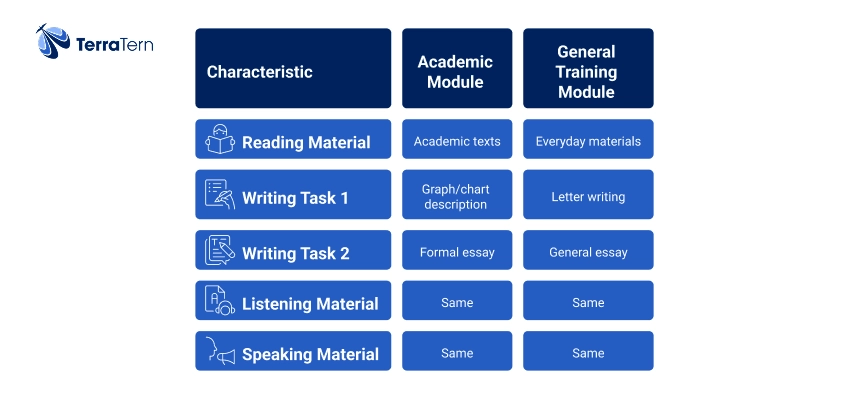
IELTS Academic Syllabus 2026
The academic IELTS syllabus 2026 looks like this:
-
Suitable for postgraduate studies or a professional qualification.
-
Concentrates on analytical research-based information.
-
In addition to academic books and journals, I will read.
-
In Writing Task 1, one has to describe charts, graphs, or diagrams.
IELTS General Training Syllabus 2026
The general IELTS syllabus 2026 looks like this:
-
Ideal to be used at work, during training or migration.
-
Reading encompasses advertisements, announcements, newspapers and manuals.
-
Task 1 is devoted to writing a formal, semi-formal or informal letter.
|
Feature |
Academic |
General Training |
|
Reading |
Academic texts |
Everyday materials |
|
Writing Task 1 |
Graph/chart/diagram |
Letter writing |
|
Listening |
Same |
Same |
|
Speaking |
Same |
Same |
What will be the IELTS Exam Pattern in 2026? Duration, Scoring & Test Format
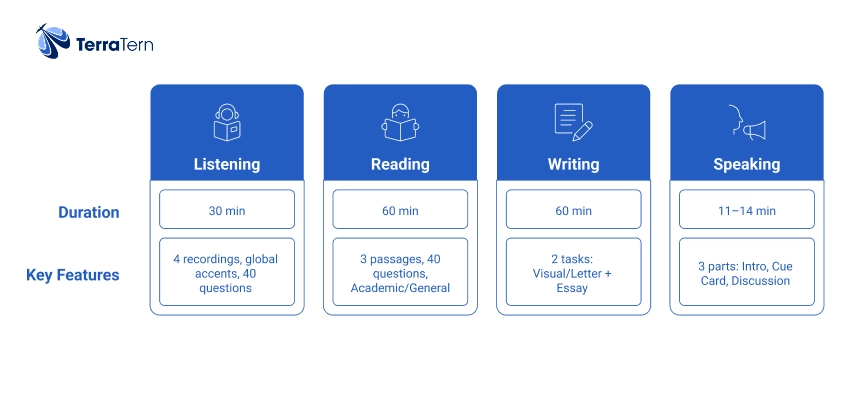
The IELTS syllabus 2026 exam pattern details are as follows:
-
The IELTS exam is structured and standard.
-
Each of the four parts is ingested in a particular order.
Duration:
The duration of the IELTS syllabus 2026 is mentioned below:
-
Listening 30 minutes (add 10 minutes for taking the answer to the paper version)
-
Reading hours- 60 minutes
-
Writing- 60 minutes
-
Talking time - 11-14 minutes
-
Total test duration - About 2 hours 45minutes
Scoring:
The scoring format of the IELTS syllabus 2026 is listed below:
-
The score of every section is rated on a band scale of 1 9.
-
You get separate grades in Listening, Reading, Writing, and Speaking.
-
The combined band score of the four section scores is computed as the average.
Test Format:
The test format of the IELTS syllabus 2026 is as follows:
-
The test can be used as a computer-based or a paper-based test.
-
The format has content, timing and scoring in common.
Time Management Tips:
Here are some time management tips for the IELTS syllabus 2026:
-
Reading: Make less than 20 minutes per passage in Reading.
-
In Writing, you are expected to take 20 minutes to complete Task 1 and 40 minutes to complete Task 2.
-
In listening, concentrate properly once you hear the audio only once.
Also Read: Vocabulary Words for IELTS: 1000+ Crucial Words & Meanings
Section-Wise 2026 IELTS Syllabus Breakdown

Here is a section-wise breakdown of the IELTS syllabus 2026:
IELTS Listening Syllabus 2026
Here are the listening IELTS syllabus 2026 details:
Total Time:
-
30 minutes
Overview:
-
Consists of 4 recordings with audio, of progressive complexity.
-
The accents used are North American, Australian, and British.
Structure:
-
Section 1: A social Interaction (Eg, making an appointment)
-
Section 2: A general topic monologue (e.g. local tour guide)
-
Section 3: A student-to-student conversation (e.g. group project discussion)
-
Section 4: A scholarly speech (e.g. university subject)
Question Types:
-
Multiple-choice
-
Matching
-
Map/diagram/plan labelling. Fill in the form, note, table, and flow charts
-
Sentence completion
Skills Tested:
-
Finding out the general notion and specific details
-
Speaker attitude and opinion recognition
-
Knowledge of the emergence of ideas
Practice Tip:
-
Visit BBC Radio, TED Talks, and podcasts daily, and listen to them in English with different accents.
IELTS Reading Syllabus 2026
Here are the details of the IELTS syllabus 2026:
Total Time:
-
60 minutes
Structure:
-
Has three parts and 40 questions.
-
The content of the Academic and General Training modules is different.
Academic Reading:
-
Excerpts are made in books, journals, magazines and newspapers.
-
Texts deal with complicated words and sophisticated concepts.
-
Made to resemble academic reading activities.
Reading General Training:
-
Advertisements, handbooks, official documents, and notices provide the texts.
-
Language is easier and more convenient.
-
Cherishes daily workplace and societal situations.
Question Types:
-
Multiple choice
-
True/False/Not Given (Identifying information)
-
Heading, feature and sentence endings matching
-
Completion of the sentence, summary and notes
-
Labelling of flowcharts, tables, and diagrams
Skills Tested:
-
Skimming and scanning of important information
-
During arguments/opinions
-
Observing rational hierarchy and relationships
Tip:
-
Reading fast is a technique that will be improved through practice and keyword identification.
Also Read: Is IELTS Difficult? New Insights, Tips & Strategies
What is IELTS Writing Syllabus in 2026?

Here are the writing IELTS syllabus 2026 details:
Total Time:
-
60 minutes
Structure:
-
Two Academic and General training tasks
Academic Writing:
-
Task 1 -Summarise and describe visual information (graph, table, chart or diagram)
-
Task 2 -Write an opinion, argument, or solution as a formally written essay
Writing Tasks: General Training:
-
Task 1- A formal letter, semi-formal, or informal letter
-
Task 2 is an essay on a broad subject with a personal or logical argument
2026 Trends:
-
Task 2 contains more analytical essays
-
More focus on organisation, readability, and grammatical correctness
Skills Tested:
-
Relevance of tasks and performance
-
Lucidity and religiosity between paragraphs
-
Wide use of vocabulary and word selection
-
Sentence diversity and grammatical correctness
Tip:
-
Effectively use linking words (but, thus, even more)
-
Group the writing into topic sentences and paragraphs
-
Do official IELTS sample tasks regularly
IELTS Speaking Syllabus 2026
Here are the speaking IELTS syllabus 2026 details:
Duration:
-
11–14 minutes
Format:
-
Carried out on a real-life basis with a qualified IELTS supervisor
-
Imitates real-life communication conditions
Divisions of the Test:
-
Part 1: Introduction and general questions on familiar topics
-
Part 2: Cue card task 1-2 minutes talk after 1 minute preparation
-
Part 3: a discussion of abstract or complex issues regarding the cue card
2026 Speaking Topics:
-
Artificial Intelligence and automation
-
Telecommuting and individual performance
-
Green life and environmental sustainability
-
Influence of social media
-
Travelling, culture and world experiences
Skills Tested:
-
The strength of responses: Fluency and coherence during responses
-
The utilisation of vocabulary or lexical resources
-
Appropriateness and accuracy in grammar
-
Articulation and enunciation
Tip:
-
Record some of your responses to typical speaking prompts
-
Study and adhere to abstract and real-life vocabulary, written and spoken
Also Read: What is Exploration IELTS Reading Answers: New Guide
What are the Preparation Tips & Top Resources for the 2026 IELTS Syllabus?

Here are some preparation tips and top resources for the IELTS syllabus 2026:
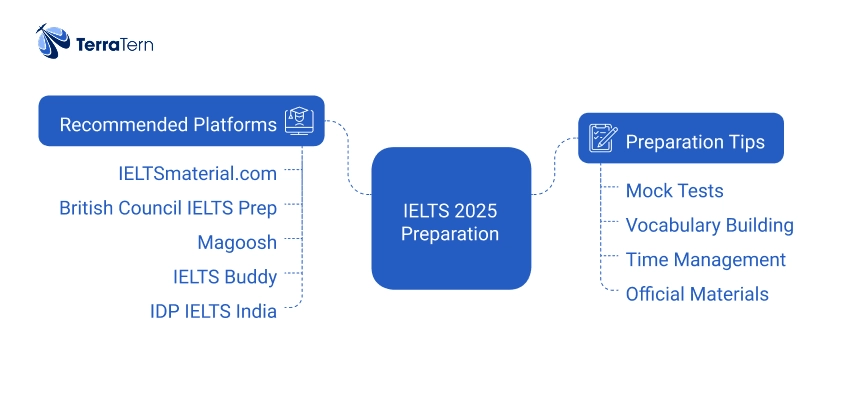
Key Preparation Tips:
Here are some key preparation tips for IELTS syllabus 2026:
-
Learn the type of exam to prepare for before you start preparing
-
Study each section by performing timed exercises every day
-
Apply genuine and up-to-date materials on every assignment
Top Practice Platforms:
Here are the top practice platforms for the IELTS syllabus 2026:
-
IELTSmaterial.com- Provides complete mock tests, writing assessments, and advice
-
British Council IELTS Prep -Free practice, webinars and courses
-
Magoosh - Has video lessons, quizzes, and an online course
-
IELTS Buddy- gives sample questions, sample answers and vocabulary lists
-
IDP IELTS India - The Site provides official extras in sample papers and changes in exams
Best Practices:
Here are the best practices for the IELTS syllabus 2026:
-
At least once a week, take a big, full-blown mock test
-
Compile and update topic-specific vocabulary lists frequently
-
Find out the struggle areas in each part with the help of the IELTS band descriptors and address these issues
What are the Latest Changes & Trends in IELTS Syllabus in 2026?

Here are the latest changes and trends in the IELTS syllabus 2026:
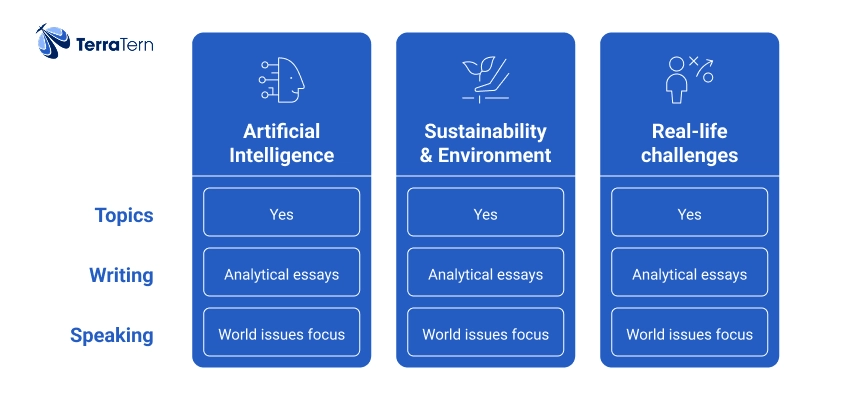
General Updates:
Here are the general updates in the IELTS syllabus 2026:
-
Overall, there is no change in the structure and format of the test.
-
Topics have become more analytical, modern and situational.
-
Much more attention is paid to the practical application of English in practice and study.
Writing Trends:
Here are some writing trends related to the IELTS syllabus 2026:
-
Charts, graphs and diagrams are frequent in task 1.
-
Essays now require a clear structure, logical path of thought, and critical thinking.
Speaking Trends:
Here are some speaking trends related to the IELTS syllabus 2026:
-
More questions require opinion, one's own experiences, and outlining explanations.
-
Among the topics are world problems, including technology, climate change, and the work culture.
Prep Trends:
Here are some preparation trends for the IELTS syllabus 2026:
-
Internet and blended forms of IELTS preparation are fast becoming the most popular means of IELTS preparation.
-
Students also use the apps, video tutorials and interactive study tools to do daily practice.
Trend Tip:
Here are some final tips for the IELTS syllabus 2026:
-
Review the new sample papers and types of questions regularly (2026).
-
Subscribe to reliable IELTS channels on YouTube and Telegram to get information on topics and tips.
Also Read: IELTS Score for Australia to Study, Work & Get PR
Conclusion
The IELTS syllabus 2026 will open access to education, employment, and migration opportunities. The first step to succeed is to learn the exam pattern, section-wise, and the new trends. Select the appropriate materials and ensure a daily study schedule devoted to Listening, Reading, Writing, and speaking. Concentration and practising objectively aid in achieving more efficiency in managing time, accuracy and confidence.
Keep up with fresh topics in Speaking and Writing, particularly the ones that touch real-world problems. You can easily score high in IELTS 2026 with a proper strategy and preparation.
Contact TerraTern for more information!


 AI Summary