
Key Highlights
- How to Increase CRS Score for Canada PR?
- What Is the CRS Score and Why Does It Determine Your Canada PR Chances?
- How Can You Increase Your CRS Score Fast With Language Test Improvements?
- How Does a Provincial Nominee Program (PNP) Nomination Increase CRS Score by 600 Points
- How Can Canadian Work Experience and Education Boost Your CRS Score?
- How Can Your Spouse's Profile Help Increase Your CRS Score?
- How Does Age Affect Your CRS Score and What Can You Do About It?
- Can a Job Offer or a Sibling in Canada Increase Your CRS Score?
- What Are the Most Common Mistakes That Keep Your CRS Score Low?
- 2026 Industry Context Section
- Conclusion
To secure permanent residency in Canada, you need to create a strategic plan and inform yourself on how to increase CRS score for Canada PR. The biggest factor in maximising your IELTS score for Canada PR CRS points is to get a high score, which can give your overall profile a huge boost. Secondly, securing a provincial nomination is very effective. At TerraTern, we will assist you in finding the best PNP to enable Indian candidates to fast-track their 2026 immigration process.
How to Increase CRS Score for Canada PR?
The following is how to increase CRS score for Canada PR, which could be increased, and the recent Express Entry cutoffs could be broken:
-
Get Better Language Tests: Aim for CLB 9 or higher, as stronger language scores can significantly improve CRS points.
-
Target Provincial Nominations: 600 points are awarded per nomination. Conduct strategic research as to the most suitable PNP with an Indian applicant in mind.
-
Upgrade Requirements: Have another degree, study French, or get Canadian work experience.
-
Provide accurate and verifiable information in your profile and supporting documents.
Also Read: A Comprehensive Guide to Express Entry Canada
What Is the CRS Score and Why Does It Determine Your Canada PR Chances?
The Comprehensive Ranking System (CRS) is a points-based system that IRCC uses to assess Express Entry candidates.:
-
Four Core Categories: CRS scores are based on core human capital, spouse or partner factors, skill transferability, and additional points.
-
ITAs and Cutoffs: When there is an Express Entry draw, IRCC has a minimum cutoff score. Candidates at or above the cutoff may receive an ITA, subject to IRCC’s tie-breaking rules.
-
Types of draws IRCC Implements: All-Program draws (not based on any factors other than the score), and Category-Based draws (targeting specific skills, such as healthcare professionals or French speakers, often with lower cutoffs). Understanding the fundamentals is the basis for figuring out how to increase the CRS score for Canada PR:
CRS Points Breakdown
|
CRS Factor |
Max Points (Single) |
Max Points (With Spouse) |
|
Age |
110 |
100 |
|
Education |
150 |
140 |
|
Language (1st) |
160 |
150 |
|
Language (2nd) |
24 |
22 |
|
Canadian Work Experience |
80 |
70 |
|
Skill Transferability |
100 |
100 |
|
Provincial Nomination |
600 |
600 |
|
Job Offer |
200 |
200 |
|
Sibling in Canada |
15 |
15 |
As per TerraTern Expert, Divyansh, the CRS is not a pass/fail test; it's a competitive ranking. Understanding every scoring factor is the first step to strategically maximising your total.
How Can You Increase Your CRS Score Fast With Language Test Improvements?
The quickest and most economical approaches to how to increase CRS score for Canada PR are to improve your scores in language.
-
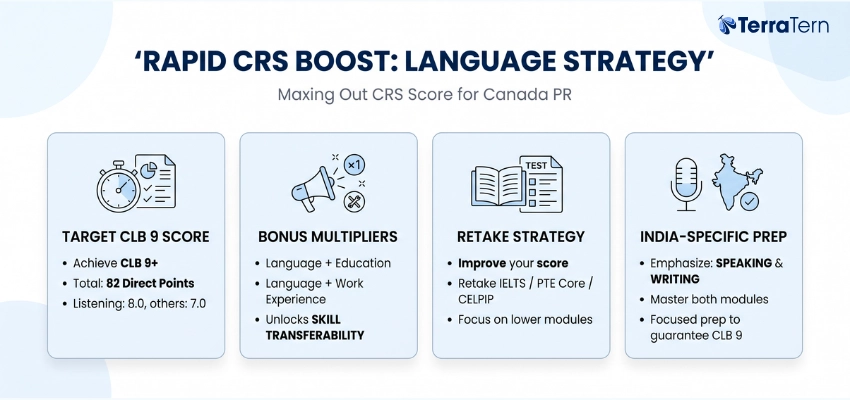
Target CLB 9: Achieving CLB 9 (IELTS: Listening 8.0, Reading 7.0, Writing 7.0, Speaking 7.0) will give a total of 82 direct points.
-
Bonus Multipliers: Higher language scores can unlock skill transferability points when combined with education or work experience.
-
Retake Strategy: If needed, you can retake IELTS, CELPIP, or PTE Core to improve your score.
-
India-Specific Prep: Indian applicants can benefit from targeted mock tests and focused preparation, and should emphasise mastering the Speaking and Writing modules to guarantee CLB 9.
What Are the IELTS and CELPIP Score Targets for Maximum CRS Points?
Knowing precisely what to mark is imperative to how to increase CRS score for Canada PR. It is also noteworthy that IRCC does not specify the Academic exams; instead, the training requirements are general training.
-
CLB 9 corresponds to IELTS 8.0 in listening and 7.0 in reading, writing, and speaking.
-
CLB 9 CELPIP Target: CELPIP scores of 9 in all four abilities generally correspond to CLB 9.
-
The CELPIP Advantage: CELPIP is popular with many applicants because it is computer-based and offered in a single sitting.
Can Learning French Increase CRS Score Significantly?
Yes, bilingualism is a powerful way to increase your CRS score for Canada PR.
-
Big Bonus: Hitting NCLC/CLB 7 in French and CLB 7 in English combines to earn a CRS 50 bonus CRS points.
-
Targeted Draws: French-language category draws have often had lower cutoffs than general draws, sometimes significantly lower.
-
Approved Tests: You need to complete the TEF Canada or TCF Canada in order to earn these juicy French proficiency points.
Important Note: For Indian applicants with even intermediate-level French, investing 3–6 months in TEF preparation could be the highest-ROI move to quickly increase their CRS score.
How Does a Provincial Nominee Program (PNP) Nomination Increase CRS Score by 600 Points
A provincial nomination is one of the most effective ways to increase CRS score because it adds 600 points.
-
The Two-Step Process: You first secure a nomination from a province, which then automatically updates your federal Express Entry profile with the 600-point bonus.
-
Active Enhanced Streams: Quebec does not use Express Entry, and Nunavut does not operate a standard provincial nominee program like other provinces.
-
Optimise Your Profile: Attract provincial interest by carefully aligning your Express Entry NOC codes with specific regional labour shortages.
-
The India Advantage: Indian applicants often benefit from targeted provincial draws in IT, healthcare, and skilled trades.
Which PNP Streams Are the Best PNP for Indian Applicants With Low CRS Scores?
If you are exploring ways to increase your CRS score for Canada PR, securing a provincial nomination is ideal, as provinces issue invitations based on specific occupational needs rather than solely on high CRS scores.
-
Targeted Tech Streams: Ontario and British Columbia actively seek international tech talent regardless of lower baseline CRS scores.
-
Accessible Cutoffs: Alberta frequently invites candidates with baseline scores well below those in federal draws.
-
No Job Offer Needed: Nova Scotia periodically opens streams that do not require a prior Canadian job offer.
Top Provincial Nominee Programs for Indian Professionals:
|
Province |
Popular Stream |
Key Benefit for Indian Applicants |
|
Ontario (OINP) |
Human Capital Priorities (Tech Draws) |
Excellent for software engineers and IT professionals without a job offer. |
|
British Columbia (BC PNP) |
BC PNP Tech |
Fast-tracked processing and continuous draws for 35 targeted tech occupations. |
|
Alberta (AAIP) |
Alberta Express Entry Stream |
Historically selects candidates with lower baseline CRS scores (sometimes 300+). |
|
Nova Scotia (NSNP) |
Labour Market Priorities |
Periodically selects specific occupations (like financial auditors or programmers) directly from the Express Entry pool. |
Expert Tip: A 600-point PNP boost bypasses years of waiting in the Express Entry pool. Indian professionals in IT, healthcare, and skilled trades should research provincial needs before their next draw.
Also Read: Check the Latest CRS Score Calculator for Canada Immigration
How Can Canadian Work Experience and Education Boost Your CRS Score?
Gaining local experience is a highly effective strategy for how to increase CRS score for Canada PR.
-
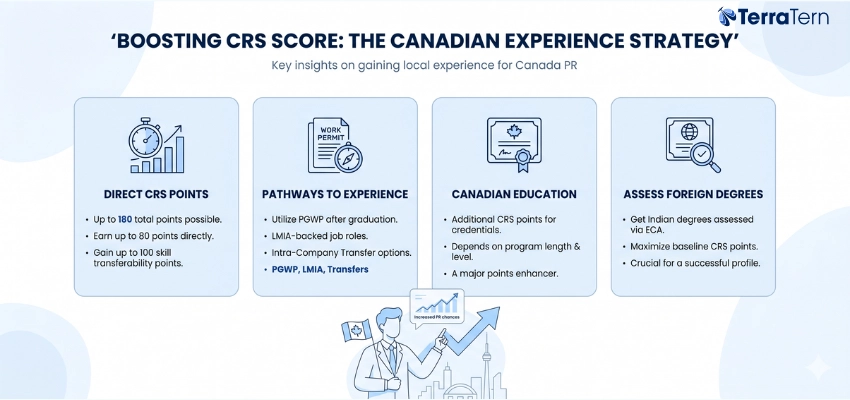
Direct Points: Earn up to 80 points (1 year = 40; 5+ years = 80) plus up to 100 skill transferability points.
-
Pathways: Utilise Post-Graduation Work Permits (PGWP), LMIA-backed roles, or Intra-Company Transfers to build experience.
-
Canadian Education: A Canadian educational credential can add additional CRS points, depending on the program length and level.
-
Foreign Degrees: Always assess Indian degrees with an ECA to maximise baseline points.
Does Getting a Canadian Education Degree or Diploma Really Increase CRS Score?
Yes, studying locally is a proven method for how to increase CRS score for Canada PR.
-
Bonus Points: Earn 15 to 30 additional points depending on the length of your program.
-
Skill Transferability: A Canadian credential heavily amplifies your overall profile points.
-
Student Advantage: An ideal pathway for Indian students transitioning to the Canadian Experience Class (CEC).
What Is an ECA and Why Is It Mandatory for CRS Points?
Getting an Educational Credential Assessment (ECA) is essential when figuring out how to increase CRS score for Canada PR.
-
Validation: It verifies that your foreign degree meets Canadian standards through approved bodies (such as WES, ICAS, or IQAS).
-
Point Retention: Without an ECA, you may lose eligibility to claim key education points for foreign credentials.
-
Mandatory Step: Indian graduates must secure an ECA to claim full points for a Bachelor's or Master's degree.
Expert Advice: Many Indian applicants leave significant education CRS points unclaimed simply by skipping the ECA. This one step could add up to 150+ points to your score.
How Can Your Spouse's Profile Help Increase Your CRS Score?
Maximising your partner's credentials is a strategic approach to how to increase CRS score for Canada PR.
-
Claim Extra Points: An accompanying spouse can contribute additional points through language ability, education, and Canadian work experience.
-
Switch Principal Applicants: Both partners should evaluate their profiles. Often, Indian applicants find that their wives have stronger language or academic credentials, making them the better primary applicants.
-
Assess the Tradeoffs: If a spouse's lower scores drag down your total, consider exploring the "non-accompanying" strategy.
Should You List Your Spouse as Accompanying or Non-Accompanying for Maximum CRS Score?
Understanding your application status is vital for how to increase CRS score for Canada PR.
-
Single Applicant Reset: Selecting "non-accompanying" evaluates you as a single applicant, boosting your total if your partner has weak credentials.
-
The Tradeoff: This temporarily separates your family and delays spousal sponsorship.
-
Test Scenarios: Always calculate both options before finalising your profile.
Important Tip: Never assume the primary earner should be the principal applicant; in many Indian couples, the younger or higher-language-scoring spouse may yield a meaningfully higher CRS total.
How Does Age Affect Your CRS Score and What Can You Do About It?
Age can contribute up to 110 CRS points for single applicants (Peak: ages 20–29). Scores decline progressively after age 30, making early application or profile optimisation in other areas critical for older candidates looking into how to increase their CRS score for Canada PR.
While you cannot pause time, understanding how age impacts your profile allows you to plan effectively:
-
The Optimal Window: Applicants aged 20 to 29 receive the maximum points (110 for single applicants; 100 for applicants with a spouse).
-
The Progressive Decline: Starting at age 30, you lose 5 points per year until age 40, and then 11 points per year, hitting zero at age 45. If you are aged 28–33, it is wise to enter the pool as early as possible.
-
Compensating Strategies: Since you cannot change your age, offsetting these point losses is the primary strategy for older applicants. You can compensate by maximising your language scores (CLB 9+), completing a Master's degree, securing a valid Canadian job offer, or targeting a Provincial Nominee Program (PNP).
Age to CRS Points Breakdown
|
Age |
CRS Points (Single) |
CRS Points (With Spouse) |
|
18–29 |
110 |
100 |
|
30 |
105 |
95 |
|
31 |
100 |
90 |
|
32 |
95 |
85 |
|
33 |
90 |
80 |
|
34 |
85 |
75 |
|
35 |
80 |
70 |
|
36 |
77 |
70 |
|
37 |
66 |
60 |
|
38 |
61 |
50 |
|
39 |
55 |
40 |
|
40 |
50 |
50 |
|
45+ |
0 |
0 |
Pro Tip: Candidates in their early 30s should act with urgency; each birthday after 30 reduces the age component, making language and PNP optimisation even more critical.
Also Read: How to Calculate Points for Canada PR? Latest Experts Guide
Can a Job Offer or a Sibling in Canada Increase Your CRS Score?
Leveraging your connections is a crucial strategy for how to increase CRS score for Canada PR.
-
Job Offers: A qualifying job offer may add CRS points depending on the occupation and current IRCC rules. These must be LMIA-supported or LMIA-exempt.
-
Sibling Factor: Having a sibling (by blood, adoption, or marriage) who is a Canadian citizen or PR currently living in Canada adds a flat 15 points.
-
The Diaspora Advantage: Many Indian applicants successfully use established family networks to secure this straightforward point boost.
Key Note: If you have a sibling in Canada who is a citizen or permanent resident, update your Express Entry profile to claim the additional CRS points where eligible.
What Are the Most Common Mistakes That Keep Your CRS Score Low?
Avoiding critical errors is just as important as knowing how to increase CRS score for Canada PR. At TerraTern, we consistently see applicants lose hundreds of points silently due to these oversights:
-
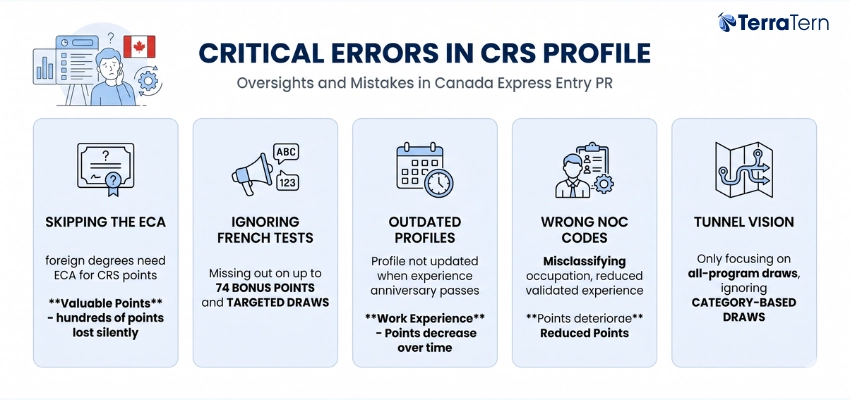
Skipping the ECA: Applicants with foreign education may lose valuable CRS points if they do not obtain an ECA.
-
Ignoring French Tests: Missing out on up to 74 bonus points and access to targeted category draws.
-
Outdated Profiles: Forgetting to update your profile when a work experience anniversary passes.
-
Wrong NOC Codes: Misclassifying your occupation, which reduces validated experience points.
-
Spousal Mismanagement: Failing to optimise your partner's profile or selecting the wrong accompanying status.
-
Tunnel Vision: Focusing exclusively on all-program draws and ignoring lower-cutoff category-based draws.
-
Waiting Too Long: Allowing your score to drop as age points deteriorate progressively after 30.
As per TerraTern Expert: Many Indian applicants in the Express Entry pool are leaving 100–200 CRS points on the table due to preventable profile errors; a professional review can identify these gaps immediately.
2026 Industry Context Section
Latest Statistics:
-
The lowest CRS cutoff for an all-program Express Entry draw in 2025 was 481 points
-
French-language category draws have had cutoffs as low as 375 CRS points
-
A notable share of Express Entry candidates typically have high CRS scores, but the exact pool distribution should be sourced from IRCC data.
-
Language proficiency alone can contribute up to 160 direct points + 100 skill transferability points = 260 total for a single applicant
-
A single year of Canadian work experience can increase the score by up to 50 points under skill transferability
2025–2026 Industry Developments:
-
Category-based Express Entry draws (French, STEM, healthcare, trades, transport) allow lower CRS thresholds for targeted profiles
-
Several provinces run Express Entry-aligned streams, but eligibility and openings change frequently.
-
IRCC now accepts PTE Core as an approved language test alongside IELTS and CELPIP
Also Read: Canada PR Visa: Eligibility, Fees, Processing Time & More
Conclusion
Knowing how to increase CRS score for Canada PR is the key to securing your Invitation to Apply in 2026. Whether you maximise your language test scores, learn French, secure a provincial nomination, or optimise your spouse's credentials, every point matters. Avoid common application mistakes, act quickly to preserve age-related points, and consistently update your Express Entry profile. Implement these proven strategies today to fast-track your Canadian immigration journey.
Contact TerraTern for more information on How to Increase CRS Score for Canada PR: 9 Proven Ways (2026).




 AI Summary