


Key Highlights
- How to Get PR in the UK for Indians?
- What Is PR in the UK, and What Does It Mean for Indian Citizens?
- What Are the Different Pathways to Get PR in the UK From India?
- What Are the Eligibility Requirements for UK PR (ILR) as an Indian Citizen?
- Is the UK Really Changing PR Rules From 5 Years to 10 Years in 2026?
- What Documents Do You Need to Apply for UK PR (ILR) From India?
- What Is the Step-by-Step Process to Apply for UK PR (ILR)?
- How Much Does It Cost to Get PR in the UK in 2026?
- How Long Does It Take to Get PR in the UK?
- What Are the Benefits of Getting PR in the UK as an Indian Citizen?
- What Happens After ILR? How Do You Get British Citizenship?
- What Are the Most Common Reasons UK PR (ILR) Applications From India Get Rejected? (content gap vs. competitors)
- Is It Easier to Get PR in the UK, Canada, or Australia for Indians?
- 2026 Industry Context Section (5–7 dated facts)
- Conclusion
Are you interested in a long-term career in the United Kingdom? For many Indian nationals, obtaining Indefinite Leave to Remain (ILR) is the main route to permanent settlement in the UK. ILR can be a route to British citizenship for people who meet the eligibility requirements of a qualifying immigration route.
This comprehensive 2026 visa guide covers all the latest visa paths, eligibility criteria, processing times, visa fees, and the process to help you settle with confidence.
How to Get PR in the UK for Indians?
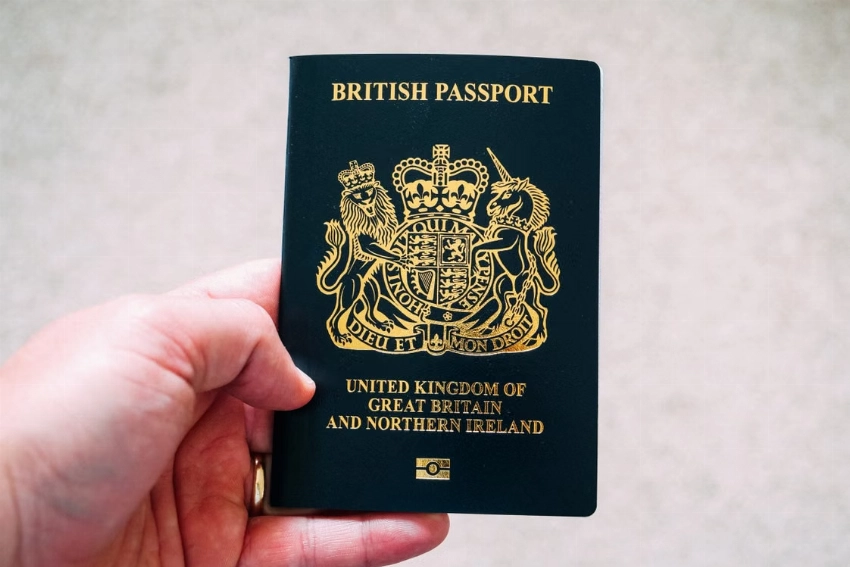
To obtain UK permanent settlement, eligible applicants must apply for Indefinite Leave to Remain (ILR).
-
Hold an Eligible Visa: Hold a qualifying visa, such as a Skilled Worker, Health and Care Worker, Global Talent, Innovator Founder, or eligible family visa.
-
Pass the Life in the UK Test: Pass the Life in the UK Test, meet the English-language requirement, and continue to satisfy the relevant route-specific requirements.
-
Cost & timeline (2026): As of 2026, ILR costs £3,226 per applicant. Many current ILR routes have a five-year qualifying period. The government has consulted on an earned-settlement model that proposes a 10-year baseline for many migrants, but applicants should check the current Immigration Rules before applying.
Also Read: UK Work Visa for Indians: Jobs, Costs & Rules
What Is PR in the UK, and What Does It Mean for Indian Citizens?
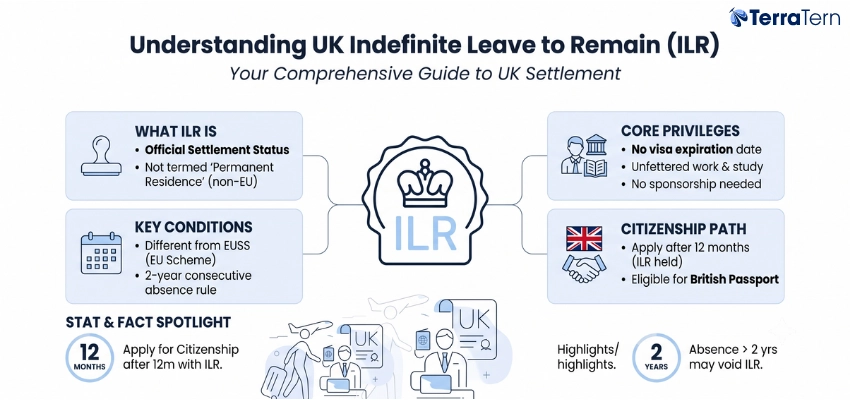
The UK does not generally use ‘permanent residence’ as the legal term for non-EU immigration routes; the relevant settlement status is Indefinite Leave to Remain (ILR).
-
The implications of ILR permanent settlement, unfettered working, studying and business privilege - no sponsor, no visa date to expire, no need to renew.
-
ILR is often the step before British citizenship. In many cases, a person may apply for naturalisation after holding ILR for 12 months. It is usually possible to apply for a British passport 12 months after ILR.
-
ILR is different from status under the EU Settlement Scheme, which applies to eligible EU, EEA, and Swiss citizens and their family members.
-
ILR can usually lapse if a person stays outside the UK for more than two consecutive years.
-
The UK does not use a points-based system to award ILR. However, some temporary visa routes, including Skilled Worker, have eligibility requirements that use points-based criteria.
As per our TerraTern Expert Shreya, if a searcher only reads one thing on this page, it should be this: "PR" is a nickname; "ILR" is the legal term. Using the right one on official forms avoids confusion during the actual application.
What Are the Different Pathways to Get PR in the UK From India?
Several visa routes can lead to ILR once the applicant meets the relevant residence, continuous residence, and route-specific requirements.
|
Route |
Typical Qualifying Period |
Who it Suits |
|
Skilled Worker visa |
5 years |
Indian professionals with a UK sponsor and an eligible job. |
|
Health and Care Worker visa |
5 years |
Indian nurses, doctors, carers, and other eligible health staff. |
|
Family/spouse visa |
5 years |
Spouses or partners of British citizens or settled people. |
|
Global Talent visa |
3 years |
Senior tech, research, academic, and creative talent. |
|
Innovator Founder visa |
3 years |
Founders building an active, scalable UK business. |
|
10-Year Long Residence |
10 years |
People who build lawful residence across multiple visa types. |
How Does the Skilled Worker Visa Lead to PR?
The Skilled Worker visa is a common route for Indian professionals who want to work towards ILR in the UK. For many Skilled Worker applicants, the salary must be at least £41,700 a year and the applicable going rate. Lower salary thresholds may apply in specific circumstances under the Immigration Rules.
Eligible applicants are able to apply for Indefinite Leave to Remain (ILR) in the UK after five years.
Can Indian Nurses and Doctors Get PR Faster Through the Health and Care Worker Visa?
The Health and Care Worker Visa offers one of the best options for how to get PR in the UK for Indian workers in healthcare. The Health and Care Worker visa has route-specific salary requirements, which may differ from standard Skilled Worker salary rules.
How Does a UK Spouse or Family Visa Lead to PR?
For applicants wondering how to get PR in the UK for Indian through family sponsorship, the UK Spouse or Family Visa provides a direct five-year route to Indefinite Leave to Remain (ILR) in the UK. Eligible partners on the five-year family route may apply for ILR after completing five years, provided they continue to meet the route requirements.
Do the Global Talent and Innovator Founder Visas Offer a Faster Route to PR?
Yes. Innovator Founder visa holders may qualify for ILR after three years if they meet the route requirements. Global Talent applicants may qualify after three or five years, depending on their endorsement or qualifying award. The Global Talent and Innovator Founder visas can allow eligible applicants to qualify for Indefinite Leave to Remain (ILR) UK after just three years, making them among the fastest options for how to get PR in UK for Indian. These routes mainly suit experienced researchers, digital technology specialists, and innovative entrepreneurs.
What Is the 10-Year Long Residence Route?
The 10-year Long Residence route is designed for people seeking how to get PR in the UK for Indians after accumulating 10 years of continuous lawful residence in the UK across eligible visa categories, such as Student, Graduate, and Skilled Worker visas. It serves as an alternative pathway to Indefinite Leave to Remain (ILR) UK for applicants who do not qualify under a single visa route but meet the long residence requirements.
Important Note: Most Indian applicants don't need to "pick" a route in isolation; the right one usually falls out of whichever visa got them into the UK in the first place. The real decision point is usually whether to optimise for the fastest route (Global Talent/Innovator, 3 years) or the most accessible one (Skilled Worker, 5 years).
What Are the Eligibility Requirements for UK PR (ILR) as an Indian Citizen?
Many ILR routes require five years of continuous residence, although qualifying periods and requirements vary by visa category. Most applicants following how to get PR in UK for Indian must complete the required period of lawful residence
-
Residency Rule: You should not spend more than 180 days outside the UK in any rolling 12-month period. For example, if you leave for 6 months in one year, that can break the continuous residence requirement.
-
Salary Rule: You must still meet your visa route’s pay threshold at settlement, which for Skilled Worker applicants is linked to the occupation rate or the relevant minimum threshold, whichever is higher.
-
English Test: Settlement currently requires B1 English, while the Life in the UK Test covers British history, laws, and society; it costs £50 and does not need to be retaken if you have already passed it for a previous application.
-
Good Character: Applicants must meet the suitability requirements, including rules on criminality, immigration compliance, and other grounds for refusal.
Expert Tip: The 180-day absence rule is calculated per rolling 12-month period across your entire qualifying period, not per calendar year, a subtle distinction that trips up otherwise well-prepared applicants.
Also Read: Work Permit UK: Complete Visa & Eligibility Guide
Is the UK Really Changing PR Rules From 5 Years to 10 Years in 2026?
The government has proposed changing the standard settlement framework through an ‘earned settlement’ model.
-
Timeline to Watch: The policy moved from the May 2025 White Paper to consultation and ministerial statements in 2026. The consultation proposed a 10-year baseline, but implementation details and transitional arrangements must be confirmed through the Immigration Rules.
-
What’s Proposed: A 10-year baseline for most migrants, longer routes for some lower-skilled roles, and faster routes for high contributors; the plan also discusses tighter treatment for some dependants and other categories.
-
Retrospective Issue: The treatment of people already on a qualifying route depends on transitional provisions, which must be confirmed in any final rules.
-
Practical Guidance: Apply only when eligible and within the permitted application window. For example, some five-year routes allow an application up to 28 days before the qualifying period is completed. This is a living section and will be updated as official announcements clarify the final UK 10-year ILR rule and what it means for applicants planning how to get PR in UK for Indian.
Expert Advice: If you're within 12–18 months of your 5-year ILR eligibility date, the single most useful thing you can do right now is confirm your exact qualifying date and prepare your documents early regardless of how the policy debate resolves.
What Documents Do You Need to Apply for UK PR (ILR) From India?
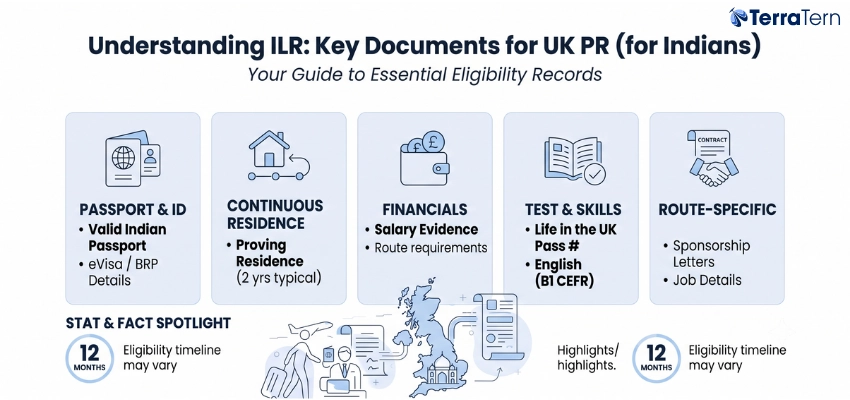
For how to get PR in UK for indian, here are the 7 essential documents for ILR UK eligibility for Indians:
-
Valid passport or travel document
-
Your eVisa details and, where relevant, your current or previous BRP.
-
Documents proving continuous residence, where required for your route, such as travel records, employer records, bank statements, tenancy documents, or utility bills.
-
Evidence of meeting salary/financial requirements for your visa route
-
Your Life in the UK Test pass reference number, if required.
-
Proof of English language proficiency (B1 CEFR level)
-
Route-specific documents (e.g., employer sponsorship letter)
Important Tip: Start collecting bank statements and payslips from month one of your qualifying visa rather than scrambling in year five. Home Office caseworkers scrutinise continuity, not just the final snapshot.
What Is the Step-by-Step Process to Apply for UK PR (ILR)?
Here are the 7 steps for how to get PR in UK for indian and ILR UK eligibility for Indians:
-
Confirm your exact qualifying date and visa route
-
Gather all supporting documents (see checklist above)
-
Complete the correct online ILR application for your route, such as SET(O), SET(M), or another form specified by GOV.UK.
-
Pay the ILR application fee (£3,226 in 2026)
-
Book your UKVCAS biometric appointment
-
Attend a biometric appointment to provide fingerprints and a photo
-
Wait for decision (standard processing: ~6 months)
As per TerraTern Expert: The processing clock starts at your biometric appointment, not at submission; factor that gap into any travel or job-change planning.
Also Read: Navigating UK Work Visa: Here is All the Info About it
How Much Does It Cost to Get PR in the UK in 2026?
For how to get PR in UK for indian, including the UK 10 year ILR rule, here are the 2026 costs:
|
Item |
2026 Cost |
|
ILR application fee (per applicant) |
£3,226 |
|
Biometric enrolment |
£19.20 |
|
Life in the UK Test |
£50 |
|
English test, if required |
~£150–£180 |
|
Priority service, optional |
+£500 |
|
Super Priority service, optional |
+£1,000 |
|
Immigration Health Surcharge on ILR |
None |
Pro Tip: Budget for the total journey cost (visa renewals + IHS paid across the 5-year qualifying period), not just the final ILR fee; the ILR fee itself is typically the smallest line item in the full 5-year cost picture.
How Long Does It Take to Get PR in the UK?
For how to get PR in UK for indian, eligibility takes 5 years on most routes (Skilled Worker, Family)
-
Global talent/innovator founder routes qualify in 3 years
-
The existing 10-year long-residence route is separate from the government’s proposed earned-settlement reform.
-
Standard ILR decision time is up to 6 months
-
Priority service: 5 working days (extra fee)
-
Super priority next working day (extra fee)
-
For several ILR routes, GOV.UK states that a standard decision is usually made within six months of providing biometric information.
Key Note: Submit as early in your eligible window as possible. A clean, early application with a straightforward profile is processed faster than a late, complex one.
What Are the Benefits of Getting PR in the UK as an Indian Citizen?
ILR generally allows you to live, work, and study in the UK without a time limit.
-
No visa renewals required (unlike temporary visas under UK 10 year ILR rule)
-
People with ILR can generally access NHS services under the ordinary-residence rules, although charges can apply for some services, such as prescriptions and dental treatment.
-
ILR normally removes the ‘no recourse to public funds’ condition, but eligibility for each benefit depends on its own rules.
-
Ability to sponsor family members to join you
-
Path to British citizenship after 12 months with ILR
-
Freedom to change employers or become self-employed without needing sponsorship under a work visa.
Important Tip: ILR is genuinely open-ended, but it isn't permanent by default; two consecutive years outside the UK can end it, unlike British citizenship, which doesn't lapse.
Also Read: UK Work Visa Requirements for Indians Latest Guide
What Happens After ILR? How Do You Get British Citizenship?
For how to get PR in UK for indian, hold ILR for 12 months to apply
-
For naturalisation, most applicants must meet the residence requirements for British citizenship, which are separate from ILR qualifying-period rules.
-
Must demonstrate good character (no serious convictions)
-
Can apply sooner if married to a British citizen
-
For most naturalisation applicants, absences must usually not exceed 450 days during the five-year qualifying period.
-
For most naturalisation applicants, absences must usually not exceed 90 days in the final 12 months before applying.
Expert Advice: ILR and citizenship have different absence rules; plan any post-ILR travel around the citizenship application's stricter continuous-residence requirements, not the more lenient ILR rules you just qualified under.
What Are the Most Common Reasons UK PR (ILR) Applications From India Get Rejected? (content gap vs. competitors)
-
Excessive UK absences beyond 180 days/year for How to get PR in UK for indian.
-
Failing to meet the salary requirement that applies to the applicant’s specific Skilled Worker settlement case.
-
Missing/incorrect documents (payslips, BRP, etc.)
-
Gaps in continuous lawful UK residence
-
Past visa breaches or compliance issues
-
Failing the English language (B1) requirement
-
Not passing the Life in the UK Test
Expert Tip: Most refusals aren't caused by dramatic ineligibility; they're caused by inconsistent paperwork (a payslip that doesn't match a bank statement, a gap in address history). Document consistency matters as much as meeting the headline thresholds.
Is It Easier to Get PR in the UK, Canada, or Australia for Indians?
UK: 5-year employer-sponsored route (proposed 10) for how to get PR in UK for indian.
|
Factor |
UK |
Canada |
Australia |
|
Pathway type |
Employer-sponsored work route first, then ILR settlement |
Points-based Express Entry |
Points-based SkillSelect |
|
Time to PR eligibility |
Usually 5 years on a qualifying visa; 3 years for some talent routes |
Direct PR is possible after an invitation |
Direct PR is possible for skilled migrants |
|
Salary/income threshold |
£41,700+ for many Skilled Worker cases, or the occupation's going rate if higher |
No fixed salary threshold; CRS points matter instead |
No fixed salary threshold; points matter instead |
|
Age restrictions |
None for ILR itself |
Under 45 for most skilled programs |
Under 45 for most skilled programs |
|
Language requirement |
B1 English for ILR; B2 from 26 March 2027 for many new Skilled Worker applications |
IELTS/CLB 7+ is commonly competitive |
IELTS 6+ is commonly needed |
|
Job offer required? |
Yes, for sponsored work routes |
Not always; points and CRS can work without one |
Not always; invitation-based selection |
|
Key advantage |
Clear path to settlement once sponsored |
Direct PR without an employer |
Strong high-income migration pathway |
Key Note: If speed is the priority and your profile scores well on points, Canada or Australia's direct-PR routes are often faster than the UK's sponsorship-then-settle model, but the UK route requires a job offer up front rather than a qualifying score, which suits some profiles better.
Also Read: UK Lottery Visa: Complete Guide for Indians
2026 Industry Context Section (5–7 dated facts)
The UK immigration landscape has shifted significantly for Indian applicants in 2025–2026. Here are the essential dated facts shaping how to get PR in UK for Indian this year.
-
Indians Lead Every Major Visa Category (Dec 2025): Indian nationals received 95,231 sponsored study visas (23% of all grants), 90,031 Skilled Worker extensions, and 90,153 Graduate Route extensions, the largest cohort across all three tracks. (UK Home Office, published Feb 2026)
-
Skilled Worker Salary Threshold Rose to £41,700 (July 2025): The general threshold increased from £38,700, and the minimum skill level jumped from RQF Level 3 to Level 6, excluding many previously eligible roles. (Home Office / Immigration Rules)
-
ILR Fee Increased to £3,226 (April 2026): Up from £3,029, affecting all settlement applicants, including those on the UK 10 year ILR rule. (GOV.UK fee schedule)
-
The 10-Year Settlement Proposal is Proposed, Not Law (2026): The May 2025 White Paper proposed doubling the ILR qualifying period from 5 to 10 years. Consultation closed on 12 February 2026; implementation is targeted for autumn 2026, but no Statement of Changes has been laid before Parliament as of mid-2026. (House of Commons Library, updated 2026)
-
English Language Requirement Rising in Two Stages (2026–2027): Skilled Worker entry moved toward B2 (from B1) around January 2026; the settlement-level English requirement separately rises from B1 to B2 on 26 March 2027. (GOV.UK / Immigration Rules Statement of Changes)
-
Political Opposition to the 10-year plan is Mounting (June 2026): A House of Lords committee report urged the government to reconsider or scrap the proposal, adding uncertainty. (House of Lords Justice and Home Affairs Committee, June 2026)
-
Fast-Track Routes Likely to Survive Reform (2026): Global Talent and Innovator Founder visa holders can already apply for ILR after 3 years rather than 5, and these accelerated pathways are expected to remain. (GOV.UK)
Pro Tip: Anyone currently midway through a 5-year qualifying period should treat GOV.UK as the single source of truth and avoid making irreversible decisions based on "10-year rule" headlines. As of today, the 5-year route is still what the law says.
Conclusion
Understanding how to get PR in the UK for Indian ultimately comes down to one destination: Indefinite Leave to Remain (ILR) in the UK. The Skilled Worker route remains the most common path for Indian professionals, with current costs around £3,226+ per applicant. Many current ILR routes, including the Skilled Worker route and the five-year family routes, still use a five-year residence period. Requirements vary by route. Check ILR UK eligibility for Indians carefully before applying.
Contact TerraTern for more information on How to Get PR in the UK for Indians: Complete 2026 Guide.




 AI Summary