

Key Highlights
- What Is a Work Permit UK?
- What Are the Different Types of UK Work Visas?
- What Are the UK Work Permit Visa Requirements?
- How Much Does a UK Work Permit Cost?
- How Long Does It Take to Get a UK Work Permit?
- How Can I Get a UK Work Permit for Indian Citizens?
- Can I Bring My Family on a UK Work Permit?
- Can a UK Work Permit Lead to Permanent Residency?
- 2026 Industry Context Section
- Conclusion
A UK work permit, granted through employer sponsorship, is your key to developing a career in one of the world's most dynamic economies. The UK work permit visa system's significance remains paramount for Indian professionals, as the nation continues to attract them to its medical, IT, engineering, and financial sectors.
Whether you are looking to expand your career opportunities abroad or relocate for various other reasons, this guide covers everything you need to know about obtaining a UK work permit for Indians, from eligibility to document requirements, application procedure, and processing times. You can rely on it to take you through the process with confidence.
What Is a Work Permit UK?

A work permit UK is the authorisation granted by the Home Office for a foreign national to undertake lawful or legal work in the UK. This authorization is now issued to a foreign national as a visa (the Skilled Worker visa), not as a literal 'work permit'.
-
Essentially, a UK work permit is formal permission from the government, granted through a sponsored visa application, for a non-British national to take up employment in the UK.
-
The pre-2008 'Work Permit' scheme was replaced by Tier 2 (General) and is now replaced by the 'Skilled Worker' visa.
-
EU nationals (except Irish nationals) must also have permission to be sponsored, a change since Brexit.
-
Employer-sponsored points system operated by the United Kingdom Visas and Immigration (UKVI) office.
-
It is strongly recommended to have a Certificate of Sponsorship from a UK employer.
Pro Tip: Don't search for a literal "work permit" application form; it no longer exists. Search for your specific visa category instead (usually Skilled Worker).
Also Read: UK Work Permit Visa Processing Time For Indians
What Are the Different Types of UK Work Visas?
The UK offers over a dozen work visa routes, but most applicants qualify through the Skilled Worker visa, Health and Care Worker visa, Global Talent visa, or Scale-up Worker visa. Whether you are navigating the updated 2026 immigration policies from India or elsewhere, securing a work permit UK is essential.
|
Visa Category |
Sponsorship Required |
Typical Applicant |
Settlement Potential |
|
Skilled Worker Visa |
Yes |
Professionals with a job offer meeting the 2026 salary thresholds |
Yes |
|
Health & Care Worker Visa |
Yes |
Medical professionals joining the NHS or the eligible care sector |
Yes |
|
Global Talent Visa |
No |
Recognized or emerging leaders in academia, tech, or the arts |
Yes |
|
High Potential Individual (HPI) |
No |
Recent graduates from eligible top global universities |
No direct route |
|
Scale-up Worker Visa |
Yes (Initial 6 months) |
Recruits joining fast-growing UK businesses |
Yes |
|
Temporary Work Visas |
Yes |
Short-term seasonal, creative, or charity workers |
No |
Skilled Worker Visa
The skilled worker visa details are:
-
Target Audience: Overseas professionals holding a valid job offer from an approved UK sponsor.
-
Key Requirement: Must meet the updated 2026 skill and salary thresholds and demonstrate English language proficiency (often B2 level).
-
Sponsorship: Requires a valid Certificate of Sponsorship (CoS) from your employer before applying.
Health and Care Worker Visa
The health and care worker visa details are:
-
Target Audience: Qualified doctors, nurses, and allied health professionals with a job offer from the NHS or an approved healthcare provider.
-
Key Requirement: Offers fast-tracked processing and a complete exemption from the Immigration Health Surcharge, though this route is now closed to new overseas applicants (since 22 July 2025) and available only to existing visa holders switching or extending in-country until 22 July 2028.
-
Benefits: Offers fast-tracked processing and a complete exemption from the expensive Immigration Health Surcharge.
Global Talent Visa
The global talent visa details are:
-
Target Audience: Recognized leaders (exceptional talent) or emerging leaders (exceptional promise) in academia, research, arts, culture, or digital technology.
-
Key Requirement: Requires an endorsement from an approved UK endorsing body unless you have won an eligible prestigious award.
-
Flexibility: No job offer or sponsor is required, allowing you to change roles, start a business, or undertake freelance work freely.
High Potential Individual (HPI) Visa
High potential individual (HPI) visa details are:
-
Target Audience: Recent graduates from a published list of top-ranked global universities outside the UK.
-
Key Requirement: No sponsor or job offer is needed to apply, but the visa is strictly non-extendable.
-
Duration: Grants 2 years (or 3 years for PhD graduates) to live, work, or look for work in the UK.
Scale-up Worker Visa
The scale-up worker visa details are:
-
Target Audience: Talented individuals recruited by a fast-growing UK business that meets the definition of a qualifying "scale-up."
-
Key Requirement: Requires employer sponsorship for only the first 6 months; after that, you can switch employers without needing a new sponsor.
-
Benefits: Offers immense flexibility and a clear pathway to settlement, provided your salary remains above the threshold.
Temporary Work Visas
The temporary work visa details are:
-
Categories: Include routes like the Seasonal Worker, Government Authorized Exchange, Creative Worker, Charity Worker, and Religious Worker visas.
-
Key Requirement: Requires a temporary sponsor and is strictly limited in duration (often 12 to 24 months, depending on the specific route).
-
Limitations: These visas do not provide a direct pathway to permanent settlement (Indefinite Leave to Remain) in the UK.
Key Note: If you don't have a job offer yet, don't assume you're ineligible; the Global Talent and HPI visas exist specifically for unsponsored applicants who meet talent or academic criteria.
Also Read: UK Post Study Work Permit: Complete Guide for Indian Students
What Are the UK Work Permit Visa Requirements?
Meeting UK work permit visa requirements means securing a licensed sponsor, a valid Certificate of Sponsorship, a salary clearing the £41,700 general threshold or the higher occupation-specific going rate, RQF Level 6 role eligibility, and proof of English proficiency.
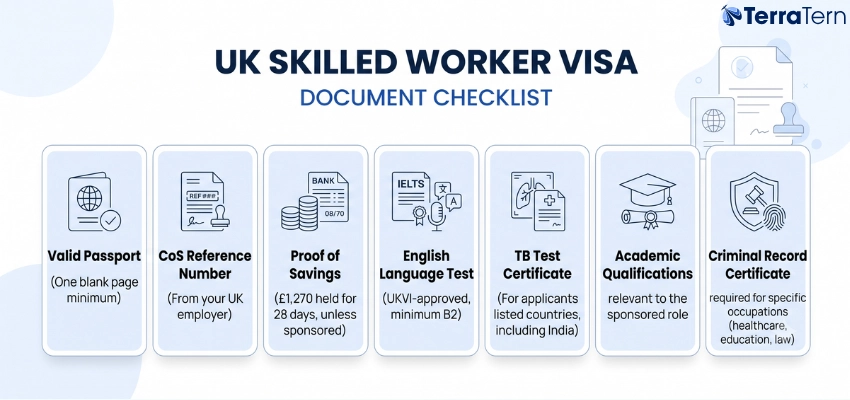
1. Document Checklist (in order of application):
-
Valid passport with at least one blank page
-
Certificate of Sponsorship (CoS) reference number from your UK employer
-
Proof of personal savings (£1,270 held for 28 days) only if your sponsor isn't covering this
-
English language test results (IELTS or UKVI-approved equivalent, minimum B2 level)
-
Tuberculosis (TB) test certificate required for applicants from listed countries, including India
-
Academic qualifications and professional certificates relevant to the sponsored role
-
Criminal record certificate required for specific occupations (healthcare, education, law)
2. The Dual-Salary Test, Which Applies?
Your salary must meet the higher of the two figures:
-
General Threshold: £41,700 per year (standard applicants)
-
Going Rate: The specific salary benchmark tied to your SOC 2020 occupation code
|
Category |
Who Qualifies |
Threshold |
|
General Threshold |
Most standard Skilled Worker applicants |
£41,700/year |
|
New Entrant |
Under 26, recent graduates, Student/Graduate visa switchers |
£33,400/year |
|
Health & Care Worker |
Nurses, doctors, allied health professionals |
£25,000/year |
|
PhD-Relevant Role |
STEM/relevant PhD holders |
£37,500/year |
|
Senior/Specialist Worker |
Intra-company transfers, senior roles |
£52,500/year |
3. The RQF Level 6 Impact:
-
From 22 July 2025, only roles rated RQF Level 6 or above are eligible for a Skilled Worker visa, equivalent to a UK bachelor's degree.
-
This raised the bar from the previous RQF 3+ threshold, meaning many mid-skilled occupations are no longer sponsorable under the standard route.
-
A Temporary Shortage List (TSL) covering RQF 3–5 roles exists but is time-limited, currently scheduled to expire alongside the Immigration Salary List in December 2026.
As per TerraTern Expert, missing the RQF Level 6 skill match is now a more common reason for refusal than salary shortfalls; have your job title and duties checked against the official SOC code before your employer issues the CoS.
How Much Does a UK Work Permit Cost?
UK work visa fees range from roughly £819 to £1,865 (updated from the previous £819 to £1,618 range for 2026) depending on visa length and application location, plus the Immigration Health Surcharge and Immigration Skills Charge paid by the employer.
-
Meeting the financial UK work permit visa requirements involves budgeting for several distinct components, whether you are applying from within the UK or from India.
-
Securing a work permit UK is a significant investment for both the applicant and the sponsor, particularly when factoring in the post-December 2025 increases to the employer-paid skills charge.
|
Cost Category |
Scope |
2026 Fee Amount |
|
Application Fee (Out-of-country) |
Up to 3 years |
£819 |
|
Application Fee (Out-of-country) |
Over 3 years |
£1,618 |
|
Application Fee (In-country) |
Up to 3 years |
£943 |
|
Application Fee (In-country) |
Over 3 years |
£1,865 |
|
Immigration Health Surcharge (IHS) |
Per year, per applicant |
£1,035 |
|
Immigration Skills Charge (ISC) |
Per year (Employer-paid) |
£480 per year for small or charitable sponsors, and £1,320 per year for medium or large sponsors. |
Important Tip: Budget for the Immigration Health Surcharge separately, as it's often the cost applicants forget to include when comparing total UK visa expenses.
How Long Does It Take to Get a UK Work Permit?
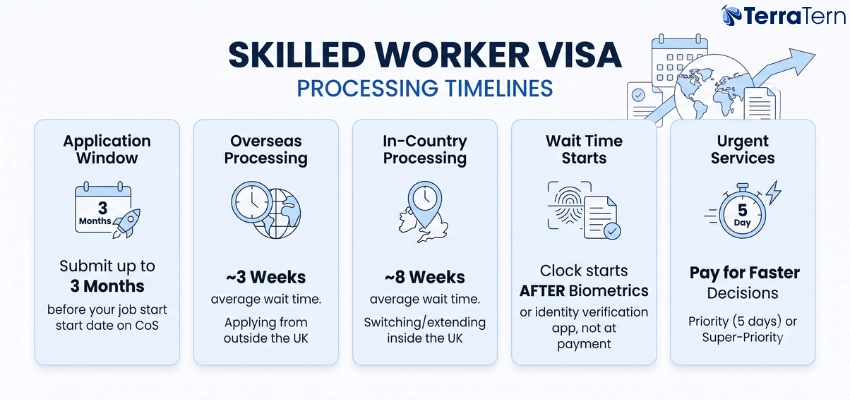
Standard skilled worker visa processing takes about 3 weeks for applications made outside the UK and around 8 weeks for in-country applications. Factoring these timelines into your relocation plan is crucial to meeting all UK work permit visa requirements.
-
Application Window: You can submit your visa application up to 3 months before the official employment start date listed on your Certificate of Sponsorship (CoS).
-
Standard Processing: Expect a wait of approximately 3 weeks if you are applying from overseas, whereas applying from within the UK (to switch or extend) typically takes up to 8 weeks.
-
Biometric Appointment Timing: The processing clock does not start when you pay the fee online; it begins only after you attend your biometric appointment at a visa application center or verify your identity via the UK Immigration: ID Check app.
-
Priority Services: If you need your work permit UK urgently, you can pay an additional fee for priority processing (decision within 5 working days) or super-priority service (decision by the end of the next working day), subject to availability.
Expert Advice: Priority and super-priority services can cut waiting times significantly for an added fee, worth it if your employer has a fixed start date.
Also Read: HPI Visa UK: Eligibility, Cost & How to Apply
How Can I Get a UK Work Permit for Indian Citizens?
Indian citizens moving to the UK can apply for UK work visas online via the Home Office, submit biometrics and documents through VFS Global centers in cities like Delhi, Mumbai, Bengaluru, and Chennai, and typically receive a decision within 3 weeks. You must secure a valid Certificate of Sponsorship before applying. Securing your work permit UK is a streamlined process if you meet all requirements.
-
Application Steps: Choose your visa category, secure your Certificate of Sponsorship (CoS), book a VFS Global appointment in India, submit your biometrics and documents, and await your decision.
-
Required Documents: You must provide a valid passport, proof of personal savings (financial evidence), and your tuberculosis (TB) test certificate, which is mandatory for Indian residents.
-
English Language: You will need to prove your English proficiency, typically by passing an IELTS for UKVI test, though Indian graduates with a UK degree are often exempt from this test.
-
Points-Based System: You must score 70 points under the UK's points-based system: 50 mandatory points for having a sponsored job offer at the required skill level, plus 20 tradeable points earned through meeting the salary threshold and English proficiency requirements.
-
Family Inclusion: When applying for a UK work permit for indian professional, your spouse/partner and children under 18 can typically apply alongside you as dependants.
Expert Advice: Indian applicants who completed a degree taught in English (including many UK-recognised Indian universities) may be able to skip the IELTS requirement entirely. Check your eligibility before booking a test.
Can I Bring My Family on a UK Work Permit?
Most sponsored work visa holders, including Skilled Worker applicants, can bring a spouse, partner, and children under 18 as dependants, provided they meet relationship and financial evidence requirements. Dependants can usually work or study, making a work permit UK an excellent family relocation pathway. You will need to pay separate application and health surcharge fees for each family member joining you.
-
Eligibility: Your spouse, civil partner, or unmarried partner (if you have lived together for at least 2 years), along with children under 18, is eligible to join you.
-
Required Evidence: You must provide solid proof of relationship, such as marriage certificates or birth certificates, plus evidence of sufficient funds to support them.
-
Work and Study Rights: Dependants hold broad permissions to work (in almost any profession) and study full-time in the UK.
-
Added Costs: Securing a UK work permit for Indian families means budgeting for each dependent's visa application fee and the Immigration Health Surcharge (IHS).
Important Note: Dependants generally have full work rights in the UK, a detail many applicants overlook that can meaningfully change a family's relocation finances.
Can a UK Work Permit Lead to Permanent Residency?
Yes, most Skilled Worker visa holders can apply for Indefinite Leave to Remain (ILR) after 5 continuous years. However, a government proposal may extend this to 10 years for future applicants. Navigating your work permit UK journey involves long-term planning, so understanding these potential timeline changes is crucial for anyone targeting permanent residency and eventual British citizenship in the future.
-
ILR Eligibility Basics: You must spend continuous, lawful time in the UK on an eligible visa, maintain your sponsored employment, and meet the minimum salary requirements.
-
The 180-Day Rule: You cannot be absent from the UK for more than 180 days in any rolling 12-month period during your qualifying years.
-
Integration Tests: At the settlement stage, you must pass the "Life in the UK" test and demonstrate your English language skills (currently B1, with a target of B2).
-
5 vs 10 Year Settlement: Please note that the transition from a 5-year to a 10-year ILR route remains a government proposal, not law, as of mid-2026.
-
Future Planning: Even with policy shifts, obtaining a UK work permit for Indian citizens remains one of the most reliable initial steps toward long-term UK settlement.
Pro Tip: If settlement is your long-term goal, keep meticulous records of your time outside the UK from day one. Absences are among the most common reasons ILR applications are delayed or refused.
2026 Industry Context Section
The UK raised salary thresholds, skill levels, and English requirements for work visas across 2025–2026, making the route more selective but more transparent.
-
22 July 2025: General Skilled Worker salary threshold rose from £38,700 to £41,700/year; new entrant rate set at £30,960–£33,400.
-
22 July 2025: Minimum skill level raised from RQF Level 3 to RQF Level 6 (bachelor's-degree equivalent), removing 100+ occupations from eligibility.
-
8 January 2026: New Skilled Worker applicants must meet English level B2 (up from B1); B2 becomes standard for extensions from March 2027.
-
8 April 2026: Home Office introduced pay-period compliance checks, requiring sponsors to maintain the salary threshold across each pay cycle, not just annually.
-
31 December 2026: The Immigration Salary List (ISL) discount scheme is scheduled to expire; ISL roles will need to meet the full going rate.
-
Ongoing Consultation: The Government has proposed extending the Indefinite Leave to Remain qualifying period from 5 to 10 years for most work routes (not yet in force as of mid-2026).
-
Health and Care Worker Visa: Closed to new overseas care worker applications since 22 July 2025; in-country switching allowed until 22 July 2028.
Key Note: If your salary offer is close to £41,700, ask your employer to check the SOC code going rate as well; many applicants are refused not for the general threshold but for missing the higher, role-specific going rate.
Conclusion
Securing a work permit in the UK requires careful planning, but it's an achievable process once you understand the system. From choosing the right category to meeting salary thresholds, skill-level criteria, and documentation standards, each step of the UK work permit visa requirements builds toward a successful application. For Indian professionals, the path to a UK work permit for indian applicants is well-established, supported by VFS Global centers across major cities and clear processing timelines.
Contact TerraTern for more information on the Work Permit UK: Complete 2026 Visa & Eligibility Guide.




 AI Summary