Key Highlights
If you are looking to travel, study, work, or settle in Germany in 2026, you need to select the right visa for your intended purpose and duration of stay. Commonly, short-term visits are covered by the Schengen visa, and work, study, or extended stay (beyond 90 days) is subject to a national visa.
This guide provides an overview of the most common categories of German visas, the requirements for each type, documents required, and the process and fee for applying in 2026. Parts of the visa application process are also easier in Germany, with an online Consular Services Portal available for several national visas.
How to Get a Germany Visa?
To get a Germany visa, you first need to identify the right visa category for your purpose of travel — tourism, study, or work — then gather the required documents, book an appointment through VFS Global or the Consular Services Portal, attend your biometric appointment, and pay the applicable fee.
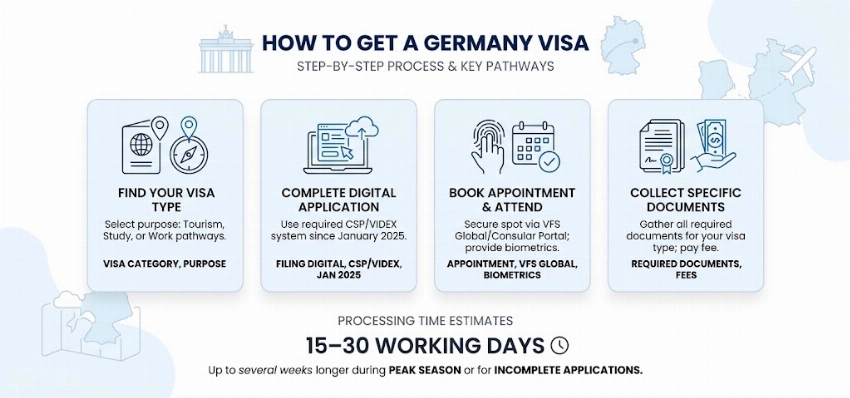
Since January 2025, most applications are filed digitally through the CSP/VIDEX system before an in-person appointment is scheduled. From there, processing generally takes 15 to 30 working days, though it can run longer during peak season or if documents are incomplete. The three most common pathways — tourist/Schengen, student, and work — each have their own document requirements, which this guide covers step by step.
-
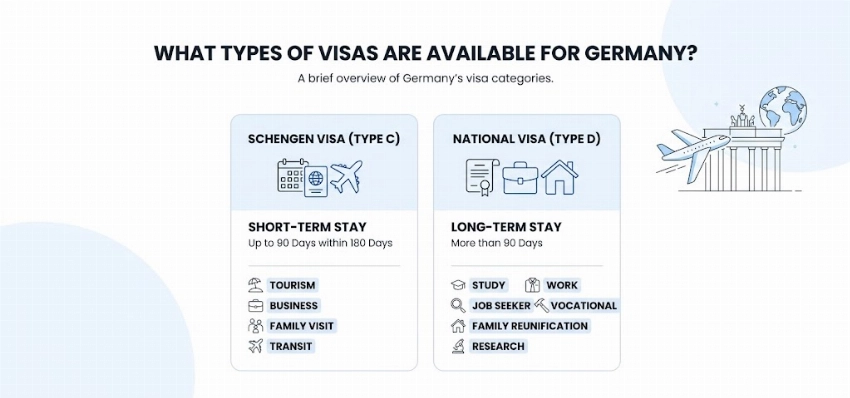
Germany issues two main visa types: the short-stay Schengen visa (up to 90 days) and the long-stay National visa (over 90 days, for study, work, or family reasons)
-
Indian applicants apply through VFS Global or Germany's Consular Services Portal (CSP)
-
Core documents include your passport, application form, insurance, and proof of funds, plus purpose-specific paperwork
-
Processing typically takes 15 to 30 working days
-
Visa fees run approximately €90 (Schengen) or €75 (National), plus a VFS service charge
According to TerraTern Expert: Applying under the wrong visa category is the single most common cause of delay — confirm your visa type before booking any appointment.
Also Read: What is Schengen Type C Visa? Updated & Complete Guide 2026
What's New for Germany Visas?
- The Consular Services Portal: The Consular Services Portal was extended: German missions around the globe have been linked to the Consular Services Portal since 2025. By 2026, applicants will be able to apply online for many kinds of visas, such as study visas and employment visas.
- Digital Parts of the Application Process: Online system for form completion, upload, and tracking of parts of the application process.
- Germany Continues to Be an Attractive Destination for Skilled Immigration: The Skilled Immigration Act ensures employment prospects for non-EU skilled workers.
- Indian Citizens: Indian citizens will no longer require an airport transit visa for transit between countries from 3 June 2026, when they cross a German airport.
- Schengen Applications Are Not Consolidated: Many national/long-term visas are applied for online via the Consular Services Portal, but Schengen visa applications are not fully accepted online via the Consular Services Portal.
- Depending on the Length of Stay: The rules of the visa are different: In case of a stay of up to 90 days, applicants will most likely obtain a Schengen visa, and for stays of more than 90 days, a German national visa is typically required.
- The Issue of Appointment Scams Is Still a Worry: German authorities stress that the appointments cannot be booked through appointment agents and agencies have no special or preferential access.
- Changes to the Response to a Visa Refusal: Germany eliminated the remonstration procedure for visa refusal from 1 July 2025, in order to modify the way applicants can respond to a visa refusal.
Expert Advice: With no formal appeal process anymore, budget extra time to double-check your documents rather than assuming you'll get a second chance if something's missing.
Also Read: Best German Language Learning Books for Beginners
What Types of Visas Are Available for Germany?
Pro Tip: If you're unsure whether you need a Schengen or national visa, the length of stay is the deciding factor — not your nationality or travel purpose alone.
How to Get a Visa for Germany from India: Step by Step
- Make Sure You Have the Right Visa: If you are planning to stay for more than 90 days, you will need a Schengen visa (Type D) for studies, work, or family reunification; if you are planning to stay for less than 90 days, you will need a Schengen visa (Type B).
- Review Eligibility Criteria: Make sure you are eligible for your travel, whether financial, educational, employment, or other criteria as may apply.
- The Necessary Paperwork: Includes a valid passport, application form, photos, proof of where you will be staying, financial documents, travel insurance, and travel documents to support your travel. Visa requirements differ depending on the type of visa.
- Fill in the Application Form: Eligible National Visa holders may provide information and upload documents online via Germany’s Consular Services Portal. This is not a place for applicants to apply for visas to enter or exit the Schengen Area.
- Make an Appointment: As per the instructions of the German mission that is responsible for your place of stay in India. The applications are made either via a visa application centre or the competent German mission, depending on the type of visa.
- Go to the Appointment: And take the necessary original and copy documents. Biometric data such as fingerprints and a photograph may be required, and a visa fee is applicable.
- If Necessary, Go for an Interview with the Visa Authorities: The visa authorities may ask you questions about your travel purpose, finances, accommodation, education, employment, or plans in Germany.
- Processing Time: This is subject to the category of visa, case-by-case verification of documents, and the German authorities in charge.
- Monitor Application: Applicants who submit their applications online via the Consular Services Portal can track the status of their application and obtain information on their application via their online account.
- If Your Visa Is Granted: Check the visa sticker thoroughly for the length of time and the validity date before departure. You will normally have to go through the necessary residence-permit procedures upon arrival in Germany for extended periods of time.
Key Note: Book your VFS appointment as early as six months in advance during peak season — slots for Indian applicants routinely sell out weeks ahead in Q2 and Q3.
Also Read: German Teacher Jobs: Experts Latest Research Insights
Which German Consulate Handles Your Application in India?
- For the Schengen Visa: the Indian applicant has the option of applying from any VFS in India irrespective of his/her residence. The application is sent to the German Consulate General in Mumbai for consideration.
- National Visas: These are obtained for work, study, family reunification, and other long-term visas and are issued by the responsible German mission, based on your country of origin and the type of visa you apply for. See if the German mission has jurisdiction before applying.
What Documents Do You Need for a Germany Visa from India?
- Passport: Valid passport with required validity and blank pages.
- Completed and Signed Visa Application Form.
- Training Data: Recent training data photographs.
- Travel Documents: Itinerary and, as appropriate, accommodation information.
- Artistic Proof: Drawings and sketches that demonstrate the financial proof.
- Visa-Specific Documents: Documents (e.g., employment, university admission, invitation, or other supporting documents based on the visa).
- Insurance: Schengen applications must have appropriate travel health insurance.
Advice by our Expert: Missing even one document is the most common reason for delays — prepare two full sets of every document, including originals and copies, before your appointment.
What Are the Germany Visa Fees for Indian Applicants?
- Schengen Visa: Adults currently pay €90 (INR 9,800), while children aged 6–12 pay €45 (INR 4,900). Visa fees are waived for children 6 and under.
- National Visa: Applicants over 18 generally pay €75 (INR 8,100), while applicants under 18 pay €37.50 (INR 4,100). Extra charges may apply.
- Most Fees Are Non-Refundable, unless the application is withdrawn or declined.
How Long Does Germany Visa Processing Take?
- Schengen Visa: The average time for Schengen visa processing is approximately 15 days from the application being submitted at the Consulate. Transferring from VFS might require more time.
- Long-Term National Visas: Processing times differ considerably according to visa category, visa document verification, and the involvement of the German authorities.
- Delays: If there is incomplete documentation, extra checks, KS or a high volume of applications, it will cause delays. The deadline for applicants to apply is well before the date of intended travel.
Expert Advice: Apply at least 6–8 weeks before your intended travel or course start date to absorb any processing delays.
Also Read: How to Learn German Language? Tips, Tricks for Beginners
How to Get a Student Visa for Germany?
Here's how you can get a student visa for Germany:
Pro Tip: Don't wait for your APS certificate to start gathering other documents; APS processing itself can take several weeks and is now a hard prerequisite for booking your VFS appointment.
What Is the APS Certificate and Why Do You Need It?
-
APS is the Academic Evaluation Centre, which is responsible for certifying the authenticity and academic eligibility of educational qualifications from India for admission to Germany.
-
Most Indian students who want to apply for a German student visa require an APS certificate.
-
It certifies that your academic documents comply with the conditions for studying in Germany.
-
Exceptions apply, for example for PhD/PostDoc applicants or holders of eligible German and/or EU scholarships.
How Much Money Do You Need in a Blocked Account for a Germany Student Visa?
-
The exact amount that students currently have to deposit in a blocked account is €11,904.
-
This equates to a maximum withdrawal limit of €992 per month.
-
The amount should be used to prove that you can afford to live in Germany during your studies.
-
Financial proof can also be in the form of a formal sponsorship declaration or an eligible scholarship.
Also Read: Learn German Language Free | Master German Without Cost
How to Get a Work Visa for Germany from India?
- Get a Suitable Job Offer from a German Employer or Employment Contract. The position should usually comply with the requirements of the relevant work-visa category.
- Confirm Your Qualifications: In the case of a visa of the type in question, it may be necessary to confirm your academic degree or vocational qualification, depending on the type of visa you are applying for, and that it is recognised or equivalent to a German qualification.
- Select the Appropriate Visa: This may range from a skilled-worker visa to an EU Blue Card to an employment visa for skilled workers to an Opportunity Card, depending on your skills and situation.
- Organise Your Documents: Your passport, employment contract/job offer, qualification documents, proof of recognition (when applying), CV, and more documents depending on the category.
- Apply Online: National visas for employment are accepted online via Germany's Consular Services Portal.
- Apply Through the Right German Mission: The German mission is responsible for the area where you live in India – not necessarily for your state of citizenship.
- Appear at Your Appointment: Present original paperwork as necessary, enter biometrics, and pay the appropriate visa fee.
- Consider Fast-Track Processing: Your German employer may consider applying for the fast-track skilled-worker procedure, which in eligible cases may lead to a pre-approval by the competent authority.
- Wait for the Decision: Processing is dependent on the type of visa, document checking, and further approvals.
- Travel and Apply for Residence Permit: After approval, enter Germany and apply for the required residence permit before the visa is due.
Key Note: If you don't yet have a job offer, the Opportunity Card is now the correct route from India — the "Job Seeker Visa" name is largely legacy terminology for a permit only available to those already studying in Germany.
Also Read: Top 10 Highest Paying Jobs in Germany For Indians
What Is the Germany Opportunity Card (Chancenkarte)?
-
Application: The Opportunity Card is a visa that enables the applicant, a qualified non-EU national, to come to Germany to look for an appropriate job opportunity.
-
Eligibility: Recognised German qualifications or six points or more in the points system.
-
Financial Evidence: Applicants need to present adequate financial evidence, which is currently €1,091 per month net of the applicants' income for 2026 (based on accepted financial evidence).
-
Search and Work: The card also allows for limited work/in search of a suitable qualified position.
What Is the EU Blue Card and Who Qualifies?
-
Purpose: EU Blue Card for highly qualified non-EU professionals who are offered a suitable job in Germany.
-
The Job Offer: Employment is generally required to be at least six months in length, and it must match the applicant's qualifications.
-
Standard Minimum Salary: €50,700 gross per year in 2026.
-
Lower Threshold: €45,934.20 per year for shortage occupations, as well as recent graduates.
Also Read: Ausbildung German Language Requirements: New Guide
Conclusion
Getting a German visa in 2026 depends primarily on your purpose of travel, length of stay, and individual eligibility. Generally, a short-stay visa is applied for a stay up to 90 days, and long-stay visas are usually applied for to pursue study or work, vocational training, etc. Germany has also updated its Consular Services Portal to enable eligible applicants to initiate many national visa applications online.
If you need help choosing the right visa and preparing your application, TerraTern can help you understand the process and plan your Germany visa journey with confidence.




 AI Summary