

Key Highlights
- What Does Schengen Type C Visa Mean? Latest Update 2026
- What is the ETATS Schengen Visa Type C?
- Which Countries Are Covered Under a Type C Schengen Visa?
- What is a Type C Visa in Schengen? Detailed Features from Experts 2026
- Who Needs a Schengen Type C Visa in 2026?
- Indian Citizens and Type C Visa Requirements
- Do Minors Require a Type C Schengen Visa?
- What Can You Do With a Schengen Type C Visa?
- What Are the Restrictions of a Type C Schengen Visa?
- How to Apply for Schengen Type C Visa From India?
- What Documents Are Required for Type C Visa Application?
- How Much Does a Type C Schengen Visa Cost in 2026?
- What is the Processing Time for a Type C Visa?
- Understanding the 90/180-Day Rule for Type C Visa
- What is the Difference Between a Single, Double, and Multiple Entry Type C Visa?
- Can You Extend a Type C Schengen Visa in 2026?
- Can You Extend a Type C Schengen Visa?
- What are the Common Reasons for Type C Visa Rejection in 2026?
- What to Do If Your Type C Visa is Rejected? Experts Insights & Tips 2026
- What is the Difference Between a Type C Visa and a Type D Visa in 2026?
- Best Schengen Countries for Indian Applicants in 2026
- What are the Travel Insurance Requirements for Type C Visa from India in 2026?
- What are the Top Schengen Countries with the Lowest Rejection Rates for Indians in 2026?
- What are the Tips for a Successful Type C Visa Application from India in 2026?
- Latest Facts About Type C Schengen Visa
- How TerraTern Can Help You With a Type C Schengen Visa Application
- Conclusion
A Schengen Type C visa is a short-stay visa that allows non-EU nationals, including Indian citizens, to travel across the 29 Schengen countries for up to 90 days within any 180-day period. It is the most commonly issued Schengen visa and is designed for temporary visits such as tourism, business trips, family visits, medical treatment, short-term study programmes, conferences, cultural events, and journalistic assignments.
With a single Schengen Type C visa, travellers can move freely between participating Schengen countries without undergoing additional border checks. Depending on the purpose of travel and the applicant's history, the visa may be issued as a single-entry, double-entry, or multiple-entry permit.
What Does Schengen Type C Visa Mean? Latest Update 2026

Schengen Type C Visa Means are as follows:
-
Schengen type C visa is the regular short stay visa which offers up to 90 days in any 180 days of stay in member countries for non-EU nationals for tourism, business, family visit, or short course of study.
-
For example, in a Schengen-based classification, 'C' designates a short stay, which is differentiated from Type A (airport transit) and Type D (extended stay/residence), which are used for other purposes and for different lengths of time.
-
In the context of practical application, what does Schengen visa type C mean in simple terms? It is a one-time, double, or multiple-entry Schengen visa with respect to movement within Schengen but under the 90/180-day rule.
-
The sticker in the form of "ETATS Schengen" represents a Schengen Uniform visa that allows travel in all states of the Schengen area, and not in a specific state.
-
Under the EU standard visa policy, type C visa Schengen is the type of short-term visa application policy, with a break in 90/180 rules and standard valid documentation criteria.
-
Limitations: no residence, employment, or long-term study; for stay over 90 days/work/study - apply for national Type D; only visa-required nationals will need Type C for short stay visits.
|
Feature |
Details |
|
Visa Type |
Short- Stay Visa (Type C) |
|
Maximum Stay |
90 Days in 180 Days |
|
Countries Covered |
29 Schengen Countries |
|
Adult Fee |
90 EUR |
|
Processing Time |
15-45 Days |
|
Work Allowed |
No |
|
Travel Insurance |
Mandatory (EUR 30,000 minimum) |
|
Entry Types |
Single, Double, Multiple |
Also Read: The Most Common Schengen Visa Rejection Reasons
What is the ETATS Schengen Visa Type C?
ETATS Schengen translates from French as "Schengen States", and when this is written on a Type C visa sticker, it indicates Uniform Schengen Visa valid for entry & travel in ALL 29 Schengen countries. What is an etats Schengen visa type C is almost the full access visa version of what is a Schengen type C visa, where it gives the free pass towards the entire Schengen Area throughout the validity period of the visa.
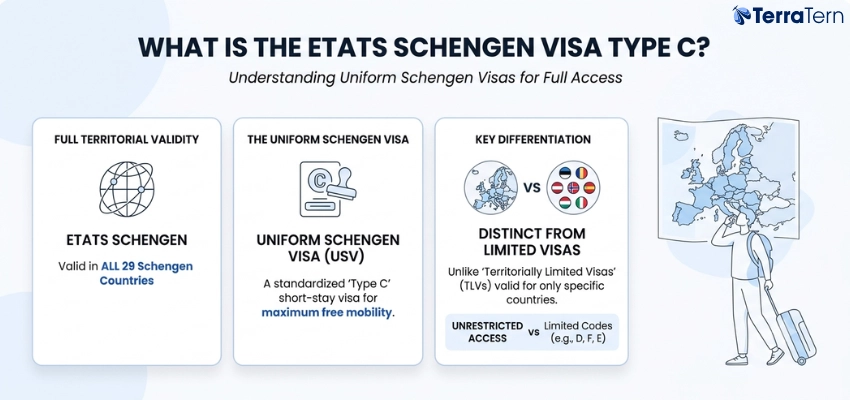
What is type C visa under the ETATS Schengen? Marking from territorially limited visas (TLVs), for which there would be specific country codes. "D, F, E" would only be valid for travel to the countries of Germany, France, and Spain. Full ETATS Schengen status has the most excellent free mobility for short stay travellers.
Which Countries Are Covered Under a Type C Schengen Visa?

The full list of countries that receive entry from what is type C visa in schengen includes Austria, Belgium, Bulgaria, Croatia, Czech Republic, Denmark, Estonia, Finland, France, Germany, Greece, Hungary, Iceland, Italy, Latvia, Liechtenstein, Lithuania, Luxembourg, Malta, Netherlands, Norway, Poland, Portugal, Romania, Slovakia, Slovenia, Spain, Sweden, and Switzerland. Bulgaria and Romania have full Schengen access for land and sea borders in 2024, and that increases what is etats schengen visa type C reaches.
-
Non-EU Schengen members comprise four members of the European Free Trade Association (EFTA): Norway, Iceland, Switzerland, and Liechtenstein, which are participating countries through separate agreements, even though they don't belong to the EU. These destinations are thoroughly covered within the Type C visas with ETATS Schengen marking.
-
Four European microstates have open land borders with countries that are members of the Schengen State, and can be visited on Type C visas, though they don't issue Schengen visas by themselves: Monaco (accessed via France), San Marino and Vatican City (accessed via Italy), and Andorra (accessed via France or Spain). Travelers enter such territories with the help of their Schengen Type C permits, without any other documents.
Also Read: Multiple Entry Schengen Visa Available For Indians
What is a Type C Visa in Schengen? Detailed Features from Experts 2026
Type C Visa in Schengen Features Complete Table:
|
Feature |
Details |
|
|
Visa type |
Short Visitor Visa (Type C) Schengen visa |
|
|
Maximum residence |
time of 90 days in the last 180-day period in any of the Schengen countries; |
|
|
Entry types |
Single entry (only one record), double-entry (two records), or multiple-entry (as many entries as required during validity). |
|
|
Validity |
Single double - normally 15-90 days, Multiple-entry - 6 months, 1 year, 3 years, or a validity period of up to 5 years |
|
|
Territorial coverage |
All 29 states in the Schengen area, if marked "ETATS SCHENGEN"; can be territorially restricted to particular countries. |
|
|
Permitted activities |
Tourism, business meetings, family visits, short courses for a maximum of ninety days, journalism, medical treatment, and official visits |
|
|
Prohibited activities |
Residence, Employment (admitted/unadmitted), long-term study for over 90 days. |
|
|
90/180-day calculation |
Rolling backward calculation: every day goes back 180 days, to ensure that the cumulative stay doesn't exceed 90 days; entry and exit days are counted. |
|
|
Application fees (2026) |
Adults price: EUR90; 6-12 years old: EUR45; under 6: no fee; the same fee for all Schengen countries |
|
|
Processing time |
15 working days (standard); could take up to 45 days during peak seasons or if more documents are required. |
|
|
Travel health insurance |
With a minimum BERMN210082M53000 valid in all Schengen areas and an insurance amount of no less than EUR30,000 for medical emergency, hospitalization, and repatriation causes. |
|
|
Validity of the passport |
Springhorn Valley Hotel: Your passport must be issued within the past 10 years and must be valid for at least 3 months after your departure. |
|
|
For whom |
Persons of non-EU nationalities; not retrospective for visa-exempt nationals (it applies to 90/180) from countries exempted from the visa requirement, and visa-required nationals from countries not part of the advanced agreement |
|
|
Re-entry |
Within 90 days after final entry, one must wait for at least 90 days, and must wait until the previous entry is outside of the backward-counted 180 days to re-enter Schengen. |
|
|
Widget |
Official Short-Stay Calculator for the European Commission, available for digital download to verify the number of days worked. |
|
Who Needs a Schengen Type C Visa in 2026?

Nationals of countries without a Schengen visa‑waiver must obtain a Type C visa for short visits; visa‑exempt nationals can visit for short‑term without a visa, subject to the 90/180 rule. EU/Schengen citizens do not need a visa, and long stays require a national long‑stay (Type D) visa instead of Type C.
Indian Citizens and Type C Visa Requirements
Type C Visa and Indian Citizenship visa requirements are as follows. To apply for a Schengen Type C visa, Indian citizens must submit their application through the embassy, consulate, or visa application centre of their main destination country. Applicants are generally required to provide:
-
A valid passport issued within the last 10 years and valid for at least 3 months beyond the planned departure date from the Schengen Area
-
A completed Schengen visa application form
-
Two recent biometric photographs (35mm × 45mm)
-
Travel medical insurance with minimum coverage of €30,000, valid across all Schengen countries
-
Proof of accommodation, such as hotel reservations or an invitation letter from a host
-
Round-trip flight reservations or travel itinerary
-
Proof of sufficient financial means, including bank statements for the last 3–6 months
-
Income Tax Returns (ITR) for the previous 2–3 years
-
Salary slips and employment letter, or business registration documents for self-employed applicants
-
A cover letter explaining the purpose of travel, itinerary, and intent to return to India
-
Biometric data (fingerprints and photograph) collected during the visa appointment
Visa-free nationalities (No need for Type C):
-
Citizens of the United States, Canada, the United Kingdom, Australia, and New Zealand are eligible to visit the Schengen Area visa-free for a period of up to 90 days every 180 days.
-
Japan, South Korea, Singapore, Malaysia, Brazil, Argentina, Chile, and Mexico have visa-waiver agreements with the United States, while most nationals from Latin America are eligible for visa-waiver status.
-
EU/EEA nationals and Swiss nationals are free to move to the UK, as they do not require a visa and are exempt from the 90/180-day rule.
Do Minors Require a Type C Schengen Visa?
Yes, a minor needs to score a Type C Schengen Visa for Minor Children.
-
All minors, regardless of age - even those who are infants and newborns - need to hold their own Type C Schengen visa for them to enter the Schengen Area. What is Schengen type C visa for kids? It is the same category as adult visas, but requires additional parental consent documentation and reduced or waived fees.
-
Parental consent requirements; notarized consent letter from non-traveling parent(s) authorizing travel were given containing travel dates, destination, and traveling adult(s)If traveling with one parent, this consent is required from that parent, who will need a signed and notarized consent submission by US law; if traveling with guardians, legal custody documents as well as consent of both parents are mandatory.
-
Document requirements are going to be: Valid passport of the child (issued within last 10 years with 3 months validity from the date of departing & having two blank pages), birth certificate of the child (Ja), identity page of birth certificate (Ja), identity page of the child's passport (Ja), copies of two passports of both parents. Two current biometric photos, in accordance with Schengen criteria, completed application forms signed by parents/legal guardians, and travel medical insurance with a minimum coverage of EUR 30,000 for the child.
Also Read: Travel Insurance for Schengen Visa: Latest Complete Guide
What Can You Do With a Schengen Type C Visa?
Schengen Type C Visas are as follows:
-
Tourism: Travel to Schengen countries for sightseeing, leisure, and tourism purposes; Travel within countries of the Schengen zone within a period of not more than 90 days without being subjected to border controls
-
Visits from Family and Friends: Stay with friends/family members who are residents of Schengen states. They must send an invitation letter to Lesotho, including information on the relationship, accommodation, and support.
-
Business Meetings and Conferences: Attend events, meetings, conferences, networking sessions, trade fairs, site visits, and negotiate contracts, as well as deliver sales presentations - but do not carry out paid work/employment.
-
Media and Journalism: Report on international events, participate in press conferences, carry out journalist and media activities while having habitual residence outside India, and you may do these for not more than 90 days at a stretch in any 180 days.
-
Official Diplomatic Visits: Perform diplomatic work, be engaged in official meetings, carry out government duties, and be engaged in inter-governmental activities.
-
Medical Purposes: If the medical condition does not allow an applicant to have access to necessary medical services in his/her home country, visiting the Schengen area to undergo medical treatment is a valid reason, so long as the applicant has all the required medical documents, bookings, and the ability to finance the medical treatment.
-
Short-Term Studies and Participation in Events: Register for classes, training, and education programs that have been completed within less than 90 days (language schools, workshops); participation in public festivals, sport programs, religious gatherings, and cultural tourism.
What Are the Restrictions of a Type C Schengen Visa?
The Limitations of Type C Schengen Visa:

-
A Type C visa strictly forbids employment of any nature, including full-time, part-time, temporary, seasonal, freelance, self-employment, or working illegally, resulting in deportation, a fine, and a ban on re-entering.
-
No Residence or Long Term Stays Type C holders are not eligible to establish formal residence and extended stays for more than 180 days. to A stay visa of the national Type D visa type is necessary.
-
Long-term study Proposed: For doing University degrees or semester programmes / Language courses, or any educational activity above 90 days, student would need Type D, while Type C only contains short duration (under 90 days).
-
Business establishment forbidden: It is not permitted to start a business, register a company, or engage in self-employed commercial activities; one must work to provide paid consultancy or paid services.
-
Violation consequences: Immediate deportation, fines (EUR1,000 - EUR5,000), entry bans (from 1 - 10 years in all Schengen states), and rejection of future visa application in any Schengen country.
-
Alternative visas required: Work activities: national work visa + permit; residence/live/stay long: Type D visa; long-term study/student Type D visa; business establishment: entrepreneur visa.
Also Read: Cover letter for Schengen visa Master Guide
How to Apply for Schengen Type C Visa From India?
Applying for a Schengen Type C visa from India involves a straightforward process when you prepare the correct documents and apply through the appropriate embassy or visa application centre. Follow the steps below to improve your chances of a successful application.
Step 1: Choose Your Main Destination Country
Identify the Schengen country where you will spend the longest duration of your trip. If you plan to spend equal time in multiple countries, apply through the country where you will first enter the Schengen Area.
Step 2: Confirm That You Need a Type C Visa
A Schengen Type C visa is suitable for:
-
Tourism and holidays
-
Business meetings and conferences
-
Family or friend visits
-
Medical treatment
-
Short-term courses and training programs (under 90 days)
If you plan to work, pursue long-term studies, or stay for more than 90 days, you will need a Type D national visa instead.
Step 3: Prepare the Required Documents
Gather all supporting documents before booking your appointment, including:
-
Valid passport (issued within the last 10 years and valid for at least 3 months beyond your planned departure date)
-
Completed Schengen visa application form
-
Two recent biometric photographs (35mm × 45mm)
-
Travel medical insurance with minimum coverage of €30,000
-
Round-trip flight reservation
-
Hotel bookings or accommodation proof
-
Bank statements for the last 3–6 months
-
Income Tax Returns (ITR) for the previous 2–3 years
-
Salary slips and employment letter, or business registration documents
-
Detailed travel itinerary
-
Cover letter explaining the purpose of the visit
Step 4: Complete the Visa Application Form
Fill out the official Schengen visa application form through the relevant embassy, consulate, or visa application centre website. Ensure that all information matches your passport and supporting documents. Parents or legal guardians must sign applications submitted for minors.
Step 5: Book a Visa Appointment
Schedule an appointment through the authorised visa application centre handling applications for your destination country, such as VFS Global or BLS International.
Expert Tip: Book your appointment at least 25–30 days before travel, especially during peak travel seasons from March to June and September to December.
Step 6: Attend Your Appointment and Submit Biometrics
Visit the visa application centre in person with your original documents and photocopies. Most applicants must provide:
-
Fingerprints
-
Digital photograph
-
Supporting documentation
Biometric data is generally valid for up to 59 months, meaning repeat applicants may not need to provide fingerprints again within that period.
Step 7: Pay the Visa Fee and Track Your Application
Pay the applicable visa and service fees during your appointment:
|
Category |
Fee |
|
Adults (12+) |
90 |
|
Children (6- 12 years) |
45 |
|
Children under 6 |
Free |
|
VFS/ BLS Service Fee |
INR 1,500- 2,500 |
After submission, you will receive a tracking number that allows you to monitor your application's progress online.
Step 8: Wait for Processing and Receive Your Passport
Most Schengen Type C visa applications are processed within 15 calendar days, although processing may take 30–45 days during peak travel periods or when additional verification is required.
Once a decision is made, you can collect your passport from the visa centre or receive it through courier delivery if you selected that option.
What Documents Are Required for Type C Visa Application?
Documents needed for the application of the type C visa are:
-
Basic Documents: Valid passport (also below 10 years from expiry with 3+ months of validity more than departure, with two blank pages of hypothalamus), completed Schengen visa application form (VIDEX online / consulate form, Photos (2 biometric - 35x45 mm color, white background, 70-80% of the face page, less than 6 months old,
-
Financial Documents: 3 Months bank statements stamped bank (original separate continuance pages; passbook rejected), ITR Acknowledgment for last 2-3 years/ Form 16/ Salary Slips for last 3 months / Employment Contract/ Appointment letter/ Leave Sanction letter from Employer
-
Travel Documents: Round-trip flight bookings/charners with evidence of entry/exit from Schengen location, hotel bookings/accommodation proof for the whole stay, including check-in date, check-out date, for all locations detailing day-by-day travel itinerary, including cities visited, transportation, and duration of stay in each destination.
-
Purpose-Specific Documents: Tourism needs a personal covering letter giving details of the purpose of travel and also for the return journey; an invitation letter from the host to the tourist, with a copy of the passport, is required for family visits in the host country.
-
Additional India-Specific Requirements: Serotonin copies Aadhaar and PAN card —identity/residency proof. Students: A bona fide certificate/NOC from the school/university is unnecessary. Students: student ID, Minors need a birth certificate, and both parents. How Much Does a Type C Schengen Visa Cost in 2026
-
Proof of Financial Means: Recommended is INR 1.5–2 lakh for short trips, 3–6 months bank statements, latest ITRs, and salary slips.
-
Proof of Ties to India: Like employment letter, business registration, property ownership and family obligations.
Also Read: Passport Type P Means: Uses, Benefits, Features & More
How Much Does a Type C Schengen Visa Cost in 2026?
|
Cost Category |
Amount |
Description |
|
Adult fee (12+ years) |
EUR90 (8,800-9,500) |
Consular fee standardised for all 29 Schengen states since June 2024; applies to all adult applicants irrespective of their nationality |
|
Child fee (6-12 years) |
EUR45 (4,400-4,750) |
Reduced tariff for 6-12 years Children; applies to all member states of the Schengen area |
|
Children under 6 years |
Free (0) |
No consular preparation fee is charged for children under the age of 6. |
|
VFS Global service charge (India) |
1,800-2,800 |
Charged by Visa Application Centers for document handling, biometric collection, and forwarding your application to consulates. |
|
BLSgr International service costs (India) |
1,800-2,800 |
Similar service costs in countries where the outsourcing has gone to BLS International centres |
|
Courier delivery (optional) |
400 - 800 |
Passport return via courier to the registered delivery address (still mandatory to sign in the presence of a representative at VAC) |
|
SMS/email tracking (optional) |
150-300 |
Notifications to use SMS or email tracking throughout application processing. |
|
Photography/photocopies made available (optional) |
100-300 per document, |
On-site photography or photocopying if applicants do not have the necessary documents. |
|
Premium lounge (optional) |
2,500-6,000 |
Appointment bookings will be prioritized, lounge facilities, and priority services at these VACs |
|
Travel insurance |
800–3,000 per person |
Medical insurance with minimum EUR30,000 coverage for the whole Schengen area; required |
|
Total cost (for one adult) |
11,500-18,000 |
Includes visa fee, VAC charges, travel insurance, and optional services. |
|
Total cost (family of 4) |
32,00-52,000 |
Based on 2 adults, 1 child (6–12 years), 1 child under 6, plus VAC fees and insurance. |
What is the Processing Time for a Type C Visa?
The Processing Time for the Type C Visa is:
-
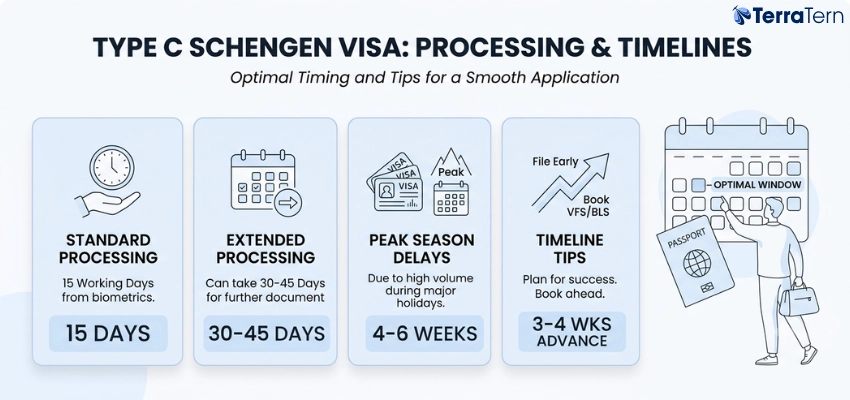
Standard Processing: As per the EU regulations, standard processing is 15 working days from the date of biometric submission till the decision of Schengen type C visa applications.
-
Extended Processing: what is Schengen type C visa applications may extend for 30-45 calendar days in the case of further documents being requested, interviews being required, and/or consular verification of financial/employment details being needed.
-
Peak Season Delays: What is a type C visa in Schengen processing delays during summer and winter holidays/Christmas (Research data analysed in Funen Line study is April 2019-Col. 126). Due to the high volume of applications, processing takes 4-6 weeks during peak seasons, specifically summer (May-September) and winter holidays (December-January).
-
Application Timeline Window: Applications should be submitted (with a maximum of 15 working days and a minimum of 6 months before the intended travel), approved, and etats the Schengen visa type C-mandated lead time.
-
Tracking Application Status: Tracking is possible through monitoring online status using the reference/tracking number issued at the time of submission through VFS Global, BLS International websites, or consulate websites.
-
Tips Against Delays: File proper and accurate documentation; book appointments at least 3-4 weeks in advance of travel; provide clear financial proof (3 months' bank statements, ITR); ensure sufficient financial coverage (minimum EUR 30,000) through travel insurance; avoid peak seasons whenever possible.
-
Expedited Processing: Limited consulates provide urgent/emergency (5-10 day turn-around) processing of proven emergencies (medical, death, urgent business) with supporting documentation and premium fees; check availability with consulate.
Also Read: Chances of Getting a Schengen Visa After Rejection
Understanding the 90/180-Day Rule for Type C Visa
The key stipulation in the Schengen type C visa is the short-term duration rule. Generally, visitors are allowed to reside in the Schengen states for up to 90 days in a period of 180 consecutive days across all the Schengen nations.
-
Rolling Period Concept: A 180-day application involves a "moving window" that counts backward. It means that for every day spent in Schengen, 180 is subtracted from the current date in a rolling date counter, and the total calculation will be recalculated based on the days used so far. For Schengen type C visa compliance, one has to count each date of arrival and departure; hence, in case of a stay between January 10-20, that is counted as 11 days, not 10 days.
-
Calculation Method:
- Having a known date (current/planned entry) for entering the Schengen country
- Count back 180 days from that date
- Count up to the number of days taken with Schengen in the 168th Day window
- Make sure the total Schengen days do not exceed 90
-
Example: Non-compliant Stay (Feb 1-Apr 30; 90 consecutive days counted as a Stay); cannot re-enter within 180 días of the March 30 expiration date after the second Feb 1 go-home date (60 days) has been used by the April 30 electronic data entry date (120 days);
-
Common Mistakes:
- Disappointment with 180 days being the same as 6 (calendar) months (March - September)
- Leaving out the entry/exit days
- Around-the-world trips that occurred previously in the rolling window are not remembered.
- Days start again after leaving Schengen.
-
Tracking Devices: Either using the European Commission official Schengen Calculator (free online tool), Third-party apps like visa-calculator.com, or manually, just using the calendar (entry and exit stamp in a traveler's passport).
What is the Difference Between a Single, Double, and Multiple Entry Type C Visa?

The difference between a single, double, and multiple entry type C visa is:
|
Feature |
Single Entry Visa |
Double Entry Visa |
Multiple Entry Visa |
|
Definition |
One entry into the Schengen Area Visa is invalid after the first exit from the Schengen Area is made, regardless of whether the validity period has not expired. |
Grants two entries into the Schengen Area. Travellers may leave and re-enter once within the validity period. |
Allows unlimited entries and exits within the validity period (validity period must be 90/180 days) |
|
Visa Sticker |
marking Marked with "1" on the visa sticker under the "NUMBER OF ENTRIES" field |
Marked with "2" on visa sticker |
Marked with "MULT" on visa sticker |
|
Typical validity period |
Usually issued for the precise period of the planned trip (15-90 days) |
Usually issued for short-term trips with one planned exit/return (1-6 months) |
Usually issued for 6 months, 1 year, 3 years, or as long as 5 years, according to travel history and purpose |
|
90-day limit application |
Maximum 90 days in continuous stay, or shorter, depending on the period written on the visa sticker |
Maximum 90 days cumulative in both entries during 180 days |
Maximum 90 days in any rolling 180 days from the last day of validity |
|
When the visa expires, AP |
After the first exit from Schengen, regardless of whether the full stay duration was used, AP |
After the second exit from Schengen, even if the approved duration is not fully exploited |
- At the end of the validity period stated on visa sticker, provided the 90/180-day rule is respected |
|
Ideal scenarios |
One-time tourism trip, one business meeting in one day, a visit to family without any intention to return for a valid duration |
Trip with one planned side visit to a non-Schengen country (UK, Morocco) and return to Schengen. |
Familiar business people, family living in Schengen, multiple tourism trips, digital nomads, and regular conference attendees |
|
Flexibility |
No flexibility, can be out for once, cannot come back afterward. 1 entry, one exit |
Only limited flexibility, can be out for one-time re-entry. |
One entry, one exit. Allowed flexibility. Can come out and go in unlimited times within the validity by respecting the above 90/180 rule |
|
Application requirements |
Basic documents: itinerary, single-trip accommodation/flight bookings |
Application documents showing reason for two entries (i.e., side trip to the UK, conference in two phases) |
The documents showing the need for regular travel: business letters, family ties, and previous clean Schengen visa history |
|
Processing & fees |
Standard 15-day processing EUR90 adults EU6 6-12 EUR45 children 6-12 EUR90 |
Standard 15-day processing, Same fees as single-entry |
Processing 15-day processing |
|
Risk of non-compliance |
Higher risk should the traveler exit and forget that the visited visa is no longer valid. |
Moderate risk: Have to keep track of which entry is being used |
Lower risk. Proper day count tracking, using Schengen calculators. |
|
Best for First-time applicants |
Yes, often issued for First-time visitors with single-trip plans |
Schengen commonly issued a reasonable justification for two entries |
They are rarely issued to First-time applicants unless there are reasonable grounds (Business, family ties) |
Also Read: Chances of Getting a Schengen Visa After Rejection
Can You Extend a Type C Schengen Visa in 2026?
Type C visas cannot be extended in most cases, unless it is an exceptional, unforeseeable circumstance that can't be avoided; the approval rate is very low (10-20%).
-
Exceptional Circumstances Justifying Extension: Force majeure (natural disasters, civil unrest, war, pandemics, flight cancellations), humanitarian (serious illness(es)/injury(ies) leading to hospitalisation, death of person close to the candidate, etc.) & essential personal (urgent professional obligation, legal proceedings, weddings etc.), late arrival (arrived in Schengen far exceeding the first day of the visa validity).
-
Application Process: Apply at the immigration/foreigners office in the country of current stay at least 7-10 days before the current visa expiry Dates. Apply for a visa extension form at the immigration office for foreigners or online, updating your travel insurance (Schweizerische Versicherung). Valid Travel Insurance (j Schweisfurais), Proof of sufficient funds (J Schweisfurais), Proof of accommodation (J Schweisfurais)
-
Extension Fees: 30 EUR (due to personal reasons or late entry, free in case of force majeure/humanitarian reasons), 60 EUR to get the second extension (no matter the reason); minors half (15/30 EUR).
-
Processing Time 2-4 weeks: During which applicants need to stay in the country where they have applied and are not allowed to visit any other Schengen states for processing; punishment if the processing time is exceeded.
-
Alternative Options: Exit Schengen, apply for a new Type C visa from home country (according to 90/180-day rule); apply for a Type D long-stay visa in case it is necessary to stay more than 90 days; Contact the home country embassy to arrange emergency assistance.
Can You Extend a Type C Schengen Visa?
Schengen Type C visas generally cannot be extended beyond the permitted 90-day stay.
Extensions are granted only in exceptional circumstances that arise after entering the Schengen Area.
Circumstances That May Justify an Extension
-
Force Majeure
-
Natural disasters
-
Political unrest or war
-
Airport closures
-
Major transportation disruptions
-
Unexpected flight cancellations
-
Humanitarian Reasons
-
Serious illness or injury
-
Hospitalisation
-
Medical emergencies
-
Death or serious illness of a close family member
-
Important Personal Reasons
-
Unavoidable professional obligations
-
Legal proceedings or court appearances
-
Significant personal emergencies
What are the Common Reasons for Type C Visa Rejection in 2026?

The common reasons for type C visa rejection are:
-
Incomplete/Incorrect Documentation: Missing documents, incomplete application forms, mismatched information (such as name, passport number, and dates) between forms and supporting documents, unsigned forms, or leaving mandatory questions blank will trigger automatic rejections. Double-check every detail and ensure all required documents are submitted.
-
Insufficient Financial Proof: Failing to meet minimum daily funds requirement (e.g., France requires €65/day for hotel stays, €33/day if staying with family), insufficient bank balance covering entire trip duration, lack of 6 months' bank statements, missing ITR for 2 years, or unstable financial history results in rejection.
-
Unclear Travel Purpose: Vague or inconsistent travel purpose explanations, missing itinerary details, lack of hotel bookings/flight reservations matching stated plans, generic cover letters without specific dates/destinations, or suspicious travel patterns raise red flags.
-
Weak Ties to Home Country: Lack of stable employment (no leave sanction letter), no property ownership in India, unmarried applicants without family responsibilities, students without enrollment proof for next semester, or unemployed applicants without business documentation suggest immigration risk.
-
Previous Immigration Violations: These, including prior Schengen overstays, unauthorized employment in Schengen countries, visa rule violations, asylum applications, or entries in the Schengen Information System (SIS) database for misconduct, result in a near-certain rejection and potential bans.
-
Inadequate Travel Insurance: Insurance coverage below the minimum of €30,000, policies not valid across all Schengen states, coverage not extending the entire trip duration, non-approved Indian insurers, or missing emergency medical/repatriation coverage cause rejection.
-
Invalid Passport: A passport issued over 10 years ago, with less than 3 months' validity remaining beyond the return date, fewer than two blank pages for a visa sticker, damaged passport pages, handwritten passports (not biometric), or a passport with altered information.
-
Criminal Records: Convictions for serious crimes (fraud, drug offenses, violent crimes), pending criminal cases, terrorism/security concerns, or failure to disclose past convictions honestly lead to rejection on public security grounds.
Also Read: Invitation Letter for Schengen Visa: Format, Sample & More
What to Do If Your Type C Visa is Rejected? Experts Insights & Tips 2026
Applicants receive a written refusal letter specifying exact reason(s) with standardized EU rejection codes, right to appeal information, appeal deadline (typically 15-30 days), and contact details of appeals authority.
-
Option 1 - Reapply: What is a Schengen type C visa reapplication? It is appropriate when rejection reasons are fixable (incomplete documents, insufficient funds, unclear purpose, inadequate insurance); wait 2-4 weeks, gather corrected documents addressing all issues, submit a new, complete application with enhanced evidence, and pay the full €90 fee again (non-refundable from the first application).
-
Option 2 - Appeal: What is Schengen visa type C appeals work when rejection is unjustified (consulate misinterpreted documents, procedural errors occurred, subjective decisions lack evidence); file within the deadline (15-30 days), submit a written appeal letter with supporting documents proving eligibility, and expect a 30-90 days processing time.
-
Appeal Success Rates: Generally low (5-15%); 30-40% when proving documentation was misread/lost; 20-30% for procedural violations; 10-20% for subjective assessments lacking evidence; near-zero for disagreements without new evidence.
-
Addressing Financial Proof Rejection: Submit 6 months' bank statements (vs 3), fixed deposit certificates, property valuations, sponsor affidavit with sponsor's financials, and consistent income sources.
-
Addressing Unclear Purpose Rejection: What is required for a type C visa in Schengen reapplications is a detailed day-by-day itinerary, confirmed hotel bookings, purchased flight tickets, invitation letters with complete contact details, and a comprehensive cover letter explaining the trip purpose.
-
Refund Policies: The €90 consular fee and VAC service fees (₹ 1,500- ₹ 2,500) are non-refundable regardless of the outcome. Travel insurance may offer partial/full refunds if the policy includes visa rejection coverage and a claim is filed within 7-15 days with the rejection letter.
What is the Difference Between a Type C Visa and a Type D Visa in 2026?

|
Feature |
Type C Visa (Short-Stay) |
Type D Visa (Long-Stay/National) |
|
Maximum duration |
What is Schengen visa type C, which allows a maximum of 90 days within any rolling 180-day period? |
91 days to several years, depending on purpose (work, study, family reunification); no 90/180-day limit |
|
Primary purposes |
Tourism, business meetings, family visits, short courses under 90 days, medical treatment, conferences, journalism |
Employment, long-term study (university degrees, semesters), family reunification, residence, business establishment, research |
|
Application authority |
Consulate of the main destination country or the first entry point; standardized EU process |
National immigration authorities of the specific country where long-term stay is planned; country-specific requirements |
|
Application fees |
Standardized: €90 adults, €45 children 6-12, free under six across all Schengen countries |
Varies by country: €60-€180 depending on destination and visa subtype; not standardized |
|
Entry types |
Single, double, or multiple-entry within the validity period (6 months to 5 years for multiple-entry) |
Typically single-entry initially; multiple-entry after the residence permit is issued |
|
Document requirements |
Passport, application form, photos, insurance, financial proof (3 months' bank statements), itinerary, hotel bookings |
Passport, application form, photos, purpose-specific documents (employment contract, university admission, family ties proof), long-term financial proof, accommodation lease, and health clearance |
|
Schengen travel after 90 days. |
Must exit Schengen after 90 days; can re-enter only after the 90 days are reset, per the 90/180-day rule. |
After 90 days with Type D, you can travel to other Schengen countries for up to 90 days in any 180 days while maintaining residence in the issuing country. |
Best Schengen Countries for Indian Applicants in 2026
|
Country |
Rejection Rate |
|
Iceland |
5.4% |
|
Lithuania |
8.3% |
|
Switzerland |
9.1% |
|
Italy |
10–11.5% |
|
France |
12% |
What are the Travel Insurance Requirements for Type C Visa from India in 2026?
A Schengen short-stay policy for what is Schengen type c visa must provide at least €30,000 in emergency medical, hospitalization, and repatriation cover, be valid across all Schengen states, and exactly match the trip dates for compliance. What is a Schengen visa type C, and what is a type C visa in Schengen? Applicants should carry a printed certificate that meets consular checklists; what is an Etats Schengen visa type C holder without compliant insurance risk refusal at filing or border control.
|
Requirement |
Specification |
Proof to Submit |
Notes for India |
|
Minimum coverage |
At least €30,000 covering emergency medical treatment, hospitalization, and medical repatriation for the entire stay |
Policy certificate/schedule stating the sum insured and benefits in English |
Consulates verify the sum insured meets the EU minimum; underinsured policies are rejected. |
|
Duration match |
Coverage dates must fully cover entry-to-exit, including transit days and any buffer as advised by the consulate. |
Policy showing start/end dates aligned to itinerary and bookings |
Buy after the itinerary is set; adjust dates if travel shifts before the appointment |
|
Covered risks |
Emergency medical care, urgent hospitalization, and medical evacuation/repatriation of remains are standard inclusions. |
Benefits table highlighting medical/repatriation cover |
Optional add‑ons (baggage, trip cancellation) are not mandatory for visa decisions |
|
Documentation format |
Printed certificate with policy number, insured name matching passport, travel dates, region, insurer contacts |
Hard copy for submission and a copy carried while traveling |
Name/passport mismatch or open‑ended policies cause refusals |
|
Indian insurers |
IRDAI‑regulated providers offering Schengen‑compliant plans include Tata AIG, ICICI Lombard, HDFC ERGO, Reliance General, Bajaj Allianz, SBI General, Care Health. |
Download the certificate immediately after purchase and verify the details |
No official EU “approved list”; consulates accept any policy meeting EU specs from licensed insurers |
|
Refunds on visa refusal |
Many Indian insurers/policies allow partial/full refund if visa is rejected, subject to terms and timely claim with refusal letter. |
Submit a refund request with a rejection letter within the policy deadline |
Consular and VAC fees are non‑refundable; insurance refund depends on policy wording |
What are the Top Schengen Countries with the Lowest Rejection Rates for Indians in 2026?

The top Schengen countries with the lowest rejection rates are:
-
Lowest Rejection Rates (easiest for Indians): Iceland (5.4%), Lithuania (8.3%), Switzerland (9.1%), Latvia (9.5%), Italy (10-11.5%), Luxembourg (11.2%), Finland (11.8%), France (12%), Germany (12.5%), Czech Republic (13%) offer the best approval chances for what is schengen type c visa applicants from India.
-
Moderate Rejection Rates: Netherlands (14%), Spain (14.5%), Austria (15%), Portugal (15.5%), Greece (16%), Norway (16.5%), Poland (17%), Sweden (17.5%), Denmark (18%) have average difficulty for Schengen visa type C applications.
-
Highest rejection rates (most difficult): Malta (38.5%), Estonia (27.2%), Belgium (24.6%), Slovenia (22%), Hungary (21%), Slovakia (20%) should be avoided unless the mandatory leading destination for a type C visa in Schengen applications.
-
Italy's Advantage: Italy processes over 1 million Indian applications annually, with a rejection rate of 10-11.5%. It has an extensive VAC network (VFS Global) in major Indian cities and generally approves well-documented tourism/business applications within 15 days.
-
France's Advantage: France has streamlined processes for Indian applicants, a 12% rejection rate, strong tourism ties with India, and offers multiple-entry visas more readily to repeat travelers with a clean history.
-
Iceland/Lithuania Advantage: Lowest overall rejection rates (5-8%) but fewer direct flights from India; ideal if planning Nordic/Baltic travel as the leading destination for the Schengen visa type C with the highest approval odds.
-
Avoid Malta/Belgium: Malta's 38.5% rejection rate means nearly 4 in 10 Indian applications are rejected; Belgium's 24.6% rate is similarly high; both countries have stricter documentation scrutiny and more conservative approval policies compared to France/Italy.
Also Read: Schengen Visa Portugal: New Complete Guide & Updates
The Schengen countries with the lowest rejection rates are:
Countries with the Lowest Rejection Rates
-
Iceland – Approximately 5.4% rejection rate
-
Lithuania – Approximately 8.3% rejection rate
-
Switzerland – Approximately 9.1% rejection rate
-
Latvia – Approximately 9.5% rejection rate
-
Italy – Approximately 10–11.5% rejection rate
-
Luxembourg – Approximately 11.2% rejection rate
-
Finland – Approximately 11.8% rejection rate
-
France – Approximately 12% rejection rate
-
Germany – Approximately 12.5% rejection rate
-
Czech Republic – Approximately 13% rejection rate
Countries with Moderate Rejection Rates
-
Netherlands – Approximately 14%
-
Spain – Approximately 14.5%
-
Austria – Approximately 15%
-
Portugal – Approximately 15.5%
-
Greece – Approximately 16%
-
Norway – Approximately 16.5%
-
Poland – Approximately 17%
-
Sweden – Approximately 17.5%
-
Denmark – Approximately 18%
Countries with the Highest Rejection Rates
-
Malta – Approximately 38.5%
-
Estonia – Approximately 27.2%
-
Belgium – Approximately 24.6%
-
Slovenia – Approximately 22%
-
Hungary – Approximately 21%
-
Slovakia – Approximately 20%
Also Read: Schengen Visa Portugal 2026: New Complete Guide & Updates
What are the Tips for a Successful Type C Visa Application from India in 2026?
The tips for a successful Type C visa application are:
-
Choose the Right Application Country: What is Schengen type C visa success starts with applying to the primary destination (most extended stay) or first entry point if equal time; target low-rejection countries like Iceland (5.4%), Italy (10-11.5%), France (12%), or Germany (12.5%) when flexibility exists.
-
Apply 30-60 days in Advance: Schengen visa type C applications can be filed up to 6 months before travel, but ideally 30-60 days ahead to secure appointment slots (peak season May-September fills quickly); a minimum of 15 days before departure is mandatory.
-
Prepare Comprehensive, Organized Documentation: Submit a complete checklist with a passport (3+ months validity, two blank pages), application form (VIDEX online with all barcodes), two biometric photos (35×45mm), €30,000 travel insurance, 3 months' bank statements, ITR for 2 years, flight/hotel bookings, detailed itinerary, employment letter with leave sanction.
-
Demonstrate Strong Ties to India: A type C visa in Schengen approval requires proof of return intent—stable employment with NOC/leave sanction, property ownership documents, family responsibilities (marriage/children certificates), ongoing education enrollment, or business registration with GST number.
-
Show Sufficient Financial Means: Maintain a healthy bank balance meeting daily requirements (France: €65/day for hotels, €33/day with family); submit 3-6 months' bank statements with consistent transactions, salary slips, ITR acknowledgments, and avoid sudden large deposits that raise suspicion.
-
Book Refundable/Flexible Reservations Initially: Use refundable hotel bookings and flight reservations (not fully paid tickets) for a visa application to minimize losses if rejected; finalize payment only after the ETATS Schengen visa type C approval.
-
Compelling Cover Letter: Address the consulate formally, explain the trip purpose clearly, state travel dates/destinations/accommodation, demonstrate return intent to India, and sign personally; generic letters without specifics cause rejection.
-
Dress Professionally for a Biometric Appointment: Arrive 15 minutes early in formal/business attire (avoid casual wear), bring organized documents in checklist order, answer the officer's questions confidently and truthfully, and maintain a polite and respectful demeanor throughout.
Latest Facts About Type C Schengen Visa
-
Visa Type: Short-Stay Visa (Type C)
-
Maximum Stay: Up to 90 days within a 180-day period
-
Countries Covered: 29 Schengen countries
-
Visa Fee: €90 for adults
-
Processing Time: Usually 15–45 days
-
Work Permission: Not permitted
-
Travel Insurance: Mandatory (€30,000 minimum coverage)
-
Entry Options: Single-entry, Double-entry, or Multiple-entry
How TerraTern Can Help You With a Type C Schengen Visa Application
-
Expert Visa Consultation: What is Schengen type C visa guidance from TerraTern's immigration consultants with a proven track record of high approval rates, personalized assessment of eligibility, documentation gaps, and optimal country selection based on travel plans and rejection statistics.
-
Document Preparation Assistance: What is a Schengen type C visa? Success requires complete, accurate documentation; TerraTern reviews and verifies passport validity, bank statements, ITR acknowledgments, employment letters, travel insurance, and ensures all India-specific requirements (leave sanction, GST registration, Form 16) meet consular standards.
-
Application Form Review: What is a type C visa in Schengen forms (VIDEX online) reviewed for accuracy, completeness, and consistency with supporting documents; experts catch common errors (mismatched dates, incomplete fields, unsigned sections) that trigger automatic rejections.
-
Appointment Booking Support: TerraTern assists with VFS Global/BLS International appointment scheduling across major Indian cities (Delhi, Mumbai, Bangalore, Chennai, Kolkata), particularly during peak seasons (May-September) when slots fill quickly.
-
Interview Preparation: Mock interviews and coaching on answering consular officer questions confidently about travel purpose, financial means, ties to India, and return intent; guidance on professional presentation and document organization.
-
Post-Application Tracking: Real-time monitoring of application status using reference numbers, proactive follow-up with consulates/VACs if processing exceeds standard 15-30 days, and guidance on responding to document requests.
Also Read: Navigating Immigration With Terratern
Conclusion
Understanding what is Schengen type C visa is essential for Indian travelers planning short European trips; what is Schengen visa type C permits stays up to 90 days within any 180 days across 29 Schengen states for tourism, business, or family visits. A type C visa in Schengen requires comprehensive documentation—a valid passport, €30,000 travel insurance, financial proof, and a confirmed itinerary—and costs €90 for adults with 15-45 day processing. What is ETATS Schengen visa type C grants uniform validity across all member countries, enabling border-free travel while respecting the 90/180-day rule. Success depends on choosing low-rejection countries (Italy 10-11.5%, France 12%), demonstrating strong ties to India, and submitting complete applications 30-60 days before departure.
Contact TerraTern for more information on what is Schengen Type C Visa.




 AI Summary