
Key Highlights
- Benefits of Pursuing PR After Studying in Canada
- Latest Facts and News:
- Understanding the Basics of Canadian PR for International Students
- Eligibility Criteria for Canada PR After Study
- Work Experience and Its Importance in PR Application
- Popular Pathways to Get Canada PR After Study
- Steps to Apply for Canada PR After Completing Your Studies
- Common Challenges for Getting PR in Canada and How to Overcome Them
- Post-PR Considerations for New Permanent Residents
- How TerraTern Can Help You Solve Your Canada PR After Study Problems
- Conclusion
Are you dreaming of making Canada your permanent home after graduation? If you're exploring how to get Canada PR after study, this comprehensive guide provides all the insights and strategies you need. Canada offers multiple pathways for international students to transition from temporary to permanent residents, making it an ideal destination for education and immigration.
Benefits of Pursuing PR After Studying in Canada
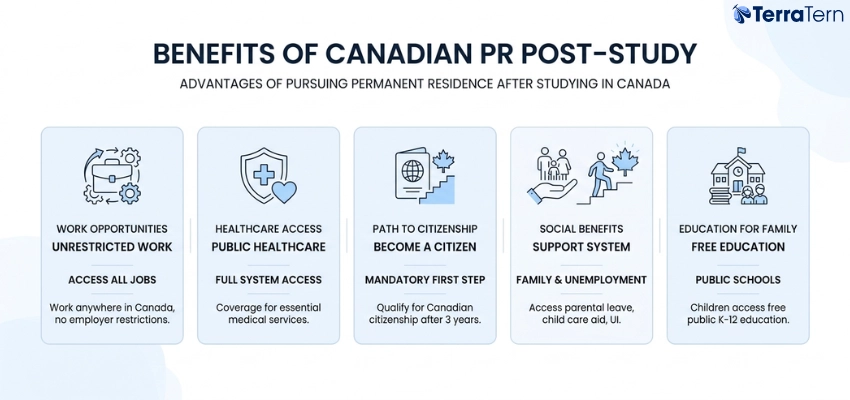
Canada is the only country giving international students superior PR chances post-study. When exploring how to get Canada PR after study, these benefits make it worthwhile:
-
Work Opportunities: PR opens jobs across all Canada without employer restrictions.
-
Healthcare Access: Full access to the public healthcare system covering medical services.
-
Path to Citizenship: PR is the mandatory first step toward Canadian citizenship after 3 years.
-
Social Benefits: Parental leave, child care assistance, unemployment insurance available.
-
Education for Family: Children access the free public education system from kindergarten.
-
Provincial Flexibility: Live and work in any province without restrictions.
-
Federal Benefits: Access to all federal social programs and banking advantages.
Latest Facts and News:
• As of 2024, Canada aims to welcome over 500,000 new immigrants annually.
• The Express Entry system now awards additional points for French language proficiency.
• Recent changes to the Post-Graduation Work Permit (PGWP) program allow for extensions in certain cases.
• Canada has introduced new pathways for essential workers and international graduates in 2024.
• The Canadian Experience Class (CEC) continues to be a popular route for international students seeking PR.
Will Canada provide PR after the study? The pathways to transition from studying in Canada to permanent residency-which are many relatively a cakewalk for international students because of the country's warm approach toward immigrants, using the Express Entry System, Provincial Nominee Programs (PNPs), and the Canadian Experience Class, amongst others. The guide below gives detailed information about the current process, eligibility requirements, and a few pieces of advice for a successful application that will fulfil your dream of becoming a permanent resident in Canada.
Also Read: Top Hotel Jobs in Canada: Latest Jobs, Salary & More
Understanding the Basics of Canadian PR for International Students
PR allows individuals to live, work, and study in Canada without restrictions. For international students, learning how to get Canada PR after studying can be life-changing. PR allows living, working, and studying in Canada without temporary visa restrictions. For international students exploring how to get Canada PR after study, understanding these fundamentals is crucial:
-
Freedom to live/work in any province without employer sponsorship
-
Access to federal and provincial social benefits (healthcare, education)
-
Stable immigration status vs. temporary study/work permits
-
40% transition rate to PR within 5 years post-graduation
-
No annual renewal requirements like temporary permits
-
Pathway to citizenship after 3 years residence
Eligibility Criteria for Canada PR After Study
Eligibility is important when it comes to understanding how to get Canada PR after study. Here are the general requirements:
Eligibility Criteria Checklist:
-
Educational Qualification: The candidate should be a graduate of a recognized Canadian post-secondary institution.
-
Work Experience: The required work experience should be fulfilled as per programs such as the CEC.
-
Language Proficiency: Minimum required scores in tests such as IELTS or CELPIP.
-
Funds: Proof of financial stability is very important as it acts as a way of showing the authorities that you can survive with the salary you have or the funds that you have accumulated over the years.
-
Legal Status: The candidate should hold a valid temporary resident status throughout his stay.
Educational Requirements for PR Application
When exploring how to get Canada PR after study, your educational background plays a critical role.
Eligible Educational Credentials:
-
Bachelor’s, Master’s, or Doctorate degrees from recognized Canadian institutions.
-
Diplomas or certifications from eligible programs lasting at least 8 months.
Also Read: How to Write SOP for Canada Study Visa: Explained For You
Work Experience and Its Importance in PR Application
Canadian work experience significantly boosts your chances of succeeding in how to get Canada PR after study.
-
Programs like the Canadian Experience Class prefer candidates with Canadian work experience.
-
Higher Comprehensive Ranking System scores in the Express Entry system for work experience in skilled occupations.
-
Demonstrates adaptability to the Canadian job market and culture.
-
Increases eligibility for provincial nomination programs targeting international graduates.
-
Strengthens your application with valuable skills relevant to the Canadian economy.
-
It may make you eligible for further points if your job falls into a high-demand occupation in Canada.
Popular Pathways to Get Canada PR After Study

There are multiple immigration pathways designed to help international students navigate how to get Canada PR after study.
Overview of Key Pathways:
-
Express Entry System
-
Provincial Nominee Programs (PNPs)
-
Canadian Experience Class (CEC)
1. Express Entry System for International Graduates
The Express Entry System is considered a viable route for students to determine how to obtain PR in Canada after studying.
Steps to Use Express Entry:
-
Create an online profile on the Express Entry portal.
-
Please submit information on education, work experience, and language proficiency and just upload all the necessary documents, which may include but are not limited to proof of funds, a valid passport, and language test results.
-
Just wait for an Invitation to Apply based on CRS scores.
-
Track any update on your Express Entry profile and ensure all information is current. When your CRS score meets or is above the cut, get an ITA.
-
Complete your Permanent Residence application within the 60-day deadline following the issuance of an ITA.
-
Pay your application fees as requested and follow biometric submission instructions accordingly.
-
Wait for final processing and approval by Immigration, Refugees, and Citizenship Canada.
-
Upon approval, receive the Confirmation of Permanent Residence and get ready for landing processes in Canada.
2. Provincial Nominee Programs (PNPs) for Students
PNPs allow provinces to nominate international students for PR. Here’s how to utilize PNPs for how to get Canada PR after study:
Examples of PNP Streams:
-
Ontario Immigrant Nominee Program (OINP)
-
British Columbia PNP (Skills Immigration for International Graduates)
-
Alberta Opportunity Stream
3. Canadian Experience Class (CEC) for Post-Graduation Work Permit Holders
The Canadian Experience Class (CEC) is one of the fastest ways to achieve PR through how to get Canada PR after study.
Eligibility:
-
The applicant must have at least 12 months of full-time skilled work experience in Canada. Completion of a recognized educational program in Canada. Work experience within NOC TEER categories 0, 1, 2, or 3 management or skilled jobs.
-
The candidate may be required to show proficiency either in English or French to at least the Canadian Language Benchmark of 5.
-
Work experience will be gained while on a valid PGWP or other authorized work permit status.
-
This work experience must be acquired within three years before applying under the CEC.
-
Should not plan to live in the province of Quebec because it has its immigration programs.
-
Part-time equivalent skilled work experience is allowed if it accumulates to 12 months of full-time work-1,560 hours.
Also Read: Is It Easy to Get a Job in Canada? Expert's Job Guide 2024
Steps to Apply for Canada PR After Completing Your Studies
Breaking down how to get Canada PR after study into actionable steps:
Key Steps:
-
Determine Eligibility: Match your profile with available immigration programs.
-
Submit an Application: Use the Express Entry or PNP portals.
-
Provide Required Documents: Gather essential paperwork like transcripts and work permits.
-
Await Results: Track your application status online.
Gathering Required Documents for PR Application

When applying for PR and getting Canada PR after study, having the correct documents is essential. Here’s a concise checklist:
-
Valid Passport: At least six months of validity.
-
Educational Credentials: Degree/diploma from a Canadian institution.
-
Language Test Results: IELTS, CELPIP, or TEF scores.
-
Work Proof: Job letters or pay stubs for Canadian experience.
-
Proof of Funds: Bank statements or GIC for financial sufficiency.
-
PCC & Medical Exam: Clean criminal record and IRCC medical certificate.
Ensure translations, check expiry dates, and keep copies ready for a smooth process.
Improving Your CRS Score for Better PR Chances

Boosting your CRS score is key to securing PR through how to get Canada PR after study.
Strategies to Improve CRS Scores:
-
Gain Canadian work experience.
-
Retake language tests for higher scores.
-
Pursue additional studies in Canada.
-
Apply for a Provincial Nominee Program (PNP).
-
Include spousal qualifications.
-
Secure an LMIA-backed job offer.
-
Learn French for bonus points.
These strategies can significantly boost your chances of PR!
Also Read: How to Become a Doctor in Canada? Experts Guide
Common Challenges for Getting PR in Canada and How to Overcome Them
Navigating how to get Canada PR after study can come with challenges, but they can be overcome with proper planning.
1. Common Challenges:
-
Difficulty meeting language proficiency requirements.
-
Financial constraints in proving settlement funds.
-
Long processing times for applications.
2. Solutions:
-
Take language preparation courses.
-
Explore scholarships or financial aid options.
-
Apply early to avoid delays.
Dealing with Language Proficiency Requirements
Language proficiency is a critical factor in how to get Canada PR after study, as it impacts your CRS score. Here's what you need to know:
Accepted Tests:
-
IELTS (International English Language Testing System)
-
CELPIP (Canadian English Language Proficiency Index Program)
-
TEF or TCF (for French proficiency)
Minimum Requirements:
-
For Express Entry, achieve at least CLB 7 in IELTS or CELPIP for skilled worker categories.
-
Higher scores can yield bonus CRS points.
Preparation Strategies:
-
Take mock tests to identify areas for improvement.
-
Use official prep materials from IELTS, CELPIP, or TEF websites.
-
Join language coaching centres for personalized guidance.
Achieving strong language scores ensures you stay competitive in the PR process!
Post-PR Considerations for New Permanent Residents
After obtaining PR, there are key steps to settle into Canada:
-
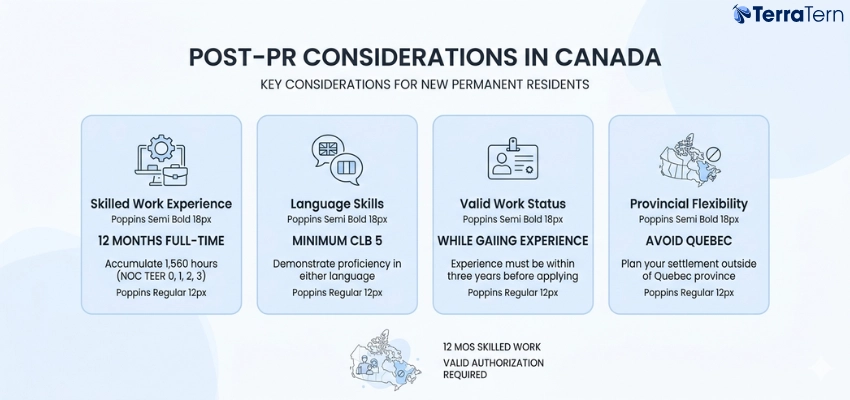
The applicant must have at least 12 months of full-time skilled work experience in Canada. Completion of a recognized educational program in Canada.
-
Work experience within NOC TEER categories 0, 1, 2, or 3 management or skilled jobs.
-
The candidate may be required to show proficiency either in English or French to at least the Canadian Language Benchmark of 5.
-
Work experience will be gained while on a valid PGWP or other authorized work permit status.
-
This work experience must be acquired within three years before applying under the CEC.
-
Should not plan to live in the province of Quebec because it has its immigration programs.
-
Part-time equivalent skilled work experience is allowed if it accumulates to 12 months of full-time work-1,560 hours.
Also Read: Multiple Entry Visa Canada: Latest Requirements & Fees 2024
Maintaining PR Status and Pathway to Canadian Citizenship
Once you get your PR for Canada, it's pretty important to know how you keep your status and through what process you will get converted to a citizen of Canada. By fulfilling certain residency requirements, keeping information updated, and meeting language proficiency requirements, one will be able to enjoy permanent resident status and work their way toward achieving citizenship in Canada. Let's delve into the major requirements and the way forward!
To keep your PR status:
-
Residency Obligation: Live in Canada for 730 days within 5 years.
-
Avoid Legal Issues: Stay clear of any criminal convictions.
-
Update Your Information: Keep your details current with IRCC.
Path to Citizenship:
-
After 3 years, you can apply for citizenship.
-
Language Proficiency: Show English or French skills.
-
Citizenship Test: Pass a test on Canadian history and government.
These steps will guide you to Canadian citizenship!
How TerraTern Can Help You Solve Your Canada PR After Study Problems
Navigating how to get Canada PR after study can feel overwhelming with complex eligibility requirements, changing immigration policies, and multiple pathway options. TerraTern provides expert guidance to simplify your journey and ensure you take the right steps toward permanent residency. TerraTern's Comprehensive Support Services:
-
Personalized Immigration Assessment: Get a free evaluation of your profile to determine eligibility for Express Entry, CEC, or PNP programs tailored to your specific background.
-
PGWP Application Guidance: Receive step-by-step assistance with your Post-Graduation Work Permit application, including the critical 180-day deadline to avoid losing eligibility.
-
CRS Score Optimization: Expert strategies to boost your Comprehensive Ranking System score through language test preparation, education upgrades, and strategic work experience planning.
-
PNP Stream Selection: Help identifying the best Provincial Nominee Program for your profile, with current 2025 updates on Ontario, Alberta, Saskatchewan, and Manitoba open streams.
Conclusion
How to get Canada PR after study is a question international students ask themselves the most when it comes to meeting the eligibility criteria and following the right pathways. From leveraging Express Entry to gaining Canadian work experience, each step plays a vital role in your PR journey. Start your application process early and explore all opportunities to strengthen your profile. With TerraTern's guidance, you can navigate the process confidently and take the first step towards your new life in Canada!