

Key Highlights
- How to Apply for Schengen Visa from India?
- What Is a Schengen Visa and Do Indians Need One?
- Are You Eligible to Apply for a Schengen Visa from India?
- What Documents Do You Need for a Schengen Visa Application from India?
- How Do You Apply for a Schengen Visa from India? (Step-by-Step Process)
- How Much Does a Schengen Visa Cost from India in 2026?
- How Long Does It Take to Get a Schengen Visa from India?
- How Are EES and ETIAS Changing the Schengen Visa Process for Indians in 2026?
- What Are the Most Common Reasons Schengen Visa Applications from India Get Rejected?
- What Happens If Your Schengen Visa Is Rejected? Can You Reapply?
- 2026 Industry Context Section
- Conclusion
Going on holiday or on business to Europe? The first step towards making that dream come true is to know how to apply for Schengen visa from India. Once you are in and have the Schengen visa, you can travel visa-free throughout the 29 countries in the Schengen zone. In this guide, you will learn about the eligibility criteria, required documents, application procedures, processing timelines, and fees to ensure your 2026 Schengen visa application goes smoothly.
How to Apply for Schengen Visa from India?

Here is exactly how to apply for Schengen visa from India. The 7-step process involves
- Determine the correct visa type and main destination country.
- Gather all required documents.
- Book a VFS Global appointment online.
- Attend the appointment, submit your file and provide biometrics.
- Pay the consular and VFS service fees.
- Track your application online.
- Collect your passport (or receive it via courier).
Most Schengen consulates in India use VFS Global to receive applications on their behalf.
Also Read: Schengen Visa Requirements for Indians in 2026: Latest Guide
What Is a Schengen Visa and Do Indians Need One?
Yes, Indian citizens need a Type C Schengen visa for any short stay (up to 90 days) in the 29-country Schengen Area.
-
An Indian passport is not on the visa-exempt list; even Indian permanent residents of the UK, US, Canada, or Australia still require a visa.
-
Understanding how to apply for Schengen visa from India is critical, as this requirement applies regardless of your exact purpose of travel.
As per our TerraTern Expert Shreya, holding a US, UK, or Schengen-adjacent residency does not exempt Indian passport holders; the passport nationality, not your residency, determines the requirement.
Which 29 Countries Are Part of the Schengen Area?
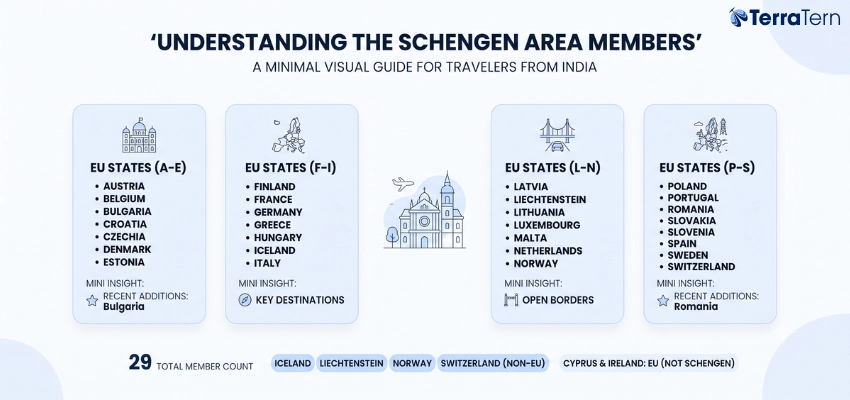
The Schengen Area includes 25 EU states plus Iceland, Liechtenstein, Norway, and Switzerland (Cyprus and Ireland are EU members but not in Schengen). Before looking up how to apply for a Schengen visa from India, note that Bulgaria and Romania were fully integrated into the Schengen Area in 2025, while Cyprus’s accession remains pending. The 29 members are:
-
List 1: Austria, Belgium, Bulgaria, Croatia, Czechia, Denmark, Estonia
-
List 2: Finland, France, Germany, Greece, Hungary, Iceland, Italy
-
List 3: Latvia, Liechtenstein, Lithuania, Luxembourg, Malta, Netherlands, Norway
-
List 4: Poland, Portugal, Romania, Slovakia, Slovenia, Spain, Sweden, Switzerland
Important Note: A single Schengen visa now covers Bulgaria and Romania by land as well as by air/sea, a change that many older guides still don't reflect.
What Types of Schengen Visas Can Indian Citizens Apply For?
If you are researching how to apply for Schengen visa from India, you will find that most Indian travellers apply for a Type C (short-stay) visa, while others cover narrower cases:
-
Type A (Airport Transit): Required for transiting through a Schengen airport zone without entering the country.
-
Type B: Now largely replaced by Type C transit visas.
-
Type C (Short-Stay): For tourism or business up to 90 days. (Check out TerraTern's dedicated Type C explainer for in-depth guidance.
-
Type D (National/Long-Stay): Issued for study, work, or residency exceeding 90 days.
Expert Advice: If your trip is purely for tourism, business, or a family visit under 90 days, you almost certainly need Type C. Don't overcomplicate the type selection.
Are You Eligible to Apply for a Schengen Visa from India?
Eligibility is the first step towards getting a Schengen visa from India. To fulfil the Schengen visa requirements, it is necessary to satisfy four fundamental pillars.
-
Valid Indian Passport: Must be a valid Indian Passport, valid for at least 3 months after your intended return date, and with at least 2 blank pages.
-
Proof of Funds: Bank statements that verify you will have enough money for the entire trip.
-
Travel Insurance: At least €30,000 coverage, covering the whole Schengen area.
-
Genuine Purpose: Clear and well-documented evidence of travel purpose (e.g. travel plans, hotel bookings, cover letter).
Expert Tip: Meeting the minimum document list doesn't guarantee approval; officers weigh your intent to return as heavily as your paperwork.
Which Schengen Country Should You Apply To?
A crucial step in understanding how to apply for Schengen visa from India is correctly identifying which embassy or consulate must process your application. You cannot simply apply to the one with the earliest appointment; you must follow the "Main Destination Rule":
-
Rule 1 (Most Nights): If you will be spending the longest number of nights in a particular country, apply to that country.
-
Example: 6 Nights in Germany + 4 Nights in France → Apply to Germany.
-
Rule 2 (First Port of Entry): If you are equally likely to enter several countries, then choose the country you will enter first.
-
.Example: 5 nights in Italy + 5 nights in Spain (entering Europe from Italy) → apply to Italy.
-
Rule 3 (Single Destination): If travelling to just one country, then apply to the consulate in that country.
-
Example: 10 nights in the Netherlands = Apply to the Netherlands.
Important Tip: Applying to the "easiest" country instead of your genuine main destination is a common shortcut that often backfires by raising a misrepresentation flag.
What Documents Do You Need for a Schengen Visa Application from India?
All applicants must have a passport, photos, a completed application, proof of travel/accommodation, proof of funds, travel insurance, and a cover letter, plus other documents as relevant to their employment status. Preparing the appropriate documents is crucial when it comes to applying for Schengen visa from India. Here is the universal checklist of the documents needed for Schengen visa application. Please refer to TerraTern's complete documents guide for extensive information.
|
Document |
Key Specification |
|
Passport |
Issued within 10 years, valid 3+ months post-return, 2 blank pages |
|
Application Form |
Fully completed online, printed, and signed |
|
Photographs |
Two recent 35x45mm photos, white background, ICAO compliant |
|
Travel Insurance |
Minimum €30,000 coverage across the entire Schengen zone |
|
Proof of Funds |
Last 6 months of bank statements showing sufficient balance |
|
Flight Itinerary |
Round-trip reservations covering your specific travel dates |
|
Proof of Accommodation |
Hotel bookings or a host invitation letter covering every night |
|
Cover Letter |
Maximum one page explaining purpose, funding, and return intent |
As per TerraTern Expert: Unstamped or undated bank statements are the single most common documentation error TerraTern sees. A signature/stamp check takes two minutes and prevents weeks of delay.
What Additional Documents Are Needed Based on Employment Status?
For Schengen visa applications, you will need to provide proof of your economic ties to India as part of your dossier. For salaried applicants, salary slips, a No Objection Certificate (NOC) or leave approval, and recent ITRs are needed. For the self-employed, GST/ITRs and business bank statements are required; for students, a bona fide certificate is needed; and those who are retired have to submit proof of pension. Identifying these categories perfectly is the key to knowing how to apply for Schengen visa from India:
|
Employment Profile |
Extra Required Documents |
|
Salaried Employees |
Salary slips (last 3 months), NOC/leave approval, ITRs (last 3 years) |
|
Self-Employed |
Business registration (GST), company bank statements, business ITRs |
|
Students |
Bonafide certificate or NOC from the educational institution |
|
Retirees |
Pension statements or official proof of retirement income |
Pro Tip: Self-employed applicants face more scrutiny; a clean, stamped 3-month business bank statement matters more than the balance size.
How Do You Apply for a Schengen Visa from India? (Step-by-Step Process)
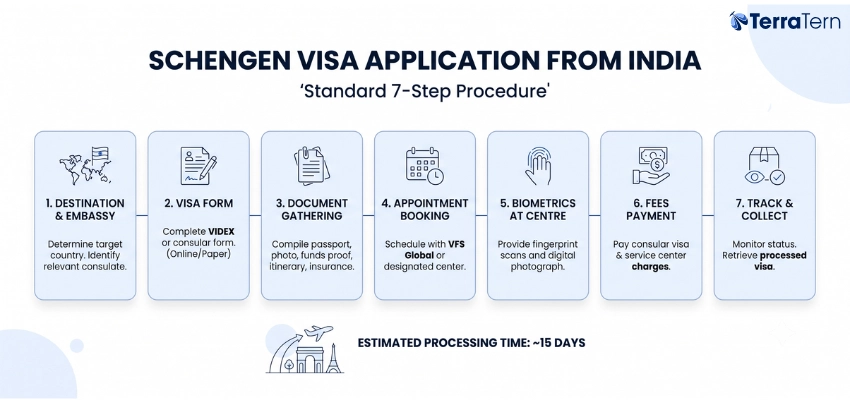
To successfully apply for a Schengen visa from India, you must follow a strict, chronological procedure. The standard process has 7 steps:
-
Determine your destination and the correct embassy
-
Complete the VIDEX or consulate form
-
Gather all required documents
-
Book a VFS Global appointment
-
Attend the centre for biometrics
-
Pay the required consular and service fees
-
Track and collect your processed visa
Key Note: The 15-day official processing clock starts only once your file reaches the consulate, not when you submit it to VFS, so always add 3–6 transit days to your planning.
Step 1: How Do You Determine Your Main Destination and the Correct Embassy?
You must apply to the embassy or consulate of the country where you will spend the most nights. If your time is split perfectly evenly across multiple countries, you must apply at your first port of entry.
Step 2: How Do You Fill Out the Schengen Visa Application Form?
You must complete the official VIDEX (for Germany) or the specific country's online portal form, print it, sign it, and ensure every single field matches your supporting documents exactly. Be aware of common form errors, such as name mismatches or selecting the wrong entry type. If applying for a minor, both parents or legal guardians must sign the form.
Step 3: How Do You Book a VFS Global or Embassy Appointment?
Book your appointment online via the relevant country's VFS Global India portal, selecting your nearest centre and aiming for a slot ideally 4 to 8 weeks before your travel date. VFS operates centres in major cities including Delhi, Mumbai, Bengaluru, Chennai, Kolkata, Hyderabad, Pune, Ahmedabad, and Chandigarh. Be prepared for peak-season backlogs, which typically occur from April to July and October to December.
Important Note: Appointment slots, not consulate processing, are usually the real bottleneck; book the moment your documents are 80% ready.
Step 4: What Happens at the Visa Application Centre Appointment?
At your scheduled appointment, you will submit your original documents and application file, provide your biometrics (10 fingerprints and a digital photograph), and you may be asked a short set of questions regarding the purpose and funding of your trip.
Expert Tip: An interview isn't automatic. Y-Axis and Atlys publicly disagree on this point, and the correct answer is: it's discretionary, triggered mainly by incomplete or inconsistent applications.
Step 5: How Do You Pay the Schengen Visa Fee?
You will pay the standard €90 consular fee plus the VFS service charge directly at the application centre. Acceptable payment methods (cash, card, or UPI) depend on the specific location's policies. For a comprehensive look at the costs involved, review our Schengen Visa Fees breakdown below.
Step 6: How Do You Track Your Schengen Visa Application?
You can track the progress of your application using the VFS Global online tracking portal by entering your reference number and date of birth, or by using the specific embassy's dedicated tracking tool where available.
Expert Advice: Check weekly, not daily; check status updates only at major milestones; daily checking adds stress without adding information.
Step 7: How Do You Collect Your Visa?
Once the consulate has made a final decision, you can collect your passport in person from the VFS centre. Alternatively, if you selected the option during your initial appointment, you can wait for secure courier delivery to your registered home or office address.
How Much Does a Schengen Visa Cost from India in 2026?
When mapping out how to apply for Schengen visa from India, understanding the financial commitment is essential. If you are calculating the total Schengen visa fee/cost from India, budget roughly INR 11,000 to INR 16,000 per adult.
Standard Consular Fees
|
Applicant Age Group |
Consular Fee |
Estimated Cost (INR)* |
|
Adults |
€90 |
~INR 8,100 |
|
Children (6 to 12 years) |
€45 |
~INR 4,050 |
|
Children (Under 6 years) |
Free (€0) |
INR 0 |
Total Estimated Budget (Per Adult)
|
Expense Component |
Estimated Cost Range (INR) |
|
Schengen Consular Fee |
~INR 8,100 |
|
VFS Service Charge |
INR 400 – INR 3,125 |
|
Mandatory Travel Insurance |
INR 300 – INR 1,500 |
|
Total Baseline Budget |
INR 8,800 – INR 12,725+ |
Important Tip: Treat the full INR 11,000–16,000 as a sunk cost the moment you book your appointment; it's non-refundable even on rejection, so spend the effort on document quality, not fee-shopping.
What Additional Costs Should You Budget For?
Mastering how to apply for Schengen visa from India also means preparing for additional logistical expenses at the application centre.
Breakdown of Additional Logistics Costs
|
Additional Requirement / Service |
Estimated Cost (INR) |
|
VFS Global Service Charge |
INR 400 – INR 3,125 |
|
Travel Insurance (per week) |
INR 300 – INR 1,500 |
|
SMS Tracking & Courier (Optional) |
INR 100 – INR 600 |
How Long Does It Take to Get a Schengen Visa from India?
When mapping out how to apply for Schengen visa from India, timing is everything. Standard processing takes 15 calendar days from the date your complete file reaches the consulate, not from your VFS submission. However, realistic end-to-end timelines, including VFS transit and appointment wait times, usually run 3 to 6 weeks.
|
Application Scenario |
Estimated Processing Time |
|
Standard Processing |
15 calendar days |
|
Peak Season Volume |
30 to 45 days |
|
Complex Cases |
Up to 60 days |
As per TerraTern Expert: Apply 4–6 weeks before travel as a rule of thumb, but during May–September and December, push that to 6–8 weeks.
What Can Delay Your Schengen Visa Application?
Even when you know exactly how to apply for Schengen visa from India, unexpected delays can happen. Incomplete financial documents, scrutiny of first-time applicants, peak-season application volume, and consulate requests for additional verification are the top causes. For city-specific details and typical waiting periods at different VFS centres, refer to our dedicated appointment-timelines guide.
How Are EES and ETIAS Changing the Schengen Visa Process for Indians in 2026?
When researching how to apply for Schengen visa from India, note these two major 2026 updates:
-
What changes (EES): Live since April 2026, the Entry/Exit System replaces physical passport stamps with digital biometric records at the European border.
-
What does not apply (ETIAS): ETIAS, launching in Q4 2026, is strictly for visa-exempt travellers. Indian passport holders do not need an ETIAS authorisation.
Pro Tip: If you're Indian and see "ETIAS" mentioned in a Schengen visa checklist for your trip, that's a red flag that the content wasn't written with an Indian applicant in mind; you still need the full Type C visa process described above.
What Is the EES and How Does It Affect Indian Travellers?
The EES digitally records your fingerprints and a facial photo at your first Schengen entry point, permanently replacing the traditional ink passport stamp. It does not add any new paperwork to your process of how to apply for Schengen visa from India,it simply modernises your border crossing experience
What Are the Most Common Reasons Schengen Visa Applications from India Get Rejected?
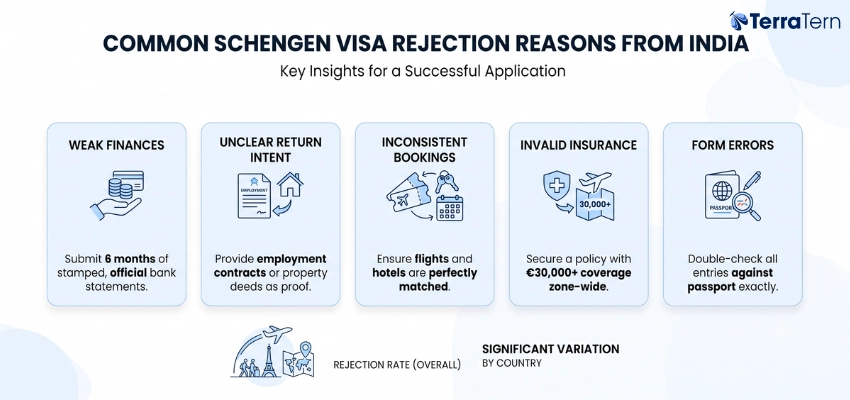
Incomplete documentation, insufficient or unstamped financial proof, weak ties to India, and inconsistent travel plans are the leading causes of rejection. When learning how to apply for a Schengen visa from India, remember that refusal rates for Indian applicants are in the mid-range overall, with significant variation by country.
-
Weak Finances: Provide 6 months of stamped, official bank statements.
-
Unclear Return Intent: Submit employment contracts or property deeds.
-
Inconsistent Bookings: Ensure your flights and hotels are perfectly matched.
-
Invalid Insurance: Secure a policy with €30,000+ coverage zone-wide.
-
Form Errors: Double-check all entries directly against your passport.
Key Note: A single strong, verifiable document addressing your ties to India (property, dependents, stable employment) can outweigh a borderline financial case.
How Can You Avoid the Most Common Rejection Reasons?
Cross-check every document against your form twice, apply to your genuine main-destination country, and build a day-by-day itinerary that matches your bookings exactly. When evaluating how to apply for Schengen visa from India, review to ensure a flawless submission.
What Happens If Your Schengen Visa Is Rejected? Can You Reapply?
Yes, there's no mandatory waiting period, but reapplying with the same weaknesses in your file almost always results in a second rejection. If your process of how to apply for Schengen visa from India hits a setback, follow this protocol:
-
Request Written Reasons: Analyse the specific standard refusal clauses marked by the consulate.
-
Address Gaps: Gather fresh, robust documentation that directly remedies the flagged errors.
-
Decide Next Move: Review our guide on the chances of getting a Schengen visa after rejection to choose between appealing and reapplying.
2026 Industry Context Section
Some of the latest facts are:
-
Latest Statistics (Dated): India submitted over 1.15 million Schengen applications in 2025, the third-largest source market globally, with an 84.2% approval rate (European Commission data).
-
Country-Level Variance: Refusal rates for Indian applicants ranged from 6.9% (Denmark) to 7.7% (Belgium) at the low end, and from 46.1% (Slovenia) to 37% (Bulgaria) at the high end, which is directly relevant to the "which embassy" decision.
-
Fee History: The adult Schengen visa fee rose from €80 to €90 on 11 June 2024 (a 12.5% adjustment under the EU Visa Code) and has remained unchanged through 2026.
-
Border Technology Shift: The Entry/Exit System (EES) became fully operational on 10 April 2026, replacing manual passport stamping with biometric registration at Schengen borders.
-
ETIAS Status (Expert Clarification / Myth-Bust): ETIAS is confirmed for a Q4 2026 launch, but it applies only to visa-exempt nationalities (US, UK, Canada, Australia, etc.). Indian passport holders are not affected by ETIAS and will continue to need a full Schengen visa; conflating the two is a common but avoidable error.
-
Area Expansion: The Schengen Area now comprises 29 countries following Bulgaria and Romania's full accession (including land borders) on 1 January 2025.
Expert Insight: "Incomplete or unstamped financial documents remain the single most preventable cause of both delays and rejections we see from Indian applicants."
Conclusion
Mastering how to apply for Schengen visa from India comes down to preparation, precision, and timing. By correctly identifying your main destination, strictly following the 2026 documentation requirements, and booking your VFS appointment well in advance, you can easily avoid common pitfalls and delays. Whether travelling for business, study, or tourism, TerraTern is here to ensure your application is seamless. Start gathering your paperwork early for a successful European journey.
Contact TerraTern for more information on how to apply for a Schengen Visa from India.




 AI Summary