

Key Highlights
- What Is the Hardest Visa to Get in 2026?
- What Makes a Visa "Hard to Get"?
- What Are the Hardest Visas to Get for Indian Citizens in 2026?
- How Long Is the Green Card Wait for Indian Applicants? (US Backlog Explained)
- What Are the Hardest Countries to Get a Visa to Visit? (Beyond Indian Immigration Corridors)
- What Are the Most Common Reasons Visa Applications Get Rejected?
- How Can You Improve Your Chances of Getting a Hard-to-Obtain Visa?
- Which Visas Are Easier to Get for Indian Applicants? (Alternatives Worth Considering)
- Conclusion
Getting an International travel document can be like a maze in some countries, but in some countries it's taken to an extreme. In 2026, Indian applicants will find the hardest visa to get is a process that requires extensive paperwork, interviews, and has high rejection rates. Whether it is the financial proofs or travel plans, these aspects are crucial to understand. This guide explains the trickiest visas for Indian citizens and provides top tips for approval.
What Is the Hardest Visa to Get in 2026?
The order of most difficult/ hardest visa to get in 2026 to least difficult, for an Indian applicant is:
-
US Employment-based Green Card: The wait time for Indian professionals is extremely long, and recently, the approval rate fell by as much as 35% for them.
-
US H-1B Work Visa: The annual quotas and rigorous screening of immigration for H-1 B work visas significantly affect selection probabilities.
-
Canada Study Permit: This path is now extremely competitive with new strict international student quotas.
-
Schengen Short-Stay Visa: Consulates require flawless daily itineraries and financial records for a Schengen Short-Stay Visa.
-
Closed-Door Tourist Destinations: These are fully closed tourist destinations, like North Korea and Turkmenistan, where there is almost absolute state control over access.
As per our Terratern Expert Divyansh, Don't lead with "North Korea"; every competitor already does, and it's irrelevant to 95% of Indian searchers. Lead with the US Green Card and H-1B; that's the true search intent behind most "hardest visa" queries from India.
Also Read: Top 15 Hardest Countries To Get Citizenship: Updated
What Makes a Visa "Hard to Get"?
You don't assign the hardest visa to get to a destination willy-nilly; there are four basic structural levers to consider when assigning the hard visa to get to a destination:
-
Annual Visa Issuance Quotas and Statutory Caps: There is a major mismatch between supply and demand for visas, irrespective of the quality of candidates.
-
Documentation & Financial-Proof Burden: Consulates require forensic analysis of your income stability, liquid assets, tax compliance, and clean financial history.
-
Approval Thresholds: Bilateral geopolitical treaties, mobility agreements for labour, and visa reciprocity have a direct impact on the approval thresholds.
-
Non-Immigrant Intent/Genuine Visitor Legal Tests: High-scrutiny countries impose a legal burden on the applicant to prove that he does not have immigrant intent, based on verifiable ties to the home country.
How Do Quotas and Per-Country Caps Increase Difficulty?
Statutory limits cause artificial bottlenecks which make high-demand pathways the hardest visa to get obtain for Indian nationals:
-
The 7% Per-Country Limit: The United States has an annual limit of 140,000 employment-based green cards, or about 9,800 per year, split between the three categories (EB-1, EB-2, and EB-3).
-
Disproportionate Demand vs Supply: Enormous numbers of Indian professionals apply for a limited number of seats; Indian candidates have to compete with hundreds of thousands of others for a fixed number of 9,800 seats.
-
The Wait-Time Disparity: In countries where one in fifty applicants applies for India, applicants have a waiting time of 1-2 years to get their visas, while Indian applicants for EB-2 or EB-3 classes face multi-decade wait times.
-
The H-1B Lottery Cap: The annual statutory cap of 85,000 (plus 20,000 visas for master's degree exemptions) is routinely exceeded by 300-400% by the number of people who register in the lottery, meaning that very few, if any, people will be chosen based on skill. The number of people who register for the lottery far exceeds the number of visas available, routinely 3-4 times as many. The H-1B cap has a 65,000 regular cap and a 20,000 US advanced-degree exemption. For FY 2027, USCIS implemented a weighted selection process rather than a purely random lottery..
Important Note: Quota-driven backlogs are the one category of "hard visa" that individual application quality cannot fix; this is where realistic expectation-setting matters most.
What Role Do Documentation and Proof of Ties Play?
Quotas are legislated,ted but the supporting documentation is the one that the applicant has complete control over:
-
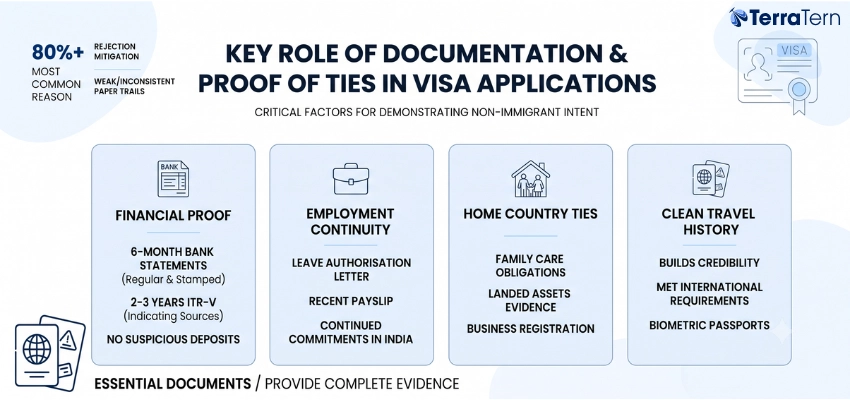
Financial Proof: Six months of regular and stamped bank statements as well as 2–3 years of Income Tax Returns (ITR-V) indicating sources of liquid funds, where there are no suspicious or unexplained bank deposits.
-
Employment Continuity: Official employer leave authorisation letter, recent pay slip and proof of continued employment commitments in India.
-
Home Country Ties: Evidence of family care obligations and/or landed assets in the home country and/or registration of a business in the home country, to demonstrate non-immigrant intent.
-
Clean Travel History: Credibility because they have met the requirements of the immigration authorities in other countries that use biometric passports.
-
Rejection Mitigation: The most common reason for a refusal across the US, UK, Canada, and Schengen countries for entry into the country is weak and/or inconsistent paper trails.
How Do Political and Diplomatic Relations Affect Visa Approval?
Approval rates can change in a heartbeat following a change in foreign policy or domestic immigration resets, making the hardest visa to get the one that's most difficult.
-
Policy Resets and Intake Caps: The reduced chances of approval under the Student Direct Stream (SDS) in Canada and the across-the-country study permit caps also had an impact. The approval rates were also affected by the transition away from the fast-track Student Direct Stream (SDS) in Canada, as well as the nationwide study permit caps.
-
Changed Visa Grant Criteria: The definition of the type of visa grants has been tightened up, leading to a volatile trend in grant rates (e.g., UK visa grant rates for Indian nationals between ~91% and ~82% with the shifts in the criteria for compliance).
-
Reciprocal Diplomatic Postures: Bilateral visa reciprocity pacts determine the pace of processing, the availability of interviews, and documentation requirements regardless of the quality of the applicants' profiles
Expert Tip: Two of the three difficulty drivers (documentation, diplomatic timing) are things an applicant or their consultant can actively manage; only quota backlogs are fixed. Frame the rest of the guide around what's actionable.
What Are the Hardest Visas to Get for Indian Citizens in 2026?
For Indian passport holders in 2025–2026, the US (Green Card, H-1B, F-1), Canada (study permit, visitor visa), and the Schengen area show the steepest rejection trends. The UK remains comparatively easier, especially for study routes. Finding the hardest visa to get requires analysing these shifting global trends.
|
Destination |
Visa Type |
Approx. Rejection Rate |
Source/Date |
Trend |
|
USA |
F-1 Student |
~41–61% |
Industry Analyses, 2025–26 |
Rising sharply |
|
USA |
B1/B2 Visitor |
~27–30% |
INA 214(b) Data, 2025–26 |
Elevated, stable |
|
USA |
EB-2/3 Green Card |
N/A (Backlog) |
Visa Bulletin, 2026 |
Multi-decade wait |
|
Canada |
Study Permit |
~74–81% |
IRCC Reporting, 2025 |
Doubled since 2023 |
|
Canada |
Visitor (TRV) |
Est. >50% |
Industry Est., 2025 |
Rising |
|
UK |
Visitor Visa |
~18% |
UK Home Office, YE 2026 |
Worsening |
|
UK |
Student Visa |
~4% |
UK Home Office, YE 2026 |
Stable/strong |
|
Schengen |
Short-Stay |
15.8% |
European Comm., 2026 |
Above global avg |
|
Australia |
Student Visa |
~18% |
Industry Analysis, 2025–26 |
Elevated |
Why Is the US Visa So Hard to Get for Indians?
Indians account for roughly three-quarters of H-1B visas issued yet compete for a fixed 85,000 annual cap. The employment-based Green Card's 7% per-country limit creates unparalleled backlogs, making it the hardest visa to get for professionals.
-
H-1B & F-1 Hurdles: Lottery mechanics, $100,000 supplemental fees, and rising rejections (see our guide to understanding F-1 visa rejection reasons) severely limit entry.
-
Green Card Waits: Estimates vary widely based on filing year. While the Visa Bulletin implies a 10–25-year wait for 2010–2014 filers, recent applicants could face up to a 134-year wait.
-
TerraTern: The Bangalore team can help you bypass bottlenecks through alternative pathways like the Intracompany Transfer Visa USA.
Expert Advice: The H-1B's approval rate for selected petitions is over 95%. The real bottleneck is the lottery selection rate, not application quality. Don't conflate the two when advising applicants.
Why Have Canada and Australia Visas Become So Difficult?
Canada's 2024 national study-permit cap, the termination of the Student Direct Stream, and doubled proof-of-funds requirements pushed Indian study-permit refusals from ~32% in 2023 to roughly 74–81% by 2025. This makes Canada the hardest visa to get for international students today.
-
Canada Breakdown: The strict timeline of a Jan 2024 cap → Nov 2024 SDS end → doubled funds requirement systematically reduced approvals. Visitor refusals also exceed 50% (review reasons for Canada visitor visa rejection).
-
Australia Nuance: Australia’s student visa refusal rate runs around 18%, driven by strict Genuine Student and financial-capacity checks.
-
Explore your Best Migration Options: such as the Skilled Independent Visa Australia 189, with our expert consultants.
Important Tip: This is the single fastest-moving visa route covered in this guide. Figures here should be re-verified every quarter, not treated as static.
Is the UK Visa Hard to Get for Indians? Latest Approval Data
While North American routes often feel like the hardest visa to get the UK remains the most accessible major Western destination for Indian applicants.
-
Student Visas: The Indian student visa grant rate remains exceptionally strong at around 96%.
-
Visitor Visas: Conversely, the visitor-visa grant rate fell year-on-year from roughly 91% to about 82%, primarily due to tighter financial documentation scrutiny.
-
Expert Assistance: Avoid common reasons for UK visa rejection when preparing your UK Tourist Visa, Global Talent Visa UK, or Family Visa UK.
As per our TerraTern Expert: If "hardest visa" searchers are actually asking "where do I stand the best chance," the honest, useful answer for many is: apply for a UK student visa, not a US or Canadian one.
Why Do Indians Face High Schengen Visa Rejection Rates?
India's Schengen rejection rate hit 15.8% in 2025, sitting above the 14.8% global average.
-
High Financial Stakes: Because India is the world's third-largest Schengen applicant nation (1.15 million applications), this rate translates to ~180,000 rejected applicants and roughly ₹150+ crore in lost non-refundable fees annually.
-
Primary Hurdle: Refusals are driven almost entirely by weak proof-of-intent-to-return documentation, making this the hardest visa to get for unprepared tourists.
-
Next Steps: Review Schengen visa rejection reasons, perfect your cover letter for a Schengen visa, and secure robust travel insurance for a Schengen visa before booking a Schengen visa for Germany.
Pro Tip: Rejection rates vary enormously by which Schengen consulate an applicant applies through; country selection within Schengen is the student visa applicant's decision.
How Difficult Is the Australia Visa for Indian Applicants?
Publicly available data is less India-specific, but Australia's overall student visa refusal rate currently runs around 18%.
-
Common Failure Points: The strict Genuine Student requirement and intensive financial-capacity checks are the primary hurdles, easily making this the hardest visa to get if your documentation is inconsistent.
-
Strategic Planning: Keep your application safe by understanding Australian visa rejection reasons, the Australian tourist visa rejection rate, and the Australian student visa success rate in 2024 before you apply for a Skilled Independent Visa Australia 189 or a Visitor Visa Australia Subclass 600.
Key Note: Where public country-specific data is thin, say so explicitly; overstating precision here would undercut the credibility built in the US/Canada/UK sections.
How Long Is the Green Card Wait for Indian Applicants? (US Backlog Explained)
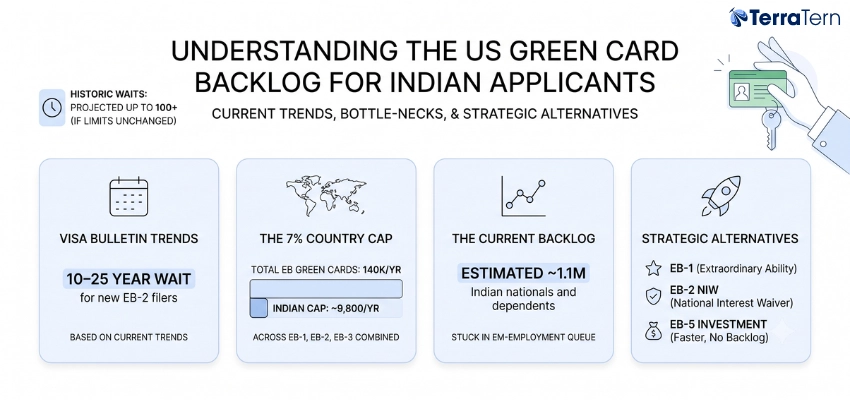
Current Visa Bulletin trends put new Indian EB-2 filers at roughly a 10–25-year wait, while older per-country-cap modelling (Cato Institute) has projected waits exceeding 100 years if caps and demand stay unchanged. Due to these systemic bottlenecks, the US employment green card is arguably the hardest visa to get.
-
The 7% Cap Math: The US issues approximately 140,000 employment-based green cards annually. Due to a strict 7% per-country limit, India is capped at roughly 9,800 green cards per year across the EB-1, EB-2, and EB-3 categories combined.
Boundless -
The Current Backlog: This math creates a massive bottleneck. An estimated 1.1 million Indian nationals and their dependents are currently stuck in the employment-based backlog.
Boundless -
Faster Alternatives: The EB-1 category (for extraordinary ability) and the EB-2 National Interest Waiver (NIW) bypass standard labour certification, offering a comparatively faster alternative.
-
Investment Routes: For those with substantial capital, the EB-5 investment visa provides a non-backlogged route that circumvents the standard employment queues entirely.
|
Visa Category |
Estimated Green Card Wait Time for Indians |
Important Caveat |
|
EB-2 / EB-3 |
10–25+ Years (some models project >100 years) |
Wait times vary significantly by filing year and rely entirely on future legislative reform or unused visa spillover. |
|
EB-1 |
3–6 Years |
Requires demonstrating sustained national or international acclaim, making the qualification bar exceptionally high. |
As per our TerraTern Expert, Shreya, whichever number a reader has seen quoted elsewhere (10 years or 130 years), both can be simultaneously "true" depending on the filing category and year. The real service TerraTern provides is mapping an individual's specific category to a realistic, current estimate rather than a headline figure.
Also Read: Best Countries for Indians to Settle: Expert Guide
What Are the Hardest Countries to Get a Visa to Visit? (Beyond Indian Immigration Corridors)
Outside the major immigration destinations, North Korea, Turkmenistan, Eritrea, and Russia remain the world's hardest tourist visas to obtain, requiring state-approved sponsors, invitation letters, or fully guided travel. Securing the hardest visa to get in these regions demands total compliance with opaque bureaucratic processes.
-
State Control: Independent travel is generally prohibited, with itineraries strictly managed.
-
Sponsorship Dependency: Applicants must secure government-approved tour operators or verified invitation letters before applying.
Which Countries Have the Strictest Tourist Visa Policies in the World?
North Korea, Turkmenistan, Saudi Arabia (historically), Eritrea, and Syria maintain the most restrictive tourist-visa regimes in the world. Obtaining the hardest visa to get for these nations generally requires a registered sponsor, an official agency, or a government-approved tour operator.
-
Mandatory Backing: Entry procedures cannot be initiated without local, authorised sponsorship.
-
Next Steps: To understand long-term immigration barriers, read our guide on the hardest countries to get citizenship.
Why Are North Korea, Russia, and Turkmenistan Visas So Hard to Obtain?
These countries impose severe procedural bottlenecks on visitors, making their authorisations exceedingly difficult to secure.
-
North Korea: The government restricts independent travel entirely, permitting entry only through heavily monitored, state-sanctioned tours.
-
Russia: Applications demand extensive travel-history documentation, detailed itineraries, and mandatory in-person biometric registration.
-
Turkmenistan: The process mandates a sponsor-issued invitation letter from the government, which suffers from notoriously high rejection rates.
Important Note: For an Indian traveller, these closed-door countries are a curiosity, not a planning priority. The real "hardest visa" decisions readers face involve the US, UK, Canada, and Schengen states covered above.
What Are the Most Common Reasons Visa Applications Get Rejected?
The top rejection drivers across the US, UK, Canada, and Schengen states are weak proof of ties to India, insufficient or inconsistent financial documentation, and an unclear or unconvincing travel or study purpose. Even when applying for the hardest visa to get, avoiding these critical pitfalls is essential.
-
Weak Ties to India: Insufficient evidence of ongoing employment, property ownership, or family commitments.
-
Inconsistent Financials: Unexplained sudden deposits or account balances that fail to match declared income.
-
Vague Itineraries: A lack of specific, confirmed day-to-day plans or unverified accommodations.
-
Documentation Errors: Missing application forms, mismatched personal details, or incorrect passport specifications.
-
Travel Violations: A recorded history of overstays or previously unaddressed visa rejections.
How Does "Proof of Ties" to India Affect Visa Approval?
Consular officers actively look for concrete evidence that strongly indicates an applicant will return to India after their temporary stay.
-
Essential Evidence: Providing verified proof of landed property, immediate family dependencies, ongoing education, or stable employment is strictly required.
-
Major Rejection Driver: Thin or unconvincing documentation of home country ties remains the single most cited rejection reason across all nationalities and visa categories.
What Financial Documentation Do Consulates Expect?
Most consulates expect three to six months of consistent, officially stamped bank statements demonstrating a stable account balance.
-
Tax Returns: Your Income Tax Returns (ITRs) and salary slips must perfectly match your declared income and professional status.
-
Traceable Funds: A clear, traceable source of funds is mandatory. Inconsistent financial behaviour or newly deposited large sums are viewed as an immediate red flag.
How Do Past Travel History and Overstays Impact Future Applications?
A clean international travel history, where previous visits were made and returned from precisely on time, greatly strengthens any new application.
-
The Risk of Overstays: Any prior overstay, regardless of how short, significantly raises your rejection risk for all future applications.
-
Biometric Tracking: Modern biometric entry and exit systems make your global overstay and compliance history instantly verifiable for consular officers.
Expert Tip: Roughly 60–70% of rejections across these categories trace back to documentation and ties issues, not eligibility itself, meaning most rejections are preventable with better preparation, not a fundamentally weaker profile.
How Can You Improve Your Chances of Getting a Hard-to-Obtain Visa?
Applicants improve their odds most by starting documentation 2–3 months early, matching financial proof to declared purpose and income, applying through the correct visa sub-category, and getting professional review before submission for high-scrutiny destinations. Navigating the hardest visa to get in 2026 requires more than just filling out forms; it demands strategic preparation.
-
Start Early: Begin gathering your financial and employment documentation at least 2–3 months before your intended application date.
-
Align Financials: Ensure your bank statements directly match your declared income, tax returns, and the specific financial requirements of the visa category.
-
Select the Right Category: Carefully review the sub-categories; applying for a specialised professional route when you only qualify for a general visitor visa guarantees a refusal.
-
Seek Professional Review: For high-stakes applications, having an expert evaluate your dossier before submission can identify critical gaps that automated consulate systems will immediately flag.
Which Documents Strengthen a Visa Application the Most?
A clear cover or purpose letter, consistent financial records, an employer or institution letter confirming your return, and verifiable evidence of assets or ongoing commitments in India carry the most weight.
-
Cover Letter: A concise, transparent letter detailing your exact itinerary, purpose of travel, and strong reasons for returning home.
-
Financial Consistency: Six months of stamped bank statements and 2–3 years of ITRs demonstrating organic, stable income without unexplained cash injections.
-
Proof of Return: An official No Objection Certificate (NOC) and an approved leave letter from your employer or academic institution.
-
Asset Verification: Certified documents showing property ownership, ongoing business investments, or substantial family commitments in your home country.
Should You Apply for a Visa Through an Immigration Consultant?
A consultant adds the most value for high-scrutiny, high-stakes categories such as the US H-1B or Green Card, Canada study permits post-2024, and Schengen applications with a prior refusal—where documentation strategy and category selection materially affect outcomes.
-
When to Self-Apply: For straightforward, low-risk applications, such as a UK visitor visa for an applicant with a flawless financial profile and robust travel history, self-application is often perfectly viable.
-
When to Seek Help: If you are navigating complex global skilled migration pathways, vocational training program approvals, or high-rejection routes, expert guidance is crucial.
-
Our Expertise: For professionals in Bangalore looking to secure complex international work permits or study visas, TerraTern's consultancy provides the strategic oversight needed to successfully clear these high-scrutiny hurdles.
What Timeline Should You Follow for Hard-to-Get Visas?
Start 2–3 months ahead for standard categories and 6–12 months ahead for backlog-driven categories like US employment green cards or Canada study permits during peak intake windows.
-
Standard Visas: For Schengen or UK tourist visas, initiate document collection and appointment booking at least 60 to 90 days before your intended departure date.
-
Peak Intakes: For high-demand international higher education routes, such as Canada or Australia study permits, begin the process 6–12 months in advance to accommodate changing financial requirements and intake caps.
-
Employment Visas: Complex work permits and permanent residency routes require continuous planning, often starting a year or more in advance to build the necessary professional and financial profile.
Expert Advice: The applicants who get rejected twice are far more common than those who get rejected once. A rushed reapplication without addressing the original refusal reason usually repeats the same outcome.
Also Read: How to Get a Turkey Tourist Visa for Indians? Guide
Which Visas Are Easier to Get for Indian Applicants? (Alternatives Worth Considering)
If you are frustrated by the hardest visa to get, looking beyond traditional North American routes can yield significantly higher success rates for your international plans.
-
Top Recommendations: Germany (specifically for student visas and the Opportunity Card), Ireland, New Zealand, and UK sponsored-study routes currently show the strongest approval rates for Indian applicants, often exceeding 90%.
-
A Strategic Shift: Redirecting your focus to these specific regions completely bypasses the severe application bottlenecks, restrictive quotas, and multi-year backlogs of US and Canadian immigration pathways.
Which Countries Offer the Highest Visa Approval Rates for Indians?
Germany approves roughly 90–95% of complete student-visa applications, often processing them within a matter of days. You can explore our detailed breakdown of the Germany student visa success rate.
-
UK Study Success: The UK's sponsored-study grant rate for Indian applicants continues to sit comfortably above 96%, remaining notably stronger and safer than the US or Canada in the current cycle.
-
Professional Pathways: High success rates also apply to skilled workers. Review the Germany job seeker visa success rate and learn the mechanics behind the Germany Opportunity Card before initiating your Germany Opportunity Card or Germany Student Visa applications.
-
Additional EU Options: For robust regional alternatives, reading up on the Austria visa for Indians provides an excellent foundation for an Austria Job Seeker Visa.
Are Job Seeker and Opportunity Visas Easier Than Traditional Work Visas?
Job-seeker visas avoid the rigid employer-dependency requirements that typically define the hardest visa to get.
-
Points-Based Flexibility: Germany's Opportunity Card and job-seeker frameworks (which are similarly offered by Austria, Sweden, and Portugal) evaluate candidates on points-based eligibility criteria like age, language, and education.
-
No Upfront Offer Needed: These routes do not require a guaranteed job offer or an unpredictable lottery selection upfront, making them structurally far less bottlenecked than the US H-1B model.
-
Next Steps: Read our guide on how to secure a job seeker visa for Germany or see if you qualify for the long-term EU Blue Card.
-
Professional Assistance: TerraTern can help you accurately calculate your points and seamlessly apply for an Austria Job Seeker Visa, Sweden Job Seeker Visa, or Portugal Job Seeker Visa.
Important Tip: Hardest visa" and "best visa for your goals" are two different questions. Those fixated on the US or Canada because of brand familiarity often have faster, statistically stronger options elsewhere.
Conclusion
Navigating the world's most restrictive immigration pathways requires strategic foresight and flawless documentation. Whether you are aiming for a US Green Card, a Canadian study permit, or a Schengen short-stay authorisation, securing the hardest visa to get demands perfect preparation. For Bangalore professionals and students seeking international opportunities, partnering with TerraTern ensures your 2026 application avoids common pitfalls. Start planning early to transform your global ambitions into a reality.
Contact TerraTern for more information on the hardest visa to get in 2026: Expert Guide for Indian Applicants.




 AI Summary