


Key Highlights
- What are the Best Countries for Indians to Settle in 2026?
- What Makes a Country the Best Choice for Indians to Settle Abroad?
- Which Are the Best Countries for Indians to Settle In 2026?
- Which Are the Best Countries for Indians to Study and Settle?
- What Are the Easiest Countries for Indians to Get PR or Citizenship?
- Which Countries Are Safest and Most Family-Friendly for Indian Families to Settle?
- What Are the Most Affordable Countries for Indians to Settle Abroad?
- How Are 2026 Immigration Policy Changes Affecting Indians Planning to Settle Abroad?
- What Documents and Preparation Do Indians Need Before Settling Abroad?
- 2026 Industry Context Section
- Conclusion
The friendly immigration policies, booming job markets, and excellent quality of life are some of the factors that make the best countries for Indians to settle in 2026, such as Canada, Australia, Germany, and New Zealand.
The best countries for Indians to study and settle are also highly correlated with the best nations for Indian students for their higher education. The post-study work rights, an expeditious visa process, and a multicultural-friendly environment for long-term Indian residents and migrants are significant factors.
What are the Best Countries for Indians to Settle in 2026?

Canada, Australia, Germany, the UK, and the USA are the most suitable countries for Indians to move to in 2026, given their PR processing speed, high demand for Indian workers, safety, and the presence of Indians on the ground.
-
These are believed to be the best countries to settle in due to their long-term residency opportunities, career prospects and quality of life.
-
The ‘best' choice depends on your training, experience, and settlement intentions; there is no single ‘best' option for any profile (student, skilled, or family migrant).
-
If you use these 5 countries, which one are you most seriously considering, and why do you like that one?
As per TerraTern Expert Shreya, never bury the answer; if a reader (or a crawler) only sees this paragraph, they should still walk away with a correct, complete answer.
Also Read: 9 Best Jobs to Settle Abroad from India: Updated
What Makes a Country the Best Choice for Indians to Settle Abroad?
The benefits a country offers to Indians make it the best choice for them when living abroad.
|
Factor |
Why It Matters |
|
PR/citizenship pathway speed |
Faster, clearer routes make settlement more secure and predictable. |
|
Job market demand |
Strong demand for your skills improves employability and salary growth. |
|
Cost of living vs. salary |
Lower living costs with good salaries help you save and support your family. |
|
Safety and quality of life |
Stable politics, healthcare, and low crime rates are vital for a long, stable life. |
|
Strength of the Indian community |
Diaspora networks ease cultural adjustment and provide support. |
What Immigration and PR Pathways Should Indians Compare?
When evaluating the best countries for Indians to settle, compare PR and work routes like student-to-PR pathways, points-based skilled migration, employer-sponsored visas, and family reunification options, focusing on transparency and processing speed.
The best countries to settle usually offer clear eligibility criteria, realistic timelines, and options to transition from temporary status to permanent residency without excessive uncertainty.
How Important Is Job Market Demand When Choosing a Country?
Job market demand is very important, as the best countries are those that need to hire international candidates in the engineering, business, Information Technology, and healthcare sectors. High demand not only lowers the risk of unemployment but also supports career growth and makes it easier to meet eligibility requirements for PR categories related to shortage occupations or skilled worker streams.
How Does the Cost of Living Affect the Decision to Settle Abroad?
The cost of living directly affects whether the countries for Indians to settle in offer financial freedom or a higher–earning, higher–spending lifestyle. Opt for locations with affordable rent and commute costs.
Despite the cost of taxes in INR, savings are possible if you consider where you wish to go, plan to save in INR terms, support the family in India, and build long-term assets rather than living paycheck to paycheck.
Why Does an Existing Indian Community Matter for New Settlers?
The substantial Indian community is a key benefit of the best countries for Indians to settle in, providing social assistance, cultural recognition, and functional support in securing housing, employment, and paperwork. Indian grocery stores, temples, festivals, and networks that help minimise loneliness and accelerate the integration of new migrants are available to established communities, too.
Important Note: A country that ranks #1 overall may not be #1 for a specific reader; encourage self-assessment against these five criteria rather than a one-size-fits-all verdict.
Which Are the Best Countries for Indians to Settle In 2026?
Canada, Australia, Germany, the USA, the UK, New Zealand, the UAE, and Singapore are the best countries for Indians to settle in 2026, depending on their profiles (Students, skilled workers, families), etc.
The approximate monthly living-cost estimates below are mid-range values for a single person and can vary by city and lifestyle. It may differ depending on the city and lifestyle, but these are considered typical.
|
Country |
Approx. PR / Long-Term Pathway Timeline |
Avg. Cost of Living (INR/month) |
Best Suited For |
Indian-Origin / Expat Population** |
|
Canada |
2–5 years via Express Entry/PNP |
INR 70,000 – INR 1,20,000 |
Students, skilled workers, families |
~1.8–2 million+ Indian-origin residents |
|
Australia |
3–5 years via skilled visas |
INR 83,000 – INR 1,40,000 |
Skilled workers, students, families |
700k+ people of Indian origin (citizens + PR + temp) |
|
Germany |
2–4 years to settlement permit |
INR 60,000 – INR 1,00,000 |
Engineers, IT, trades, STEM students |
200k+ Indian nationals and origin residents (rapidly growing) |
|
USA |
7–15+ years (employment-based, backlog) |
INR 1,00,000 – INR 2,80,000 |
Highly skilled tech, healthcare, research |
4.9 million+ Indian-origin population |
|
UK |
5 years to ILR (most work routes) |
INR 95,000 – INR 2,00,000 |
Students, skilled workers, families |
1.8 million+ Indian-origin community |
|
New Zealand |
2–5 years via Skilled Migrant / Green List |
INR 80,000 – INR 1,40,000 (est.) |
Safety-focused professionals, families |
240k+ people of Indian ethnicity |
|
UAE |
No PR; renewable residency, Golden Visa |
INR 90,000 – INR 1,70,000 (Dubai range) |
Tax-free earners, entrepreneurs, and expats |
3.5 million+ Indians (one of the largest diasporas) |
|
Singapore |
5–10 years typical for PR (discretionary) |
~INR 1,80,000 – INR 2,80,000 |
Finance, tech, biotech professionals |
650k+ Indian-origin residents and workers |
Expert Tip: Resist ranking purely by popularity; flag where 2026 policy changes (caps, fees, thresholds) have shifted a country's relative attractiveness versus 2023-2024 rankings that most competitor content still reflects.
Why Is Canada One of the Best Countries for Indians to Settle?
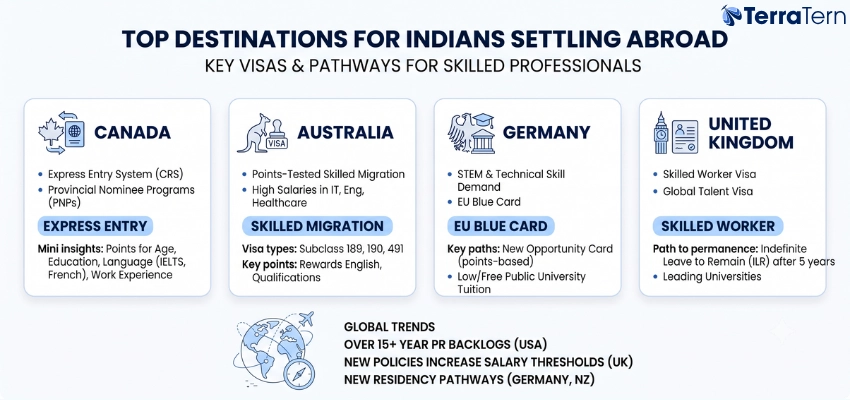
Canada is consistently seen as one of the best countries for Indians to settle in because of its points-based Express Entry system, strong Provincial Nominee Programs (PNPs), and the world’s largest Indian-origin immigrant community outside India.
Express Entry uses a Comprehensive Ranking System (CRS) to score age, education, language (IELTS + French), and work experience, and 2026 category-based draws increasingly reward French skills and in-demand occupations.
Why Do Indians Consider Australia a Top Country to Settle In?
Australia stands out as one of the best countries for Indians to settle because of its points-tested skilled migration system and high salaries in IT, engineering, and healthcare. Key routes include Subclass 189 (independent skilled visa), 190 (state-nominated), and 491 (regional), which reward age, English proficiency, qualifications, and occupation on shortage lists.
Is Germany a Good Country for Indians to Settle and Work?
Germany has rapidly become one of the best countries for Indians to settle, especially for engineers, IT professionals, and skilled trades. Low or free public university tuition and strong demand for STEM and technical skills make it attractive for both students and experienced workers. For workers, the EU Blue Card and the new Opportunity Card (a points-based job-seeker residence that considers qualifications, experience, and language) are key pathways.
Is the USA Still One of the Best Countries for Indians to Settle Despite Visa Changes?
The USA remains one of the best countries for Indians to settle in terms of pure earning potential, especially in tech, finance, and healthcare. However, the 2026 H-1B fee increases and evolving employer-sponsorship rules have added cost and uncertainty to the classic route, even as some changes face legal and policy challenges. H-1B is a lottery-based, employer-sponsored work visa, and Indian nationals face long green card backlogs in employment-based (EB-2, EB-3) categories, making PR timelines often 7–15+ years.
Why Is the UK Still a Popular Choice for Indian Settlers?
The UK continues to rank among the best countries to settle in because of its Skilled Worker and Global Talent visas, as well as its globally recognised universities.
Most work-based routes lead to Indefinite Leave to Remain (ILR) after 5 years of continuous lawful residence, provided salary and sponsorship conditions are met. Graduate Route rules and higher family visa requirements have tightened between 2024 and 2026, including increases to salary thresholds for sponsored jobs, raising the entry bar.
Why Is New Zealand a Great Option for Indians Seeking a Safe Settlement?
New Zealand is increasingly viewed as one of the best countries for Indians to settle in, particularly for those prioritising safety, nature, and a relaxed lifestyle. The Skilled Migrant Category uses a points system focused on qualifications, skilled work experience, and salary, and recent “green list” occupations fast-track PR for shortages in healthcare, construction, agriculture, and IT. Although smaller in population, New Zealand’s Indian community is growing, and monthly living costs typically range from INR 80,000 to INR 1,40,000, depending on the city.
Why Do Many Indians Choose the UAE to Settle and Work?
The UAE is a unique entry on the list of the best countries for Indians to settle because it offers renewable residency rather than classic PR and combines tax-free income with fast visa processing. Employment visas are employer-sponsored, and long-term 10-year Golden Visas are available for investors, professionals, and certain high earners, allowing extended residence and stability.
There is no permanent residency in the Western sense, but many Indians treat the UAE as a long-term base since visas can be renewed and the Indian expatriate population is huge.
Is Singapore a Good Country for Indians to Settle Abroad?
Singapore is firmly among the best countries for Indian high-skilled professionals to settle in finance, technology, and biotech. The usual route begins with an Employment Pass or a related work visa, followed by a discretionary PR application assessed by the authorities rather than by a transparent points-based grid.
While PR is not guaranteed, many long-term professionals with high salaries and stable employment are approved, and monthly living costs in Singapore are around INR 1,80,000–INR 2,80,000, depending on the area and lifestyle.
Which Are the Best Countries for Indians to Study and Settle?
Canada, Germany, Australia, the UK, and New Zealand are the best countries for Indians to study and settle, offering globally recognised degrees, post-study work visas, and realistic PR pathways for Indian students planning long-term migration. These destinations consistently rank high for education quality, immigration friendliness, and career outcomes.
Why Is Canada the Top Choice for Indians to Study and Settle?
Canada is often ranked #1 among the best countries for Indians to study and settle because of its high-quality universities, PGWP (up to 3 years), and clear PR options via Express Entry and PNP. Typical annual tuition for Indian students ranges roughly from INR 10–25 lakh, and while the 2026 study-permit cap has tightened approvals, eligible students still enjoy strong settlement prospects.
Why Is Germany Ideal for Indian Students Who Want to Settle Long-Term?
Germany is a leading choice among the best countries for Indians to study and settle, thanks to low or zero tuition at public universities, strong demand for STEM and tech graduates, and EU Blue Card or Opportunity Card routes to PR. Post-study, many graduates can work and progress to a settlement permit in about 2–4 years, though German language skills are increasingly important as policies favour integration.
Is Australia a Good Country for Indian Students to Study and Settle?
Australia features prominently among the best countries for Indians to study and settle because of its globally respected degrees, 2–4-year post-study work visas, and skilled migration PR routes such as Subclass 189/190. Tuition often ranges from INR 15–30 lakh per year, and while rules continue to evolve, students in in-demand fields still find a viable bridge from study to PR via points-tested pathways.
Can Indian Students Study and Settle Successfully in the UK?
The UK remains one of the best countries for Indians to study and settle due to its top universities and the Graduate Route, which offers 2–3 years of post-study work depending on the degree level. Tuition for Indian students often falls in the INR 15–35 lakh annual range, but 2025–2026 policy changes have tightened dependent visa requirements and raised Skilled Worker salary thresholds, making careful planning essential for PR after 5 years of work.
Is New Zealand Worth Considering for Indian Students Who Want to Settle?
New Zealand is increasingly highlighted in lists of the best countries for Indians to study and settle because it offers good universities, a typical 3-year post-study work visa for many programmes, and clear PR options via the Skilled Migrant and Green List pathways. Tuition commonly ranges from INR 12 to 25 lakh per year, and recent 2026 policy messaging has been positive for Indian students targeting long-term settlement with skills in healthcare, IT, and key shortage areas.
Expert Advice: Don't just repeat the settlement section with "for students" appended; the real differentiator for study-and-settle searchers is post-study work visa duration and PR-conversion mechanics, so lead with those two data points for every country.
What Are the Easiest Countries for Indians to Get PR or Citizenship?
The easiest countries for permanent residency (PR) include Canada, Germany, and New Zealand because they offer transparent, points-based or skills-based immigration systems. PR gives you the right to live and work permanently, while citizenship grants a passport and voting rights. Citizenship timelines vary significantly depending on the country's naturalisation rules.
|
Country |
Typical PR Timeline |
Typical Citizenship Timeline |
PR Without Prior Job Offer? |
|
Canada |
2–5 years (Express Entry/PNP) |
Citizenship after ~3 years as a permanent resident (varies) |
Yes (Express Entry/CEC/PNP routes) |
|
Germany |
2–4 years (EU Blue Card / Opportunity Card) |
~3–8 years (fast-track EU routes exist) |
Yes (Opportunity Card / study-to-work) |
|
New Zealand |
2–5 years (Skilled Migrant/Green List) |
Typically 5+ years after PR; pathways vary |
Sometimes (Skilled Migrant Category) |
|
Portugal |
3–5 years via Golden/Residence routes (investor options) |
Citizenship after 5 years (residency) |
Yes (investment routes) |
|
UAE |
No classic PR (renewable long-term visas, Golden Visa) |
Citizenship rare / discretionary, long timeline |
N/A (residency via employment/investment) |
|
Singapore |
3–8+ years (discretionary PR by employment track) |
Citizenship after several years; discretionary |
No (PR usually follows strong employment) |
Important Tip: Easiest" is relative to the applicant's profile; a mid-career applicant with no language certification will find Germany harder than Canada, while a French-speaking candidate may find Canada's 2026 category draws easier than expected.
Which Countries Are Safest and Most Family-Friendly for Indian Families to Settle?
The best countries to settle with families are Canada, New Zealand, Australia, and Germany because they combine excellent safety, healthcare, education, and strong Indian communities.
-
Family-specific visa streams usually include dependent/spouse visas, child education access, and family reunification routes tied to PR or sponsorship.
-
The quality of schooling and access to public healthcare are strong reasons families prioritise these destinations when choosing the best countries for Indians to settle.
Pro Tip: Spousal work rights are the most commonly overlooked factor in family relocation planning; always confirm whether the destination country grants the accompanying spouse independent work authorisation.
What Are the Most Affordable Countries for Indians to Settle Abroad?
For Indians researching the best countries to settle in on a budget, it's essential to distinguish between "cheap to live in" and "cheap to immigrate to," since visa costs differ from monthly expenses.
-
Germany, Portugal, and selected Eastern/Southeast European or Asian destinations often offer a lower cost of living and, for Germany, low/no public tuition, making them more affordable than the US/UK/Australia.
-
“Cheap to live in” (monthly rent, groceries, transport) differs from “cheap to immigrate to” (visa/investment fees, minimum stay or investment requirements); factor both when choosing the countries for Indians to settle.
-
Consider salary-to-cost ratios: countries with moderate living costs but strong demand in your occupation (Germany for engineers; Portugal for remote/investor routes) often give the best value for settlers.
Key Note: Affordability should be evaluated against salary purchasing power, not absolute rent. A "cheap" country with a weak job market can cost more in lost earning potential than a pricier country with strong salaries.
How Are 2026 Immigration Policy Changes Affecting Indians Planning to Settle Abroad?
Immigration policy changes have significant implications for Indians wanting to migrate abroad. The policy changes affecting Indians planning to settle abroad are:
-
Canada: Reduced temporary-resident intake and tightening of study permits mean applying earlier, choosing provinces with active PNP streams, and prioritising strong documentation (job offers, language, ECA) to stay competitive for the best countries for Indians to settle.
-
USA: The H-1B fee increase and ongoing legal uncertainty raise employer costs and slow hiring; prepare alternative plans (global remote roles, Canada/Australia pathways) if US sponsorship delays jeopardise timing.
-
UK: higher Skilled Worker salary thresholds and dependent-visa tightening mean target roles that meet the new pay bands or secure employer sponsorship early to keep the UK
-
Start Applications 6–12 months earlier, keep digital and certified documents ready, convert study or short-term offers into durable PR routes where possible, and track country-specific rule updates closely.
Important Tip: Policy volatility is now a genuine selection criterion; a country's historical "ease of immigration" reputation can lag 12-18 months behind its actual current policy, so always verify against the latest official source before committing to a pathway.
What Documents and Preparation Do Indians Need Before Settling Abroad?
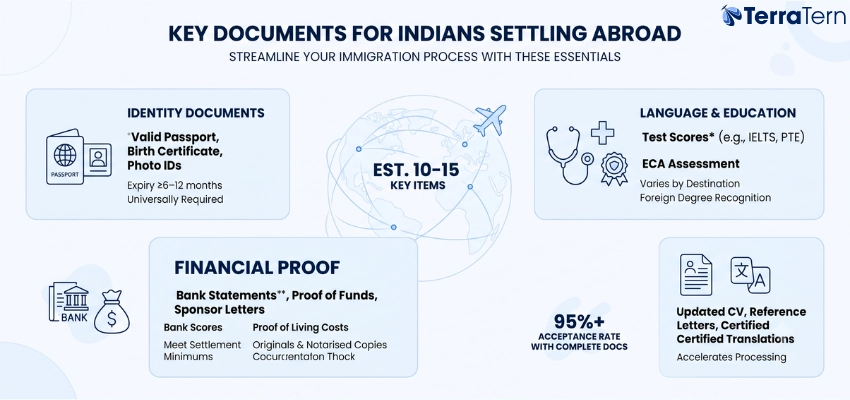
Preparation is key to making documents ready for Indians settling abroad. Here are the documents you need:
-
Identity Documents: A valid passport (expiry ≥6–12 months), a birth certificate, and certified photo IDs; these are universally required when preparing to move to the best countries for Indians to settle.
-
Language & Education: IELTS/PTE/TOEFL or German test scores, and Educational Credential Assessment (ECA) for foreign-degree recognition requirements vary by destination and PR stream.
-
Financial Proof: Bank statements, proof of funds or sponsor letters, and salary slips to meet settlement/visa minimums; some countries require evidence of living costs or tuition funds.
-
Medical & Legal Clearance: Immigration medical exam, vaccinations if needed, and a police clearance certificate (PCC) for background checks; keep both the original and notarised copies.
-
Practical Prep: Updated CV, employer reference letters, certified translations, and multiple certified copies of every key document; having these organised speeds processing.
Pro Tip: Start the language test and ECA process first; they have the longest lead times and are the most common cause of avoidable application delays.
2026 Industry Context Section
Some of the key facts are:
-
Diaspora Scale: India has the world's largest emigrant population, with over 18.5 million Indians living overseas as of 2024, and more than 35 million when including Persons of Indian Origin (MEA, Jan 2026 data).
-
Destination Shift: The UAE and USA are now tied as the top two destinations, each hosting roughly 17% of Indian emigrants, with West Asia/GCC countries hosting nearly half of all Indian out-migrants (Data For India, 2026 analysis).
-
Canada's 2026 Policy Tightening: Canada’s 2026–2028 plan reduces temporary residents, including international students and foreign workers. For 2026, IRCC has introduced a cap that allows provinces and territories to issue around 408,000 study permits in total, with a sharply reduced number of new permits, and is scaling back new temporary worker arrivals as part of a broader temporary-resident reduction strategy.
-
H-1B Disruption for the US: A $100,000 H-1B petition fee took effect in September 2026 (over 70% of H-1B holders are Indian citizens); a federal judge struck the fee down in June 2026 as exceeding executive authority, and the ruling is under appeal — a live, unresolved policy risk worth flagging.
-
UK Tightening: The UK raised the Skilled Worker visa minimum salary threshold and tightened dependent visa rules in 2025-2026, even as India remains the UK's largest source of international students (~97% sponsored study visa approval rate for Indians, year ending 2026).
-
Indian Tech Talent Earning Power: Indian nationals in the US post a median annual income of roughly $146,000, about two-thirds higher than that of US-born college graduates (EIG/StudentEB5 data, June 2026), a credibility-building stat for the "career opportunity" angle.
-
Expert Insight (Quotable): Industry commentary (e.g., Transglobal Overseas Education) frames 2026 as a year where "skills, financial preparedness, and long-term employability", not just country choice, determine success, reflecting the broader shift toward merit-based, skills-matched immigration systems across Canada, the UK, and Australia.
Key Note: This is the section that sets TerraTern apart from every competitor reviewed; none of them synthesises the H-1B fee saga, Canada's 2026 caps, and UK threshold changes into a single, current-context block. Own this gap.
Conclusion
Canada, Australia, Germany, the USA and the UK continue to rank highly for Indian settlement, alongside emerging favourites such as New Zealand, the UAE and Singapore for specific profiles.
The changes within the policy are even more important than ever to apply early, avoid any speculation and have proof. With concerted effort, the right documentation, and the right timing, both study-then-settle and direct skilled-migration options remain available. Have a TerraTern consultation on a country and path that suit you.
Contact TerraTern for more information on Best Countries for Indians to Settle in 2026: Expert Guide.




 AI Summary