Key Highlights
- What Is the Germany Job Seeker Visa Success Rate in 2026?
- What Factors Affect the Germany Job Seeker Visa Success Rate for Indians?
- How Does Degree Recognition Impact the Germany Job Seeker Visa Success Rate 2026?
- Which Fields Have the Highest Germany Job Seeker Visa Success Rate?
- How Much Money Do You Need to Improve Your Germany Job Seeker Visa Success Rate?
- How Can Indian Applicants Improve Their Germany Job Seeker Visa Success Rate?
- Germany Job Seeker Visa vs Opportunity Card: Which Has a Better Success Rate?
- 2026 Context
- Conclusion
The Germany job seeker visa success rate varies significantly by field, qualifications, and documentation completeness — there's no single official figure IT, engineering, and healthcare professionals see meaningfully higher approval and job-search outcomes than lower-demand fields For 2026, degree recognition (Anabin/ZAB) and a strong motivation letter are the two biggest levers applicants control
The Opportunity Card has replaced the traditional Job Seeker Visa as the main entry route for most Indian applicants without a prior Germany connection
What Is the Germany Job Seeker Visa Success Rate in 2026?
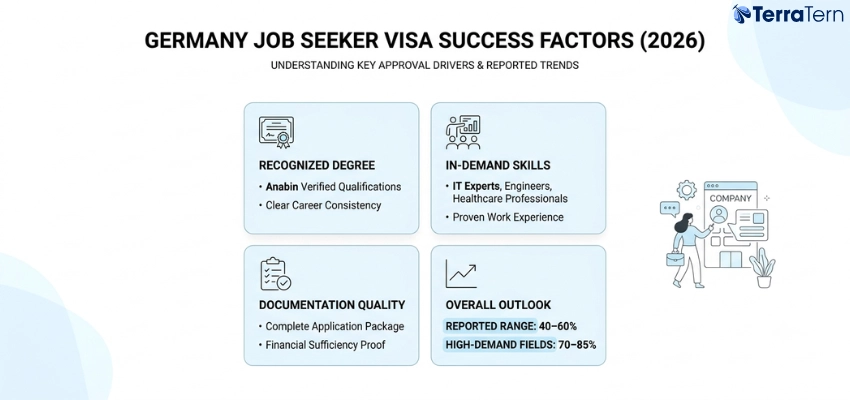
The Germany job seeker visa success rate depends heavily on the applicant's field, degree recognition status, and documentation quality — there is no single official approval percentage published by German authorities. Reported outcomes range from roughly 40–60% overall, rising to 70–85% for well-documented applicants in high-demand fields like IT, engineering, and healthcare, and dropping sharply for applicants without a recognized degree or clear career consistency.
-
The overall success rate ranges from 40% to 60%, depending on the applicant profile, market demand, and the quality of documentation.
-
In fields of shortage such as IT, Engineering, and Healthcare, a candidate's chances of success are reported to be 70% to 85%.
-
Candidates who meet the criteria of a recognised degree, solid work experience, financial documentation, and full documentation typically have the highest prospects.
-
The germany job seeker visa success rate 2024 was discussed in the same way and was highly variable by profession rather than a fixed rate.
-
The actual success rate from the German embassy is unknown, and it would not be advisable to rely on it as an absolute figure; it is only a guide.
As per TerraTern Expert Divyansh, don't anchor on a single percentage; your actual odds depend far more on degree recognition and field demand than on any general statistic.
Also Read: Germany Job Seeker Visa Success Rate: Latest Update
What Factors Affect the Germany Job Seeker Visa Success Rate for Indians?
The success rate of the Germany job seeker visa depends significantly on the strength of the Indian applicant's profile, rather than on an official percentage.
-
It is essential to have the degree recognised; otherwise, there is a significant risk of disapproval if Anabin or ZAB does not accept it.
-
Industry can make a difference; industry-specific sectors, such as IT, engineering, and healthcare, tend to be more successful than saturated or unrelated ones.
-
Consistency is useful; if your degree and experience are closely aligned with the job field you are looking for, it increases your credibility.
-
Financial support needs to be secure –typically a fully funded blocked account for the duration of the visa.
-
A motivation letter should be specific, include realistic job targets, and mention German companies or job portals.
-
The visa does not require language skills; however, proficiency in German can help one succeed in the job hunt upon arrival.
-
All of these factors had a significant impact on germany job seeker visa success rate 2024 as well, and there are no absolute numbers that all people seeking jobs in Germany can rely on.
Important Note: Most rejections stem from "missing links" in the profile or inconsistencies among degree, experience, and stated career direction, not from a lack of qualifications.
How Does Degree Recognition Impact the Germany Job Seeker Visa Success Rate 2026?
For the germany job seeker visa success rate 2024, the same trend was observed, with recognition problems being a significant factor in its poor performance.
-
Frequently, the application is judged by the degree recognised.
-
Your foreign degree must be translated and certified as a German qualification by German authorities.
-
Your case is likely to be easier to support if your degree is found in Anabin.
-
A ZAB Statement of Comparability will be vital if it is not mentioned.
-
Even with good work experience and/or financial evidence, recognition is necessary.
-
For many applicants, this will make or break the application.
Expert Tip: Check your Anabin status before you do anything else; it's the gating factor that determines whether the rest of your preparation even matters.
Which Fields Have the Highest Germany Job Seeker Visa Success Rate?
The best fields to have for a Germany job seeker visa are
-
The germany job seeker visa success rate tends to be the best for IT/software, engineering, healthcare, and skilled trades, as there are ongoing shortages in these fields in Germany.
-
Great success areas include software development, civil engineering, mechanical/electrical engineering, nursing, and trades such as electricians and mechanics.
-
The Moderate success fields are finance and business management, in which the applicant has strong qualifications and relevant experience.
-
It is less likely to be successful in saturated markets or less competitive markets, such as some arts and humanities positions.
-
The same trend was observed for the germany job seeker visa success rate 2024, with short-term occupations having the most favourable prospects.
Expert Advice: If your field sits in a shortage occupation category, lead with that in your motivation letter; it directly addresses the embassy's core concern about labour market fit.
How Much Money Do You Need to Improve Your Germany Job Seeker Visa Success Rate?
Money needed to make germany job seeker visa pursuit a success
-
The success rate of the germany job seeker visa depends on a fully funded blocked account.
-
Prospective visa holders should also estimate that the costs of holding a visa will be approximately €947-€1,091 per month, depending on current requirements.
-
If you are staying for 6 months, you'll need to save enough money for the entire time, plus a little extra.
-
One of the easiest reasons to avoid rejection is underfunding.
-
Another issue the germany job seeker visa success rate 2024 faced was financial constraints.
-
The embassy will probably prefer to overfund it a bit, rather than just barely enough.
Important Tip: Under-funding the blocked account is one of the most preventable causes of rejection; over-fund slightly rather than cutting it close to the minimum.
How Can Indian Applicants Improve Their Germany Job Seeker Visa Success Rate?
Indian applicants can significantly improve their Germany Job Seeker Visa success rate by focusing on three factors within their direct control: degree recognition, a targeted motivation letter, and complete financial documentation.
1. Verify Degree Recognition via Anabin or ZAB: Indian applicants should check the status of their degree on the Anabin database before applying, as German authorities assess whether a qualification is comparable to a German degree.
2. Write a Specific, Evidence-Based Motivation Letter: A strong motivation letter names specific companies, industries, and job portals (such as StepStone, Indeed.de, or LinkedIn) the applicant plans to target, rather than offering generic statements about "seeking opportunities in Germany." German consulate officers look for evidence of a realistic, research-backed job search strategy. Applicants should reference specific roles matching their qualifications and explain why the German market suits their career path.
3. Fully Fund the Blocked Account With Margin: Applicants must deposit sufficient funds in a Sperrkonto (blocked account) to cover living expenses for the duration of the visa, typically calculated at a fixed monthly rate. Rather than depositing the bare minimum, applicants should add a reasonable buffer, since consulates may view accounts funded at the exact threshold as a risk factor if any fee or currency fluctuation reduces the balance below the required level.
4. Ensure Career Consistency Across Documents: Consulate officers cross-check the degree, prior work experience, and stated job-search direction for logical alignment. An applicant with a mechanical engineering degree applying to search for marketing roles, for example, may raise doubts about genuine intent. Keeping the CV, motivation letter, and job-search plan consistent with the academic and professional background significantly strengthens the credibility of the application.
5. Document At Least 5 Years of Relevant Work Experience: While the Job Seeker Visa has no strict minimum experience requirement for most applicants, having five or more years of well-documented, relevant experience — supported by offer letters, relieving letters, and detailed role descriptions- makes the application more competitive. This experience should logically connect to the roles the applicant intends to pursue in Germany, reinforcing the career consistency reviewed by consulate officials.
6. Build Basic German Language Proficiency: German language skills are not mandatory for the Job Seeker Visa itself, but even A1 or A2-level proficiency meaningfully improves post-arrival job-search outcomes, since many German employers, especially outside large multinational firms, prefer candidates who can communicate in German. Applicants who invest in basic language courses before departure often gain faster traction with recruiters and secure interviews once in the country.
As per TerraTern Expert, applicants who treat the motivation letter as a real job-search plan, not a formality, consistently achieve stronger outcomes than those who submit a generic cover letter.
Germany Job Seeker Visa vs Opportunity Card: Which Has a Better Success Rate?
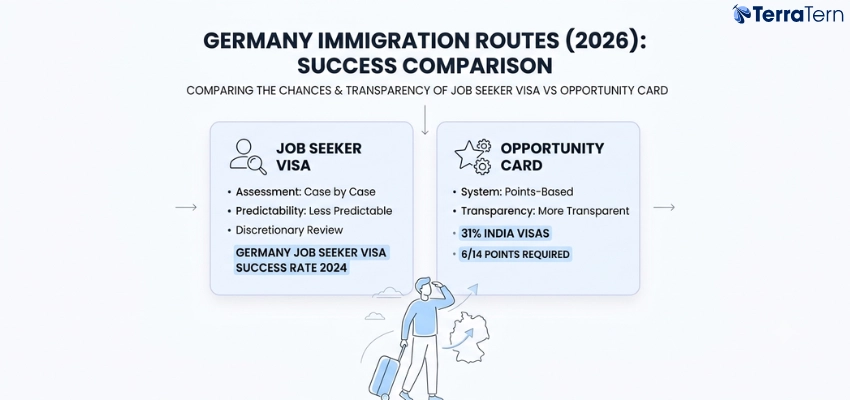
The germany job seeker visa success rate is now generally considered less predictable than the Opportunity Card because the Job Seeker Visa is assessed more case by case.
-
The Opportunity Card is the main route for many applicants without a direct connection to Germany, because it uses a points-based system rather than relying solely on discretionary review.
-
Applicants are scored on recognition of qualifications, language skills, work experience, age, and prior stay in Germany.
-
A minimum of 6 out of 14 points is required for eligibility under the Opportunity Card system.
-
This clearer structure makes it easier for applicants to estimate their chances before applying.
-
For the germany job seeker visa success rate 2024, the traditional job seeker route became less central after the India waiting list was discontinued on June 5, 2024.
-
India reportedly accounts for nearly 31% of all Opportunity Card visas issued, showing strong demand from Indian applicants.
-
The Opportunity Card is often the better option if you want a more transparent path to eligibility.
Pro Tip: If you don't yet have a job offer and are applying fresh from India, check your Opportunity Card point score first; it's now the more common and more transparent pathway.
2026 Context
-
India accounts for nearly 31% of all Germany Opportunity Card visas issued, the highest share of any country.
-
Germany's skilled-worker shortage is projected at 400,000+ professionals annually.
-
Blocked account requirement: roughly €947–€1,091/month depending on source verify current figure before publishing
-
Minimum 5 years of relevant work experience typically required (some sources cite exceptions at 3 years)
-
Degree recognition via Anabin/ZAB is consistently cited as the single biggest approval factor; without it, the success rate drops sharply.
-
The traditional Job Seeker Visa waiting list from India was discontinued on June 5, 2024, with the Opportunity Card now the primary route.
Read More: 10 Simple Steps to Securing a Job in Germany From India
Conclusion
The Germany Job Seeker Visa offers a perfect chance for global talents to assess opportunities in one of Europe’s most fluent economies. With the modifications of the German policies and the prognosis of the job market, the success rate of the German job seeker visa for the job seekers is at an all-time high. If the visa application and the prospects of getting a job in Germany are clear and maximized, and if the resources and support available are fully employed, one can increase his or her chances of getting a good job in Germany, thus rewarding the process. While starting with this process, it will be pertinent to note that several factors affect the success rate of the German job seeker visa, and necessary measures should be taken to overcome possible hardships. But with proper thinking strategies and good planning and preparation, you stand the chance of being opportune to fulfil your dream career in Germany.
To know more about job seeker visas for Germany, you must contact TerraTern immediately. Offering many services related to immigration, TerraTern offers many services to make sure that your immigration dreams are turned into reality!