Key Highlights
- What Is the Average Salary in Germany for a Doctor in 2026?
- What Factors Affect the Doctor Salary in Germany?
- What Is the MBBS Doctor Salary in Germany for Indian Graduates?
- What Is the Gross vs Net Doctor Salary in Germany After Tax?
- How Do Doctor Salaries in Germany Vary by Specialty?
- How Do Doctor Salaries in Germany Compare Across Cities and States?
- Doctor Salary by Experience in Germany
- What are the Additional Benefits Beyond the doctor's salary in Germany?
- How Can Indian MBBS Doctors Get Approbation to Practice in Germany?
- Is the Doctor's Salary in Germany Worth It Compared to India?
- Doctor Salary in Germany by Hospital Type
- What Are the Strategies to Maximise Your Doctor Salary in Germany?
- How TerraTern Can Help You?
- Conclusion
Doctors in Germany earn strong pay by European standards, but the real number depends on job title, hospital type, specialty, state, and overtime. For readers searching for doctor salary in Germany, the most useful answer is not one fixed number but a clear salary range by career stage and setting. A first-year MBBS doctor salary in Germany is usually lower than that of a specialist, while senior physicians and chief doctors can earn much more through base pay, shift work, and on-call duties. Recent 2025-2026 salary data from collective agreements and salary trackers shows that the average salary in Germany for doctor roles often starts around the mid-€50,000s and can rise well above €100,000 for senior posts.
What Is the Average Salary in Germany for a Doctor in 2026?
Doctors' salaries in Germany are relatively generous in 2026, with an average of €68,000 gross per year, varying by experience, profession and speciality.
Salary by Career Level
|
Career Level |
Title |
Monthly Gross (€) |
Annual Gross (€) |
|
Year 1 Resident |
Assistenzarzt (Ä1 Stufe 1) |
5,090–5,500 |
61,000–66,000 |
|
Year 3 Resident |
Assistenzarzt (Ä1 Stufe 3) |
5,600–5,900 |
67,000–71,000 |
|
Year 5 Resident |
Assistenzarzt (Ä1 Stufe 5) |
6,100–6,400 |
73,000–77,000 |
|
Specialist |
Facharzt (Ä2) |
6,800–8,200 |
82,000–98,000 |
|
Senior Physician |
Oberarzt (Ä3) |
8,500–9,800 |
102,000–118,000 |
|
Chief Physician |
Chefarzt (Ä4) |
15,000–25,000+ |
180,000–300,000+ |
Average Salary by Speciality (Hospital vs. Private)
|
Specialty |
Hospital Annual (€) |
Private Practice Annual (€) |
|
Cardiology |
90,000–130,000 |
200,000–400,000+ |
|
General Surgery |
85,000–120,000 |
180,000–350,000+ |
|
Radiology |
90,000–125,000 |
250,000–500,000+ |
|
Dermatology |
80,000–110,000 |
200,000–400,000+ |
|
Internal Medicine |
82,000–110,000 |
180,000–300,000 |
|
General Practice |
75,000–95,000 |
150,000–280,000 |
Expert Takeaway: Germany's median doctor salary of €98,750 per year is more than twice the national average wage, making medicine one of the most financially rewarding careers for Indian MBBS graduates relocating to Germany.
What Factors Affect the Doctor Salary in Germany?
In Germany, a variety of factors impact the salary of a doctor, leading to substantial salary differences in 2026.
-
Specialisation: High-demand fields like cardiology (€90,000–€130,000 hospital), radiology (€90,000–€125,000), and orthopaedics command premiums over general practice (€75,000–€95,000).
-
Years of Experience: Pay scales increase gradually from €61,000-66,000 (Year 1 resident) to €180,000-300,000+ (Chefarzt).
-
Location: Salaries are higher in Bavaria (average €75,000-€95,000) and Baden-Württemberg because of demand and living costs; rural bonuses of €10,000.
-
Employer Type: Hospital pay (TV-Ärzte scale) is guaranteed and lower than private practice, where specialists can earn €200,000-€500,000+ per year.
-
Public vs Private: Public hospitals offer fixed pay with benefits; private hospitals increase pay via patient fees.
-
Specialisations: AI, telemedicine, and English skills increase pay, as 8,000 practices close by 2026.
-
Government Support: Monthly allowances of €25-€300 for public hospital retention, relocation bonuses.
How Does Experience Impact the Doctor Salary in Germany?
Career advancement through TV-Ärzte results in a 100% salary increase in 10 years.
-
Year 1 resident: €61,000–€66,000 gross annually.
-
Year 5 resident: €73,000–€77,000.
-
Specialist (Facharzt): €82,000–€98,000.
-
Chief physician: €180,000–€300,000+.
Which Medical Specialisations Offer the Highest Salary in Germany?
Radiology, cardiology, and anesthesiology are the highest paid for demand and complexity.
-
Radiology: €90,000–€125,000 hospital; €250,000–€500,000 private.
-
Cardiology: €90,000–€130,000 hospital.
-
Anesthesiology: €85,000–€120,000 hospital.
How Does Location Affect the Doctor Salary in Germany?
High costs and shortages mean 15-20% higher in southern states; rural bonus: +€10,000.
-
Bavaria: €75,000–€95,000 average.
-
Baden-Württemberg: €75,000–€100,000.
-
Berlin: €65,000–€85,000.
-
Rural Saxony: Lower base + bonuses.
Does Public vs Private Sector Affect a Doctor's Salary in Germany?
Private offers 2-5x hospital salaries (fees); public is secure.
-
Public hospitals: €60,000–€300,000 (fixed scales).
-
Private: €200,000–€500,000+ for specialists.
-
Hybrid roles blend benefits.
Expert Takeaway: Specialisation is the single most powerful lever for increasing your doctor salary in Germany — moving from a general practitioner to a cardiology or neurosurgery specialist can double or triple your annual income.
Also Read: Family Reunion Visa Germany: Latest Experts Guide
What Is the MBBS Doctor Salary in Germany for Indian Graduates?
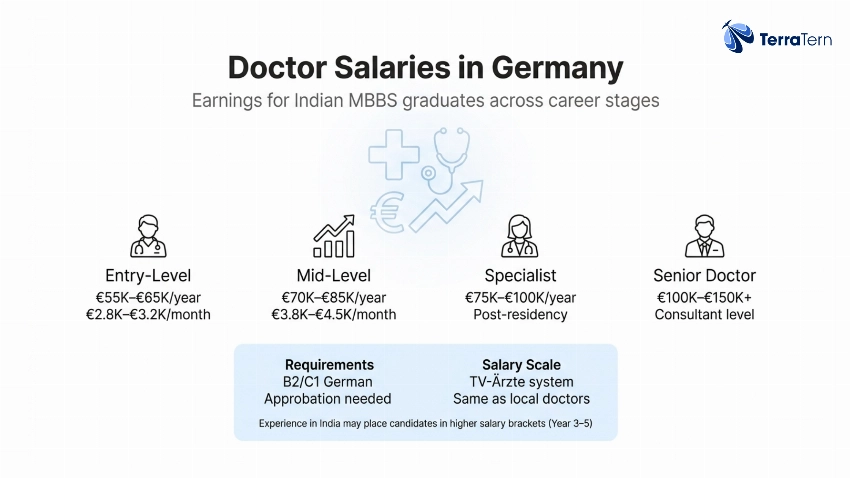
German salaries for Indian MBBS graduates generally begin as medical residents (Assistenzarzt) after the language exam (B2/C1 German) and Approbation, and are comparable to the salaries of local graduates.
-
Entry-Level Resident (0-2 years): €55,000–€65,000 gross annually (INR 47–56 lakhs), netting €2,800–€3,200 monthly (INR 2.4–2.7 lakhs).
-
Mid-Level (3-5 years experience): €70,000–€85,000 yearly (INR 60–73 lakhs), with net €3,800–€4,500 monthly.
-
Specialist (Facharzt, post-residency): €75,000–€100,000 annually (INR 64–85 lakhs).
-
Senior/Consultant: €100,000+ gross (INR 85+ lakhs), up to €150,000+ with experience.
-
Note: Payscale is TV-Ärzte; Indian experience can lead to Year 3-5 (€67,000+).
Expert Takeaway: An Indian MBBS doctor in Germany earns more in one month as a resident (INR 4–INR 5 lakh net) than many specialists earn in a year in India — making Germany one of the highest ROI destinations for Indian medical graduates.
Also Read: Germany Visa Tracking Guide: Experts' Updates & Tips
What Is the Gross vs Net Doctor Salary in Germany After Tax?
German doctor pay is gross (before taxes) and net (after taxes and contributions such as income tax (14-45%), social security (20%) and health insurance).
Job Role (Gross/Net Monthly Salary)
|
Role |
Monthly Gross (€) |
Monthly Net (€) |
Annual Net (€) |
Deduction % |
|
Entry Resident (Ä1) |
5,100–5,500 |
2,800–3,200 |
33,600–38,400 |
38–42% |
|
Mid Resident (3-5 yrs) |
5,700–6,400 |
3,800–4,500 |
45,600–54,000 |
35–40% |
|
Specialist (Facharzt) |
6,800–8,200 |
4,500–5,600 |
54,000–67,200 |
32–38% |
|
Senior (Oberarzt) |
8,500–9,800 |
5,500–6,800 |
66,000–81,600 |
30–35% |
|
Chief (Chefarzt) |
15,000–25,000+ |
9,000–15,000+ |
108,000–180,000+ |
35–45% |
Expert Takeaway: While Germany's tax deductions look steep on paper, doctors still net INR 2.75–INR 6+ lakh per month — several multiples above comparable Indian salaries — and receive world-class social security benefits in return.
How Do Doctor Salaries in Germany Vary by Specialty?
Annual doctor salaries in Germany are highly variable by speciality because of market demand, technical aspects and potential to go into private practice.
-
Radiology: €90,000–€125,000 hospital; €250,000–€500,000+ private (top earner).
-
Cardiology: €90,000–€130,000 hospital; €200,000–€400,000 private.
-
Orthopaedics/Surgery: €85,000–€120,000 hospital; €180,000–€400,000 private.
-
Anesthesiology: €85,000–€115,000 hospital.
-
Dermatology: €80,000–€110,000 hospital; €200,000–€400,000 private.
-
Internal Medicine: €80,000–€110,000 hospital.
-
Psychiatry: €78,000–€100,000 hospital; €150,000–€250,000 private.
-
General Practice: €75,000–€95,000 hospital; €150,000–€280,000 private (lowest).
Expert Takeaway: If you're an Indian MBBS graduate choosing a specialisation path, Germany's acute shortage of cardiologists, radiologists, and orthopaedic surgeons makes these fields not only financially rewarding but also in the highest demand — meaning faster job placement.
How Do Doctor Salaries in Germany Compare Across Cities and States?
Average physician salaries in Germany differ between cities and states based on demand, living costs and medical facilities.
-
Bavaria (Munich): €75,000-€95,000 average; specialists can earn as much as €150,000 (highest); rural shortage and high cost of living.
-
Baden-Württemberg (Stuttgart): €75,000 - €100,000; tech-heavy industry provides 10-15% higher pay than average.
-
North Rhine-Westphalia (Cologne): €70,000- €90,000; numerous university hospitals provide moderate, consistent pay.
-
Hamburg/Bremen: €70,000–€95,000 (median €101,500–€104,500); port cities balance urban perks with competitive pay.
-
Berlin: €65,000- €85,000; cosmopolitan environment, but lower salaries compensated by psychiatry opportunities.
-
Eastern States (Saxony, Saxony-Anhalt): €60,000–€80,000 (median €94,000–€96,500); incentives like €10,000 bonuses for rural roles.
Expert Takeaway: For Indian doctors prioritising income-to-cost-of-living ratio, smaller cities in Baden-Württemberg or Bavaria outside Munich offer the best balance — strong salaries with significantly lower rent than major urban centres.
Also Read: Is IELTS Required for Germany? Latest Guide for Study & Work
Doctor Salary by Experience in Germany
One of the biggest content gaps in competing pages is experience-based salary progression. Readers do not just want the starting pay; they want to know how quickly doctor salary in Germany rises over time. A practical breakdown helps answer that search intent clearly:
-
Year 1 Resident Doctor: around Rs. 4.63 lakh to Rs. 5.10 lakh gross per month.
-
Year 3 Resident Doctor: often around Rs. 5.09 lakh to Rs. 5.37 lakh gross per month.
-
Year 5 Resident Doctor: often around Rs. 5.55 lakh to Rs. 5.82 lakh gross per month.
-
Specialist Doctor: often around Rs. 6.73 lakh to Rs. 8.46 lakh gross per month.
What are the Additional Benefits Beyond the doctor's salary in Germany?
German doctors enjoy numerous benefits beyond attractive salaries, improving their quality of life.
-
Ample Paid Leave: 24-30 days a year, plus public holidays and sick days.
-
Full Health Insurance: Coverage for doctors and their families (including dental and eye care), with employer contributions (8% of salary).
-
Retirement Plans: Employer contributes to pension plans.
-
Shift and Overtime: €25-€50/hour for on-call/weekends/long shifts, 20-30% more salary.
-
Annual Bonuses: Performance bonuses based on service, patient satisfaction or hospital goals.
-
Continuing Education: Paid conferences, courses, and specialities.
-
Work-Life Balance: No more than 40 hours per week, strong anti-burnout measures.
-
Family Support: Childcare subsidies, parental leave (up to 14 months paid).
Expert Takeaway: For Indian doctors, Germany's non-salary benefits — particularly 30+ paid leave days, fully funded health insurance, and generous pension contributions — represent an additional "hidden salary" worth €10,000–€20,000 per year in real value.
How Can Indian MBBS Doctors Get Approbation to Practice in Germany?
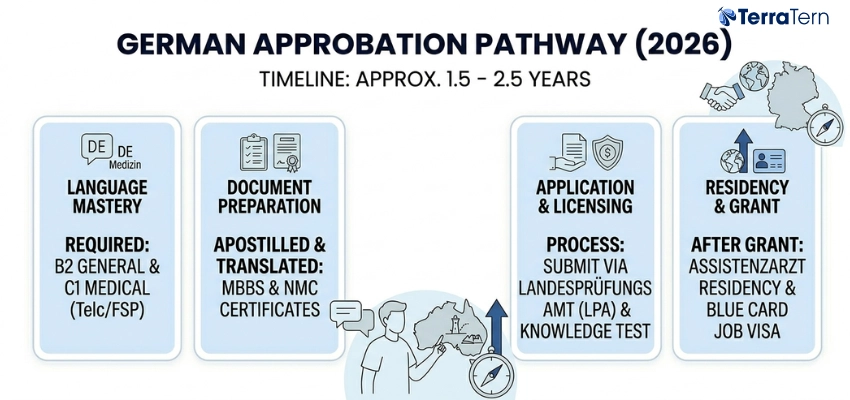
Approbation, the full medical license to practice in Germany, can be obtained by Indian MBBS doctors in a systematic procedure (Landesprüfungsamt) that takes 1.5 to 2.5 years.
-
Study German: Obtain B2 general German (Goethe/TestDaF), then C1 medical German (Telc Deutsch B2-C1 Medizin or Fachsprachprüfung (FSP) – oral test on patient communication).
-
Collect & Apostille: MBBS degree, mark sheets, internship certificate, NMC registration, Good Standing Certificate (less than 3 months old), CV, passport, police clearance, medical fitness certificate - all apostilled, translated into German by sworn translators.
-
Submit Application: Apply to state health authority (e.g., Berlin LAGeSo); pay a €200-1,000 fee for equivalence assessment (Gutachten).
-
Take Knowledge Test (Kenntnisprüfung/KP): If MBBS is not 100% equivalent, sit an oral-practical test in internal medicine/surgery (3 hours, €1,000 fee, 50-70% pass after preparation).
-
Get Approbation & Job Visa: Get permanent, nationwide license; apply for job visa (Blue Card) after approval.
-
Residency: As Assistenzarzt (€55,000+ salary), specialising (Facharztprüfung in 5-6 years).
Expert Takeaway: Starting your Approbation paperwork at least 8 months before your intended move date is the single most important step — document delays, not language skills, are the #1 reason Indian doctors face unexpected delays in Germany.
Also Read: Blue Card Germany: Expert Guide for Skilled Professionals
Is the Doctor's Salary in Germany Worth It Compared to India?
Yes, German doctor salaries are worth it for Indian MBBS graduates, with 3-6x higher income, better working conditions, and job security, despite the higher cost of living.
-
Salary Multiplier: Residents earn INR 47–56 lakhs/year (4–6x India's INR 8–12 lakhs); specialists INR 64–85 lakhs (3x+ India's INR 15–25 lakhs); seniors INR 85+ lakhs (2–3x India's INR 30–40 lakhs).
-
Take-Home Pay: Germany's net €2,800-3,200/month pays 1.5-2 months' worth of living expenses vs. 0.9 months for India; savings 2-3x higher after costs.
-
Work-Life Balance: 40-hour week, overtime compensation, 30 days off vs India's 60-80 hour shifts, burnout.
-
Perks: Free health insurance, pensions, training vs. India's perks; total value adds 20-30% to salary.
-
Career development: Residency to Facharzt (paid, 5-6 years) vs. PG admission in India; shortages ensure employment.
-
ROI Downsides: 1-2 year approbation, German language (€5,000-€10,000), 3X cost of living (Germany: €1,777, India: €425).
Expert Takeaway: The language investment is the #1 predictor of salary and job placement speed in Germany – Indian doctors who achieve C1 Medical German before arrival consistently out-earn those who arrive at the B2 level by €5,000–€10,000 in their first year.
Doctor Salary in Germany by Hospital Type
Another section missing from many competitor articles is hospital type. The same doctor can earn different amounts depending on whether they work in a university hospital, municipal hospital, private clinic, or group practice. University hospitals often follow collective agreements closely, while private clinics may offer stronger incentives in some specialties. In practice, that means a doctor with the same qualification can see a different monthly result depending on employer, call duty, and bonus structure.
|
Hospital type |
Common salary pattern |
Notes |
|
University hospital |
Stable collective pay |
Often clearer pay ladder |
|
Municipal hospital |
Similar to public tariff pay |
Shift allowances may add more |
|
Private clinic |
Variable base + incentives |
Specialty and billing matter more |
|
Private practice |
Highest upside for some specialties |
Better for cardiology, radiology, GP |
What Are the Strategies to Maximise Your Doctor Salary in Germany?
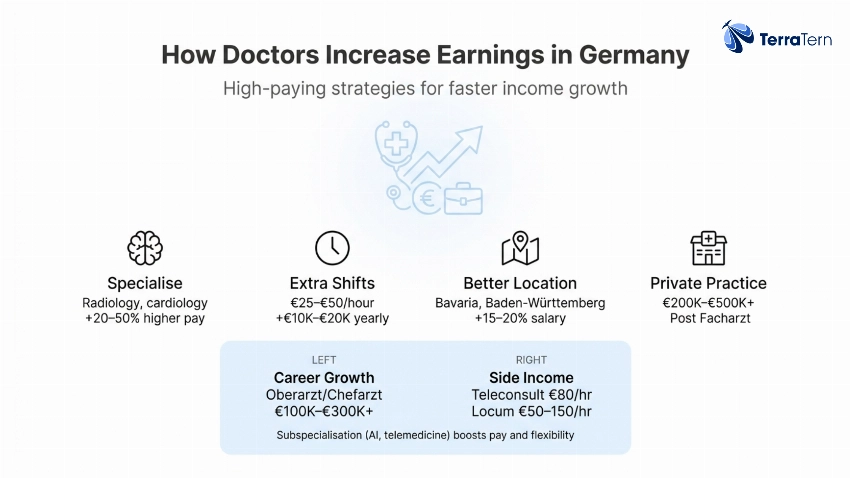
German doctors can boost earnings by making smart career choices, tapping high-paying specialities, and side jobs.
-
Select Lucrative Specialities: Focus on radiology (€90k-€500k+), cardiology (€90k-€400k), or orthopaedics to earn 20-50% more than general practitioners.
-
Take Shifts/On-Call: Earn an extra €25-€50/hour in night shifts, weekends, and holidays to increase income 20-30% (€10k-20k annually).
-
Target Premium Locations: Move to Bavaria, Baden-Württemberg, to earn 15-20% more base salary plus rural bonuses (€10k).
-
Open Private Practice: Go private after Facharzt for €200k-€500k+ from patient fees (hospital maximums cap at €100k).
-
Subspecialise: Obtain AI diagnostics or telemedicine certificates for pay increases and locum fees (€50-150/hour).
-
Seek Senior Positions: Target Oberarzt/Chefarzt roles (€100k-300k+) and bonuses.
-
Side Hustles: Teleconsulting (€80/hour), writing (€70/hour), or assessments (€90/hour) through platforms.
Expert Takeaway: The most overlooked salary multiplier in Germany is shift pay — a resident doctor (Assistenzarzt) who takes on regular night shifts and weekend on-call duties can increase their total annual income by 15–25% above their base tariff salary.
How TerraTern Can Help You?
TerraTern helps doctors and medical professionals plan their move to Germany with clear guidance at every step. The team can support you with job search, document checks, visa planning, and the steps needed for medical recognition in Germany. It also helps you understand salary expectations, contract details, and what to prepare before relocation.
For doctors who want a smooth transition, TerraTern can make the process easier, faster, and less confusing.
-
Helps doctors and medical professionals plan their move to Germany with clear step-by-step guidance.
-
Supports job search, document checks, and visa planning.
-
Guides you through the medical recognition process in Germany.
-
Helps you understand salary expectations and contract details.
-
Explains what to prepare before relocation.
-
Makes the transition easier, faster, and less confusing for doctors moving to Germany.
Conclusion
In 2026, Germany provides an upgrade for Indian MBBS doctors with resident salaries from €55,000-€66,000 (INR 47-56 lakhs, 4-6x India's rates) to €100,000+ for specialists (severe shortages) plus generous benefits (30 days leave, insurance) and opportunities to reach €500,000+ through high-demand specialties (radiology/cardiology) or private practice despite the Approbation process (B2/C1 German proficiency, knowledge test). Despite higher living expenses (3x India) and 1-2-year licensing, better work-life, career progression, and 2-3x net savings make this overwhelmingly attractive to ambitious doctors seeking work-life balance, stability and prestige over India's long hours and salary caps.




 AI Summary