Key Highlights
- What Are Civil Engineering Jobs in Singapore?
- Are Civil Engineers in Demand in Singapore in 2026?
- Why Are Civil Engineering Job Opportunities in Singapore Growing in 2026?
- What Are the Top Latest In-Demand Civil Engineering Roles For Indians in Singapore in 2026?
- Which Are the Current Top Companies Hiring for Civil Engineering Jobs in Singapore?
- Civil Engineering Jobs in Singapore for Indian Professionals
- What Latest Skills and Qualifications Do You Need for Civil Engineering Jobs in Singapore in 2026?
- How Can You Apply for Current Civil Engineering Jobs in Singapore from India?
- What Are the Latest Visa Requirements for Civil Engineers Working in Singapore in 2026?
- What Latest Salaries Can Civil Engineers Expect in Singapore in 2026?
- What Is the Current Career Growth Path for Civil Engineers in Singapore?
- What Are the Top Future Trends Shaping Civil Engineering Jobs For Indians in Singapore in 2026?
- What Current Challenges Do Foreign Civil Engineers Face in Singapore?
- How Does Singapore's Current Civil Engineering Sector Compare Internationally?
- Is Singapore Better Than Australia, Canada, or Germany for Civil Engineers?
- How Can TerraTern Help You Get Civil Engineering Jobs in Singapore in 2026?
- Conclusion
The rate of growth in civil engineering jobs in Singapore will be very high in 2026. Large-scale projects in the public sector, green infrastructure, intelligent mobility, and green urban development are the drivers.
Singapore keeps on attracting engineering talent in the world due to its stable economy, high standard of infrastructure and long-term national development targets. Civil engineering careers in Singapore are associated with good career development, remuneration, and exposure to state-of-the-art technology for students, freshers, and experienced engineers.
|
Factor |
Details |
|
Active Job Openings |
5,700+ Civil Engineering Jobs |
|
Entry- Level Salary |
SGD 3,000- 5,000/ month |
|
Mid-Career Salary |
SGD 4,500- 8,000/ month |
|
Senior Salary |
SGD 10,000+/ month |
|
Top Employers |
LTA, HDB, AECOM, Arup, Woh Hup |
|
Work Visa Options |
Employment Pass, S Pass |
|
In-Demand Skills |
BIM, Revit, AutoCAD, Green Building |
What Are Civil Engineering Jobs in Singapore?
The civil engineering jobs in Singapore in 2026 include all the positions that will be undertaken in the planning, design, supervision, and upkeep of the Singapore construction and infrastructure projects. The construction process of Singapore is very organised and regulation-compliant, and in this context, the civil engineers have to operate in a very coordinated setting that entails government-based agencies, local companies, and international corporations. Its roles include site operations, project engineering, structural design, digital construction, quality control and specialist roles in infrastructure, buildings and industrial developments.
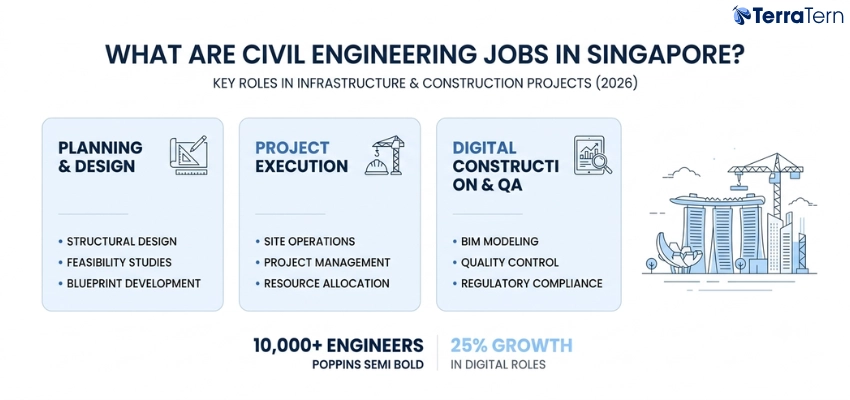
There are plenty of opportunities available to new graduates, diploma students, and professionals with field experience, since engineers are required at all stages of operation, from initial design to final handover.
Are Civil Engineers in Demand in Singapore in 2026?
Civil engineers remain in high demand in Singapore in 2026 due to major government-backed infrastructure investments, MRT expansions, smart city initiatives, and green building projects. More than 5,700 active civil engineering vacancies are available across public and private sectors.
Key Demand Drivers
-
Cross Island MRT Line
-
Jurong Region Line
-
Changi Airport Terminal 5
-
Tuas Mega Port
-
HDB BTO Housing Projects
-
PUB Water Infrastructure Projects
Why Are Civil Engineering Job Opportunities in Singapore Growing in 2026?
The forecasts of the civil engineering job opportunities in Singapore in 2026 are expected to increase due to the significant investment in large-scale public infrastructure projects, such as MRT extensions, road upgrading, and residential construction. The government, in turn,n is actively driving the r-development and rejuvenation endeavours, and this increases the demand for engineers both in the government and non-government sectors. Commercial and industrial construction is still powered by strong foreign investment.
Singapore has an ageing infrastructure that needs to be upgraded every time, thus adding to the demand for hiring. Moreover, new laws that promote online building and sustainability have provided new professional positions in such fields as BIM, green engineering, and high-tech quality control. It is with these combined drivers that the job market is one of the best in Southeast Asia in relation to the civil engineering job opportunities in Singapore.
What Are the Top Latest In-Demand Civil Engineering Roles For Indians in Singapore in 2026?
The most demanded jobs, along with their duties, wage packages, the number of applications to get the search records, and the qualification requirements, are presented below.
|
Job Role |
Monthly Salary (SGD) |
|
Site Engineer |
3,500- 5,500 |
|
Project Engineer |
4,500- 8,000 |
|
Structural Engineer |
6,000- 10,000 |
|
BIM Coordinator |
5,000- 9,000 |
|
QA/QC Engineer |
4,500- 7,500 |
|
Geotechnical Engineer |
5,500- 10,000 |
1. Site Engineer Positions
In Singapore, site engineer jobs will continue tobey the staple of civil engineering employment in the year 2026. Site Engineers, on the one hand, are responsible for day-to-day supervision of construction sites, and the work in the environments should adhere to the drawings, safety regulations, and construction schedules.
They liaise with contractors, subcontractors, suppliers and consultants. They handle safety compliance, inspection, reporting and quality control during the project stages. New graduates are also welcome to do such positions, and most companies would want candidates who are ready to learn the on-site procedures by learning them directly on the job.
Entry salaries will be between SGD 3,000 and 5,000 (INR 1,87,000 and 3,12,000). Companies such as Woh Hup, Kajima, Lum Chang, and some of the large construction contractors are actively recruiting. These are the gateway positions that offer several Singapore civil engineering careers.
2. Civil Project Engineer Jobs in Singapore
The civil project engineer jobs in Singapore coordinate the meetings, communicate with the clients, track the project budgets, monitor the timelines, and make sure that all deliverables comply with the technical and regulatory requirements.
Employers insist on candidates with 2- 5 years of experience since such candidates will be able to own the project progress. The wages are between SGD 4,500 and 8,000 (INR 2,80,000 and 5,00,000) per month. Civil project engineer jobs in Singapore are in high demand, and most of the vacancies are usually occupied in the Downtown Core, which is always engaged in commercial development and government-funded projects.
This is one of the stable and most demanded options among mid-level civil engineers in Singapore.
3. Structural Engineer Roles
Structural Engineers provide reliability, stability and integrity of buildings and structures. They conduct structural inspection, load checking, design inspection, and verifications to verify that the building is in line with the stringent building codes and BCA strict requirements in Singapore.
Such positions typically involve 3-6 years of experience because structural design needs to be accurate and requires working experience with engineering software. The salaries are between SGD 6,000-10,000 a month (INR 3,75,000-6,25,000). Most of these jobs are in residential high-rise buildings, big commercial buildings, and transport buildings.
The field of structural engineering is still among the most specialised and high- responsibility branches in the Singaporean civil engineering industry.
4. Diploma Civil Engineering Jobs in Singapore
Some of the typical diploma civil engineering jobs in Singapore roles are the Site Supervisor, CAD Technician, Draughtsman, Project Coordinator and Civil Engineering Technician.
Such functions of diploma civil engineering jobs in Singapore demand practical abilities and knowledge of drawings, measurements, and processes on-site. Given the fact that many employers provide training to enable the diploma holders to advance their careers to higher levels over time, it is a good career path in the long run.
The salaries are generally between SGD 500 and 3,800 per month. The number of openings specifically targeted to the diploma qualifications is 600+. The fact remains that many diploma graduates are subsequently upgraded to part- time or sponsored programs to the degree level of engineering.
5. BIM Coordinator and Digital Construction Roles
There are very high demands for BIM Coordinators and digital construction specialists as Singapore is being pushed towards being more digital under BC.A. The positions demand good expertise on Revit, BIM 360, Navisworks and AutoCAD.
They deal with site team coordination, clash detection, 3D modelling, and coordination. These jobs are interrelated with design, planning, and real-world implementation, and thus,s it is one of the rapidly expanding fields of jobs in civil engineering in Singapore.
The salary is between SGD 5,000 and 9,000 a month, depending on experience and software knowledge. The requirement is increasing as a number of projects at various levels are supposed to adhere to the BIM standards, giving digital construction experts long-term career security.
6. Quality Control Engineer and QA/QC Specialist
Quality Control Engineers of QA/QC Specialists are in charge of testing, inspection, and compliance of materials and construction works. They make sure that the project is done according to the BCA regulatory requirements, quality standards, and safety requirements.
These functions are critical in ensuring that defects are prevented, there is proper implementation of designs and proper documentation of audits and approvals. These jobs are targeted at employees who have 2-4 years of experience.
The salaries are between SGD 4,500 and 7,500 per month. There is strong demand in building contractors, infrastructure-related firms, and projects involving government-related work since quality control is strictly applied in the construction industry in Singapore.
Also Read: Civil Engineering Jobs in Canada: Latest Pay, Scope & More
Which Are the Current Top Companies Hiring for Civil Engineering Jobs in Singapore?
Civil engineering jobs in Singapore are regularly employed by several big building, infrastructure and engineering companies. These businesses are in both commercial, residential, industrial and government-related activities, and they provide good career growth opportunities to new graduates as well as experienced personnel.
Tier 1 construction contractors (Woh Hup, Kajima, Shimizu,Dragages, Gammon, Ssangyong and Lum Chang) recruit aggressively for Site Engineering, Project Engineering, QA/QC, and diploma-level supervisors. These companies deal with large high-rise buildings, MRT stations, airports, and integrated projects.
Design-oriented positions are found in engineering consultancies such as Arup, AECOM, Surbana Jurong, Meinhardt, CPG Consultants, Jacobs and Ramboll and can be a Structural Engineer, Civil Designer, BIM Coordinator and infrastructure consultant. They are engaged in the work on long-term masterplanning, structural design, and multi-disciplinary work.
Employers in the public sector, such as Land Transport Authority (LTA), Housing and Development Board (HDB), Building and Construction Authority (BCA), and PUB-Singapore Water Agency, also employ engineers in transport networks, water projects, regulatory supervision and huge mass housing.
These groups of employers constitute the best environment of civil engineering employment in Singapore that provides stable jobs, specialised jobs and chances of getting foreign talents with relevant skills.
Civil Engineering Jobs in Singapore for Indian Professionals
The information for civil engineering jobs in Singapore for Indians:
Why Singapore Attracts Indian Civil Engineers
-
English-speaking workplace
-
Strong infrastructure sector
-
Competitive salaries
-
PR pathway
-
Low tax rates
Challenges for Indian Engineers
-
Employment Pass eligibility
-
Degree recognition
-
Local code adaptation
-
High living costs
How Indian Engineers Can Improve Hiring Chances
-
BIM certification
-
Green Mark training
-
AutoCAD & Revit expertise
-
PEB recognition
What Latest Skills and Qualifications Do You Need for Civil Engineering Jobs in Singapore in 2026?
A combination of education, technical ability, certifications, and soft skills is necessary to join civil engineering jobs in Singapore. The employers seek candidates who may conform to the local standards, work with sophisticated software, multicultural teams, and produce accurate projects.
Current Educational Requirements by Career Level
Diploma-level jobs are for candidates who are eligible to work as Site Supervisor, Draughtsman, CAD Technician, and Assistant Engineer. The Singapore Polytechnic, Ngee Ann Polytechnic and Temasek Polytechnic are among the popular institutions.
The jobs at the degree level normally need a Bachelor’s degree in Civil engineering, a course offered in reputable institutions like NUS, NTU, or other credible foreign universities. Degree graduates are eligible to become a Site Engineer, Project Engineer, QA/QC Engineer, and structural designer.
Civil engineering jobs in Singapore seeking Professional Engineer (PE) status require pursuing a guided path. It is a procedure that requires one to complete a Bachelor’s degree with an approved institution, pass the Fundamentals of Engineering Examination (FEE), become an Engineer-in-Training (EIT), complete at least four years of supervised practice, and pass the Practice of Professional Engineering Examination (PE). It is a certification to sign off on regulated works.
Higher qualifications, Postgraduate degrees in engineering, e.g. Master of Engineering, offer specialisation in structural engineering, geotechnics, water engineering, or sustainable infrastructure. Such credentials are generally costly at an average of 14 per cent in terms of salary increase. Other engineers also undertake project management, MBAs, or dual-specialisation courses to get access to upper managerial positions.
Essential Technical Skills for the Singapore Market in 2026
The employers of civil engineering jobs in Singapore are more interested in engineers who are able to use design tools, planning software and digital construction platforms that match the requirements of BCA.
Your design software skills must be very competent in designing with AutoCAD to draft, Revit to design BIM, STAAD Pro to analyse the structural design, and Civil 3D to design infrastructure. Project scheduling software such as Primavera P6 is appreciated in the planning of massive multi-phase developments.
Digital construction skill requirements involve operating BIM 360, clash detection software by use of Navisworks, and other sophisticated applications such as 3D laser scanning and drone surveying to inspect or survey the site. The implementation of digital twins in large-scale projects has become a part of many companies.
The structural design roles require structural and analysis tools, including SAP2000, ETABS, and SAFE. The GIS software knowledge may be needed for surveying and infrastructure roles.
The tools associated with sustainability in Singapore related to the Green Mark framework are becoming critical. LEED processes, energy modelling software, and environmental performance assessments knowledge are an advantage.
Lastly, there are documentation skills. Quantity surveying, reporting, and planning require the use of MS Project and Excel. PowerPoint is popular in the presentation of design updates and client reports.
Latest Industry Certifications That Boost Employability
The construction industry in Singapore is very strict in hiring candidates with known professional qualifications. The knowledge about the regulatory standards and quality requirements can be evidenced by local certifications like BCA Academy courses, Green Mark Professional, or Registered Inspector (RI) qualifications. Senior-level practitioners are often seeking CoreTrade certification to be eligible to work on the site in a position of management.
International certifications do not exist. PMP (Project Management Professional) is an organisation that is appreciated in high-level management positions. LEED certification AP is significant in the engineering that is concerned with sustainability. PE engineers can use international PE recognition, as it relies on inter-engineering board agreements.
The credentials enable the candidates to stand out in a competitive market as well as enhance eligibility towards senior or specialised roles.
Current Soft Skills Valued by Singapore Employers
In civil engineering jobs in Singapore, they operate in multicultural teams, and hence they need to communicate and be clear. Effective verbal and written communication skills are useful in coordinating with the consultants, contractors, and clients. Leadership qualities are essential when controlling site teams, subcontractors and project schedules.
Time management is essential because most projects have strong time limits. Good problem-solving skills are also important to employers, particularly in addressing site issues in a fast and timely manner without affecting the quality or safety.
The other important skill is adaptability since the regulations, technologies, and project requirements change frequently. One also needs to write reports, email clients and prepare documents to be submitted to regulators, which is only possible with English proficiency.
How Can You Apply for Current Civil Engineering Jobs in Singapore from India?
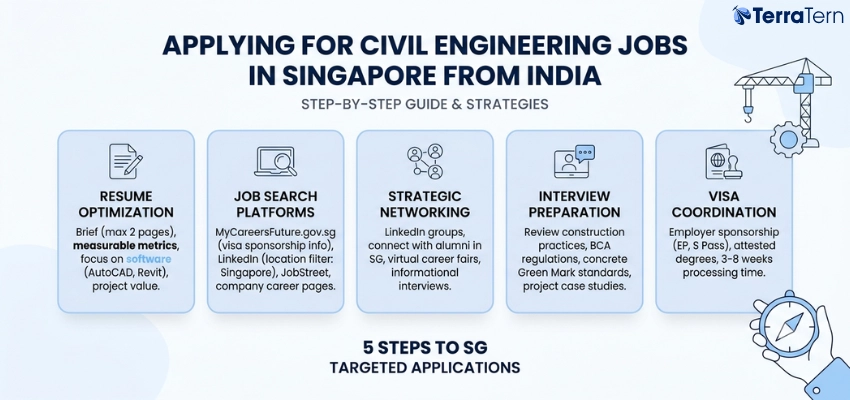
The Indian hiring process can be strategised so that it includes resume preparation, job hunting, networking, proper interviewing, and coordinating with the hiring companies in terms of the visa process.
Step 1 - Optimise Your Resume for Singapore Employers
- Civil engineering jobs in Singapore require employers to provide brief resumes, not longer than two pages. An official picture is not mandatory but a usual feature. Concentrate on measurable accomplishments and not long accounts. Focus on software abilities, particularly AutoCAD, Revit, BIM experience or project scheduling exposure.
- Provide related projects and clarify what you have done in terms of project value, schedules and the team size. Incorporate civil engineering expertise that is in line with the industry standards in Singapore, like site supervision, structural detailing, and green buildings. The shortlisting opportunities can be enhanced by matching your resume to the requirements listed in vacancy advertisements.
Step 2 - Use the Right Job Search Platforms
- There are various platforms that are necessary when applying to civil engineering jobs in Singapore.
- The government portal is called MyCareersFuture.gov.sg and shows the availability of visa sponsorship. It is a platform that is mostly used by many employers when making Employment Pass applications.
- LinkedIn jobs are somewhat helpful once you select the location filter as Singapore. The Easy Apply feature accelerates the application. Being a follower company enhances your exposure.
- JobStreet Singapore offers more advanced filters, making it easier to find jobs by experience and specialisation. In fact, Singapore combines job postings and provides salary comparison tools. GrabJobs is applicable to quick mobile applications.
- Another option is to apply directly through the career pages of companies such as AECOM, Aurecon, LTA, Arup, Surbana Jurong, and Meinhardt.
Step 3 - Network Effectively for Singapore Opportunities
- Networking helps a lot in boosting your chances of landing a civil engineering jobs in Singapore. Become members of LinkedIn groups (like Indians in Singapore, Singapore Civil Engineering Professionals or Expats in Singapore). Such communities usually exchange employment opportunities and tips.
- Contact alumni based in Singapore, particularly those from NUS, NTU, or other large Indian engineering colleges. Numerous practitioners would be willing to exchange advice. Singapore is hiring for virtual career fairs.
- Ask engineers in your target companies to conduct an informational interview. Visiting company pages and commenting on their posts increases your visibility to recruiters.
Step 4 - Prepare for Remote and In-Person Interviews
- Review the construction practices, building codes and safety requirements of Singapore before the interview. Get acquainted with the BCA regulations and Green Mark sustainability standards.
- Provide detailed case studies from your past projects that illustrate your technical solutions to problems and your teamwork.
- Some of the frequent questions interviewers ask include the grades of concrete used in Singapore, site safety measures, problems encountered in construction projects in tropical climates, and HDB specifications. You must be ready to speak about your skills in software applications such as AutoCAD, Revit, or analysis tools.
Step 5 - Coordinate Visa Application with Employer
- The majority of civil engineering jobs in Singapore require employer-sponsored visas, such as the Employment Pass or S Pass. Once a job opening occurs, the application is submitted to the company. You may need attested degree certificates, copies of your passport, experience letters, and, in some cases, professional references.
- The visa processing normally takes 3 to 8 weeks, depending on the paperwork and the employer's profile. Use the MOM COMPASS self-assessment tool to approximate your eligibility to EP before applying.
Step 6 - Follow Up Strategically
- Write a thank-you email within 24 hours of the interview. Restatement of interest and emphasis of key qualifications. And if you do not receive a reply within 7 to 10 days, send an amicable follow-up note.
- Keep your LinkedIn active by reading industry posts and continuing your job search. You stand better chances of getting interviews and offers when you apply to more than one position.
What Are the Latest Visa Requirements for Civil Engineers Working in Singapore in 2026?

Civil engineering jobs in Singapore have to meet some requirements of a visa that have to be met by the Ministry of Manpower (MOM). The right type of visa will be based upon your education level, experience, salary and position. Singapore deploys a transparent, structured system whereby qualifications, employer background and competitiveness of salary are evaluated and then approved.
Employment Pass (EP) for Civil Engineering Professionals
The most common visa is the Employment Pass, which is offered to civil engineers with degrees. They also require a minimum monthly salary of SGD 5,600, but applicants below 30 with excellent qualifications can be considered with a minimum salary of SGD 5,000. It is a requirement to have a recognised Bachelor's degree or above, and must have one year or more of experience in engineering, and must have a confirmed employment offer with a Singaporean employer.
The eligibility of EPs is determined by the Compass framework, a points system that considers competitiveness in salaries, education level, diversity contributions, and skill focus at the firm level. The Dependent Pass scheme may also allow EP holders to bring their children and spouse.
The pass is a two-year first-time pass and is renewable. Once the EP holders have had a few years of steady employment, they can apply for Singapore Permanent Residency under the Professional, Technical, and Skilled Workers (PTS) scheme.
S Pass for Diploma Civil Engineers
S Pass would be applicable to the mid-skilled civil engineers, particularly those who have diplomas or equivalent qualifications. SGD 3,300/month is the minimum amount that S Pass holders should have, and the applicant is required to have related working experience and a work offer made to them by a sponsoring employer. In contrast with the EP, the S Pass is not exempt from foreign worker quotas and levies that restrict the availability, depending on the company size and sector.
The processing normally lasts between 3 to 8 weeks based on documentation. The S Pass lasts up to 2 years and is renewable. The choice is the best option to be used by diploma-qualified civil engineers who have three to five years of experience seeking site-based jobs, drafting jobs, or assistant engineering jobs.
Personalised Employment Pass (PEP) for Senior Engineers
The Personalised Employment Pass is tailored towards high-income professionals. To qualify, current EP holders must have a minimum monthly salary of SGD 22,500, or foreign professionals who apply overseas must demonstrate a fixed monthly salary of at least SGD 22,500. The greatest advantage is its flexibility: the PEP does not depend on a particular employer; therefore, one can change jobs without filing another visa.
The PEP holders have a period of six months, after which they can seek new employment if they quit their jobs. The pass is valid for 3 years and is not renewable. The visa will best suit senior leaders of the engineering profession, as well as top-level project managers and directors in large construction or consultancy companies.
ONE Pass for Exceptional Engineering Talent
The Overseas Networks and Expertise (ONE) Pass is aimed at the most talented persons in the world. They need to have a monthly earning of at least SGD 30,000 or have graduated from the top international universities with a good record in their major. The ONE Pass is very flexible, like the PEP, and lets individuals acquire numerous roles or even initiate business in Singapore.
It lasts 5 years and targets elite engineers, top-level consultants, and individuals with an outstanding global portfolio. It is a work pass category that is prestigious, but it is very rare.
What are the Current Required Documents for a Visa Application in 2026?
To avoid procrastination, applicants should be in a position to produce all the necessary documents.
The common requirements are:
-
An authentic passport valid for at least 6 months.
-
Offer letter from the Singapore employer.
-
Degrees or diplomas, as well as other educational certificates that are well attested or apostilled.
-
Academic transcripts
-
Certificates of professional qualification, PE credentials where necessary.
-
Experience certificate or employment reference letters.
-
Updated resume or CV
-
Passport-size photographs
-
Health insurance reports
-
Medical examination outcomes when needed.
-
Visa processing cost of about INR 6,750.
Visa Application Timeline and Process in 2026
The visa is obtained according to a planned schedule of employment and the collection of work permits.
First, you have to find a job offer which may last from a couple of weeks to a few months. Once accepted, the employer then applies to the MOM portal using the EP or S Pass application. The candidates have the option of using the self-assessment tool of the COMPASS to verify their eligibility.
MOM then examines the application, which normally takes 3 to 8 weeks. Upon approval, an In-Principle Approval letter is emailed. Applicants are then sent to Singapore, where they undergo any medical screening they may need, and their work pass card is issued by the Ministry of Manpower.
The end-to-end process will normally last between 4 and 10 weeks, depending on the employer's profile, the quality of the documentation, and the processor's load.
What Latest Salaries Can Civil Engineers Expect in Singapore in 2026?
The wages of civil engineering jobs in Singapore depend on experience, specialisation and the employer. The nation has unique competitive compensation packages which are backed up by good benefits, consistent projects, and well-defined career growth for both local and foreign engineers.
Current Entry-Level Civil Engineer Salaries (0-2 Years Experience)
Recent graduates and diploma engineering graduates typically receive SGD 3,000 to 5,000 per month, which translates to an average of SGD 46,200 to 62,376 in annual income. The government agencies can provide a little less starting pay, but can pay in benefits and in-service training programs.
The range of payment between SGD 3,500 and 4,500 is the standard payment of private contractors. The engineering consultancies in the international market have better starting salaries, which usually range between SGD 4000 and 5000/month.
Benefits such as employer CPF contributions of approximately 17 per cent, full medical insurance, 14 to 21 days of annual leave, and training or safety certification allowances are common.
Mid-Career Civil Engineer Salaries (3-9 Years Experience) in 2026
Three to five years of experience on sites will make engineers earn between SGD 4,500 and SGD 6,000 per month. Five-eight years experienced Project Engineers receive between SGD 5,500-8,000 monthly salary.
Design experience of between 6-8 years in structural engineering attracts between SGD 6500 and 10000 per month. The annual packages for mid-career engineers range from SGD 66,030 to SGD 96,000. The average monthly income for this bracket is around SGD 6,039.
Latest Senior Civil Engineer Salaries (10+ Years Experience)
The senior engineers make about SGD 7,320-8,370/month, which translates to an annual salary of SGD 87,840-100,440. Project Managers handle larger scopes and earn SGD 8,000 to 12,000 per month.
Engineering Directors with many years of experience and leadership roles can earn SGD 15,000 to 25,000 or more per month, and annual packages may range from SGD 180,000 to 300,000 or more. These packages are usually performance bonuses, annual wage supplements and incentive pay.
Current Salary Variations by Specialisation
Engineering specialisations attract different salaries.
The General civil engineers have an average minimum of SGD 58,800 per year. The structural engineers receive pay between SGD 72,000 and 90,000, representing a 15 to 25 per cent premium.
BIM coordinators have salaries ranging from SGD 66,000 to 84,000, and sustainability consultants have salaries ranging from SGD 72,000 to 96,000, depending on the increasing complexity of green building knowledge.
Geotechnical engineers have an average salary of 66,000 to 90,000, and project managers have an average salary of 84,000 to 144,000 per year, depending on project size and seniority.
Salary Differences by Location in Singapore in 2026
There are also differences in salaries between districts. Concentrated global companies usually mean that salaries in the Downtown Core and Central Business District are 10 to 15 per cent above the national average.
Queenstown is offering competitive rates to engineers to work on large-scale government projects. The salaries of industrial developments in Jurong Industrial Area are competitive. Tuas and the western parts have standard to above-average salaries, particularly in infrastructure jobs.
The difference in location may result in an overall monthly disparity of SGD 500-1000.
How Latest Civil Engineer Salaries Compare Regionally
The salaries in Singapore are still very competitive within the Asia-Pacific region. An average civil engineer makes approximately SGD 58,800 per annum or approximately INR 36.5 lakh.
Malaysia provides approximately MYR 48,000 each year, which is approximately 77 per cent less. India has a cost of about INR 6 lakh, which is about 84 per cent lower. Australia charges approximately 85,000 AUD, which is approximately 29 per cent more than Singapore, whereas Dubai generally charges AED 120,000, which is approximately 26 per cent less.
The differences notwithstanding, Singapore offers excellent long-term value owing to higher career growth rates, reduced personal income tax, mandatory employer CPF contributions, and a highly stable job market.
Also Read: Civil Engineering Jobs in Europe: Latest Guide
What Is the Current Career Growth Path for Civil Engineers in Singapore?
The civil engineering jobs in Singapore are quite straightforward: as a Graduate/Junior Engineer, you get experience in sites and design, and advance to positions of Project Engineer in 3-5 years. At age 68, you have a chance to move to Senior Engineer or Project Manager, particularly after working under a PE and developing robust technical and coordination capabilities. Having experience and qualifications (BIM, Green Mark) lots of them become Principal Engineer, Construction Manager, or Technical Lead in year 10-12. The Professionals who receive Professional Engineer (PE) registration will have faster promotions, an increase in salaries, and chances of becoming a Director or Specialist.
Career Progression Timeline and Milestones in 2026
Years 0-2: Graduate Engineer / Junior Site Engineer
-
Role: Supervisory work on the site, support of senior engineers.
-
Milestone: Become an Engineer-in-Training (EIT)
-
Salary: SGD 3,000–5,000 monthly
-
Concentration: Learn the standards in Singapore, crystallise building site experience, and learn AutoCAD/BIM.
Year 3-5: Project/ Site Engineer
-
Role: Responsible for independent project elements, contractor management, and customer relations.
-
Milestone: 4 years of qualifying experience towards PE registration.
-
Salary: SGD 4,500–6,500 monthly
-
Central Message: Essentials of project management, communication with the stakeholders.
Years 6 -8: Senior Engineer / Senior Project Engineer
-
Role: Project lead for project segments, mentor juniors, and conduct design reviews.
-
Milestone: Become a Professional Engineer (PE) registered.
-
Salary: SGD 6,500–10,000 monthly
-
Development: Specialisation, building leadership skills.
9-12 years Project Manager/Principal Engineer
-
Position: Project ownership, P and L, client management.
-
Milestone: Lead projects in the value of SGD 10M+
-
Salary: SGD 8,000–15,000 monthly
-
Specialisation: Business acumen, strategic thinking, and management.
Years 15 and Above: Director / Associate Director of Engineering
-
Job Title: Multi-project management, strategic management, business management.
-
Milestone: Head an area of practice or business unit.
-
Salary: SGD 15,000–30,000+ monthly
-
Concentration: Corporate development, research and development, and strategic decision making.
Professional Engineer (PE) Registration Pathway
The biggest milestone is becoming a Professional Engineer (PE), which is required for senior positions and greatly boosts earning potential.
PE Registration in Singapore Steps:
-
Complete a Bachelor of Business Administration degree approved by the BCA (NUS, NTU, or foreign institutions of educational excellence).
-
Pass the Fundamentals of Engineering Examination (FE) → become EIT.
-
Achieve PE-monitored experience in engineering for 4 years.
-
Complete the Practice of Professional Engineering Examination (PPE).
Submit:
-
PE application (SGD 300)
-
Two PE references
-
Comprehensive report on work experience.
-
Get registered by the Professional Engineers Board (PEB)
Specialisation vs. Management Career Tracks
Technical Specialist Track:
-
Concentration: Structural, geotechnical, transport or sustainability engineering
-
Positions: Senior Engineer, Principal Engineer, Technical Director
-
Skills: Rigorous qualifications, technical skills in the niche.
-
Advantages: Expert power, professional consulting
-
Salary Ceiling: SGD 120,000–180,000 annually
Management Track:
-
Specialisation: Leadership, client relations, strategy
-
Roles: Project Manager, General Manager of Engineering, Director/Vice President
-
Qualifications: P&L ownership, business development (MBA can be handy)
-
Advantages: Influence and remuneration are increased.
-
Salary Ceiling: SGD 200,000–400,000+ annually
Latest Skills Development for Career Advancement
Early Career (0–4 years)
-
Technical software (AutoCAD, Revit, Civil 3D)
-
BCA codes and documentation
-
On-site coordination
Mid Career (5–9 years)
-
Project management
-
Client communication
-
Commercial awareness
Senior Career (10+ years)
-
Business development
-
Strategic decision-making
-
Mentoring and technical leadership
What Are the Top Future Trends Shaping Civil Engineering Jobs For Indians in Singapore in 2026?

The civil engineering jobs in Singapore are undergoing significant changes in technology, environmental friendliness and infrastructural demands. The need and demand for green building professionals is on the rise, and the Green Building Masterplan has the prospect of 80 per cent of buildings becoming green certified in 2030. BIM and digital construction skills have become a necessity as projects are now being developed not in 2D CAD but in advanced 3D and 7D models.
The Smart Nation project is establishing opportunities in the field of smart infrastructure, IoT applications, and data-driven engineering. The increasing application of modular construction (PPVC), 3D printing, and robotics is changing the delivery format of projects. Climate change is also pushing the need for experts in coastal protection, flood management, and climate-resilient design. Collectively, these trends have benefited engineers who upskill in sustainability, BIM, digital, and automation, making them highly competitive in Singapore's diverse job market.
Green Building and Sustainability Focus
Hiking jobs: Sustainability Engineer, Green Mark Specialist, Carbon Analyst.
Required Skills:
-
Green Mark & LEED criteria
-
Energy simulation
-
Lifecycle assessments
-
Salary premium is 15–25%
Building Information Modelling (BIM) and Digital Construction
Many large projects require BIM.
New positions: BIM Manager, Clash Detection Specialist, Digital Construction Engineer.
Skills in Demand:
-
Revit, BIM 360, Navisworks
-
4D/5D BIM modeling
-
Point cloud processing
-
Salary premium is 10–20%
Smart Nation Infrastructure Integration
Internet of Things infrastructure is the norm.
New jobs: Smart Infrastructure Engineer, IoT Integration Specialist
Required Skills:
-
IoT systems
-
Data analytics & Python
-
Cloud platforms
-
Cybersecurity basics
Modular and Advanced Construction Technologies
PPVC (modular construction) has been widely used on HDB projects.
Concrete printing on 3D is under trial.
In-Demand Skills:
-
Familiarity with manufacturing off-site.
-
Coordination of module assembly.
-
Prefabrication quality assurance
Climate Resilience and Coastal Protection
Rise in sea-levels → huge national plans of coastal defence.
Growing fields:
-
Water resources engineering
-
Flood management
-
Climate adaptation design
Required Skills:
-
Hydraulic modeling
-
Nature-based solutions
-
Essentials of climate science.
Automation and Robotics in Construction
Manpower dependence minimised by robotics, AI and drones.
Key Roles:
-
Construction automation Specialist
-
Drone Survey Coordinator
-
Customer Service Manager, Robotics Engineer
Skills Needed:
-
Drone data processing
-
Automated manufacturing processes
-
Integration of robotics in the workflow.
What Current Challenges Do Foreign Civil Engineers Face in Singapore?
The problematic areas that foreign civil engineers have when operating in the sphere are strict work visa regulations, increased EP salary levels, and the COMPASS scoring policy. There are also numerous challenges in the process of internationalising their degrees and professional qualifications by the PE Board. It may require time to adjust to the local building codes, tropical building requirements, and high-paced culture of building in Singapore. Another huge challenge with newcomers is the high cost of living or housing. There is also the need to adjust to the workplace expectations, such as working long hours on the job, the use of formal communication and a multicultural workforce.
Nevertheless, engineers who upgrade in BIM, sustainability, and local codes, plan ahead, and aim at firms that are used to hiring foreigners can deal with these difficulties much more easily.
Also Read: Pursue Civil Engineering Jobs in Germany: Everything You Need To Know
Work Visa Stringency and Salary Thresholds in 2026
The intensifying tough visa policies of Singapore are also a hurdle to foreign engineers. There is an increase in the Employment Pass salary standard (SGD 5,600 in 2026), and the COMPASS system will introduce new levels of evaluation, starting with qualification and finishing with employer diversity indices. It is an advantage to many companies to hire candidates who have already complied with these requirements, and the number of newcomers is reduced.
Here’s how you can handle it:
-
Target companies that regularly employ foreign engineers.
-
Ensure your degree is accepted by MOM and other relevant authorities.
-
Develop such skills as BIM, sustainability engineering, and digital construction.
-
When you have a diploma, you should take the S Pass pathway.
A contractual agreement should be made to negotiate a salary package that is evidently above the EP threshold.
Latest Professional Qualification Recognition
The other big issue is to have your qualification accepted by the Professional Engineers Board (PEB). Not all foreign degrees are recognised, and engineers may require further examinations or experience under a Singapore-registered PE. Career growth becomes very sluggish without any acknowledgement.
To find your way, take the following steps:
-
Before applying, be sure that your degree is on the PEB-approved list.
-
Early registration as an Engineer-in-Training.
-
Work under a PE registered in Singapore to gain some local experience.
-
Where necessary, seek a local part-time program to meet the recognition requirements.
Current Adaptation to Singapore Building Codes and Practices
Singapore's engineering standards are not similar to those of most countries. Engineers will be forced to adjust to local structural standards, tropical-climate considerations, and high-rise design standards. The work culture that is fast-paced and precision-oriented may also be overwhelming to newcomers.
To adapt smoothly:
-
Participate in orientation and code courses at BCA Academy.
-
Salute Singapore Structural Codes and local practices.
-
Obtain mentoring from engineers who have worked on local projects.
-
Proactively perform roles that allow the application of Singapore standards.
-
Devote oneself to regular self-learning.
High Cost of Living vs. Salary Expectations
One of the largest shocks is the cost of living. The biggest cost is rental, as room rent costs between SGD 1,000-2,500 and apartments between SGD 2,500-4,500. Although entry-level engineers earn around SGD 3,000 to 4,000, the first few months may be rather tight financially.
In order to remain financially comfortable:
-
Reduce rent through shared accommodation.
-
Take advantage of Singapore's efficient MRT system.
-
Eat out frequently and use hawker centres as a cheap source of food.
-
Bargain fringe benefits or moving allowances.
-
Budget realistically before relocating.
Workplace Culture and Communication Style Expected in 2026
Singaporean workplaces are usually formal, structured and multicultural. Other companies have a lot of hierarchy, whereas others have a direct manner of communicating with others, which might not be the same as in your home country.
You may do so more easily as follows:
-
Monitor communication at the workplace.
-
Learn good English technical writing skills.
-
Be submissive to the hierarchy, but be enterprising.
-
Acquire cross-cultural teamwork
-
Participate in unofficial team and company events.
Latest Work-Life Balance Expectations
Civil engineering work, particularly construction and site-based work, tends to involve long working hours, including Saturdays and on-call during the peak of the project. Burnout may occur due to the unpreparedness of foreign engineers.
You can set expectations on a prudent basis:
-
Eliminate confusion on working hours during interviews.
-
Consultancies are preferable when the balance between work and life is important.
-
Another agreeable approach is to negotiate overtime pay.
-
Get your working conditions written down in your contract.
How Does Singapore's Current Civil Engineering Sector Compare Internationally?
The civil engineering jobs in Singapore are very accurate, faster and well-regulated to make it outstanding in the world. Infrastructure, development of urban innovations and long-term planning put the country in the group of the most developed engineering environments of the world. Singapore is both challenging and rewarding for foreign engineers because the country has high technical standards and effective project implementation compared to many other international markets.
This is the way Singapore is performing on key world indices:
-
Singapore boasts of very strict engineering codes and project approval systems that guarantee high standards of safety and quality.
-
The nature of infrastructure projects is highly technological, where there is a compulsion to use BIM, digital engineering and integrated project delivery.
-
The government has a positive implication on the sector with agencies such as BCA, LTA, PUB, and JTC in place to stabilise the project pipelines.
-
Project timelines are shorter, and expectations are stricter than in Western countries, requiring strong preparedness and flexibility.
-
Singapore is comparable to other global leaders such as Japan, Germany, and South Korea in terms of engineering precision, yet it has a more multicultural, English-speaking work environment.
-
The country scores higher than most Asian markets in worker safety, construction productivity programs, and environmental engineering norms.
-
The international value of experience in Singapore is improved by the fact that the world recognises the mega-projects undertaken in this country, such as the Marina Bay development, the Changi Airport expansions, and underground tunnelling.
Salary and Compensation Comparison
|
Country |
Entry-Level Annual |
Mid-Career Annual |
Senior-Level Annual |
Tax Rate |
Purchasing Power Index |
|
Singapore |
SGD 46,200-56,770 (INR 28.8-35.5L) |
SGD 66,030-72,468 (INR 41.2-45.2L) |
SGD 87,840-100,440 (INR 54.9-62.7L) |
0-15% typical |
High |
|
UAE |
AED 60,000-84,000 (INR 13.5-18.9L) |
AED 120,000-180,000 (INR 27-40.5L) |
AED 240,000+ (INR 54L+) |
0% |
Very High |
|
Australia |
AUD 65,000-75,000 (INR 36-41.6L) |
AUD 85,000-105,000 (INR 47.2-58.3L) |
AUD 120,000+ (INR 66.6L+) |
19-32.5% |
High |
|
Canada |
CAD 55,000-65,000 (INR 33.8-40L) |
CAD 75,000-95,000 (INR 46.1-58.4L) |
CAD 110,000+ (INR 67.6L+) |
20-33% |
Medium-High |
|
India |
INR 3-4.5L |
INR 6-10L |
INR 15-25L |
5-30% |
Baseline |
What are the Latest Technology and innovations in Civil Engineering Jobs in Singapore?
Singapore is internationally known to be fast and strict in the use of engineering technologies. The nation is on the frontline of mandatory BIM application in large-scale projects, state-of-the-art digital construction processes and stringent green building standards, which target an 80 per cent Green Mark certification by the year 2030. The new developments include smart infrastructure systems that combine sensors, IoT networks, and predictive maintenance.
-
Singapore has older, more mature infrastructure and stronger policy enforcement than the UAE, indicating that Singapore is a smarter city.
-
Australia boasts high technology capacity but lacks the faster, nationwide requirements for BIM and digital engineering.
-
Canada has high levels of engineering practices and is also heterogeneous in provinces.
-
Europe has strong sustainability innovation, but it lacks unified cross-country standards.
The benefit of Singapore lies in the regular government demand for technology that accelerates the development of engineers.
Current Work Environment and Career Stability
Singapore has a well-organised, very safe working atmosphere with well-defined career development and high workplace ethics. Good governance, clear rules and regulations and quality public infrastructure make the work of engineers much easier in their day-to-day lives. This brings about the predictability of employment and long-term growth.
-
UAE possibly has higher short-term income, low long-term stability, and no previous PR trajectory.
-
Australia also has good career stability and citizenship options, but has a more rigid and slow visa system.
-
Canada is a great place to work with high work-life balance and immigration policies, but it is associated with colder climates and slower construction rates.
-
Singapore takes a middle position: Proximity to Asia, a work culture that meets Western standards, high safety standards, and realistic PR opportunities for employers to hire talented engineers.
Project Types and Professional Development in 2026
Singapore engineers are involved in the most technical projects in the region, even though the country is small. Specialisations: high-rise towers, underground tunnelling, underground expressways and MRT, land reclamation- exposure to advanced engineering methods in a short time in career.
-
UAE offers high-profile megaprojects at the expense of cyclical market volatility.
-
Australia specialises in mining, urban sprawl, major transport corridors and infrastructure particular to an area.
-
Canada focuses on cold-climate design, hydro projects, resource infrastructure, and city rejuvenation.
-
India provides large-scale infrastructure development at low cost and time-starved terms.
The merit of Singapore is expeditious quality project exposure in a brief project turnaround, and expediency in professional growth.
Latest Quality of Life and Living Conditions
Singapore is always rated as one of the safest places in the world, with good health care, transport, cleanliness and multicultural inclusiveness. Life is very convenient, and efficient services and the use of the English language are common.
-
The high cost of living is cushioned by the fact that one does not need to own a car, thanks to the excellent MRT and bus network.
-
New entrants have price flexibility because food is cheap in hawker centres.
-
Singapore (as opposed to Australia) has a smaller space, yet it is well connected; the UAE (as opposed to Singapore) has a more open and North American-ready culture; Canada and Europe (as opposed to the city) have no weather issues and can be enjoyed all year round.
-
The combination of tropical climate, Asian culture of food and work environment characteristic of the whole world makes Singapore a smooth transition for Indian civil engineers.
Is Singapore Better Than Australia, Canada, or Germany for Civil Engineers?
|
Country |
Average Salary |
PR Pathway |
Job Demand |
|
Singapore |
High |
Moderate |
Very High |
|
Australia |
Very High |
Strong |
High |
|
Canada |
High |
Strong |
Moderate |
|
Germany |
Moderate |
Moderate |
High |
How Can TerraTern Help You Get Civil Engineering Jobs in Singapore in 2026?
Here you can make a few points centring on this:
-
TerraTern takes you through the whole process of job application in Singapore, resume optimisation, job matching and interview preparation.
-
The team assists you in achieving EP and COMPASS standards by matching your capabilities, documents, and remuneration needs with MOM standards.
-
TerraTern offers pre-vetted openings with reputable Singapore employers who proactively hire foreign civil engineers.
-
They help to develop your career profile- LinkedIn plan, employer targeting and skill development (BIM, Green Mark, etc.)
-
TerraTern takes care of you even after selection, assisting with relocation planning and compliance verification.
Conclusion
Civil engineering jobs in Singapore have one of the most opportunities with future-ready career environments for civil engineers, with high adoption of advanced technology, good infrastructure investment, and well-defined growth opportunities. Although there is a lot of competition and foreigners cannot enter the country without a visa and their qualifications have to be recognised, as well as the cost of living, all these problems are solvable with the proper preparation.
By establishing solid technical bases, acquiring BIM and sustainability expertise, knowledge of local codes, and carefully approaching reputable employers, engineers can be in a position to succeed in the long term. Singapore has been one of the best international sites for civil engineers on the basis of stability, high-quality life, and global standards of professional exposure.
Contact TerraTern for more information on civil engineering jobs in Singapore.




 AI Summary