
Key Highlights
- What's New for Canadian Citizenship Benefits in 2026?
- What Are the Key Political Rights of Canadian Citizenship?
- What Are the Social Benefits of Canadian Citizenship for Indians?
- What Are the Financial Benefits of Canadian Citizenship?
- What Are the Benefits of Canadian Citizenship in the US?
- How Far Does a Canadian Passport Travel?
- Can Canadian Citizens Hold Dual Citizenship With India?
- Canadian Citizenship vs. Permanent Residency: What Actually Changes?
- What Are the Downsides of Canadian Citizenship?
- How Do Indians Apply for Canadian Citizenship?
- Conclusion
Canadian citizenship offers a life-changing experience, with a host of rewards personally and professionally. The successive expats who have successfully made the transition test a variety of core Canadian citizenship benefits to discover a route to global mobility and long-term security. In addition to being posted in the United States, the benefits offer unmatched cross-border career flexibility, including easy access to TN visas among the many unique advantages of Canadian citizenship in the US job market.
Further, social benefits of Canadian citizenship provide significant benefits, with universal healthcare and world-class education, and the substantial financial benefits of Canadian citizenship, such as the tax-sheltered growth of investments, business opportunities, and pension security in 2026.
What's New for Canadian Citizenship Benefits in 2026?
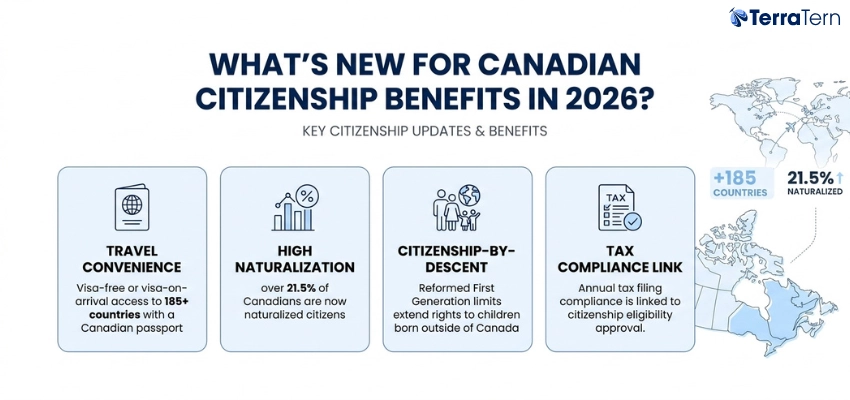
Core Canadian citizenship benefits entail that citizenship gives individuals unconditional access to residency rights, to voting, and to crossing borders between Canada and other countries.
-
Travel Convenience: travel anywhere in the world without a visa or with a visa-on-arrival to more than 185 countries with a passport issued by Nepal!
-
High Naturalization: The majority of Canadians are now naturalized citizens (more than 21.5%).
-
Citizenship-by-Descent: Reformed First Generation limits extend citizenship rights to children who are born outside of the country.
-
Tax Compliance Link: Annual tax filing compliance history is maintained and holds true for approval of eligibility.
As per our TerraTern Expert Shreya, Passport rankings, processing times, and eligibility figures shift often. Treat every number above as a starting point, and verify it against IRCC.ca before making a decision based on it.
Also Read: Canadian Citizenship Benefits: Latest Experts Guide
What Are the Key Political Rights of Canadian Citizenship?
One of the key advantages of Canadian citizenship benefits is the exclusive political rights granted to Canadian citizens and not permanent residents. Naturalized citizens have a constitutional right to vote in all tiers of government: federal, provincial, and municipal. Also, it entitles individuals to serve in the political arena and to employment in certain positions in the federal government that mandate a top security clearance.
Can Canadian Citizens Vote and Run for Office?
Indeed, a core Canadian citizenship benefit is the right to vote and stand for election in every jurisdiction where they reside, including municipalities, provinces, and the federal district. Permanent residents have limited political rights, whether being permanent residents or not. Having this same right gives you the power to directly affect policies covering taxation, healthcare, education, and national laws concerning immigration.
What Government and Security-Clearance Jobs Require Citizenship?
A long-term stable government is one of the Canadian citizenship benefits. Permanent residents may have access to some federal jobs, but citizens have exclusive job benefits:
-
Democratic Participation: Only citizens are allowed to vote and to run for office.
-
Fed Orders: Citizens receive the majority of positions in government through the political process.
-
Citizenship: It is a difficult obligation in the RCMP, CSIS, and Canadian Armed Forces, but where it does factor into jobs, it's a critical hard requirement.
Important Note: If a government or security-sector career is part of your long-term plan, citizenship isn't optional; many of these roles simply aren't open to permanent residents, no matter their qualifications.
What Are the Social Benefits of Canadian Citizenship for Indians?
Understanding the social benefits of Canadian citizenship is essential for Indian expats planning their long-term future. A key Canadian citizenship benefit is guaranteed lifetime access to public healthcare and education, faster family-sponsorship processing, and automatic citizenship transfer to your children, valuable advantages layered on top of what most Indian PRs already receive.
Do Canadian Citizens Get Free Healthcare and Education?
While basic access already exists for permanent residents, evaluating the social benefits of Canadian citizenship shows that a critical Canadian citizenship benefit is the permanent removal of status uncertainty:
-
Healthcare: Citizens and PRs both access Canada's publicly funded healthcare system for doctor visits, hospital stays, and essential medical services once provincial eligibility is established, but citizenship permanently removes any risk tied to maintaining PR status.
-
K-12 Education: Public school education is completely free for both citizens and PR dependents alike across all provinces and territories.
-
Post-Secondary Tuition & Aid: Both citizens and PRs pay domestic tuition rates rather than elevated international rates, with shared access to government student loans and grants; however, select specialised scholarships and awards remain strictly reserved for citizens.
How Does Citizenship Affect Family Sponsorship for Indian Families?
When evaluating the comprehensive social benefits of Canadian citizenship, family reunification stands out as an area where acquiring a Canadian citizenship benefits delivers a significant upgrade:
-
Automatic Citizenship for Children: Children born to a Canadian citizen, even outside Canada, generally acquire citizenship automatically without a separate application, subject to standard Citizenship Act provisions.
-
Faster Family Sponsorship: Citizens can generally expect smoother and faster processing pathways when sponsoring spouses, parents, and dependent children for PR compared to PR holders.
-
Parental and Childcare Support: Citizens maintain uninterrupted access to government-funded child benefits, childcare subsidies, and parental-leave programs without any risk of status interruption
Expert Advice: Don't expect citizenship to unlock brand-new healthcare or school access; PR already covers that. The real upgrade here is permanence and faster family sponsorship, not new day-to-day services.
Also Read: CA Salary in Canada
What Are the Financial Benefits of Canadian Citizenship?
Exploring the financial benefits of Canadian citizenship reveals a system designed for long-term economic stability. A major Canadian citizenship benefit is the continued, guaranteed eligibility for Employment Insurance (EI), the Canada Pension Plan (CPP), and Old Age Security (OAS) without any future status-renewal risks.
What Tax Benefits Do Canadian Citizens Get?
Understanding taxation advantages is a critical Canadian citizenship benefit. While many of these overlap with permanent residency, the true financial benefits of Canadian citizenship lie in the permanent removal of status-related uncertainty:
-
GST/HST Credit: Available to eligible low- and middle-income citizens and PRs alike, determined strictly by income rather than citizenship status.
-
Foreign-Income Treaty Relief: Citizens who later work or reside abroad may rely on Canada's extensive tax treaties to significantly reduce double taxation on foreign income, depending on their residency status for tax purposes.
-
Investment and Property Flexibility: Citizens face absolutely no restrictions tied to immigration status when investing in Canadian businesses or purchasing property. This is a flexibility PRs mostly already share, but citizenship removes any future uncertainty attached to it.
-
Professional Consultation: Tax treatment depends heavily on individual circumstances, including your specific work and living arrangements. This is general information, not personalized tax advice. Always speak with a certified cross-border tax advisor before making financial decisions.
Are Citizens Eligible for Pensions and Unemployment Support?
Securing lifetime access to vital support networks is an essential Canadian citizenship benefit. Evaluating the financial benefits of Canadian citizenship reveals that while PRs can access these programs, citizenship guarantees lifetime continuity:
-
Employment Insurance (EI): Both citizens and permanent residents who have made qualifying contributions are fully eligible for EI during job loss or a career transition.
-
Canada Pension Plan (CPP): Contributions and eligibility function identically for both citizens and PRs. The CPP is strictly tied to your work and contribution history in Canada, not your citizenship status.
-
Old Age Security (OAS): OAS is available to eligible citizens and PRs who successfully meet Canadian residency requirements. However, citizenship permanently removes any long-term uncertainty about maintaining this eligibility or meeting PR physical presence days later in life.
|
Program |
Permanent Resident |
Citizen |
|
GST/HST credit |
Yes (income-based) |
Yes (income-based) |
|
Employment Insurance |
Yes |
Yes |
|
Canada Pension Plan |
Yes |
Yes |
|
Old Age Security |
Yes |
Yes — no status-renewal risk |
|
Citizen-only scholarships |
No |
Yes |
Expert Advice: The financial upside of citizenship is less about unlocking new programs and more about removing renewal risk on the ones you can already access as a PR. Set expectations accordingly, especially if a scholarship or specific program is your main motivation.
Also Read: Canadian Citizenship for Indians: Eligibility, Process, Cost
What Are the Benefits of Canadian Citizenship in the US?
For those prioritizing cross-border mobility, a major Canadian citizenship benefit is the unmatched travel and professional freedom granted in the United States. Canadian citizens enjoy up to a six-month visa-free tourist stay in the US, which is double the standard 90-day Visa Waiver Program allowance granted to most other visa-exempt nationalities.
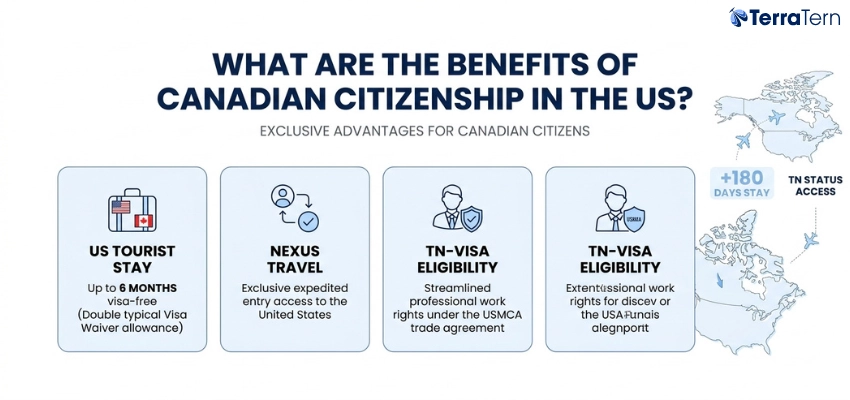
Additionally, this status unlocks exclusive NEXUS trusted-traveller access and streamlined TN-visa professional work eligibility under the USMCA/CUSMA trade agreement, solidifying the immense benefits of Canadian citizenship in US job markets and transit networks.
How Long Can Canadian Citizens Stay in the US Visa-Free?
One of the most practical benefits of Canadian citizenship in US travel is extended visa-free entry:
-
Six-Month Entry Allowance: Canadian citizens can generally stay in the United States for up to six consecutive months per visit for tourism or business without needing a visa.
-
No ESTA Requirement: Travellers from the approximately 40 Visa Waiver Program (VWP) countries are restricted to 90 days and must pre-register via ESTA. Canadian citizens bypass ESTA entirely.
-
Frictionless Border Crossing: Bypassing advanced visitor-visa applications and ESTA registrations serves as an immediate, hassle-free Canadian citizenship benefit for leisure and business visitors alike.
What Is the NEXUS Program and How Does It Help?
The NEXUS program is a joint Canada-US trusted-traveller initiative designed for frequent border crossers. Highlighting the tangible benefits of Canadian citizenship in US travel and transit, NEXUS provides for entrepreneurs and cross-border commuters, cutting down transit friction and saving valuable billable time, directly enhancing the broader, making NEXUS an invaluable Canadian citizenship.
-
Fast-Tracked Border Clearance: Expedited processing through dedicated kiosks at major international airports and land ports of entry.
-
Expedited Security Screening: Seamless access to TSA PreCheck lines at participating US airports and verified priority security lanes in Canada.
-
Dedicated Highway Lanes: Priority processing lanes at major land border crossings, cutting hours off road travel during peak times.
A Note on TN-Visa Work Access
Beyond leisure and transit, unlocking major opportunities is possible through specialized US career opportunities:
-
USMCA/CUSMA Eligibility: A premier Canadian citizenship benefit is direct access to the TN nonimmigrant visa classification under the USMCA trade agreement.
-
Expedited Port-of-Entry Processing: Qualified Canadian professionals (such as software engineers, accountants, management consultants, and scientists) can apply for and receive work authorization directly at land borders or airport pre-clearance facilities.
-
High-Yield Career Mobility: While the TN classification is strictly a temporary nonimmigrant status that does not lead directly to a green card, rapid access to higher compensation brackets in the American labour market remains one of the greatest benefits of Canadian citizenship in US professional advancement.
Important Tip: Don't conflate benefits of Canadian citizenship in the US with a full US-vs-Canada citizenship comparison. This section is about the access advantages a Canadian citizen gets when visiting or working temporarily in the US, not a verdict on which citizenship is better overall.
Also Read: How to Check if a Canada Visa is Original or Fake?
How Far Does a Canadian Passport Travel?
Securing a Canadian passport unlocks exceptional global mobility, making it one of the world's most powerful travel documents. For expats weighing their long-term options, this international freedom is one of the most compelling Canadian citizenship benefits for professionals and their families.
-
Extensive Global Access: A Canadian passport currently provides visa-free or visa-on-arrival entry to roughly 185+ countries worldwide.
-
The Schengen Area: Enjoy frictionless travel across Germany, France, Italy, and all other Schengen member states.
-
The United Kingdom: Access the UK effortlessly for short-term stays without advance visa applications.
-
Asia & Oceania: Travel smoothly to Japan, South Korea, and Singapore, and easily enter Australia using an Electronic Travel Authorization (eTA).
-
Worldwide Consular Protection: Beyond travel privileges, Canadian citizens receive full, guaranteed support from Canadian embassies and consulates globally, a crucial safety net unavailable to permanent residents, who must rely on their home country's consular services while travelling on a foreign passport.
|
Destination / Benefit |
Entry Requirement / Status |
|
Global Mobility |
~185+ countries (Visa-free / Visa-on-arrival) |
|
The Schengen Area |
Visa-free |
|
United Kingdom |
Visa-free (Short stays) |
|
Australia |
Electronic Travel Authorization (eTA) |
|
Japan, South Korea, Singapore |
Visa-free |
|
Global Consular Support |
Full protection via Canadian embassies |
As per TerraTern Expert: Passport rankings change from year to year; always confirm the current-year visa-free country count before quoting it, since this is one of the figures readers (and AI search tools) check most often for accuracy.
Can Canadian Citizens Hold Dual Citizenship With India?
Because India strictly prohibits dual nationality, Indian-origin individuals cannot hold both passports simultaneously. However, transitioning offers a unique Canadian citizenship benefit for Indians: you can surrender your Indian passport and obtain an Overseas Citizen of India (OCI) card, retaining lifelong visa-free entry and vast civil rights without holding Indian citizenship.
What Happens to My Indian Passport After Canadian Citizenship?
Securing Canadian citizenship benefits for Indians requires strict compliance with Indian law:
-
Mandatory Surrender: You must immediately surrender your Indian passport to the nearest Indian mission.
-
Strict Compliance: Retaining both passports simultaneously is a serious legal violation.
-
Penalties: Failing to surrender the document can result in financial penalties.
-
Next Steps: Most individuals subsequently apply for an OCI card.
What Rights Does the OCI Card Provide?
The OCI card serves as a tremendous Canadian citizenship benefit for Indians, offering strong, practical ties to India:
-
Lifetime Visa: Indefinite, visa-free entry and residency.
-
Property: Buy and inherit non-agricultural real estate.
-
Business: Full economic and financial activity rights.
-
Education: Access to NRI admission quotas.
-
Employment: Work privately, though Indian government roles are prohibited.
-
Consular: Access local Indian mission support.
Pro Tip: Surrendering your Indian passport isn't paperwork you can put off; build it into your citizenship timeline from day one, since delays or non-compliance can create real legal complications later.
Also Read: Top 10 Benefits of Canadian Permanent Residency
Canadian Citizenship vs. Permanent Residency: What Actually Changes?
Permanent residency already grants the right to live, work, study, and access healthcare anywhere in Canada. However, upgrading your status unlocks a premier Canadian citizenship benefit.
|
Aspect |
Permanent Resident |
Citizen |
|
Voting rights |
No |
Yes |
|
Can run for office |
No |
Yes |
|
Canadian passport |
No |
Yes |
|
Deportation risk |
Yes (on criminal grounds) |
No |
|
Status renewal required |
Yes (PR card, ~every 5 years) |
No |
|
Residency obligation to maintain status |
Yes |
No |
|
Government/security clearance jobs |
No (most) |
Yes |
|
Healthcare & K-12 education access |
Yes |
Yes — unchanged |
Key Note: If voting, government-sector jobs, and long-term peace of mind aren't priorities for you, PR alone already covers most day-to-day rights. Citizenship is most valuable for permanence and civic participation, not for unlocking new daily benefits.
What Are the Downsides of Canadian Citizenship?
While the advantages are vast, obtaining a Canadian citizenship benefit requires navigating a few significant trade-offs:
-
Loss of Indian Citizenship: India prohibits dual citizenship. Becoming Canadian means surrendering your Indian passport, a major personal and administrative step that is only partially softened by acquiring an OCI card.
-
Residency Tracking: You must accurately track and prove a minimum of 1,095 days of physical presence within the 5 years prior to applying. This can be burdensome for frequent international travellers or those with offshore employment.
-
Language Proficiency: Applicants between the ages of 18 and 54 must formally prove English or French conversational proficiency through an approved evaluation.
-
Tax Compliance: You must demonstrate strict tax-filing compliance for at least 3 of the 5 years counted toward your residency requirement. Additionally, global tax-reporting complexity may increase if you later choose to reside outside of Canada.
-
Time and Cost: Application processing is an extensive commitment, frequently taking 12 to 16 months, and the government fees are significantly higher than a standard PR card renewal.
Pro Tip: A genuinely balanced view, trade-offs included, not just upside, is what separates useful guidance from marketing copy. If frequent international travel or uncertainty about giving up Indian citizenship gives you pause, it's worth weighing carefully rather than assuming citizenship is automatically the right next step.
How Do Indians Apply for Canadian Citizenship?
Securing a lifelong Canadian citizenship benefit involves a rigorous but strictly defined application process:
-
Residency: Formally prove 1,095 days (3 years) of physical presence in Canada within the 5 years immediately preceding the date of your application.
eservices.cic.gc.ca -
Language: Provide officially recognized proof of English or French proficiency for applicants aged 18 to 54.
-
Citizenship Test: Pass a formal examination covering Canadian history, values, institutions, and democratic rights (mandatory for ages 18 to 54).
Expatica -
Tax Filing: Provide documented evidence of Canadian income tax compliance for at least 3 of the last 5 years.
Citizenship Act - Justice Canada -
Full Walkthrough: Following the preparation of these documents, the typical 12- to 16-month journey includes application submission, a potential interview, and ultimately the official citizenship oath ceremony.
Key Note: Start collecting your tax-filing records and language-test results well before you're eligible to apply; these two requirements cause the most avoidable delays.
Also Read: How to Get Canada PR After Study? Latest Process
Conclusion
The core Canadian citizenship benefits span exclusive political participation, unmatched global mobility, and absolute freedom from residency renewal obligations. While healthcare, education, and social security access largely mirror permanent residency, citizenship guarantees these rights permanently.
You must carefully weigh the significant trade-off of surrendering your Indian passport against these lifelong structural gains. If you are ready to evaluate your timeline, TerraTern's eligibility calculator offers a practical starting point.
To know more about Canadian immigration, visit Terra Tern now!