



Key Highlights
- Why Are Architecture Universities in Canada the Right Choice for Indian Students in 2026?
- What Are the Best Architecture Universities in Canada According to QS Rankings 2026?
- What Are the Admission Requirements for Architecture Universities in Canada for Indian Students?
- How Much Does It Cost to Study at Architecture Universities in Canada?
- What Scholarships Are Available at Architecture Universities in Canada for Indian Students?
- How Can Indian Students Apply to Architecture Universities in Canada Step-by-Step?
- What Are the Career Opportunities After Studying at Architecture Universities in Canada?
- What Are the Specialisations Available at Architecture Universities in Canada?
- Is an Indian Architecture Degree Recognised in Canada? (CACB vs. COA Explained)
- How Does Studying Architecture in Canada Lead to Canada PR for Indian Students?
- Conclusion
Architecture Universities in Canada align their degrees with the CACB Standards, provide hands-on experience through studio courses, and offer robust co-op/internship programs that open doors for students to pursue careers in architecture around the world. Such programs, led by the University of Toronto, UBC, McGill, Waterloo, and others, are accredited, lead to licensure and paid work experience, and offer a well-defined pathway to a PGWP-to-PR. Cities such as Toronto, Vancouver, and Montreal offer strong design ecosystems, a rich, real-world design studio program and industry networks for emerging architects that lead to licensure and paid work experience, and yield a clearly defined pathway to PGWP-to-PR.
Why Are Architecture Universities in Canada the Right Choice for Indian Students in 2026?

Canada’s top architecture schools help international students build careers in architecture with valid degrees from top universities in Canada and a direct pathway to permanent residency. This is a perfect match for students from India seeking a design career abroad.
-
Several Canadian universities appear in the QS World University Rankings by Subject 2026 for Architecture and Built Environment. Verify the exact top-100 count and ranks before publishing.
-
Canadian professional architecture programs and accreditation status should be verified separately for licensure and international recognition.
-
Urban design combines classroom learning with real-world city analysis and studio work.
-
More than 6800 job openings for architects are expected to exist in Canada by 2028.
-
A completed eligible Canadian program may make a graduate eligible for a PGWP, which can later support PR pathways such as Express Entry.
-
The skills acquired during a PGWP seamlessly transfer to the Canadian Experience Class (CEC) or Provincial Nominee Programs (PNPs).
-
French/English bilingual environments are an excellent value for targeted global francophone markets and are available in Montreal.
As per TerraTern Expert Shreya, Canada's PGWP makes architecture graduates uniquely positioned; an M.Arch from a CACB-accredited university can lead directly to skilled-worker PR within 2–3 years of graduation.
Also Read: Top Affordable Universities in Canada for Indians
What Are the Best Architecture Universities in Canada According to QS Rankings 2026?
The QS Subject Rankings always pick the Architecture Universities in Canada out of the top international schools. It is important to consider a school's total ranking, tuition, and particular attributes of the program when narrowing your search.
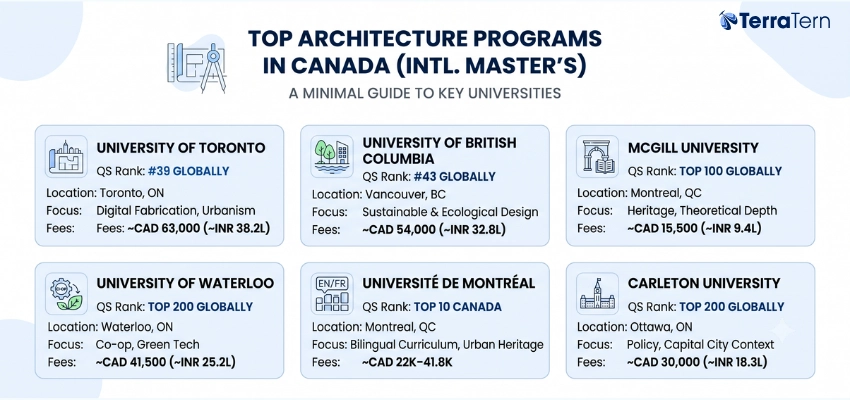
|
University |
QS Subject Rank (2026) |
Location |
Program Focus |
Annual Fees (Intl. Master's) |
|
University of Toronto |
#39 globally |
Toronto, ON |
Digital Fabrication, Urbanism |
~CAD 63,000 (INR 38.2L) |
|
University of British Columbia |
#43 globally |
Vancouver, BC |
Sustainable & Ecological Design |
~CAD 54,000 (INR 32.8L) |
|
McGill University |
Top 100 globally |
Montreal, QC |
Heritage, Theoretical Depth |
~CAD 15,500 (INR 9.4L) |
|
University of Waterloo |
Top 200 globally |
Waterloo, ON |
Co-op, Green Tech |
~CAD 41,500 (INR 25.2L) |
|
Université de Montréal |
Top 10 Canada |
Montreal, QC |
Bilingual Curriculum, Urban Heritage |
~CAD 22,000–41,800 |
|
Carleton University |
Top 200 globally |
Ottawa, ON |
Policy, Capital City Context |
~CAD 30,000 (INR 18.3L) |
|
Dalhousie University |
Ranked |
Halifax, NS |
Building Tech, Coastal Design |
~CAD 25,000 (INR 15L) |
Important Note: Don't choose a university based solely on QS rank; CACB accreditation status is more important for Indian students planning to practice architecture in Canada after graduation.
Is the University of Toronto the Best Architecture School in Canada?
The John H. Daniels Faculty is one of Canada’s leading architecture schools; verify the ranking source before using a #1 claim. Situated in the heart of downtown Toronto, the school offers 13 rigorous programs.
-
Focus: Students are immersed in design innovation, urbanism, and digital fabrication, utilising massive studio spaces and 3D prototyping labs.
-
Admission: Highly competitive. Requires an IELTS of 6.5 and a spectacular creative portfolio.
-
Industry Integration: The Daniels Faculty partners with leading Toronto and global firms, giving students immediate exposure to high-level networking.
-
Community: The University of Toronto has a large international student population, which contributes to a diverse campus environment.
-
Best For: Urban Design and Digital Fabrication
Why Is UBC's Architecture Program Ideal for Sustainable Design?
The School of Architecture and Landscape Architecture (SALA) at the University of British Columbia leverages Vancouver’s renowned eco-city ethos.
-
Focus: SALA is internationally recognised for its emphasis on sustainable design, green infrastructure, and ecological architecture.
-
Campus Highlight: UBC is home to the 17-floor Brock Commons Tallwood House. Once the world's tallest mass timber building, it serves as a living, breathing case study for students.
-
Admission: Requires an IELTS of 7.0 and a B+ average in senior coursework for master's applicants.
-
Environment: Vancouver consistently ranks in the top 20 globally for students, offering an unparalleled mix of urban density and spectacular natural landscapes.
-
Best For: Ecological Architecture and Mass Timber Construction
What Makes McGill University's Architecture Program Unique?
Founded in 1896, the Peter Guo-hua Fu School of Architecture at McGill is one of North America's oldest and most prestigious design schools.
-
Focus: McGill’s architecture school benefits from donor support and strong institutional resources.
-
Value: It offers one of the lowest tuition rates among top-tier schools globally, at approximately CAD 15,500 (INR 9.41L) per year for international students.
-
Location: Situated in Montreal, a UNESCO City of Design and a QS Top-10 student city for 2026.
-
Research: Home to cutting-edge facilities like the FARMM laboratory and the Laboratory for Integrated Prototyping.\
-
Best For: Heritage Preservation and High ROI
Does the University of Waterloo Offer the Best Co-op Architecture Program?
Waterloo’s School of Architecture has a strong co-op component that gives students paid work experience during the degree.
-
Global Reach: It is the only Canadian architecture school with a permanent international facility, operating in Rome, Italy, since 1979.
-
Curriculum: Rated as Canada's greenest architecture curriculum, emphasising environmental responsibility alongside digital computation.
-
The Co-op Advantage: Students alternate between study terms and paid work terms. By graduation, students have accumulated up to two years of professional experience, making them highly employable.
-
Admission: Requires exceptionally high grades (70%+ in Maths/Physics, 80%+ overall) alongside a portfolio and a mandatory interview.
-
Best For: Paid Industry Experience
What Does Université de Montréal Offer for International Architecture Students?
Université de Montréal’s School of Architecture should be described using the correct accreditation or program recognition terminology.
-
Community: It hosts over 10,000 international students within a larger body of 45,000 students.
-
Bilingual Edge: While primarily French, the environment incorporates international culture and bilingual resources, making it ideal for Indian students aiming to enter diverse global markets.
-
Context: Located in Montreal, students are constantly exposed to a rich blend of historic European-style architecture and modern North American design.
-
Best For: Francophone Markets and Cultural Integration
What Are the Admission Requirements for Architecture Universities in Canada for Indian Students?
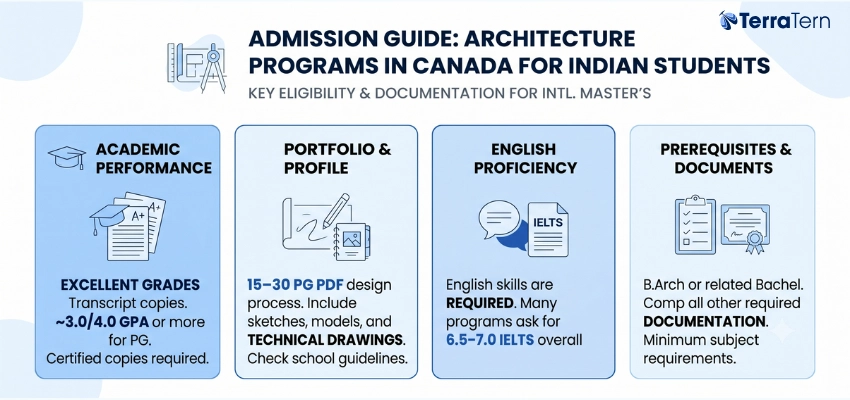
Indian students interested in architecture education institutions in Canada require excellent grades and academic performance, a portfolio or profile, English skills, and all other required documentation.
-
Grade 12 (10+2): For undergraduate admission, Indian students usually need Class 12 marks, minimum subject requirements, transcripts, and certified copies.
-
PG: In context appropriate bachelor level (B.Arch/B.GPA ( Des or related) ~3.0/4.0 or more, or related to prerequisites in some programs.
-
Work Sample: 15–30 page PDF of design process (sketches, technical drawings, and models); reflect on school guidelines.
-
English: English proficiency requirements vary by program, but many architecture programs ask for IELTS 6.5–7.0 overall.
-
Documents: SOP, 2-3 LORs, CV, Translations of documents, LOA for study permit.
Expert Tip: Your architecture portfolio is weighted as heavily as your academic grades at most Canadian universities. Indian students should begin building their portfolio 6–12 months before applying, not after shortlisting.
How Much Does It Cost to Study at Architecture Universities in Canada?
Tuition fees at architecture universities in Canada range from CAD 15,000 to CAD 63,000 per year (approximately INR 9.4 lakh to INR 38 lakh), depending on the university and program level. Understanding the financial commitment is vital. Costs are split between tuition and living expenses, which vary drastically by city.
|
University |
Program |
Estimated Annual Fees (CAD) |
Approx. INR Equivalent |
|
University of Toronto |
M.Arch |
~CAD 63,000 |
INR 38.23 Lakhs |
|
UBC |
M.Arch |
~CAD 54,000 |
INR 32.85 Lakhs |
|
University of Waterloo |
B.Arch Studies |
~CAD 41,500 |
INR 25.23 Lakhs |
|
Carleton University |
B.Arch |
~CAD 30,000–35,000 |
INR 18–21 Lakhs |
|
Dalhousie University |
M.Arch |
~CAD 25,000–30,000 |
INR 15–18 Lakhs |
|
McGill University |
M.Arch |
~CAD 15,500 |
INR 9.41 Lakhs |
Expert Advice: McGill University offers a top-100 global architecture program at one of the lowest tuition fees in Canada (~INR 9.41L/year), making it an exceptional value for cost-conscious Indian students who don't want to compromise on ranking.
Also Read: Best Courses to Study Abroad for Indian Students
What Scholarships Are Available at Architecture Universities in Canada for Indian Students?
The following scholarships are available at selected architecture universities in Canada:
-
University of Toronto: Graduate Fellowships & Daniels Dean’s Scholarships: up to CAD 15,000/yr (~INR 9.15L); merit-based for architecture graduate students at top architecture universities in Canada.
-
UBC: International Partial Tuition Scholarships & Graduate Awards: up to CAD 12,000 (~INR 7.32L); departmental awards for M.Arch applicants.
-
McGill: MEDA Fellowship / Graduate Excellence Award: ≈CAD 10,000+ (~INR 6.1L+); competitive merit and research awards.
-
University of Waterloo: International Master’s Award of Excellence (IMAE): ≈CAD 5,000 (~INR 3.05L); automatic/selection-based for some master’s students.
-
Carleton University: Architecture Graduate Awards: CAD 3,000–8,000 (~INR 1.83–4.88L); departmental bursaries for architecture students.
-
Vanier Canada Graduate Scholarship: CAD 50,000/yr (~INR 30.5L); PhD research scholarship (highly competitive).
-
Ontario Graduate Scholarship (OGS): CAD 10,000–15,000 (~INR 6.1–9.15L); provincial award often open to international students with strong grades.
-
Canada Graduate Scholarships: Master’s (CGS-M): CAD 17,500 (~INR 1.07L) one-year merit award for master’s students.
-
External & Targeted Awards: AAUW International Fellowships (for women), Shastri Indo-Canadian Institute awards (India-Canada exchanges); values and eligibility vary.
Important Tip: Apply to the Ontario Graduate Scholarship early; many Indian students overlook it because it appears province-specific, even though some international students may be eligible.
How Can Indian Students Apply to Architecture Universities in Canada Step-by-Step?
Indian students applying to architecture universities in Canada should follow these steps:
-
Research & shortlist CACB-aligned programs 12+ months before intake; compare fees, city, specialisations and recognition.
-
Check COA reciprocity if you plan to practise in India after graduation.
-
Prepare academic documents (attested transcripts, degree certificates) 10–12 months ahead.
-
Build a strong portfolio (15–25 pages) showcasing sketches, studio projects, CAD/BIM work, and process start 8–12 months early.
-
Book and complete English test (IELTS/TOEFL/PTE) 6–9 months before deadlines; aim above minimum scores for competitiveness.
-
Submit online applications (Oct–Mar for Sept intake) with SOP, 2–3 LORs, CV, portfolio and application fee.
-
Accept LOA and pay deposit; use LOA to apply for a study permit and prepare financial proof (GIC/bank statements).
-
Apply for Canada Study Permit (IRCC) ideally 4–6 months before travel; include LOA, GIC, medical/biometrics as required.
-
Arrange housing, health insurance, travel and orientation; enrol in studio courses on arrival.
As per TerraTern Expert: Begin building your portfolio at least a year before your target intake. This is where most Indian applicants fall short: they have strong grades but weak design portfolios when applying to top schools like Waterloo or U of T.
What Are the Career Opportunities After Studying at Architecture Universities in Canada?
The career landscape for designers in architecture universities in canada is incredibly lucrative. Thanks to sustained infrastructure development, architectural professionals are in high demand.
|
Job Role |
Average Annual Salary (CAD) |
INR Equivalent |
|
Licensed Architect |
CAD 85,000–143,000 |
INR 52–87 Lakhs |
|
Project Manager (Construction) |
CAD 75,000–138,000 |
INR 46–84 Lakhs |
|
Urban Designer |
CAD 70,000–100,000 |
INR 43–61 Lakhs |
|
BIM Coordinator |
CAD 70,000–100,000 |
INR 43–61 Lakhs |
|
Architectural Designer |
CAD 65,000–90,000 |
INR 40–55 Lakhs |
|
Landscape Architect |
CAD 60,000–95,000 |
INR 37–58 Lakhs |
Pro Tip: Graduating from an eligible M.Arch program may make students eligible for up to a 3-year PGWP, which can help them gain Canadian work experience.
Also Read: Difference Between College and University in Canada
What Are the Specialisations Available at Architecture Universities in Canada?
Leading architecture universities in Canada offer specialisations including Sustainable Architecture, Digital Fabrication, Urban Design, Heritage Conservation, and Landscape Architecture.
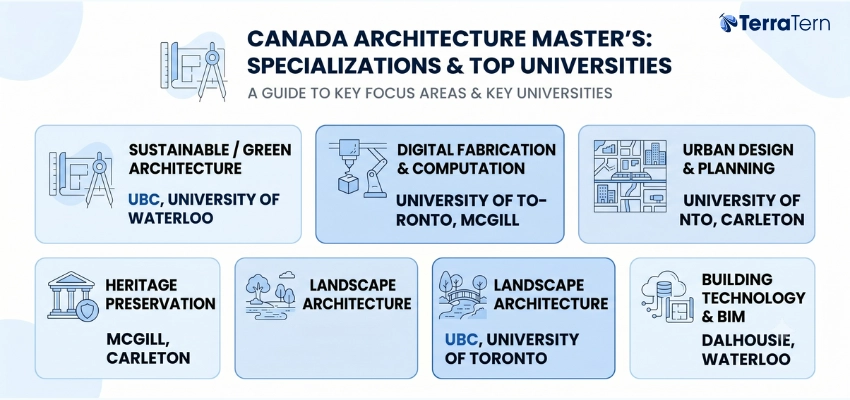
|
Specialisation |
Top Universities to Consider |
|
Sustainable / Green Architecture |
UBC, University of Waterloo |
|
Digital Fabrication & Computation |
University of Toronto, McGill |
|
Urban Design & Planning |
University of Toronto, Carleton |
|
Heritage Preservation |
McGill, Carleton |
|
Landscape Architecture |
UBC, University of Toronto |
|
Building Technology & BIM |
Dalhousie, Waterloo |
-
Sustainable Architecture: Focuses on LEED standards and Passive House design. UBC leads this space through active research and living labs.
-
Digital Fabrication: Involves robotics, 3D printing, and parametric design. The University of Toronto offers world-class facilities for this.
-
Heritage Preservation: Focuses on adaptive reuse of historic structures. McGill and Carleton excel here due to their proximity to older, historic city centres.
Key Note: If you're deciding between universities, match the specialisation to your long-term career goal; a Waterloo co-op in sustainable design yields different career capital than a U of T M.Arch in digital urbanism.
Is an Indian Architecture Degree Recognised in Canada? (CACB vs. COA Explained)
An Indian B.Arch is not automatically recognised in Canada; graduates must have their academic credentials assessed by the CACB to pursue licensure.
-
CACB evaluates academic qualifications and portfolios against Canadian standards, not Indian licensure exams.
-
Process: submit transcripts and portfolio to CACB, receive a deficiency report if gaps exist.
-
Many Indian B.Arch holders complete a Canadian M.Arch (1–2 years) to meet CACB requirements.
-
Check COA-Canada ties if you plan to return to India.
-
For clear pathways, prioritise CACB-accredited architecture universities in canada.
As per TerraTern Expert, Divyansh, always verify your target Canadian university's CACB accreditation status before applying; only degrees from CACB-accredited programs qualify you for the licensure pathway in Canada without additional bridging requirements.
How Does Studying Architecture in Canada Lead to Canada PR for Indian Students?
Canada's immigration system is designed to retain international students it educates, especially in skilled fields such as architecture.
-
The PGWP Advantage: Under 2026 rules, graduating from an eligible master's program grants you a 3-year Post-Graduation Work Permit, even if the study program was shorter than two years.
-
Gaining Canadian Experience: You use this PGWP to work as an Architectural Designer or Intern Architect, gaining highly valued local work experience.
-
Express Entry (CEC): After exactly one year of skilled, full-time work in Canada, you become eligible to enter the Express Entry pool under the Canadian Experience Class (CEC).
-
Provincial Pathways: Provinces such as Ontario, British Columbia, and Alberta have specific Provincial Nominee Program (PNP) streams targeting skilled tech and design professionals, which can further boost your chances of receiving an Invitation to Apply (ITA) for permanent residency.
Key Note: Indian architecture students who complete an M.Arch in Canada and register with a provincial architectural association before applying for PR have significantly stronger CRS profiles due to their Canadian credentials and provincial connection. Start planning your PR pathway from day one of your studies.
Also Read: 1 Year Master's Programs in Canada: Fees, Benefits & Colleges
Conclusion
Architecture universities in Canada blend elite CACB-accredited education with a strategic PR pathway for Indian students. Top institutions like U of T, UBC, and McGill offer world-class design training, while the PGWP and Express Entry system transform academic investment into permanent residency. With competitive salaries and growing urban demand, choosing architecture universities in Canada is both a career and immigration decision, maximising global opportunities and long-term settlement potential.
Contact TerraTern for more information on Architecture Universities in Canada: Top Ranked Programs, Fees & Admission Guide for Indian Students 2026.




 AI Summary