Key Highlights
- What Is a Bridging Visa in Australia?
- What Are the Different Types of Bridging Visas in Australia?
- What Is Bridging Visa A (BVA) and What Work Rights Does It Give?
- What Is Bridging Visa B (BVB) and How Does the Bridge Visa B Australia Process Work?
- What Is Bridging C Visa Australia (BVC) and Does It Include Work Rights?
- What Are Bridging Visa D and E (BVD, BVE)?
- What Is the Partner Bridging Visa Australia Process?
- How Long Does a Bridging Visa Australia Last? (Validity Explained)
- Can You Work in Australia on a Bridging Visa?
- What is the Latest Market Update on Bridging Visa Australia?
- Conclusion
Wondering what a bridging visa in Australia is and how it protects your status? A bridging visa Australia lets you stay lawfully while your substantive application is processed or reviewed. There are five subclasses, each with unique rights: a partner bridging visa Australia usually inherits your prior work rights, while bridging C visa Australia often starts with none.
Need to travel? A Bridge Visa B Australia is essential, as leaving on a BVA cancels it. Bridging visa Australia validity lasts until your application is finally decided, months or even years. So, can you work in Australia on a bridging visa. It depends entirely on your subclass and grant conditions.
What Is a Bridging Visa in Australia?
Understanding what is bridging visa in Australia is essential before lodging any onshore application. Here's a crisp breakdown:
- A Legal Bridge, Not A Pathway: A bridging visa Australia is a temporary visa that keeps you lawfully in the country while your substantive visa application, or a review of one, is being processed.
- It Maintains Status, Nothing More: It doesn't function as a standalone immigration route or grant permanent residency on its own.
- Automatic Activation: In most cases, it activates automatically when you lodge a valid new application onshore or when your previous visa expires.
- No Impact On PR Timeline: Being on a bridging visa doesn't reset or advance your permanent residency timeline independently; it simply preserves your lawful presence.
- Multiple Subclasses: Options range from BVA to bridge visa b Australia, each carrying different travel and work conditions.
- Conditions Vary: Your rights depend on the specific subclass and the conditions listed on your grant letter, making a bridging visa Australia highly situation-specific.
Pro Tip: A bridging visa protects your legal status, not your visa outcome. It buys you time, but your substantive application still needs to be approved on its own merits.
Also Read: Australia Work Visa Requirements For Indians in 2026 Guide
What Are the Different Types of Bridging Visas in Australia?
Australia has five main bridging visa types: BVA, BVB, BVC, BVD, and BVE, each granted in different circumstances with different work and travel rights. Knowing what a bridging visa in Australia is starts with understanding these subclasses.
This bridging visa Australia framework ensures no one becomes unlawful while waiting for a decision on their substantive application. The table below is your core reference for every bridging visa Australia option, and each type is broken down in detail in the sections that follow.
|
Bridging Visa |
Subclass Number |
When Granted |
Work Rights |
Travel Rights |
|
Bridging Visa A |
010 |
Onshore application lodgment |
Inherits previous visa rights |
None (requires BVB) |
|
Bridging Visa B |
020 |
Separate application approval |
Inherits previous visa rights |
Yes, during specified period |
|
Bridging Visa C |
030 |
Lodgment after visa expiry |
Often none (requires separate grant) |
None |
|
Bridging Visa D |
040/041 |
Emergency short-term situations |
None |
None |
|
Bridging Visa E |
050/051 |
Detention or unlawful status resolution |
Discretionary (often limited) |
None |
Key Note: Most applicants only ever encounter a BVA but knowing what BVB, BVC, and BVE mean matters if your circumstances change, such as needing to travel or facing a refusal.
Also Read: Australia Student Visa Processing Time After Medical: Guide
What Is Bridging Visa A (BVA) and What Work Rights Does It Give?
Bridging Visa A (subclass 010) is granted automatically to most applicants who lodge a substantive visa application while in Australia, and it generally carries the same work rights as the visa held immediately before. Here's a crisp breakdown:
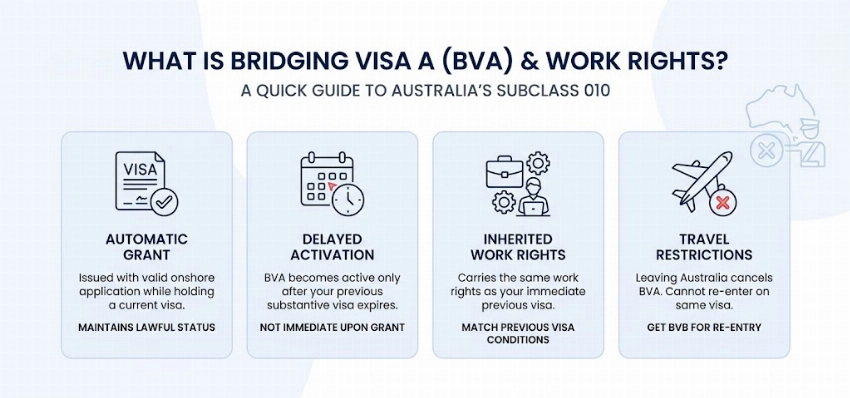
- Automatic Grant: A bridging visa Australia of this type is issued automatically when you lodge a valid substantive application onshore while holding a current visa.
- Delayed Activation: Your BVA only becomes active once your previous substantive visa expires, not the moment it's granted.
- Inherited Work Rights: It generally carries the same work rights as the visa you held immediately before lodging.
- Critical Travel Restriction: Leaving Australia on a BVA cancels it, and you cannot re-enter on the same visa.
- Need To Travel? Get A BVB First: You must secure a bridge visa b australia before departing to protect your status and re-entry rights.
- No Standalone Benefit: This bridging visa Australia simply maintains lawful status; it doesn't advance your PR timeline.
As per TerraTern Expert: If you're on a BVA and need to travel for any reason, even a family emergency, apply for a BVB first. There is no exception that lets you safely leave on a BVA alone.
What Is Bridging Visa B (BVB) and How Does the Bridge Visa B Australia Process Work?
Bridging Visa B (subclass 020) allows a BVA or BVE holder to travel overseas and legally re-enter Australia during a specified travel period while their substantive application is still being decided. Here's how the bridge visa b Australia process works:
- Separate Application Required: Unlike a BVA, this bridging visa Australia isn't automatic; you must apply and pay a separate fee.
- Processing Time: Approval can take days to weeks, so apply at least 3–4 weeks ahead of travel.
- Specified Travel Period: The bridge visa B Australia grants a defined window during which you can leave and re-enter Australia lawfully.
- Reasonable Grounds Needed: You must demonstrate a genuine reason for travel (work, family, study, or personal circumstances) for approval.
- Not For Everyone: BVC and BVE holders generally cannot apply for a bridge visa b Australia.
- Protects Your Application: Traveling on a valid BVB ensures your substantive application continues processing while you're overseas.
Important Note: Never book non-refundable flights before your BVB is granted; approval isn't guaranteed, and processing delays are common enough to make this a real financial risk.
Also Read: How to Get a Working Visa in Australia From India
What Is Bridging C Visa Australia (BVC) and Does It Include Work Rights?
Bridging Visa C (subclass 030) is generally granted when you lodge a substantive visa application after your previous visa has already expired, and it often comes with no automatic work rights. Here's a crisp breakdown:
- Granted After A Gap: Unlike a BVA, a bridging c visa Australia typically applies when you became unlawful before lodging your new application.
- No Automatic Work Rights: This bridging visa Australia usually starts with no permission to work.
- Work Rights On Request: You may apply separately for work rights by demonstrating financial hardship or another compelling reason.
- No Travel Allowed: BVC holders cannot apply for a BVB, meaning overseas travel is not possible while on a bridging c visa Australia.
- Maintains Lawful Status: Despite its limits, this visa keeps you lawfully onshore while your application is decided.
- Plan Ahead: Because work and travel rights are restricted, prepare your finances before lodging a bridging c visa australia.
Expert Tip: If there's any chance your current visa might expire before you lodge your next application, prioritize lodging early. Landing on a BVC instead of a BVA can cost you both work rights and travel flexibility.
Also Read: Parent Visa Australia 2026: Costs, Processing Time & Your Options
What Are Bridging Visa D and E (BVD, BVE)?
Bridging Visa D (subclass 040/041) is a short-term, 5-working-day visa for emergency situations with no work or travel rights, while Bridging Visa E (subclass 050/051) applies to people in detention, facing removal, or resolving unlawful status, often with reporting conditions. Understanding what is bridging visa in Australia at this level helps clarify these rarer scenarios:
- BVD Emergency Stopgap: Granted when you can't immediately lodge a valid application; this bridging visa Australia lasts only about 5 working days and carries no work or travel rights.
- BVD Buys Time: It bridges the short gap until you can lodge a valid substantive application or a BVC/BVE is granted.
- BVE For Unlawful Or Removal Cases: Applies to people in detention, facing removal, or actively resolving their unlawful status.
- BVE Strict Conditions: Often includes reporting requirements, mutual obligation conditions, and address notification obligations.
- BVE Limited Rights: This bridging visa Australia usually grants no work rights and no travel, though work permission may be sought in limited cases.
- Smaller Share Of Applicants: Both BVD and BVE apply to fewer people than BVA, BVB, or BVC, but complete the picture of what is bridging visa in Australia
Expert Advice: If you're on a BVE, resolving your underlying status through review, a fresh application, or departure should be your immediate priority, since it's the most operationally restrictive bridging visa type.
Also Read: Family Sponsored Visa Australia: Requirements & Guide 2026
What Is the Partner Bridging Visa Australia Process?
A partner bridging visa Australia is typically a BVA granted automatically when you lodge an onshore partner visa application (subclass 820/801 pathway) while holding a valid substantive visa.
-
This bridging visa australia activates once your current visa expires, keeping you lawful throughout the often-lengthy partner visa assessment period.
-
Work rights generally mirror whatever conditions your previous visa carried if you held a student visa with restricted hours, those restrictions continue; if you held an unrestricted work visa, full work rights carry over.
-
Once the temporary partner visa (subclass 820) is granted, your bridging visa ceases and the 820 visa takes effect with its own full work and travel entitlements.
-
The permanent stage (subclass 801) is then assessed separately, usually two years after initial lodgement, without requiring a new bridging visa since you already hold the 820.
-
Partner applicants frequently ask about travel the same BVA restriction applies: leaving Australia without a BVB cancels your bridging status and can jeopardise your partner application.
-
If your previous visa had already expired before lodging the partner application, you may receive a BVC instead, which typically carries no automatic work rights.
Important Tip: Partner visa processing delays mean many applicants spend a year or more on a bridging visa. Plan your finances and work arrangements around this realistic timeline, not the official processing estimate alone.
Also Read: Top Australia Visa Agents in India: New Updated List
How Long Does a Bridging Visa Australia Last? (Validity Explained)
A bridging visa Australia validity generally runs until your underlying substantive visa application, including any merits review, is finally decided, which can span months to several years. A bridging visa Australia does not have a fixed expiry date like substantive visas; it is directly tied to the outcome of the application it bridges.
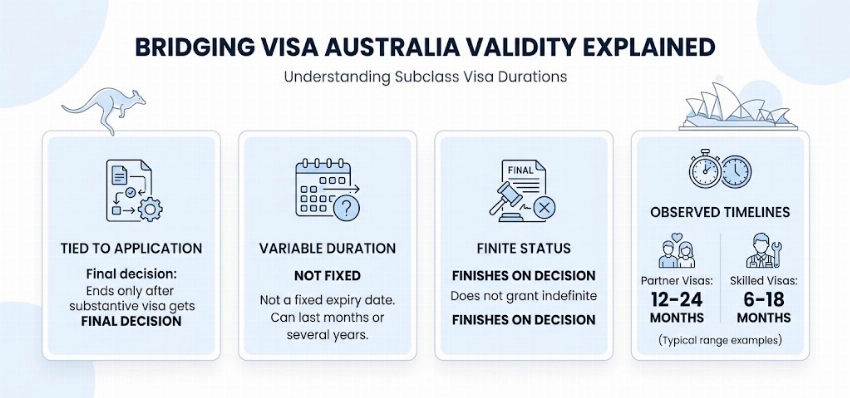
Realistic processing timelines observed for common pathways include 12–24 months for partner visas and 6–18 months for skilled visas, meaning applicants often remain on bridging status for extended periods.
This does not mean indefinite stay; once a decision is made, the bridging visa ends. Key exceptions to the general validity rule: Understanding bridging visa Australia validity is essential to avoid the common misconception that a bridging visa grants indefinite lawful stay; it ends the moment a final decision is reached on your underlying application.
|
Bridging Visa Type |
Typical Validity Period |
|
BVA (010) |
Until substantive application is decided |
|
BVB (020) |
Specific travel period plus processing time |
|
BVC (030) |
Until underlying application is finalized |
|
BVD (040/041) |
Exactly 5 working days |
|
BVE (050/051) |
Specified date on the grant letter |
As per TerraTern Expert Shreya, Don't equate "bridging visa" with "temporary stay" for applicants in slow-processing categories like partner visas; a bridging visa can realistically last well over a year, so plan your life in Australia around that possibility.
Also Read: Australia Dependent Visa Processing Time Guide
Can You Work in Australia on a Bridging Visa?
So, can you work in Australia on a bridging visa? It depends entirely on the subclass and the specific conditions listed on your grant letter. A BVA usually inherits your previous visa's work rights, while BVC, BVD, and BVE often start with no work rights. Here's an actionable breakdown:
- Check Your Grant Letter First: Your Bridging Visa Australia grant notification states your exact work conditions; read it carefully before starting any job.
- Verify Via VEVO: Use the Visa Entitlement Verification Online (VEVO) system to confirm your current work rights in real time.
- Watch For Condition 8101: If your visa carries Condition 8101, it means no work permitted a common trap when asking can you work in Australia on a bridging visa.
- BVA Inherits Rights: A bridging visa Australia of the BVA type usually carries the same work rights as your previous visa.
- BVC/BVD/BVE Often Restrict Work: These typically start with no work rights unless separately granted.
- Apply For A Variation: If you have no work rights but need them, you can request a variation by demonstrating financial hardship or another compelling reason.
- Employer Obligation: Employers must verify your work rights via VEVO before hiring, with penalties for non-compliance.
Also Read: Work and Holiday Visa Australia: Latest Subclass 462 Guide
What is the Latest Market Update on Bridging Visa Australia?
Bridging visas fall under Part 050 of Schedule 2 of the Migration Regulations 1994, with five distinct subclasses: BVA (010), BVB (020), BVC (030), BVD (040/041), and BVE (050/051), the foundation of what is bridging visa in Australia
-
BVA holders in 2026 are increasingly spending extended periods, 12, 18, even 30 months on bridging status, as processing times for partner and skilled visas remain stretched, directly affecting bridging visa Australia validity.
-
Australia's 2026 visa-hopping reforms have tightened rules around lodging fresh onshore applications while on certain bridging visa types, making it critical to know whether a BVA, bridging c visa (subclass 485), or another subclass applies before switching pathways.
-
BVD, used for short emergency situations, remains capped at 5 working days with no work or travel rights.
-
Health insurance obligations under Condition 8501 continue to apply to bridging visa Australia holders connected to visas like the 485 graduate or skilled pathway, requiring continuous OSHC/OVHC coverage.
-
Bridging visa B (Australia) applications remain essential for BVA holders who need to travel, with 2026 guidance recommending applying 3–4 weeks before departure.
-
Employers must verify a partner bridging visa Australia holder's or any bridging visa holder's work rights via VEVO before employment, with penalties for non-compliance increasingly emphasized in 2026 compliance guidance.
Also Read: Australia Tourist Visa from India: Guide for Indians
Conclusion
A bridging visa in Australia is what keeps you legally in the country while your next visa whether partner, skilled, or graduate, is being decided, and understanding what is bridging visa in Australia is changes what you can and can't do.
Remember three takeaways: never travel on a BVA without a bridge visa b australia; work rights are subclass-specific, so always confirm whether you work in Australia on a bridging visa before starting work; and bridging visa Australia validity ties to your application's timeline. Whether on a bridging c visa Australia or partner bridging visa Australia, unsure which bridging visa Australia applies? Book a TerraTern consultation today.





 AI Summary