

Key Highlights
- What Is the Current Australia Student Visa Processing Time After Medical in 2026?
- Why Is the Medical Examination Mandatory for the Australia Student Visa (Subclass 500)?
- What Happens Step-by-Step After You Complete the Medical Exam?
- What Factors Affect the Australia Student Visa Processing Time After Medical?
- What Happens If Your Medical Results Raise a Health Concern?
- How Can Indian Students Speed Up Their Australia Student Visa After Medical?
- What Are the Australia Student Visa Processing Times by Education Sector in 2026?
- 2026 Updates — What Has Changed for Australia Student Visa Medical Processing?
- Conclusion
The average Australia student visa processing time after medical is 33 days (median for Subclass 500) to 4-6 weeks for priority applications, according to official 2026 figures. This can be expedited by submitting detailed documentation, selecting a university under MD115, and the absence of medical complications, with complex applications taking months. Students from India should submit eMedical early to prevent TB delays. Regularly check ImmiAccount.
What Is the Current Australia Student Visa Processing Time After Medical in 2026?

The average time for Australia student visa processing time after medical for Subclass 500 with a clean medical in 2026 is 6-8 weeks, according to the Department of Home Affairs (DHA) benchmarks: 50% of visas processed in 32 days, 90% in 6 months. Total processing time: 1-12 weeks, depending on the case.
2026 Processing Time Scenarios
|
Scenario |
Estimated Processing Time |
|
Clean medical clearance, complete application |
4–6 weeks post-medical |
|
Minor follow-up test required |
7–9 weeks |
|
Referral to Medical Officer of the Commonwealth (MOC) |
10–20+ weeks |
|
Tuberculosis (TB) sputum culture required |
Add 8 weeks (culture result wait) |
|
Application under the NOSC upper threshold provider |
Longer lowest priority queue |
As per TerraTern Expert, Divyansh, Indian students from high TB-burden regions should expect that a chest X-ray showing any abnormality, even historic, may trigger sputum culture testing, automatically extending processing by at least 8 weeks. Book your medical exam at least 3 months before your course start date.
Also Read: Australia Study Visa Processing Time: Latest Guide
Why Is the Medical Examination Mandatory for the Australia Student Visa (Subclass 500)?
Medical checks ensure the country's health requirements safeguard its citizens against infectious diseases such as tuberculosis and HIV.
Subclass 500 Key Medical Exam Points
-
Screened by panel doctors; results automatically sent to DHA via HAP ID, not applicants.
-
Applicants can complete a My Health Declaration before lodging their visa application (pre-lodgement), which removes the medical assessment step from the visa queue. Alternatively, the medical exam can be completed after lodgement using the HAP ID generated in ImmiAccount, with results reviewed in parallel with other visa checks.
-
OSHC health insurance is a mandatory visa condition that complements, but does not substitute, the mandatory medical examination required for the Subclass 500 application.
What Is a HAP ID and How Does It Work in the Medical Process?
The HAP ID simplifies the post-medical visa processing stage by creating a direct data link between the panel physician and the DHA, eliminating manual document submission.
-
Post-lodgement unique reference from ImmiAccount for panel physician appointments.
-
Results auto-report; students don't submit.
-
Medical examinations completed without a HAP ID and results submitted outside the eMedical system are not accepted by the DHA and will require the applicant to repeat the medical process, causing significant delays.
Important Note: Never book a medical exam without your HAP ID. Results from any clinic not accessed via the HAP ID system are automatically rejected, which may result in your application being refused.
What Happens Step-by-Step After You Complete the Medical Exam?
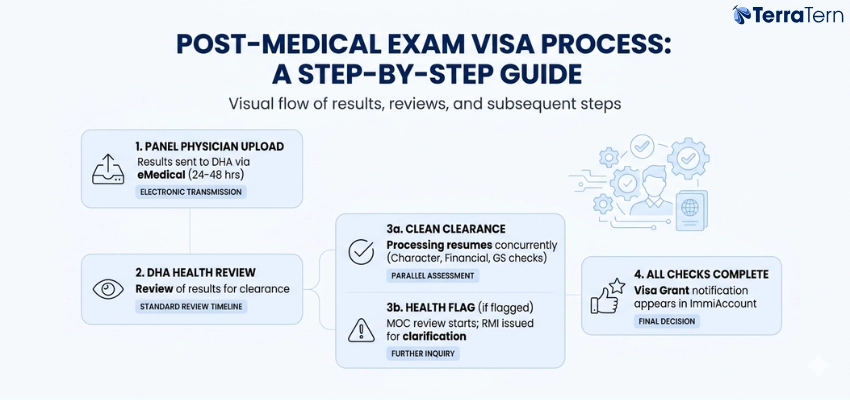
After you complete your medical examination, the eMedical system transmits results directly to the DHA. Clean results are typically reviewed within 2–4 weeks, after which standard processing of character, financial, and GS checks continues concurrently. Indian high-volume applicants may notice longer status gaps, but ImmiAccount provides reliable tracking.
-
Panel Physician: uploads results electronically to DHA via eMedical system (24-48 hours).
-
DHA Health Review: conducted (2–4 weeks standard for clearance).
-
Clean Clearance: Processing resumes—character, finances, and GS checked concurrently.
-
Health Flag: MOC review starts; RMI issued via ImmiAccount for clarification.
-
All checks Complete: Visa Grant Notification appears in ImmiAccount.
Assessment in Progress' indicates that your medical review is underway. This is normal and does not indicate a problem with your application.
Typical Timeline:
Medical submission → 2-4 weeks review → Clearance → 4-6 weeks total processing
How Can You Track Your Australia Visa Status After Medical Clearance?
Monitor australia student visa processing time after medical exclusively via ImmiAccount—DHA's sole reliable method post-medical.
-
Log in to immi.homeaffairs.gov.au with your credentials.
-
Select "User application summary" for the current status overview.
-
Watch key statuses: "Received" → "Assessment in Progress" → "Further Information Required" → "Finalised".
-
Activate email notifications for instant RMI/RFI alerts.
-
Review the Messages tab daily for health or document requests.
-
Post-grant: Use VEVO (Visa Entitlement Verification Online) to confirm conditions and expiry.
Expert Tip: If your ImmiAccount status has remained on "Assessment in Progress" for more than 10 weeks with no message, consider lodging a status enquiry directly with the Department of Home Affairs, but only after the 90th percentile processing time has elapsed.
What Factors Affect the Australia Student Visa Processing Time After Medical?
When calculating expected timelines, it is highly recommended to consult the Department of Home Affairs (DHA) official monthly processing time tool page for current baseline estimates. However, understanding the exact student visa for Australia from India processing time requires looking at specific individual, medical, and systemic variables.
Here is a quick overview of the key variables:
|
Factor |
Impact on Processing |
|
Health Outcome |
Clean results process quickly; flagged results face MOC review delays. |
|
TB History & X-rays |
Abnormalities or history trigger mandatory specialist clearances. |
|
MD115 Priority Level |
High priority levels bypass standard DHA processing queues. |
|
Sector & NOSC Allocation |
Providers over their student caps cause severe processing delays. |
|
Document Completeness |
Missing non-medical files trigger RFIs, pausing the timeline. |
|
Peak Season Volume |
February and July intakes create heavy administrative bottlenecks. |
|
Nationality Volume |
High-volume regions (such as India) naturally experience long queues. |
How Does Ministerial Direction 115 Affect Processing Time for Indian Students?
Ministerial Direction 115 (MD115), effective November 14, 2025, prioritises Australia student visa processing time after medical by education provider risk and student caps, replacing MD111. Indian applications lodged pre-November 14, 2025, follow MD111; post-date use MD115—priority fixed at lodgement. Ministerial Direction 115 (MD115) came into effect on 14 November 2025, replacing MD111. Applications lodged before this date continue to be processed under MD111; applications lodged on or after 14 November 2025 are processed under MD115. Priority level is fixed at the date of lodgement and does not change. This change fundamentally alters how student visas are prioritised in the DHA queue. Crucially, priority is determined purely by your lodgement date and does not change once submitted. Applications lodged before November 14, 2025, will be processed under the old MD111 guidelines, while any application lodged on or after November 14, 2026, will be processed under the new MD115 rules.
Comparison: MD111 vs. MD115 Priority Structures
|
Feature |
Ministerial Direction 111 (Pre-Nov 14, 2026) |
Ministerial Direction 115 (Post-Nov 14, 2026) |
|
Primary Metric |
Provider Evidentiary Level (Risk-based: Level 1, 2, or 3) |
National Overseas Student Cap (NOSC) Allocation |
|
Highest Priority |
Students attending Level 1 (low-risk) institutions |
Students attending providers well below their NOSC limit |
|
Lowest Priority |
Students attending Level 3 (high-risk) institutions |
Students attending providers near or exceeding their NOSC limit |
|
Impact on Timeline |
Fast processing for Level 1; severe delays for Level 3 |
Fast processing for under-cap providers; stalled processing for capped-out providers |
Expert Advice: Under MD115, your education provider's NOSC status can affect your processing priority even if your own application is perfect. Before enrolling, check whether your Australian institution is approaching its intake cap. Your TerraTern advisor can verify this for you.
Also Read: Australia Visa Processing Time: Tourist & Student Guide
What Happens If Your Medical Results Raise a Health Concern?
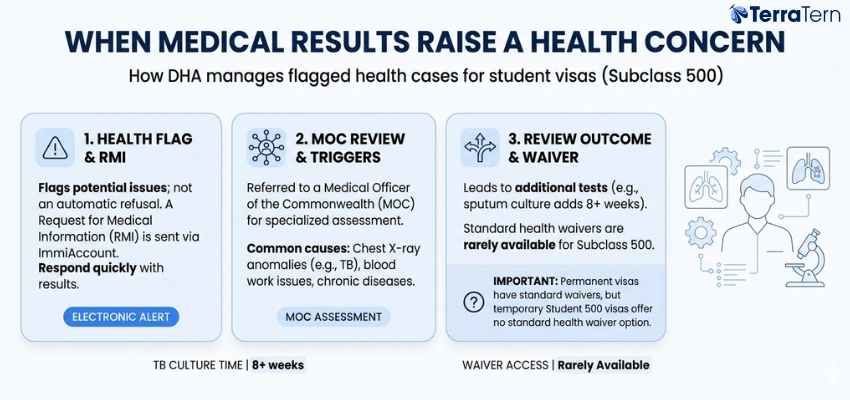
A health concern flag during australia student visa processing time after medical creates anxiety for Indian students, but it rarely means automatic refusal—DHA evaluates individual circumstances carefully.
-
Health Flag Meaning: Indicates potential issues needing clarification; not a visa denial trigger by itself.
-
RMI Process: Request for Medical Information arrives via ImmiAccount, respond quickly with specialist reports or test results.
-
MOC Referral: Medical Officer of the Commonwealth assesses complex cases like TB exposure, HIV positivity, or chronic diseases (e.g., diabetes, cancer).
-
Common Triggers: TB-related chest X-ray anomalies (prevalent in India), HIV status, or conditions posing public health risks.
-
Additional Tests: TB sputum culture typically adds 8+ weeks; blood tests or specialist consults extend review.
-
Waiver Availability: Health waivers apply mainly to permanent visas; Subclass 500 temporary student visas offer no standard waiver option.
Can You Appeal or Speed Up Processing If Your Medical Is Under Review?
Options to accelerate australia student visa processing time after medical under MOC review remain limited; no guaranteed expedites exist, but proactive steps help minimise delays.
-
File a formal expedite request through ImmiAccount, backed by medical documentation from a medical professional proving low risk.
-
Verify all supporting documents (GTE, finances, academics) are error-free to prevent parallel holds.
-
Reply to RMI within deadlines; late responses add 2–4 weeks unnecessarily.
-
No merits review or appeal rights for Subclass 500 health decisions; compliance is key to resolution.
Important Note: Responding to a Request for Medical Information (RMI) within 28 days is critical; delayed responses are one of the top controllable causes of extended post-medical processing times.
How Can Indian Students Speed Up Their Australia Student Visa After Medical?
Indian students can reduce australia student visa processing time after medical by following these prioritised actions, potentially shaving 2–4 weeks off standard timelines.
-
Complete a medical exam via My Health Declaration before lodgement to eliminate sequential delays.
-
Book with NADH-approved panel physicians in Delhi, Mumbai, or Bangalore, faster eMedical uploads than smaller cities.
-
Submit 100% complete non-medical documents (GTE, finances, academics) at lodgement to avoid parallel processing holds.
-
Respond to ImmiAccount messages within 24–48 hours for RMIs or RFIs.
-
File a formal expedite request, along with the course commencement letter, if the intake deadline looms.
-
Consult a MARA-registered agent to confirm the Level 1 NOSC provider status prior to lodgement.
How to Speed Up Australia Student Visa Processing?
The above steps are within your control and can reduce your total post-medical processing time by 2–4 weeks when applied consistently from the pre-lodgement stage.
Is It Better to Complete the Medical Exam Before or After Lodging the Visa Application?
Strategic timing impacts australia student visa processing time after medical, which is chosen based on your health profile.
-
Pre-Lodgement (My Health Declaration): Ideal for healthy Indian students; results are ready immediately, removing a 2–4 week health assessment delay from the visa processing queue.
-
Post-Lodgement (HAP ID): Better for known conditions (TB history, chronic illness); MOC review runs in parallel with GTE/financial checks, avoiding the risk of upfront refusal.
-
Recommendation: No-complication applicants should do medical first; complex cases post-lodgement for efficiency.
-
Key Caveat: Pre-lodgement exams expire after 12 months; always verify the DHA panel physician list.
As per TerraTern Expert: Completing the medical exam before lodgement is the single most impactful action you can take to reduce total processing time. It removes an entire sequential step from the visa assessment chain.
What Are the Australia Student Visa Processing Times by Education Sector in 2026?
Australia student visa processing time after medical is integrated within the overall Subclass 500 timelines under MD115 sector priorities. Assuming medicals are submitted at lodgement, these windows encompass post-medical review for Subclass 500 processing time for India 2026 applicants. Indian university applicants under MD115 are assigned Priority 2 status for Higher Education providers, typically resulting in processing times of 5–8 weeks when the provider is operating within its NPL allocation, while VET delays are common for high-volume sectors.
|
Education Sector |
Priority Level (MD115) |
Indicative Processing Time |
|
Schools & ELICOS |
Priority 1 — Highest |
4–6 weeks |
|
Higher Education (University) |
Priority 2 |
5–8 weeks |
|
VET (TAFE/Private) |
Priority 3 |
6–10 weeks |
|
Non-Award / Foundation |
Priority 4 |
7–12 weeks |
|
Providers near NOSC cap (15%+) |
Lowest priority |
10–20+ weeks |
Pro Tip: If you're applying through a VET or private college provider, check their NOSC allocation status before lodging. Being linked to a provider that has exceeded its 15% NOSC threshold places your application in the lowest priority queue, regardless of how perfect your documents are.
Also Read: Study In Australia- Unlocking A Complete Guide
2026 Updates — What Has Changed for Australia Student Visa Medical Processing?
Key 2026 changes influence australia student visa processing time after medical, prioritising compliance and caps.
-
MD115 (Nov 14, 2025): Replaces MD111 with three tiers; Priority 1 starts in 1-4 weeks, shifts queues for Indian applicants.
-
Visa Fee Hike (Jul 1, 2025): Subclass 500 now AUD 1,600 (from AUD 710); impacts pre-lodgement budgeting.
-
CoE Mandatory (Jan 2026): Letter of Offer insufficient, full Confirmation of Enrolment required before lodgement.
-
English Threshold rise: IELTS minimum overall score of 6.0 (up from 5.5) for Subclass 500 eligibility.
-
NOSC Caps Enforced: Providers exceeding enrolment limits drop to the lowest priority, delaying medical-integrated processing.
-
Enrolment Cap Expansion: Australia raises international student limit to 295,000 for 2026, easing some volume pressure.
-
90th Percentile Extension: Now 7–8 months for complex cases (from 2024's 47–261 days peak).
Key Note: The combination of MD115's new priority structure and increased NOSC oversight means the institution you choose now directly impacts your visa processing speed, not just the quality of your education.
Conclusion
Australia student visa processing time after medical typically spans 4–8 weeks for clean results under 2026 MD115 priorities, with Indian applicants benefiting from strategic timing, such as pre-lodgement My Health Declaration exams. Key to success: complete documentation, Level 1-2 NOSC providers, and rapid ImmiAccount responses to RMIs. Track exclusively via ImmiAccount; expect TB-related delays common for Indian students. Consult MARA agents, such as TerraTern, for provider cap verification before CoE acceptance to optimise timelines and secure timely course starts.
Contact TerraTern for more information on Australia Student Visa Processing Time After Medical: 2026 Guide.




 AI Summary