

Key Highlights
- What Is the Difference Between Permanent and Temporary Parent Visas in Australia?
- What Are the "10-Year Parent Visa" and "5-Year Multiple Entry Visa" for Parents?
- What Is the Parent Visa Australia Cost in 2026?
- What Is the Processing Time for a Parent Visa in Australia?
- Should You Choose the Sponsored Parent Temporary Visa or a Permanent Parent Visa?
- What is the Latest Market Update on Parent Visa Australia 2026?
- Conclusion
Looking forward to visiting Australia in 2026 with parents? It's not just a single program in the parent visa Australia; there are multiple alternative options, and the prices are very different for each pathway, as are the eligibility criteria. The parent visa Australia costs vary from non-contributory at about $8,665 to over $49,900 for contribution visas, so it is important to understand the costs before you enter into the commitment. Permanent relocation is not a requirement; however, for those who want to reunite with their family sooner, the 5-year multiple entry visa for parents (subclass 870) in Australia will allow family members to do this with the option of a 10-year parent visa Australia.
This guide explains the processing time for parent visa Australia; you might choose the right one for you.
What Is the Difference Between Permanent and Temporary Parent Visas in Australia?
The decision on which way to undertake a parent visa Australia application is ultimately a matter of two mandatory choices: fast vs. permanent! These are permanent visas (subclasses 103, 143, 804, and 864) which provide permanent residency, but do have long visa avenues (12-15 years, or more than 30 years, for each visa type) and require meeting the Balance of Family Test.
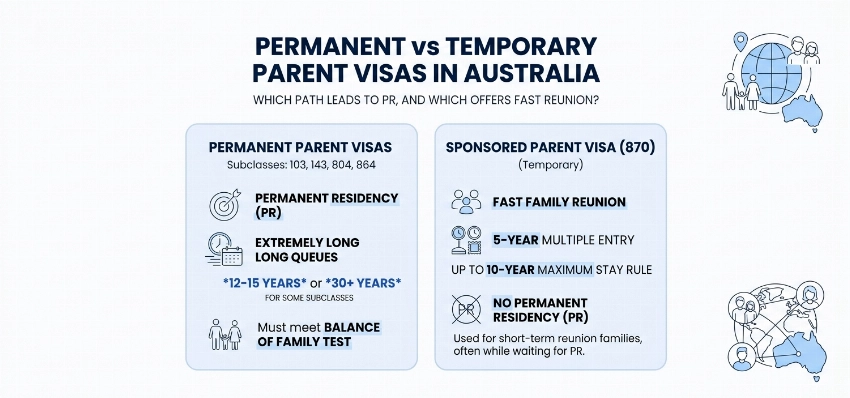
The sponsored Parent visa (subclass 870), on the other hand, does not lead to PR. It allows for holding for additional periods of time and allows 5 year multiple entry visa Australia for parents up to a maximum of 10 year parent visa Australia rule, but it allows for lifetime visas for parents. A lot of families use the 870 to reunite shortly, although a permanent application is in the queue simultaneously.
|
Visa Type |
Subclass |
Leads to PR? |
Typical Processing Time |
Cost Range |
Balance of Family Test Required? |
|
Non-Contributory Parent |
103 / 804 |
Yes |
30+ years |
~$8,665+ |
Yes |
|
Contributory Parent |
143 / 864 |
Yes |
12–15 years |
~$49,900 |
Yes |
|
Contributory Parent (Temporary then Permanent) |
173 → 143 |
Yes |
2 years (temp) + queue |
Similar to 143, staged |
Yes |
|
Sponsored Parent (Temporary) |
870 |
No |
Months (sponsorship + visa processing) |
~$5,000–$20,000+ depending on stay length |
No |
As per our TerraTern Expert Shreya, this decision isn't just about speed vs. permanence, it's irreversible in one direction, so treat it as a genuine family conversation, not just a cost-and-time comparison.
Also Read: Family Sponsored Visa Australia: Requirements & Guide 2026
What Are the "10-Year Parent Visa" and "5-Year Multiple Entry Visa" for Parents?
However, there is only one parent visa in Australia visa that is known as the 'sponsored parent visa (Temporary) subclass 870'.
-
The 870 is given on either a 3-year grant or a 5-year grant, depending on grant eligibility, cost, and availability at the time of the applicant's submission.
-
The "870 visa Australia" described is the ‘5 year multiple entry visa Australia for parents', in which the visa holder can freely travel in and out of Australia, as many times as they choose, during the 5-year period of validity without the need to reapply each time.
-
The “10 year parent visa Australia” is not a visa specifically awarded every 10 years; rather, it is a lifetime cap. The total combined number of years over all the grants may not be more than 10, and parents can receive multiple 870 grants. Australia), parents must reapply for a successive grant (grant number 870).
-
The lifetime maximum for the Cap is 10 years, after this time, the parent will be required to leave Australia or migrate to another visa pathway (the 870 visa is not a pathway to permanent residence).
Important Note: If you're specifically searching for a "10-year parent visa", what you actually want is the Sponsored Parent (Temporary) visa's cumulative stay allowance, not a different, faster, or cheaper product than what's covered elsewhere in this guide.
Also Read: Australia Dependent Visa Processing Time Guide
What Is the Parent Visa Australia Cost in 2026?
The cost of the Sponsored Parent (Temporary) visa is around AUD 6,370 for a three-year grant and AUD 12,440 for a five-year visa, effective from July 2026, and the cost of the permanent visa varies depending on the contributory vs. non-contributory stream.
When navigating a parent visa Australia strategy, it is important to have a well-mapped, precise financial picture since the government fees are paid in instalments, are not refundable, and are variable by yearly instalment every July. The dual currency cost breakdown table below provides exact calculations for each major permanent and permanent visa category in Australian Dollars (AUD) and estimated Indian Rupees (INR) to allow families to assess the parent visa Australia cost in Australian Dollars and estimated Indian Rupees.
|
Visa Type & Subclass |
First Instalment (AUD) |
Second Instalment (AUD) |
Total (AUD) |
Approx. INR (INR) |
|
Sponsored Parent (Temporary - 3 Years) Subclass 870 |
AUD 420 (Sponsorship) + AUD 6,370 (Visa) |
N/A |
~AUD 6,790 total |
~₹3.75 Lakhs+ |
|
Sponsored Parent (Temporary - 5 Years) Subclass 870 |
AUD 420 (Sponsorship) + AUD 12,440 (Visa) |
N/A |
~AUD 12,860 total |
~₹7.10 Lakhs+ |
|
Non-Contributory Parent Subclass 103 / 804 |
~AUD 6,600 |
~AUD 2,065 per adult |
~AUD 8,665+ per parent |
~₹4.80 Lakhs+ per parent |
|
Contributory Parent Subclass 143 / 864 |
~AUD 6,300 |
~AUD 43,600 per adult |
~AUD 49,900+ per parent |
~₹27.50 Lakhs+ per parent |
Important Financial Considerations:
-
Assurance of Support & Bonds: Permanent contributory (such as subclass 143) must have an accompanying government bond (for a single grant holder AUD 10,000 over 10 years, for a couple AUD 14,000 over 10 years) in addition to specific income requirements.
-
Strategic Trade-Offs: Non-contributory paths may have a lower initial cost, but you wait a long time in the queue, several decades. The road of contributory paths involves a significant investment of capital upfront, with time nearing visa approval, but significantly speeds up visa results.
Expert Tip: Budget for the second instalment separately from the first; it's due later in the process, and families sometimes underestimate their total cash-flow needs by focusing only on the upfront application fee.
Also Read: Australia Visa Processing Time: Tourist & Student Guide
What Is the Processing Time for a Parent Visa in Australia?
The processing time for parent visa Australia options depends heavily on the visa tier: the Sponsored Parent (Temporary) visa typically processes within several months, while permanent parent visas can take anywhere from 15 to over 30 years due to strict annual capping and queueing legislation relative to global demand.
-
Securing a parent visa Australia pathway requires understanding that permanent family streams operate under strict government quotas. The breakdown of waiting periods, capping rules, and procedural factors is detailed below.
-
Parent Visa Processing Time Matrix
|
Visa Type |
Subclass |
Typical Processing Time |
Key Factors Affecting Timing |
|
Sponsored Parent (Temporary) |
870 |
Several months (approx. 3 to 5 months) |
Subject to an annual cap of 15,000 sponsorships per program year; depends on application completeness. |
|
Contributory Parent (Permanent) |
143 / 864 |
Approx. 15 years |
Subject to capping and queueing; dependent on annual migration program planning levels and queue release dates. |
|
Non-Contributory Parent (Permanent) |
103 / 804 |
Approx. 30 to 33 years |
Massive historical backlog, extremely limited annual allocation, and strict chronological queueing. |
Unlike skilled or employer-sponsored visas, all permanent parent migration categories are legally subject to capping and queueing:
-
Capping: The Australian Government sets a maximum limit on how many parent visas can be granted during each financial year program. Once that cap is reached, no further permanent visas can be issued until the next program year begins on July 1.
-
Queueing: Eligible applications are placed into a chronological queue based on their valid submission date. Because global demand drastically outweighs the annual allocation, applicants face multi-decade waits for non-contributory paths (Subclass 103/804) and roughly 15 years for contributory options (Subclass 143/864).
-
The Subclass 870 Cap: The temporary 870 visa operates under a separate cap of 15,000 approvals per program year. If this cap is reached, new visa applications must wait until the following program year opens, making early application planning essential.
Expert Advice: If your family is even considering a permanent parent visa, lodge the expression of interest or application as early as possible given multi-decade queues; delaying by even a year can matter over such a long timeline.
Also Read: Parent Visa Applications Australia: Full Guide to Reunite Families
Should You Choose the Sponsored Parent Temporary Visa or a Permanent Parent Visa?
Choose the Sponsored Parent Temporary visa if you want faster reunification and are comfortable with a temporary outcome; choose a permanent parent visa if achieving Australian permanent residency for your parents is the priority, despite the multi-year wait.
Key Decision Factors for Your Family Strategy
-
The Irrevocable Disqualification Warning: Applying for or holding a temporary subclass 870 visa permanently and irrevocably bars applicants from ever transitioning to or applying for any permanent parent visa Australia category (such as Subclass 143, 103, 864, or 804).
-
Cost vs. Timeline Trade-Offs: Evaluating the parent visa Australia cost requires balancing the lower upfront cost and predictable processing time of a 5-year multiple-entry visa for parents against the heavy financial investment of a permanent contributory stream.
-
Weighing the Processing Backlog: Families must carefully review the extensive processing time for parent visa Australia permanent queues, which span 15 to 30+ years, before deciding if permanent residency is strictly necessary versus temporary residency.
-
The Role of the 10-Year Framework: A 10-year parent visa Australia pathway can be achieved sequentially through two consecutive 5-year subclass 870 grants, offering long-term stability without permanent settlement rights.
-
When to Choose Temporary (Subclass 870): Ideal for families prioritising rapid reunification, lower initial staging outlays, and temporary stays of 3 or 5 years without needing Medicare access or permanent residency.
-
When to Choose Permanent (Subclass 143/103): Essential for families who are fully committed to long-term permanent settlement, state-subsidised healthcare access, and eventual citizenship despite high financial outlays or long queues.
-
Uncertain? Seek Professional Guidance: Because temporary sponsorship permanently blocks future permanent parent pathways, undecided families should consult TerraTern before lodging any application to avoid irreversible legal pitfalls.
Pro Tip: Never apply for the 870 visa as a "temporary stopgap" while you decide about permanent residency because the choice is irreversible. Treat it as a final decision, not a placeholder, and get professional advice first if there's any doubt.
What is the Latest Market Update on Parent Visa Australia 2026?
As of 1 July 2026, the Sponsored Parent (Temporary) subclass 870 parent visa Australia fee is approximately AUD 6,370 for a 3-year grant or AUD 12,440 for a 5-year grant, paid in two instalments.
-
Permanent parent visa Australia queues remain among the longest in the system, with non-contributory subclass 103 processing often exceeding 20–30 years due to limited annual places versus high demand.
-
Subclass 870 parent visa Australia grants are capped at 15,000 per program year (1 July–30 June); once the cap is hit, no further visas are issued until the next year.
-
Indian nationals represent a significant share of parent visa Australia demand, with thousands of applications lodged and a notable portion of places going to Indian applicants each year.
-
The 870 sponsor income threshold is approximately AUD 83,455, separate from Assurance of Support rules used in some permanent parent streams.
-
Unlike permanent options, the 870 parent visa australia has no Balance of Family Test, so it does not require at least half the applicant’s children to live in Australia.
-
870 holders must maintain adequate private health insurance for the full duration (condition 8501), as they generally cannot access Medicare.
-
Always verify the latest fees, caps, income thresholds, and processing times on the Department of Home Affairs website, as they can change.
Key Note: Don't choose the 870 visa purely because it's faster since applying for it permanently closes the door to permanent parent visas; it's the right choice only if your family has genuinely decided against pursuing PR for your parents.
Also Read: Sponsorship Visa Australia Requirements: Latest Guide
Conclusion
Parent visa Australia choices in 2026 centre on the temporary 870 visa, as a 10-year parent visa Australia is unavailable. The 870 acts as a 5-year multiple-entry visa for Australia for parents without a Balance of Family Test. Parent visa Australia cost is AUD 6,370 for three years or AUD 12,440 for five years, paid in instalments.
Processing time for parent visa australia exceeds 20-30 years for permanent visas due to limited places, while 870 is capped at 15,000 grants yearly. Indian nationals comprise a significant applicant group. Always check official sources for updates on parent visas in Australia.
Contact TerraTern for more information on Parent Visa Australia: A Comprehensive Guide.