


Key Highlights
- What Are the Best PhD Universities in Germany? (Top 10 Ranked)
- Why Is Germany One of the Best Countries for a PhD in 2026?
- What Are the Admission Requirements for a PhD in Germany for Indian Students?
- What Is the Difference Between a Structured and Individual PhD in Germany?
- What Scholarships and Funding Are Available for a PhD in Germany for Indian Students?
- How Do You Choose the Right PhD University in Germany for Your Field?
- What Are the Costs of Doing a PhD in Germany for Indian Students?
- What Is the Application Process for a PhD in Germany from India?
- What Career Opportunities Are Available After a PhD in Germany for Indian Students?
- 2026 Industry Context Section
- Conclusion
Germany has become one of the leading countries for doctoral research, attracting thousands of foreign scholars to its shores each year. The best PhD universities in Germany provide an unrivalled combination of world-class quality, no tuition fees, and robust financing systems for Indian students who want to pursue research at top international institutions, without being obligated to pay to the moon and back.
What Are the Best PhD Universities in Germany? (Top 10 Ranked)

The QS World University Rankings 2026 is the most convenient guide to choosing the best PhD universities in Germany. This is a well-organised list of the best 10:
|
# |
University |
QS Rank (2026) |
Location |
Best for |
English PhD? |
|
1 |
Technical University of Munich (TUM) |
#22 |
Munich |
Engineering, Tech, Natural Sciences |
Yes |
|
2 |
Ludwig-Maximilian University (LMU Munich) |
#58 |
Munich |
Medicine, Life Sciences, Humanities |
Yes (STEM/Medicine) |
|
3 |
Heidelberg University |
#80 |
Heidelberg |
Medicine, Natural Sciences, Philosophy |
Partial |
|
4 |
Free University of Berlin |
#88 |
Berlin |
Social Sciences, International Relations |
Yes |
|
5 |
Karlsruhe Institute of Technology (KIT) |
#98 |
Karlsruhe |
Physics, Engineering, Environmental Sci |
Yes |
|
6 |
RWTH Aachen University |
#99 |
Aachen |
Engineering, Applied Sciences |
Yes |
|
7 |
Humboldt University Berlin |
~#120 |
Berlin |
Natural Sciences, Arts, Social Sciences |
Partial |
|
8 |
TU Berlin |
Top 200 |
Berlin |
Engineering, Economics, Urban Planning |
Yes |
|
9 |
University of Hamburg |
Top 200 |
Hamburg |
Natural Sciences, Law, Social Sciences |
Partial |
|
10 |
University of Freiburg |
Top 200 |
Freiburg |
Biology, Medicine, Ecology |
Partial |
Is TUM the Best University for a PhD in Engineering in Germany?
TUM consistently ranks as the first choice for the best PhD universities in Germany in engineering and technology. It rose from QS #28 in 2024 to QS #22 in 2026, achieving its best-ever position, and to #19 globally in the Engineering & Technology QS Subject Rankings.
-
TUM has established strong ties with industry, and these collaborations translate into funded PhD projects and industry-integrated research opportunities, e.g., with BMW, Siemens, Bosch, and Audi.
-
TUM Graduate School enables more than 4,500 doctoral students to conduct structured research alongside scholars from various disciplines.
-
The standard acceptance rate is about 8-10% and is considered competitive but attainable for good Indian applicants. More than a third of the students are international, and all students in STEM doctoral programmes study English.
-
No tuition fees; contribution per semester is around €150; PhD programmes taught in English across all four fields – Engineering, Computer Science, Life Sciences, and Management.
As per TerraTern Expert, Shreya, TUM's Graduate School model provides structured mentorship and funding pathways that significantly increase completion rates, especially valuable for Indian students navigating Germany's doctoral system for the first time.
Also Read: PhD in Germany for Indian Students: New Full Guide
Why Is LMU Munich a Top Choice for a PhD in Medicine and Life Sciences?
LMU Munich is a renowned research university, founded in 1472, and one of the oldest and best PhD universities in Germany for doctoral studies in Medicine and Life Sciences.
-
It has trained 16 Nobel Prize winners, and its relationships with the Munich cluster of Max Planck Institutes offer PhD students access to the latest lab technology and additional funding, such as fellowships and grants, that would not be available at standard universities.
-
The Graduate Centre at LMU is the hub for the administration of more than 100 structured doctoral programmes.
-
Its Medical Centre sees more than half a million patients a year, offering excellent clinical research exposure.
-
It is one of the most comprehensive academic institutions in Germany, with 54,600 students (17% international) and 130 libraries.
-
Within Medicine, there exist PhD programmes taught in English (approx. €150 per semester). The International Max Planck Research Schools (IMPRS) provide fellowships for doing a PhD in Medicine in English.
Important Note: LMU's partnership with Munich's Max Planck Institutes means PhD students often get access to cutting-edge labs and funding that goes beyond what a standard university can offer.
How Strong Is Heidelberg University for a PhD in Natural Sciences?
Heidelberg University is the oldest university in Germany (founded in 1386) and ranks #1 in Germany for research publications, #5 in Continental Europe, and among the best PhD universities in Germany for PhDs. At an international level, it ranks at THE #47 and ARWU #51.
-
The fully funded, structured PhD tracks stipend at the Heidelberg Graduate School of Life Sciences (HBIGS) and the Heidelberg Biosciences International Graduate School is available.
-
Around 17% (just a bit easier to get into than TUM) of the total number of doctoral students is from abroad. Heidelberg's well-organised postgraduate courses are suitable for students from an Indian background who have a strong background in Chemistry or Biology.
-
Main facts to consider for Indian students: 20% of international students; fully funded PhD positions available in the Life Sciences at HBIGS; and the cost of living in Heidelberg is between €750 and €950 per month.
Expert Tip: Heidelberg's HBIGS graduate school offers fully funded, structured PhD tracks in life sciences with stipends. Indian students with strong backgrounds in biology or chemistry should prioritise this.
Is RWTH Aachen the Best PhD University for Engineering Research?
RWTH Aachen ranks among the highest-ranked engineering research universities in Europe and is one of the best PhD universities in Germany in fields such as mechanical, electrical, chemical, and biomedical engineering.
-
It has more than 1,000 industry partnerships, and one of the largest interdisciplinary research centres in Europe is the Jülich Aachen Research Alliance (JARA), in partnership with Forschungszentrum Jülich.
-
In research collaborations with Indian engineers, RWTH Aachen is comparable to TUM and has much lower living expenses (Aachen: €750- €950 per month; Munich: €1100- €1300 per month).
-
All RWTH Aachen doctoral programmes in natural sciences and engineering are available in English.
-
English PhD in Engineering; 1000+ industry partners; access to Jülich research infrastructure; no tuition fees.
Expert Advice: RWTH Aachen's collaboration with Forschungszentrum Jülich, one of Europe's largest interdisciplinary research centres, gives PhD students access to infrastructure and funding unavailable at most universities worldwide.
What Makes the Free University of Berlin and Humboldt University Top Choices for Social Science PhDs?
These are the two highest-ranked establishments in Berlin, located in the city centre. QS #88 & Humboldt University is amongst the best in Berlin, in the very heart of the city.
-
If Indian students are pursuing their PhD in humanities/social sciences/ international studies, FU Berlin and Humboldt University are the best PhD universities in Germany for this.
-
FU Berlin (QS #88) is Germany's top-ranked university for social sciences and international relations, founded in 1948 in West Berlin.
-
All these give Berlin an edge over other cities: living costs are only €800–€1000 per month; in addition, there are many independent research institutes (WZB, DIW Berlin, Hertie School) with additional funding and co-supervision opportunities.
-
English-taught PhD programmes in SS&H; less expensive living costs; a wide network of external research institutes.
Important Tip: Berlin has a distinct advantage over Munich for humanities PhDs: lower cost of living (€800–€1,000/month vs €1,100–€1,300/month in Munich) combined with a dense cluster of independent research institutes that offer supplementary funding.
Why Is Germany One of the Best Countries for a PhD in 2026?
The best PhD universities in Germany don't exist in isolation; they are part of a broader ecosystem that makes Germany an exceptional doctoral destination:
-
Zero tuition fees at all public universities for PhD students, regardless of nationality
-
5 universities in the global top 100 (QS 2026): TUM, LMU, Heidelberg, FU Berlin, KIT
-
30,000+ international doctoral students currently enrolled (DAAD, 2024)
-
DAAD scholarships of €1,200–€1,600/month covering living costs, travel, and health insurance
-
Paid Research Associate positions (Wissenschaftlicher Mitarbeiter contracts) at €1,500–€2,500/month, legally employment contracts, contributing to German pension rights
-
18-month post-PhD job seeker visa, no other European country offers this combination of free doctoral education and a guaranteed pathway to skilled employment
-
EU Blue Card eligibility post-PhD with a salary threshold of €43,992/year (2026)
-
Germany–India bilateral science cooperation agreements are expanding in 2026, creating new joint PhD opportunities
As per TerraTern Expert: Germany's post-PhD 18-month job-seeker visa is a game-changer for Indian researchers. No other European country offers this combination of free doctoral education AND a guaranteed window to convert your degree into a high-skilled work permit.
What Are the Admission Requirements for a PhD in Germany for Indian Students?
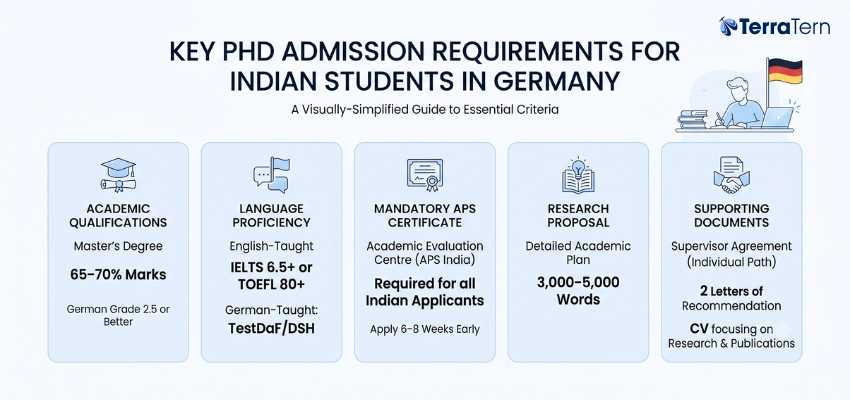
To gain entry to the best PhD universities in Germany, Indian students must meet the following criteria:
-
Academic Qualification: Master's degree with 65–70% marks (equivalent to German grade 2.5 or better)
-
English Proficiency: IELTS 6.5+ or TOEFL 80+ for English-taught programmes; TestDaF/DSH for German-taught ones
-
APS Certificate: Mandatory for all Indian applicants issued by the Academic Evaluation Centre (APS India) in New Delhi. Apply at least 6–8 weeks before your application deadline; no German university will process your application without it
-
Research Proposal: 3,000–5,000 words for most programmes
-
Supervisor Agreement: Required for the Individual PhD pathway
-
Letters of Recommendation: Typically 2, from academic supervisors or research mentors
-
CV/Resume: Emphasising research experience, publications, and academic projects
Pro Tip: The APS (Academic Evaluation Centre) certificate is a non-negotiable requirement for Indian applicants; many students lose months by starting applications without it. Apply at least 6–8 weeks before your intended application deadline.
Also Read: How to Get Admission in German Universities for Indian Students (Guide)
What Is the Difference Between a Structured and Individual PhD in Germany?
The best PhD universities in Germany offer both models, but the Structured PhD is strongly recommended for most Indian applicants. It reduces financial uncertainty, provides structured mentorship, and has clearer completion timelines.
|
Feature |
Structured PhD |
Individual PhD |
|
Duration |
3 years |
4–6 years |
|
Framework |
Graduate school, organised curriculum |
Independent research under one supervisor |
|
Funding |
Built-in stipend (school/fellowship) |
Self-arranged or industry-linked |
|
Similarity to |
UK/US PhD model |
Traditional German model |
|
Best for |
Most Indian students |
Those with existing supervisor contacts |
Key Note: For Indian students unfamiliar with Germany's academic culture, the Structured PhD significantly reduces risk; the Graduate School framework provides a safety net that the Individual model does not.
What Scholarships and Funding Are Available for a PhD in Germany for Indian Students?
Funding is rarely a barrier at the best PhD universities in Germany:
|
Funding Source |
Monthly Amount |
Notes |
|
DAAD Scholarship |
€1,200–€1,600 |
Includes travel allowance and health insurance; competitive for internationals. |
|
Wissenschaftlicher Mitarbeiter (research assistant) |
€1,500–€2,500 |
Employment contract with salary, social contributions, and pension; may include teaching duties. |
|
IMPRS / Max-Planck Fellowships |
€1,365–€1,500 |
Highly competitive, STEM-focused, structured programmes. |
|
Helmholtz Association Fellowships |
Varies |
Strong in engineering & natural sciences; amounts depend on programme and seniority. |
|
Deutschlandstipendium |
€300 |
Supplementary award to top students; adds to other funding. |
|
DFG Research Grants |
Project-based |
Funding attached to the professor’s grant covers stipend, equipment, and travel, depending on the project. |
As per TerraTern Expert, Divyansh, Many Indian applicants overlook the "Wissenschaftlicher Mitarbeiter" (Research Associate) contract as a funding source. These paid university positions are legally employment contracts, meaning PhD students also contribute to the German pension and social security system, which strengthens their future PR applications.
How Do You Choose the Right PhD University in Germany for Your Field?
The best PhD universities in Germany depend on your field: TUM and RWTH Aachen lead in Engineering; Heidelberg and LMU dominate Medicine and Life Sciences; FU Berlin and Humboldt are top in the Social Sciences. For most Indian students, aligning with a professor’s active research projects before applying is the single most important step.
|
Field |
Top Universities (recommendation) |
|
Engineering & Technology |
Technical University of Munich (TUM), RWTH Aachen, KIT |
|
Medicine & Life Sciences |
Heidelberg University, LMU Munich, Charité Berlin |
|
Natural Sciences (Physics, Chemistry) |
LMU Munich, KIT, TU Berlin |
|
Social Sciences & Humanities |
Free University Berlin, Humboldt University, University of Hamburg |
|
Business & Economics |
University of Mannheim, LMU Munich, TU Berlin |
|
Computer Science & AI |
TUM, RWTH Aachen, Saarland University |
Important Tip: German professors respond far better to personalised emails referencing their recent publications than to generic "I want to do a PhD in your department" messages. Spend 30 minutes reading their latest paper before writing.
Also Read: Best Private Universities in Germany For Studies
What Are the Costs of Doing a PhD in Germany for Indian Students?
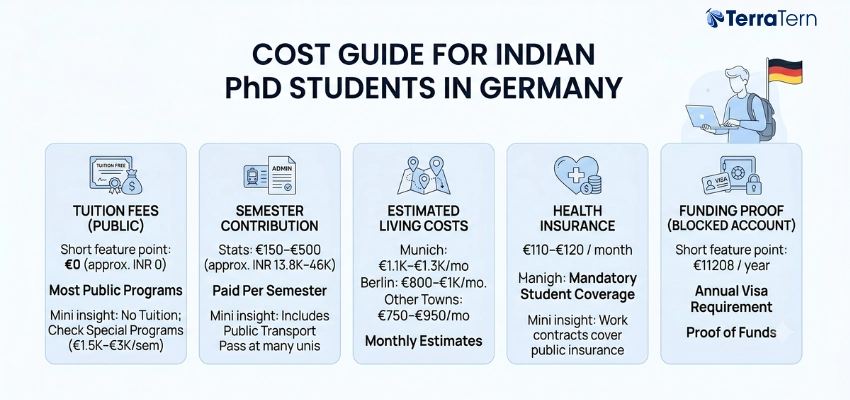
Despite zero tuition at public institutions, attending the best PhD universities in Germany involves costs that require planning:
|
Item |
Cost (EUR) |
Cost (INR, approx.) |
Notes |
|
Tuition (public universities) |
€0 |
INR 0 |
Most public PhD programmes have no tuition; exceptions may charge €1,500–€3,000/semester. |
|
Semester contribution (semester ticket, admin) |
€150–€500 |
INR 13,800–INR 46,000 |
Paid each semester; includes a public-transport pass at many universities. |
|
Living cost, Munich |
€1,100–€1,300 / month |
INR 101,200–INR 119,600 / month |
The highest housing costs in Germany. |
|
Living cost, Berlin |
€800–€1,000 / month |
INR 73,600–INR 92,000 / month |
More affordable than Munich, and a good international community. |
|
Living cost, Aachen / Heidelberg |
€750–€950 / month |
INR 69,000–INR 87,400 / month |
Typical for medium-sized university towns. |
|
Health insurance (student/PhD) |
€110–€120 / month |
INR 10,120–INR 11,040 / month |
Mandatory; research-employee contracts include public insurance contributions. |
|
Blocked account (visa requirement) |
€11,208 / year |
INR 1,031,136 / year |
Required to show proof of funds for a visa (amount set by German authorities). |
|
APS certificate |
, |
INR 25,000–INR 30,000 |
May be required by some German embassies for Indian applicants (check current rules). |
Expert Tip: Munich offers Germany's best university options (TUM and LMU) but also its highest cost of living. For budget-conscious Indian PhD students, RWTH Aachen and Heidelberg offer near-equivalent research quality at significantly lower living costs.
What Is the Application Process for a PhD in Germany from India?
Securing admission to the best PhD universities in Germany follows a methodical process spanning 12-18 months:
-
Obtain your APS Certificate (6–8 weeks, start first)
-
Identify your research area and target supervisor or Graduate School
-
Write your research proposal (3,000–5,000 words)
-
Contact professors (Individual PhD) or apply via the Graduate School portal (Structured PhD)
-
Submit application documents, transcripts, CV, research proposal, 2 LORs, and English score
-
Receive the offer letter or the supervisor agreement
-
Apply for a German Student Visa at the German Embassy/Consulate in India
-
Open a blocked account with €11,208
-
Enrol and register at your university upon arrival
Pro Tip: The APS certificate, issued by the German Academic Evaluation Centre in New Delhi, is mandatory for all Indian applicants to German universities. It cannot be obtained retroactively, and without it, no German university will process your application.
What Career Opportunities Are Available After a PhD in Germany for Indian Students?
A doctoral degree from the best PhD universities in Germany opens multiple high-value pathways. Industry R&D roles at Siemens, BASF, Bayer, SAP, BMW average salaries of €45,000–€70,000/year (approximately INR 40–INR 63 lakh/year).
-
Academic Route: Postdoc positions across Europe, with a clear professorship track
-
Return to India: Full recognition for IIT/IISc faculty positions and CSIR/DRDO research roles
-
EU Blue Card: Qualifying salary threshold of €43,992/year (2026) easily met by most PhD-level R&D roles
-
Permanent Residency: A PhD + 2 years of German work experience qualifies for a settlement permit, one of the fastest PR pathways in Europe for Indian nationals
Key Note: A German PhD is one of the fastest legal pathways to EU permanent residency for Indian nationals. A PhD and 2 years of work in Germany qualify you for a settlement permit, which is faster than most standard skilled-worker PR timelines.
Also Read: Germany Study Visa Requirements: Latest Checklist
2026 Industry Context Section
Latest Statistics (with dates):
-
Germany hosts 30,000+ international doctoral students (DAAD, 2024)
-
49,008 Indian students enrolled in German universities in 2023–24, up 15.1% YoY (DAAD Annual Report 2024)
-
Public universities in Germany charge zero tuition fees; semester contributions are €150–€500
-
DAAD PhD fellowships provide €1,200–€1,600/month plus travel and health allowances (DAAD 2026)
-
TUM moved from QS #28 to QS #22 globally in the 2026 rankings, the highest ever for a German university
-
5 German universities rank in the global top 100 (QS 2026–26): TUM, LMU, Heidelberg, Free University Berlin, KIT
-
Germany–India academic partnerships are expanding under bilateral science cooperation agreements
Expert Insight: "Germany's combination of tuition-free doctoral education, world-class research infrastructure, and a clear post-study immigration pathway makes it arguably the best-value PhD destination in the world for Indian students in 2026."
Conclusion
The best PhD universities in Germany, TUM, LMU Munich, Heidelberg, RWTH Aachen, FU Berlin, KIT, and Humboldt, collectively represent one of the most compelling doctoral options available to Indian students worldwide. Zero tuition fees, structured funding, English-taught programmes, world-class research infrastructure, and a clear immigration pathway make Germany stand apart. Choosing among the best PhD universities comes down to your specific field: chase the institution that is strongest in your research area, not simply the one with the highest overall ranking.
Contact TerraTern for more information on the best PhD Universities in Germany for Indian Students.