Key Highlights
- What is Permanent Residency in Austria?
- What Are the Eligibility Requirements for Austria Permanent Residency?
- Difference Between Permanent Residency and Citizenship
- What Are the 3 Main Pathways to Austria Permanent Residency for Indians?
- How Does the Red-White-Red Card Points System Work for Indians?
- Application Process for Austria Permanent Residency
- Maintaining Your Austria Permanent Residency Status
- Pathways to Austrian Citizenship
- What Are the Benefits of Austria Permanent Residency for Indians?
- How Can TerraTern Help You Secure Austria Permanent Residency?
- Conclusion
Austria permanent residency, officially the Daueraufenthalt-EU (Long-Term EU Resident status) is granted to non-EU nationals, including Indians, after 5 years of continuous legal residence in Austria, provided they meet financial, language, and integration requirements.
Austria Permanent Residency gives individuals a secure and enduring means of living in one of the most financially stable and economically prosperous nations in Europe. In that case, acquiring Austria Permanent Residency provides access not just to superior living standards but also to outstanding health services, encouraging education systems as well as endless economic opportunities. Another great advantage of Austria Permanent Residency eligibility is the ability to travel freely within the Schengen borders without visas, thus drawing interest from all global citizens. Regardless if you want to move into Austria for employment, business or family matters; it provides its residents with a legal framework suitable for starting their lives in this EU member state that has diverse cultural practices and is centrally located geographically. This article will explain how one can benefit from Austria Permanent Residency including conditions for eligibility and application process.
What is Permanent Residency in Austria?
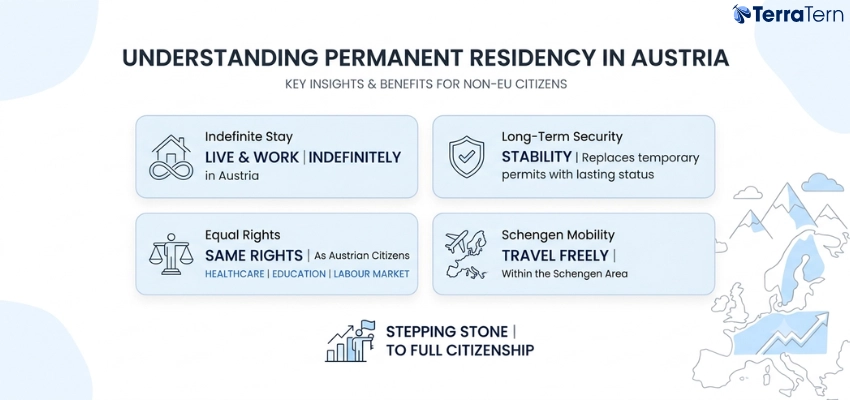
Austria Permanent Residency is a legal status that allows non-EU citizens to live and work in Austria indefinitely. Unlike temporary residence permits, which must be renewed periodically, Austria permanent residency grants long-term security and stability, allowing holders to enjoy the same rights as Austrian citizens in many areas, such as access to healthcare, education, and the labour market. This status is often a stepping stone to full citizenship and provides the flexibility to travel freely within the Schengen Area.
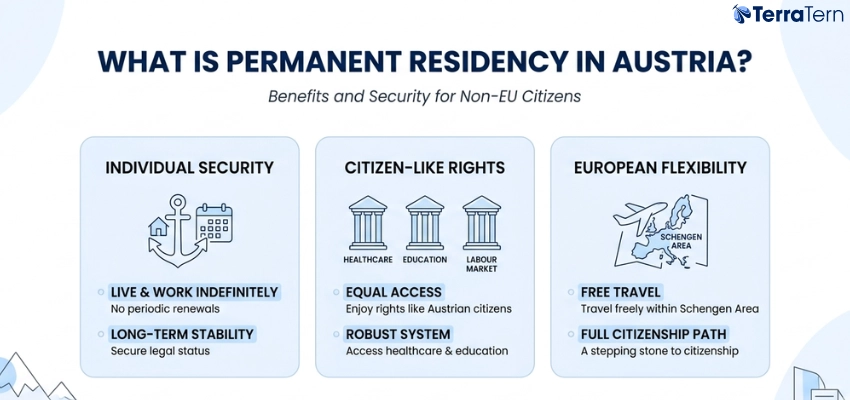
With Austria permanent residency, individuals can build a future in one of Europe’s most prosperous and culturally vibrant nations, benefiting from its high standard of living and robust economic opportunities.
What Are the Eligibility Requirements for Austria Permanent Residency?
To qualify for Austria permanent residency, you usually need to show that you have lived in Austria legally for 5 continuous years, have enough income to support yourself, hold valid health insurance, pass B1 German under Integration Agreement Module 2, and have a clean record.
-
5 Years of Continuous Legal Residence: All five years must be on valid Austrian residence permits, not just time spent in the country. For Indian students, remember that study time may count only partly toward the 5-year total.
-
Financial Self-sufficiency: Your monthly income must meet or go above Austria’s social assistance reference rate. This shows you can live without welfare support.
-
Health Insurance: You need comprehensive health coverage for your stay in Austria. If you are employed and covered under public social insurance, that is usually accepted.
-
Integration Agreement Module 2: This means German at B1 level. You must complete Module 1 first, then pass the exam-based B1 certificate for PR.
-
No Serious Criminal Record: Authorities want a clean legal history in Austria and your home country. Indian applicants are often asked for a Police Clearance Certificate.
-
Adequate Accommodation: You must show proof of a proper place to live, such as a lease agreement or property papers.
Difference Between Permanent Residency and Citizenship
Austria Permanent Residency and Austrian Citizenship offer different levels of rights and obligations. Here's a comparison to highlight the main differences:
|
Criteria |
Austria Permanent Residency |
Austrian Citizenship |
|
Duration |
Indefinite, with renewal every 5 years |
Permanent |
|
Voting Rights |
Not allowed |
Full voting rights in all elections |
|
EU Mobility |
Limited to the Schengen Area |
Full EU mobility rights |
|
Access to Social Benefits |
Eligible for most benefits |
Full access to all benefits |
|
Dual Citizenship |
Not allowed |
Rarely permitted |
|
Passport |
No Austrian passport |
Austrian passport with visa-free access to 189 countries |
What Are the 3 Main Pathways to Austria Permanent Residency for Indians?
The three main pathways for Indians to obtain permanent residency (Daueraufenthalt-EU) in Austria are: the skilled worker route based on the Red-White-Red (RWR) Card, the student-to-professional route that moves from a student permit to a Graduate RWR Card and then career-based permits, and the financially independent persons route for investors/retirees.
|
Pathway |
Best For |
Entry Permit |
Work During? |
PR Timeline (actual residence) |
|
Skilled Worker (RWR Card) |
Employed professionals with job offer |
Red-White-Red Card (2 years) |
Yes — for specified employer |
5 years (all years count 100%) |
|
Student → Graduate → Professional |
Indian students at Austrian universities |
Student Residence Permit |
Limited during study |
6–8 years (50% credit on study years) |
|
Financially Independent Person |
Investors, retirees, high-net-worth individuals |
Residence Permit (Niederlassungsbewilligung) |
No work allowed initially |
5 years (all years count 100%) |
|
Family Reunification |
Spouses/children of Austrian PR holders |
RWR Card Plus |
Yes (open) |
5 years |
|
Researcher / Scientist |
PhD researchers, academic staff |
Settlement Permit (Special) |
Yes (research only) |
5 years |
How Does the Red-White-Red Card Points System Work for Indians?
The Red-White-Red Card uses a points-based system, and skilled workers generally need at least 50 points, scored across education, work experience, language skills, age, and salary. Indian applicants with degrees from IITs, NITs, IIMs, AIIMS, and other strong technical institutions are often well-positioned to meet the threshold through qualifications and relevant experience, especially when they add German language points.
-
Austria's Red-White-Red Card is based on a points-based immigration system.
-
Most skilled workers need a minimum of 50 points to qualify.
-
Points are awarded for education, work experience, language skills, age, and salary level.
-
Higher qualifications and specialized skills can help applicants score more points.
-
German language proficiency can significantly improve an applicant's score.
-
Graduates from institutions such as IITs, NITs, IIMs, AIIMS, and other reputed universities may receive strong points for educational qualifications.
Application Process for Austria Permanent Residency
When you apply for Austria permanent residency, there are aspects where careful attention needs to be paid as it involves collecting specific documents, meeting the eligibility criteria as well as understanding and meeting timelines and fees. This guide crafted by the experts in our organisation provides a holistic overview of the step by step process, including the required documents and all necessary information:
1. Step-by-Step Guide
A. Documentation: Applicants need to gather the following required documents:
-
Valid passport and proof of current residency in Austria.
-
Proof of sufficient financial means, such as bank statements or employment contracts, demonstrating financial stability.
-
Comprehensive health insurance covering medical costs in Austria.
-
A clean criminal record from your country of origin.
-
Proof of German language proficiency at least at A2 level (unless exempt).
B. Application Submission: You need to submit an application at the local immigration office (Magistrat) in Austria or at an Austrian embassy if one is applying from abroad. Ensure all documents are translated into German and are certified as well.
C. Review and Decision: The application then will be reviewed by authorities and they will check eligibility and verify the authenticity of the provided documents. The candidate may even be asked to attend an interview during this stage.
2. Processing Times and Fees
-
Processing Time: Austria permanent residency applications usually take time between 3 to 6 months for approval, it depends on the intricacy and complexity of the case as well as on the authorities.
-
Fees: Application fees usually range from €100-€200, it depends oon the category and residency type.
3. Additional Considerations
If you are applying under special categories such as Red-White-Red Card system then the process may ask for more documentation related to employment or qualification.
Maintaining Your Austria Permanent Residency Status
Maintenance of Austria permanent residency status asks for sticking to specific conditions, including renewals on time and continuous agreement with Austrian law. Understanding the renewal process and potential risks of losing your Austria permanent residency is essential for long-term stay in Austria.
1. Renewal Process
-
Regular Renewals: Permanent residency in Austria requires renewal every 10 years. The applicants need to submit updated documents including proof of continuous residence in Austria, good finances and health insurance.
-
Checklist of Requirements:
-
Proof of residence in Austria.
-
Valid health insurance.
-
Sufficient financial means.
-
Updated criminal record (if required).
2. Potential Reasons for Loss of Status
-
Absence from Austria: Continued periods of absence-more than 12 consecutive months can lead to loss of permanent residency.
-
Non-Compliance: Participating in illegal activities or the failure to meet financial or residence conditions may result in revocation of the residency status.
3. Reapplying After Losing Status
-
Regaining Residency: Individuals have the option to reapply If Austria permanent residency status is lost due to continued absence or other reasons. The process requires demonstration of eligibility again, including proof of continued ties to Austria, sufficient financial means, and sticking to Austrian legal requirements.
-
Eligibility Check: Reapplicants will need to meet the same criteria as new applicants, but
This section informs of the steps necessary to maintain or regain Austria permanent residency.
Pathways to Austrian Citizenship
Austria permanent residency is an important step toward obtaining Austrian citizenship, offering long-term stability and numerous benefits.
-
Hold the Austria Permanent Residency for 10 consecutive years
-
Have German proficiency (B1)
-
Pass citizenship as well as integration test spanning over Austrian History and laws.
-
Have a clean criminal record
-
Finances should be clean and good
-
Stay in austria should be continuous, absences should not be extended.
What Are the Benefits of Austria Permanent Residency for Indians?
Austria Permanent Residency (Daueraufenthalt-EU) offers Indian nationals long-term stability, greater employment flexibility, and access to a wide range of social benefits.
-
Live in Austria indefinitely without needing to renew employer-based residence permits.
-
Work for any employer in any sector or become self-employed.
-
Change jobs freely without requiring approval or notification to immigration authorities.
-
Enjoy visa-free travel across the Schengen Area using your Indian passport and Austrian PR card.
-
Stay up to 90 days within a 180-day period in other Schengen countries.
-
Access Austria's social security system, including pensions, unemployment benefits, and family support programs.
-
Benefit from Austria's healthcare system through comprehensive public health insurance coverage.
-
Sponsor eligible family members through a simpler family reunification process.
How Can TerraTern Help You Secure Austria Permanent Residency?
Navigating Austria's permanent residency process can be challenging, especially for Indian professionals who must meet residence, employment, language, and documentation requirements.
-
Assess your eligibility for Austria Permanent Residency (Daueraufenthalt-EU).
-
Create a personalized PR roadmap based on your profile and long-term goals.
-
Guide you on residence permit renewals and compliance requirements.
-
Assist with document collection, verification, and application preparation.
-
Help you understand German language requirements and integration obligations
Read More: How to Get a Job in Austria? Experts Guide
Conclusion
In summary, there are many advantages of having permanent Austrian residency for people who want to stay in Europe for prolonged periods because it allows access to good medical care, a high standard of education, and robust economies. Meeting requirements such as having a legal residence and showing that you have money can help applicants secure this indefinite status. This also provides a route towards acquiring Austrian nationality, thus increasing your rights within EU territories. Whether you’re an entrepreneur, an expert worker, or just planning to bring back relatives home, having an Austrian permanent residence permit is an excellent option towards a stable future right in the centre of Europe.
To learn more about Austria Permanent Residency and find ways to settle in Austria, you must contact TerraTern. With an expert team and over a hundred services, TerraTern is a leading player in immigration-related services!