Key Highlights
- How to Get a Job in Austria from India?
- How Should I Research the Austrian Job Market Before Applying?
- How Do I Format My CV to Get a Job in Austria?
- Which Job Portals Should I Use to Get a Job in Austria?
- How Do I Prepare for Job Interviews in Austria?
- What Happens After I Get a Job Offer in Austria?
- 2025–2026 Industry Context Section
- Conclusion
To obtain employment in Austria during 2026, you need to select your preferred industry between healthcare, IT and engineering and hospitality and skilled trades before you can align your qualifications with Austria's job requirements. The major job portals, which include AMS Jobroo,d karriere. at and StepStone, and LinkedIn, allow users to create alerts for positions that accept English-speaking applicants and international candidates. Applicants need to create their CV according to Austrian standards, which include structured content, mandatory photographs, exact timelines and truthful information and write personalised motivation letters for each company they apply to. The document shows my qualifications, which match European standards, together with my work background and basic knowledge of the German language.
How to Get a Job in Austria from India?
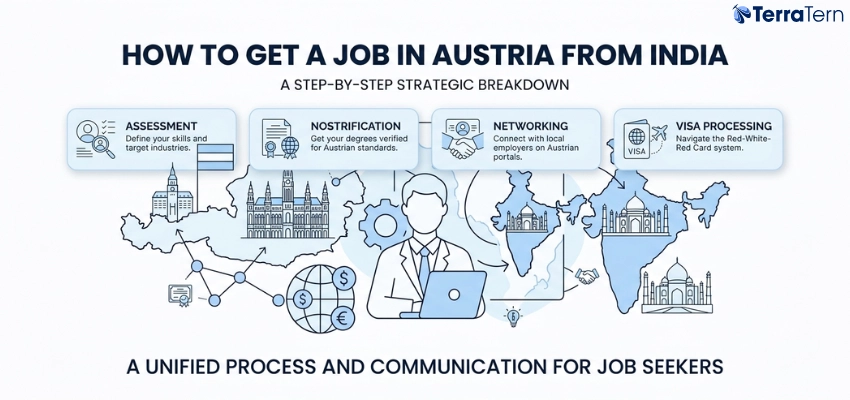
The step-by-step breakdown for how to get a job in Austria from India is
-
Research Shortage Sectors: Your strategic focus should target IT, engineering, and healthcare sectors because these fields maintain operational pathways for Indian professionals who want to join the Austrian workforce.
-
Optimise Your CV: Create your resume according to standard Austrian/Europass guidelines by adding a professional photo and listing your work experience in reverse chronological order.
-
Target Local Portals: The job application process requires you to submit multiple applications through three main Austrian job portals,s which include Karrier,d StepStone Austria and the official AMS eJob-Room platform.
-
Get Degrees Recognised: The nostrification process,s which evaluates degrees, needs to start as soon as possible because it helps you verify your Indian educational credentials.
-
Apply for Your Visa: Once you receive an official how to get a job in Austria, you can start learning about the Red-White-Red Card point-based system and the EU Blue Card,d which will help you find employment in Austria.
Also Read: Jobs in Austria for Foreigners: Latest Experts' Guide
How Should I Research the Austrian Job Market Before Applying?
Research efforts should concentrate on Austria's officially recognised shortage occupations, which include IT and healthcare, engineering and finance, because these fields show both elevated employment needs and simplified visa approval procedures. Research strategies need to avoid mass-job application methods because applicants should create specialised approaches on how to get a job in Austria from India. The Austrian labour market requires exact work, so you should begin your how to get a job in Austria from India through focused industry research.
-
Cross-reference your occupation:Before you invest time in job searching for a particular position, you should verify your occupation against Austria's 2026 shortage occupation list. The 2026 update contains 64 nationwide and 66 regional shortage professions. The process for obtaining a Red-White-Red Card becomes simpler for these positions because candidates need to achieve only 55 points, and they avoid the usual requirement for labour market assessment.
-
Research typical salary bands: The local market requires you to research salary rates for your specific job position and location because this information helps you create accurate salary expectations, which will aid your visa salary threshold planning. The collective agreement minimum standards apply to shortage positions, but the EU Blue Card program, along with other routes, maintain their own specific legal requirements
-
Identify 10–15 target companies: You must find particular businesses operating within your chosen industry and location instead of sending out generic applications to multiple companies. Your international talent sponsorship efforts should focus on organisations that have already demonstrated their capability to sponsor foreign workers.
As per TerraTern Expert Divyansh, Don't skip the shortage-list cross-reference step; targeting a listed occupation can mean the difference between your future employer needing to run a labour market test and being able to skip it entirely.
How Do I Format My CV to Get a Job in Austria?
Austrian CVs (Lebenslauf) typically include a professional photo, follow a clear reverse-chronological structure, and run to about 1–2 pages, noticeably different from CV conventions in several other job markets Indian applicants may be more familiar with. Mastering this layout is a crucial step when figuring out how to get a job in Austria, as local recruiters expect specific structural conventions. Aligning your application with these expectations drastically improves your chances of learning how to get a job in Austria successfully.
Austria CV Structure Checklist:
-
Photo: Customary though not strictly mandatory; use a high-quality, professional headshot.
-
Summary: A brief, impactful professional profile highlighting your core expertise.
-
Experience: Reverse-chronological work history with clear, metric-driven achievements.
-
Education: Academic degrees listed with dates, institutions, and major specialisations.
-
Languages: Clearly stated proficiency levels (e.g., CEFR scale A1–C2) for German and English.
-
Certifications: Relevant professional credentials that validate your technical skills.
Key Formatting Tips:
-
Length: Keep it strictly to 1–2 pages; avoid long, narrative CVs.
-
Cover Letter (Anschreiben): Always include a tailored cover letter explaining your specific value to the role.
-
Language Choice: An English CV works for international tech roles, but a German version signals a stronger long-term commitment.
Important Note: If you're applying to a mix of international and traditional Austrian employers, prepare two CV versions: an English one for multinational/tech-sector roles and a German one for more traditionally-oriented Austrian companies, rather than assuming one version fits every application.
Which Job Portals Should I Use to Get a Job in Austria?
When figuring out how to get a job in Austria, where you look is just as important as how you apply. For the most effective job hunt, Indian applicants should combine major private-sector boards with official government listings and direct networking.
If you are actively planning how to get a job in Austria, focus your search on these core platforms:
-
Karriere. at: Austria's largest dedicated job portal, offering strong visibility across almost all sectors.
-
StepStone Austria: Highly effective for corporate and professional roles, with excellent filtering options for language requirements.
-
AMS eJob-Room: Operated by Austria's Public Employment Service, this provides the widest official listing base, including many roles not advertised elsewhere.
-
LinkedIn and Xing: Essential for direct recruiter outreach and networking, particularly valuable for IT and finance professionals.
-
Company Career Pages: Always check directly with larger employers (such as AVL List, Samsung SDI, Erste Group, OMV Group, or Red Bull GmbH) for exclusive, unlisted roles.
Expert Advice: Don't rely on a single portal; set up alerts across Karriere.StepStone, and AMS eJob-Room simultaneously, since Austrian employers don't consistently cross-post the same listing to every platform.
How Do I Prepare for Job Interviews in Austria?
Austrian interviews are notoriously formal and structured. If you are learning how to get a job in Austria, expect a focus on punctuality, concrete qualifications, and at least conversational German — even for purely English-speaking technical roles.
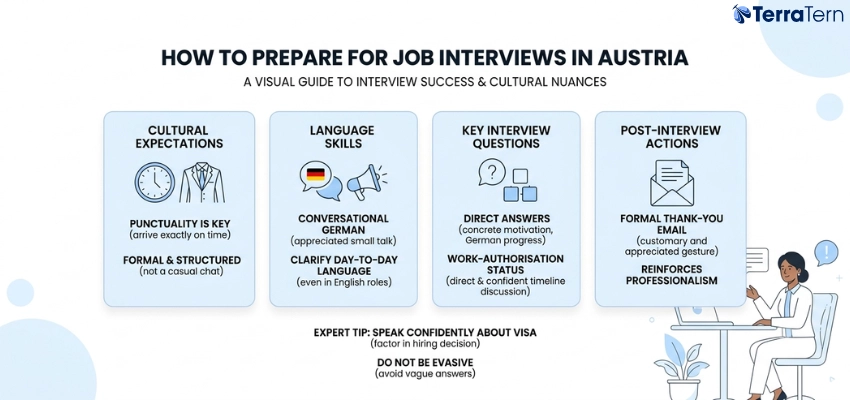
To succeed in your interviews as you figure out how to get a job in Austria, prepare using this framework:
-
Formality: Arrive exactly on time and dress professionally. Expect a highly structured, qualifications-focused discussion rather than a casual chat.
-
Language: Be ready for German small talk. Always clarify the team's actual day-to-day working language before accepting an offer, as English job postings can sometimes be misleading.
-
Common Questions: Prepare direct, concrete answers regarding your motivation for relocating to Austria, your timeline for improving your German, and your specific visa or work-authorisation status.
-
Follow-up: Send a brief, formal thank-you email shortly after the interview; it is a customary and appreciated gesture that reinforces your professionalism.
Expert Tip: Be ready to speak directly and confidently about your visa and work-authorisation timeline in the interview itself; Austrian employers factor this into their hiring decision, and vague or evasive answers here can cost you the offer even if your qualifications are strong.
What Happens After I Get a Job Offer in Austria?
Once you secure a job offer, you generally apply for either the Red-White-Red Card (points-based, employer-tied) or the EU Blue Card (degree-based, higher salary threshold), while finalising your nostrification if it isn't already complete. Understanding this final phase is essential when researching how to get a job in Austria. Successfully executing how to get a job in Austria culminates in navigating these vital post-offer administrative steps.
Post-Offer Checklist & Timeline:
-
Select Your Visa Pathway: Transition to applying for your Red-White-Red Card or EU Blue Card. (For a deep dive into point calculations, refer to TerraTern's dedicated 2026 Austria Visa Guide).
-
Finalise Nostrification: Ensure your degree's recognition process is complete or well underway. A pending nostrification is the most common processing blocker at this stage if not started earlier.
-
Plan Your Timeline: Budget approximately 6–12 weeks for standard visa processing, in addition to any outstanding time needed for your qualification assessments.
-
Understand Card Validity: The initial Red-White-Red Card is valid for 24 months. You can transition toward unrestricted Austrian labour market access (the Red-White-Red Card Plus) after approximately 21 months of continuous employment.
Important Tip: If your nostrification isn't finished by the time you receive an offer, tell your prospective employer directly and give them a realistic timeline; most employers experienced in hiring internationally will accommodate this rather than withdraw the offer, provided you're transparent early.
2025–2026 Industry Context Section
Austria's job market conditions and visa thresholds have both shifted into 2026, making current, dated information more important than the generic advice found across much existing content on this topic.
-
Effective 1 January 2026, the Red-White-Red Card minimum gross salary for the "Other Key Workers" category rose to €3,465/month, and the EU Blue Card threshold rose to €55,678/year — both directly relevant to what a "successful" job offer needs to include for visa purposes.
-
Austria's 2026 Skilled Workers Ordinance lists 64 nationwide shortage occupations, including "Daten-Scientist," several ICT roles, and nursing — targeting these roles specifically improves both job-search and visa-approval odds.
-
Austria's job vacancy rate remains around 4%, among the highest in the EU, with more than 170,000–220,000 open positions reported across recent months.
-
Salaries in Austria are structured around 14 annual payments (12 monthly plus two special payments), which changes how a job offer should be evaluated against a monthly-salary expectation formed from other markets.
-
Nostrification (degree recognition) for Indian applicants typically takes around three months, since India is not among the roughly 55 countries with automatic mutual qualification recognition — a timeline that should run in parallel with, not after, the job search.
-
Job portals like AMS eJob-Room (Austria's official public employment service listing platform) and Karriere. and StepStone Austria (the two leading private job boards) remain the most consistently cited sources for genuine openings, alongside LinkedIn for networking-driven roles.
-
Vienna hosts the largest concentration of roles and English-speaking positions, but Graz, Linz, and Salzburg offer lower competition in engineering, industrial, and tourism-sector roles respectively.
Key Note: Don't treat your job search and your nostrification application as sequential steps; running them in parallel from day one is the single biggest timeline-saver available to Indians
Conclusion
Securing a career in Europe is highly achievable if you follow a structured strategy. From cross- referencing the official shortage occupations to tailoring your Lebenslauf and leveraging local job portals like Karriere. Each step brings you closer to your goal. Understanding how to get a job in Austria from India requires proactive planning, particularly regarding early degree nostrification and visa points tracking. By aligning your skills with the 2026 labour market needs and navigating the Red-White-Red Card process efficiently, you can turn your professional aspirations into reality. For more tailored relocation blueprints, let TerraTern guide your journey on how to get a job in Austria.
Contact TerraTern for more information on How to Get a Job in Austria: 2026 Step-by-Step Guide.