Key Highlights
- What are the Australia Study Visa Requirements After 12th?
- What Is the Australia Study Visa After 12th and Who Needs It?
- What Are the Eligibility Criteria for Australia Study Visa After 12th?
- What Are the Documents Required for Australia Study Visa After 12th?
- What Is the IELTS Score Required for Australia Study Visa After 12th?
- How to Apply for Australia Study Visa After 12th: Step-by-Step Process
- What Are the Australia Study Visa Fees After 12th in 2026?
- How Long Does Australia Study Visa Processing Take After 12th?
- What Courses Can Indian Students Study in Australia After 12th?
- What Are the Common Reasons for Australia Study Visa Rejection After 12th?
- What Are the Post-Study Work and PR Options After Studying in Australia?
- How Can TerraTern Help Indian Students With Australia Study Visa After 12th?
- 2026 Industry Context Section
- Conclusion
Want to plan for Australia study visa requirements after 12th? It is important to comprehend Australia study visa requirements after 12 th to ensure an easy approach to a Subclass 500 student visa in 2026. You will need to meet fundamental eligibility criteria, including a valid passport, Confirmation of Enrolment (CoE), the student's English proficiency, financial capacity, Overseas Student Health Cover (OSHC), and a health and character check, which must be facilitated via the official ImmiAccount portal.
What are the Australia Study Visa Requirements After 12th?

Once you have completed 12th, Indian students should have a valid passport and a Confirmation of Enrolment (CoE) from a CRICOS-registered institution.
-
Should have achieved a minimum of 60-70% in Class 12 and must possess English proficiency requirements (normally IELTS 6.0 overall or equivalent).
-
Should demonstrate financial ability of about AUD 29,710 through a bank account, a loan or sponsorship.
-
Has to obtain Overseas Student Health Cover (OSHC) and complete a health and character examination.
-
Subclass 500 visa charges AUD 2,000 since July 2024; submit online through ImmiAccount (Department of Home Affairs).
-
The processing time is typically 4 to 12 weeks.
Also Read: Australia Study Visa Requirements: Guide for Students
What Is the Australia Study Visa After 12th and Who Needs It?
A Student Visa (Subclass 500) is issued to non-citizens who have completed Class 12 and wish to study full-time in Australia and remain for more than 3 months. It is termed an Australia study visa after 12th.
Similar Types of Visas are:
-
Subclass 590 (Student Guardian): parents/legal guardians of a minor student.
-
Subclass 485 (Temporary Graduate): a post-study work visa for graduates who wish to remain and work in Australia after completing their CRICOS-registered course.
-
For Indian students, meeting Australia study visa requirements after 12th means securing a CoE, proving financial capacity, English proficiency, health, and character, and submitting the application online via ImmiAccount.
|
Visa Subclass |
Purpose |
Who It’s For? |
|
500 |
Full-time study in Australia for more than 3 months |
Non-citizen international students, including those on foundation/pathway programs after 12th grade |
|
590 |
Accompany a student under 18 as a parent/guardian |
Student guardians or parents of minor students on Subclass 500 |
|
485 |
Post-study work in Australia after graduation |
Recent graduates of CRICOS-registered courses who wish to work in Australia |
As per TerraTern Expert, Shreya, every Indian student studying in Australia needs the Subclass 500, regardless of course duration or level,and applying without a CoE (as of January 2026) will result in automatic rejection.
What Are the Eligibility Criteria for Australia Study Visa After 12th?
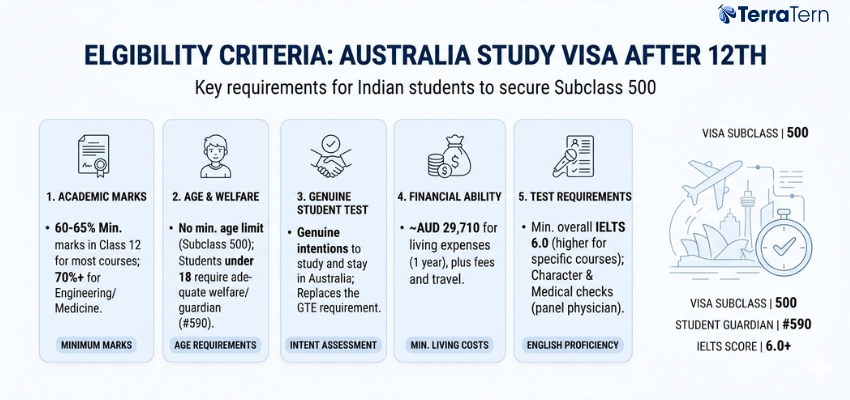
In order to secure an Australia study visa requirements after 12th, Indian student should have at least 60-65 per cent marks in Class 12 to most undergraduate courses; 70 and above is the norm in other courses like Engineering and Medicine.
-
There is no minimum age restriction for the Subclass 500 visa; however, students under 18 must have adequate welfare arrangements or a Subclass 590 guardian in place.
-
Should pass the Genuine Student (GS) test (was GTE), demonstrating genuine intentions to study and genuine intentions to study in Australia.
-
Should demonstrate financial ability of approximately AUD 29,710 for living expenses, plus one-year school fees and travel to and from.
-
English proficiency requirement: minimum overall IELTS 6.0 in Subclass 500 (higher requirements may be requested by particular courses/universities).
-
Should possess a good character record (Police Clearance Certificate) and good medical examinations by a panel physician approved by the panel.
What Percentage Is Required in 12th for an Australia Study Visa?
Australia study visa requirements after 12th do not specify a fixed percentage; however, universities usually require: Science/Engineering 70 or more, Commerce/Business 65 or more, Arts/Humanities 60 or more.
-
Go8 and other high-ranking universities tend to impose higher academic requirements on them than middle-level institutions do.
-
Students who fall below these figures are allowed to undertake foundation or pathway programs, which serve as entry-level programs for degree programs.
-
The approval of a visa is based on the authentic intent and funds of a student; the percentage is determined by the university itself and not the visa itself.
Important Note: If you scored below 65% in Class 12, don't give up; foundation year programs at Australian universities offer a legitimate and widely accepted pathway to undergraduate entry.
What Is the New Genuine Student (GS) Test for Australia Visa After 12th?
In 2026, the old Genuine Temporary Entrant (GTE) rule was replaced by the Genuine Student (GS) test, which is now a component of the australia study visa requirements after 12th.
-
It assesses your real intentions for studying in Australia, including your course choices, career objectives, study plan, and how they align with your future career in India or abroad.
-
The GS statement should describe: what made you pursue that course, why Australia, how it fits in your career; do not give answers that are vague or inappropriate.
-
The red flags are unstable course decisions, unrealistic career plans or previous visa rejections with no specific reasons given.
-
The GS statement is not the same as a Statement of Purpose (SOP). Both can be requested, and make sure they are specific to the visa or university.
Expert Tip: Your GS statement is the most human-reviewed part of the visa file; a generic statement is the #1 reason for rejections among otherwise eligible 12th-pass applicants.
What Are the Documents Required for Australia Study Visa After 12th?
For Australia study visa requirements after 12th, Indian applicants must upload a structured set of documents under the Subclass 500 visa. Below is a practical checklist grouped by category.
|
Document |
Category |
Why It’s Required |
|
Valid Passport (6+ months validity) |
Identity |
Primary travel and identification document for visa processing |
|
Confirmation of Enrolment (CoE) |
Enrolment |
Mandatory from 2026; issued by a CRICOS-registered institution |
|
IELTS / PTE / TOEFL Scorecard |
English Proficiency |
Proves language readiness for the course |
|
10th & 12th Mark Sheets |
Academic |
Confirms academic eligibility after 12th |
|
Financial Proof (Bank Statement / Loan Letter) |
Financial |
Shows at least AUD 29,710 for living expenses and tuition |
|
OSHC Certificate |
Health Insurance |
Mandatory health cover for the entire visa duration |
|
Genuine Student (GS) Statement |
Visa Requirement |
Supports by proving genuine study intent |
|
Police Clearance Certificate (PCC) |
Character |
Confirms no criminal record |
|
Passport-sized Photographs (4) |
Identity |
As per the Department of Home Affairs specifications |
|
Statement of Purpose (SOP) |
Academic |
Required by most universities for admission, and sometimes the visa |
|
Medical Examination Report |
Health |
Issued by an approved panel physician |
|
Aadhaar / PAN Card |
Identity |
Supporting national ID documents for Indian applicants |
What Financial Proof Is Required for Australia Study Visa From India?
For an Australia study visa requirements after 12th, Indian students must show sufficient financial capacity covering living costs, tuition, and incidental expenses. Total funds typically range from AUD 55,000 to 80,000, depending on the course and university.
|
Component |
Amount / Note |
Why It’s Required |
|
Living Expenses |
AUD 29,710 per year |
Mandatory living-cost benchmark for 12 months |
|
First-Year Tuition Fees |
University-specific |
Varies widely by course and institution |
|
Return Travel Cost |
~AUD 3,000 |
International airfare to and from Australia |
|
OSHC Premium |
~AUD 500–800/year |
Compulsory health insurance for the visa period |
|
Personal Bank Statement (3–6 months) |
Main source |
Must not be older than 28 days on the application date |
|
Education Loan Approval Letter |
Optional / backup |
Accepted if the bank balance is insufficient |
|
Sponsor Declaration (parent/guardian) |
Optional/third-party |
Confirms financial support and responsibility |
|
Term Deposits / FDs |
Supplementary |
Shows stable, locked-in funds |
|
Tangible Assets (gold, property) |
Extra support |
Can strengthen the application, but cannot replace liquid bank funds |
Expert Advice: Maintain a consistent bank balance for at least 3–6 months before applying. Sudden deposits in the weeks before the application are among the top reasons visa officers flag financial documents for scrutiny.
Is OSHC Mandatory for Australia Study Visa After 12th?
Yes. Overseas Student Health Cover (OSHC) is mandatory for Australia study visa after 12th under the Subclass 500 visa and must stay active for your entire stay in Australia, including breaks between semesters.
-
OSHC covers hospital treatment, visits to general practitioners (GPs), and limited pharmaceuticals for international students.
-
Major approved providers include Bupa, Medibank, Allianz Care, AHM, and NIB.
-
Cost is typically around AUD 500–800 per year for a single student, depending on the insurer and policy.
-
Many Australian universities arrange OSHC automatically and include it in the offer/CoE; always check your offer letter.
-
If OSHC lapses during your stay, you may be in breach of visa conditions, which can lead to visa cancellation.
Important Tip: Never let your OSHC lapse; even a gap of a few days between policies during semester break can technically breach your Subclass 500 conditions.
Also Read: Minimum Percentage Required for Australia After 12th: Essential Guidelines
What Is the IELTS Score Required for Australia Study Visa After 12th?
For Australia study visa requirements after 12th, the IELTS score you need depends on the course and institution, but the Subclass 500 visa sets a baseline.

-
Minimum for a Subclass 500 Visa: IELTS 5.5 overall, with no band score below 5.5 (as of 2026).
-
Subclass 485 (Post-Study Work): typically IELTS 6.5 overall with 5.5+ per band.
-
Diploma/Certificate Courses: Some institutions accept IELTS 5.5 overall.
-
Go8 and Top Universities: usually ask for 6.5–7.0 for competitive undergraduate programs.
-
Alternatives to IELTS: PTE Academic (approx. 42–58), TOEFL iBT (60–80), Cambridge C1, OET, and several other approved tests, including 9 options accepted from August 2026.
-
Exemptions: Some English-medium school students (e.g., CBSE/ICSE) may get IELTS waivers if their school meets DHA criteria.
As per TerraTern Expert: Starting from August 2026, Australia accepts nine English language tests, if IELTS doesn't suit your preparation style, PTE Academic is now equally valid and often faster to prepare for.
How to Apply for Australia Study Visa After 12th: Step-by-Step Process
The Australia study visa requirements after 12th are met through a nine-step online Subclass 500 application, starting with university shortlisting and ending with visa grant. The full journey from research to visa approval typically takes 6–12 months if planned well in advance of the intake. Below is a crisp, step-wise breakdown you can follow as an Indian student after Class 12.
Step 1 — Research and Shortlist Courses and Universities
Choose only CRICOS-registered institutions for valid Australia study visa requirements after 12th grade compliance.
-
Consider course relevance, university ranking, intake months (February, July, November), city/location, and available scholarships.
-
Popular choices after 12th are the University of Melbourne, the University of Sydney, UNSW, Monash, ANU, and the University of Queensland.
-
Start research 12–18 months before your intended intake to allow time for tests, applications, and visa processing.
Step 2 — Prepare and Clear English Proficiency Test
Take one of the approved tests: IELTS, PTE Academic, TOEFL iBT, Cambridge C1, OET, or other 2026-recognized English-tests.
-
Ideal Preparation Window: 3–6 months before applying to a university and a visa.
-
Minimum for Visa: IELTS 6.0 overall; most undergraduate programs expect 6.5 or higher.
Step 3 — Apply to the University and Receive CoE
Submit your application with 10th/12th mark sheets, SOP, LORs (if asked), English-test scores, and other documents required by the university.
-
Accept the offer and pay the first-semester tuition instalment to get your Confirmation of Enrolment (CoE).
-
CoE is now mandatory for all Subclass 500 applications from January 2025.
Step 4 — Arrange Financial Proof and OSHC
Prepare 3–6-month bank statements or education-loan approval showing at least AUD 29,710 plus tuition and travel costs.
-
Purchase OSHC from an approved provider (e.g., Bupa, Medibank, Allianz Care) or confirm that your university has arranged it for you.
Step 5— Write a Genuine Student (GS) Statement
Clearly explain why you chose that course, why Australia, and how it aligns with your career goals to meet Australia study visa requirements after 12th.
-
Address any prior rejections, gaps, or unusual course choices honestly.
-
Use the official GS-statement portal (MyCourseFinder or department-linked form) as required from 2026.
Step 6 — Complete Medical and Police Clearance
Book a medical check-up with a panel physician listed on the Department of Home Affairs website.
-
Apply for a Police Clearance Certificate (PCC) at your local passport/Police station counselling office; allow 2–3 weeks for processing.
Step 7 — Submit Visa Application via ImmiAccount
Create an ImmiAccount at immi.homeaffairs.gov.au and start the online Subclass 500 visa form.
-
Upload all documents (CoE, passport, financial proof, OSHC, English scores, medical/PCC, GS statement, photographs).
-
Pay the visa fee of AUD 2,000 (from July 2024) and submit.
Step 8 — Wait for Processing and Respond to Additional Requests
Subclass 500 processing typically takes 4–12 weeks, depending on your university’s NPL-based priority level (Priority 1 vs Priority 2).
-
Monitor your ImmiAccount and email regularly; respond promptly to any additional information or document requests from the department.
Step 9 — Receive Visa Grant Letter and Plan Travel
The visa grant is sent by email; check conditions and validity dates carefully.
-
Book flights only after receiving the grant, and confirm your address with the university within 7 days of arrival in Australia.
Pro Tip: The biggest delay in Australia student visa processing is incomplete documentation, especially missing CoEs or bank statements that are more than 28 days old. Prepare every document before opening your ImmiAccount.
What Are the Australia Study Visa Fees After 12th in 2026?
For Australia study visa requirements after 12th, the base Subclass 500 visa fee from July 2024 is AUD 2,000 (approx. INR 1.0–1.3 lakh), with total first-year costs (tuition, living, OSHC, travel) typically ranging from INR 15 lakh to INR 25 lakh, depending on the university and city.
|
Fee Component |
Amount (AUD) |
Approx. INR |
|
Subclass 500 Visa Fee (main applicant) |
AUD 2,000 |
~INR 1.10–1.30 lakh |
|
Living Expenses (1 year) |
AUD 29,710 |
~INR 16.35 lakh |
|
Tuition Fees (1 year) |
AUD 20,000–50,000 |
~INR 11–27 lakh |
|
OSHC (1 year, single) |
AUD 500–800 |
~INR 27,000–44,000 |
|
Return Travel |
AUD 1,500–3,000 |
~INR 82,000–1,65,000 |
|
Medical Examination |
AUD 300–500 |
~INR 16,000–27,500 |
Key Note: Budget for at least INR 18–20 lakh in liquid funds before submitting your application. This covers visa fee, living proof, OSHC, and initial travel, which are the four non-negotiable financial checklist items.
Also Read: Study In Australia- Unlocking A Complete Guide
How Long Does Australia Study Visa Processing Take After 12th?
Processing for the Australia study visa after 12th typically takes 4–12 weeks under the 2026 NPL-based priority system, though some Priority 1 applicants clear in as little as 16 days or 4–6 weeks.
-
Priority 1: Universities below 80% of their NOSC allocation; faster processing (often 1–4 weeks).
-
Priority 2: Providers at 80–115% of allocation; slower processing, often 5–8 weeks or more.
-
Priority 3: Providers above 115%; processed last, with longer waits (9–12 weeks+).
-
Key factors: incomplete documents, peak Jan/July intakes, heightened country-specific checks, and response time to department requests.
-
Practical Advice: Apply 3–4 months before the course start so your Australia study visa requirements after 12th timeline stays safe.Track status via the ImmiAccount dashboard on the Department of Home Affairs site. Onshore applicants often automatically receive a Bridging Visa A when they lodge a valid Subclass 500 application, provided their current visa remains valid.
As per TerraTern Expert, Divyansh, choose a university with a strong NPL compliance record. Students applying to Priority 1-eligible universities can receive their visa grant within 3 weeks, while standard processing can take up to 3 months during peak periods.
What Courses Can Indian Students Study in Australia After 12th?
Indian students after 12th can pursue undergraduate degrees, diplomas, foundation/pathway programs, and vocational training (VET) in Australia, with Engineering, IT, Business, Health Sciences, and Commerce being the most popular streams under Australia study visa requirements after 12th.
|
Course Stream |
Entry Requirement |
Duration |
PR Pathway? |
|
Engineering & IT |
70%+ in 12th Science; IELTS 6.5 |
3–4 years |
Yes (many courses on the Skilled Occupation List) |
|
Business & Commerce |
65%+ in 12th; IELTS 6.0–6.5 |
3 years |
Yes, for eligible business-related roles |
|
Health Sciences / Nursing |
70%+; IELTS 7.0 |
3–4 years |
Yes, a strong PR pathway in the health fields |
|
Arts & Humanities |
60–65%; IELTS 6.0 |
3 years |
Partial (depends on skill-based roles) |
|
Diploma / VET |
60%+; IELTS 5.5 often accepted |
1–2 years |
Limited, mainly via further study or work routes |
|
Foundation Year |
Below 65% in 12th |
1 year |
Leads to UG entry; PR depends on subsequent degree and occupation |
Important Note: If your career goal includes Australian PR, prioritise courses in Engineering, Nursing, Accounting, or IT. These fields feature prominently on Australia's Medium and Long-Term Strategic Skills List (MLTSSL), giving you significant PR pathway advantages.
What Are the Common Reasons for Australia Study Visa Rejection After 12th?
For Australia study visa requirements after 12th, rejections often stem from documentation and intent-related issues, even if the student otherwise looks eligible.
-
Weak or generic Genuine Student (GS) statement with no clear career path or course rationale.
-
Bank statements printed more than 28 days before the application date or with unexplained, sudden, large deposits.
-
Insufficient financial proof: less than AUD 29,710 plus tuition and travel, or unclear sponsor income.
-
IELTS or equivalent English-test score below the required threshold or missing from the file.
-
Submitting only a Letter of Offer instead of a valid Confirmation of Enrolment (CoE), especially after January 2026.
-
Using non-NAATI-certified translations for non-English documents or documents with inconsistencies (name spelling, DOB, etc.).
-
Previous visa refusals, overstays, or health/character issues that were not disclosed or explained properly.
Expert Advice: Nearly 60–70% of rejectable applications contain at least one document inconsistency. Having an expert review your file before submission is the single most effective way to improve your visa outcome.
Also Read: Comprehensive Guide to the Australia Study Visa Process
What Are the Post-Study Work and PR Options After Studying in Australia?
After completing studies, graduates can stay and work under Australia study visa requirements after 12th, then target permanent residency.
-
Temporary Graduate Visa (Subclass 485): Allows 2–4 (or up to 5-6) years of work based on qualification level and study location; often the first step after graduation.
-
Work Rights During Study (Subclass 500): As of July 2023, the 48-hour fortnightly work cap was permanently removed; student visa holders now have unlimited work rights throughout their stay, both during semester and official breaks.
-
Main PR Pathways: Subclass 189 (Skilled Independent, no state nomination), 190 (State-Nominated), and 491 (Regional Skilled Work).
-
Australian Study Bonus: Graduates with an Australian degree can earn 5 extra points on the PR points test.
-
Regional-Study Advantage: Studying at a regional university often extends Subclass 485 duration and adds extra points for 491/190 pathways.
Pro Tip: Students who study in regional Australia not only get extended Subclass 485 work rights but also earn additional PR points, making regional universities a strategically smart choice for long-term migration goals.
How Can TerraTern Help Indian Students With Australia Study Visa After 12th?
TerraTern supports Indian students through the full Australia study visa requirements after 12th grade, from course shortlisting to visa grant and life in Australia.
-
End-to-End Guidance: University and course selection, prioritising CRICOS-registered institutions aligned with your 12th scores and career goals.
-
SOP and GS-statement Drafting: Tailored, Genuine Student narratives and Statements of Purpose that clearly link 12th-level background to your chosen course.
-
Visa Application Support: Assisting with ImmiAccount creation, online form completion, and AUD 2,000-fee submission.
-
MARA-Aligned Strategies: Staying updated with 2026 NPL-based processing and visa rules to maximise your success.
-
CTA: Book your free consultation with TerraTern today to build a clear roadmap from Class 12 to an Australian university and beyond.
-
Social Proof Placeholders: Add client success stories/testimonials (e.g., “1,200+ students placed in Australia”) to reinforce trust and conversion.
Key Note: With the 2026 visa fee at AUD 2,000 and student caps now in effect, there is no room for application errors. Working with a knowledgeable consultant is now more valuable than ever.
2026 Industry Context Section
Some of the latest facts are:
-
Student Cap Introduced (2026): Australia capped international student intake at 295,000 new places for 2025–26, making early applications and university choice more critical than ever. (Source: Australian Government, 2026)
-
Visa Fee Doubled: The Subclass 500 application fee rose to AUD 2,000 from July 2026, up from AUD 1,600 in 2024. (Source: Study Australia / Department of Home Affairs, 2026)
-
CoE Now Mandatory: Since January 2026, a Confirmation of Enrolment (CoE), not a Letter of Offer, is the only accepted enrolment proof for all onshore applications. (Source: Department of Home Affairs, January 2026)
-
GTE Replaced by Genuine Student (GS) Test: The new GS test focuses on academic and career intent rather than temporary stay proof, effective 2026. (Source: Australian Government Policy Update, 2026)
-
India is Australia's #2 Source Country: Over 1.78 lakh Indian students enrolled in Australian institutions in 2026, according to the Department of Education, Australia.
-
Nine English Tests Accepted (from August 2026): Australia expanded from IELTS-only to accepting nine recognised English language tests, offering more flexibility for Indian applicants.
-
85–90% Visa Success Rate: The overall student visa success rate for Indian students in 2026 remained high at 85–90%, particularly for well-prepared applicants with complete documentation.
Also Read: Australia Study Visa Fees: Tips, Apply, Requirements
Conclusion
Understanding Australia study visa requirements after 12th clearly, academics, finances, English, GS test, and documentation is key to a successful Subclass 500 application. By planning early, meeting each criterion, and avoiding common mistakes, Indian students can smoothly transition from Class 12 to an Australian university and build a strong foundation for long-term study and career opportunities in Australia.
Contact TerraTern for more information on Australia Study Visa Requirements After 12th: 2026 Guide.




 AI Summary