Key Highlights
- What Are the Current Eligibility Requirements for Australia Study Visa (Subclass 500)?
- What Is the GTE Requirement and How Do You Write a Strong GTE Statement in 2026?
- What Latest Documents Are Required for Australia Study Visa from India?
- What Is the Australia Study Visa Processing Time in 2026?
- What Are the Current Fees for Australia Study Visa from India?
- What Are Latest Work Rights for Indian Students on an Australia Study Visa?
- Why Should Indian Students Choose to Study in Australia in 2026?
- What Is the Current Post-Study Visa and PR Pathway After Australia Study Visa?
- How Can TerraTern Help Indian Students with the Australia Study Visa Process in 2026?
- 2026 Industry Context
- CONCLUSION
- Conclusion
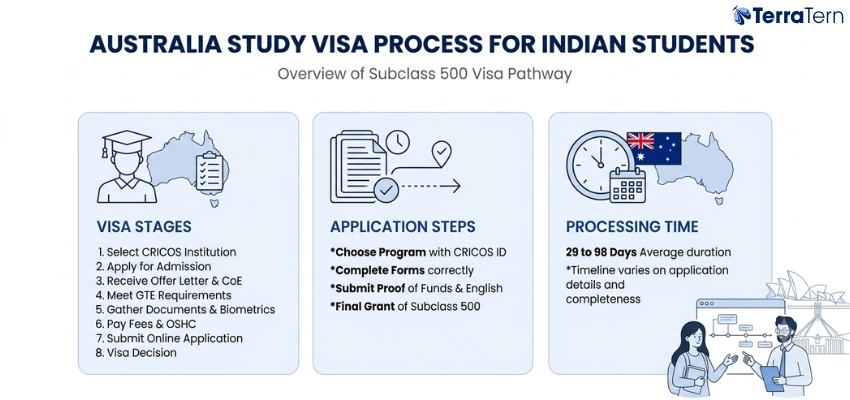
The study visa for Australia for Indian students consists of 8 stages,s from choosing a CRICOS-registered institution to getting the visa granted as a subclass 500 visa. The Australia study visa processing time for most of the applicants takes 29 to 98 days, depending on the complexity of the application and the completeness of the documents.
|
Step |
Action |
Typical Timeline |
|
1 |
Choose CRICOS-registered institution and course |
4–8 weeks research |
|
2 |
Accept offer and receive Confirmation of Enrolment (CoE) |
1–4 weeks after offer |
|
3 |
Arrange English proficiency test (IELTS/TOEFL/PTE) |
Allow 2–3 months for preparation + test |
|
4 |
Prepare financial evidence (bank statements, loan letter) |
Ongoing; finalise 6 weeks before applying |
|
5 |
Write GTE (Genuine Temporary Entrant) statement |
1–2 weeks; personalised; minimum 800 words |
|
6 |
Complete health examination (HAP — Health Assessment Protocol) |
2–4 weeks |
|
7 |
Lodge application on ImmiAccount + pay AUD $710 fee |
1–2 days once all documents ready |
|
8 |
Await processing; respond to Additional Information (AI) requests if needed |
29–98 days |
What Are the Current Eligibility Requirements for Australia Study Visa (Subclass 500)?
The Australian Department of Home Affairs has set academic, financial, English language, health, and character criteria for Indian students seeking to undertake the Australia study visa process for subclass 500. It is important to meet these requirements to ensure a successful Australian study visa process and visa approval.
Australia Student Visa Eligibility Checklist
Confirmation of Enrolment (CoE) from a CRICOS-registered Australian education provider.
Satisfactory English language skills in line with requirements of the selected course and institution.
|
Course Level |
Typical IELTS Requirement |
|
ELICOS/ English Courses |
Overall 5.5 |
|
VET/ TAFE Courses |
Overall 6.0 |
|
Undergraduate Degrees |
Overall 6.5 |
|
Postgraduate Degrees |
Overall 7.0 |
Also Read: How To Prepare For Australia Immigration Interview: Student Visa
What Is the GTE Requirement and How Do You Write a Strong GTE Statement in 2026?
The Genuine Temporary Entrant requirement is Australia's evaluation of whether an international student is entering Australia for the main purpose of temporary study or not.
The word count for a GTE statement is not required, but successful applications will typically be 800 to 1,500 words long.
The Five DHA GTE Assessment Factors:
|
Factor |
What DHA Evaluates |
What Makes a Strong Response |
|
1. Situation in India |
Employment, family ties, property, business interests |
Specific evidence: job letter, family dependents, property ownership documents |
|
2. Immigration risk |
Age, marital status, financial situation, country risk |
Cannot change; mitigate with strong factors 1, 3, 4, 5 |
|
3. Value of course to career |
Does the qualification logically advance your stated career goals? |
Specific career plan with role title, employer type, industry |
|
4. Immigration history |
Prior compliance with Australian or other country visa conditions |
Disclose everything honestly; prior refusals need explanation |
|
5. Course consistency |
Does study level make sense given your academic history? |
Explain why this course level (downgrading raises flags) |
GTE Statement Paragraph Structure:
Para 1- Brief Background With Regards to India: Current job title, industry, employer, how long employed. Educational background. The reasons for studying to promote one's career.
Para 2- Justification for the Course: (why this course in particular, skills or knowledge it offers). The reason why this course is not present in India in the same quality. How it bridges a particular career gap.
Para 3- Australian-Specific: Quality of Australian education, global recognition, specific university strengths. Not a generic compliment — specific to your industry.
Para 4- Career Plan Using this Qualification 1: Role you are planning to pursue in India after graduation with this qualification. The Australian qualification that will help you get there. Specific industry, company type or function.
Para 5- Property Ownership: Family (Spouse, children, parents who rely on you). A commitment to employment on return. Business interests. Otherwise, you are to return.
Para 6- Closing Reaffirmation: Clear and direct statement outlining your intention to meet all the visa conditions and return to India after completion of the course.
Common GTE Mistakes to Avoid:
-
Taking a Template From the Internet- DHA case officers identify repeated phrases
-
Generic Career Objective- “I want to get better at what I do” (no specific role or industry)
-
Not Referring to Family Connections to India- This is the easiest piece of proof of the desire to return.
-
Inconsistency Between GTE Narrative and Documents- (e.g., claiming to be employed but no employment letter attached)
If you mentioned plans to apply for PR or stay in Australia, this is a red flag, irrespective of your intentions.
What Latest Documents Are Required for Australia Study Visa from India?
Image: https://www.pexels.com/photo/group-of-people-sitting-on-chair-in-front-of-table-8199558/
When applying for the Subclass 500 visa, Indian students will need to provide a comprehensive application with academic, financial, identity, health, and supporting documents for the Australia study visa process. One of the most common delays in the Australia study visa process is the absence or incongruence of documents.
Australia Study Visa Document Checklist:
-
Valid Indian passport with at least 6 months' validity after the intended dates of stay; all pages of the passport must be scanned (if applying online, blank pages also have to be scanned)
-
Confirmation of Enrolment (CoE) issued by your CRICOS-registered institution; should be for the duration of your study; and
-
A personalised written statement to accompany the application form, preferably between 800–1,500 words long, and not a template (see GTE statement).
-
English proficiency certificate (IELTS, TOEFL iBT, PTE Academic, Cambridge — must be at or above the minimum required for the course; not expired)
Bank statement(s) and/or financial records showing the funds available:
-
Personal savings account bank statements for 6+ months (not a recent large deposit)
-
6+ months bank statements from parents + sponsor declaration letter + relationship proof
-
Sanction letter for education loan issued by the Indian bank (signed and stamped)
-
Award letter to be given to the student in a letter of scholarship (official from the institution).
The ITR, or Income Tax Return, is a document that is required to be submitted by those who are employed.
-
Overseas Student Health Cover (OSHC)- Most institutions organise this; provide the policy document number; need to cover the entire visa period.
-
Indian National Police Certificate (National Police Certificate)- (Online through Passport Seva Portal); also needed for any country you have resided in for 12+ months in the last 10 years.
-
Health Examination (if applicable)- Fill out the Health Assessment Protocol (HAP) online; visit a panel physician in India that is approved by DHA;
-
Biometric Photo- Regular digital photo that meets the DHA requirements; uploaded through ImmiAccount.
-
Academic Transcripts– All degrees/diplomas/mark sheets (India and other countries)
-
Visa Application Fee Receipt- (Paid using ImmiAccount via Visa/Mastercard, BPAY equivalents)
India-Specific Financial Document Notes:
|
Financial Evidence Type |
What DHA Looks For |
Common Indian Red Flags |
|
Bank statements |
Consistent balance over 6 months |
Large single deposits within 3 months; multiple account transfers without explanation |
|
Education loan |
Bank-sanctioned letter with interest rate, tenure, and disbursement amount |
Unregistered lender letters; amounts below course fees |
|
ITR (Income Tax Return) |
Declared income matching stated monthly income |
Mismatch between stated and declared income |
|
Parents as sponsor |
6 months statements + employment proof + relationship documents |
Statements from parents but no salary/income source shown |
|
Scholarship |
Official award letter on institution letterhead |
Email confirmation only; not signed by authorised officer |
What Is the Australia Study Visa Processing Time in 2026?
An Australia study visa process application will generally take between 29 and 75 days for most Subclass 500 visas in 2026, with 90% of Subclass 500 visa applications being processed within 98 days. The processing time for more complex applications, such as health checks, police clearances, or other information requests, can take up to 120-150 days. It is essential to know the timeline to plan the Australia study visa process more efficiently.
Australia Study Visa Processing Time Table (2026)
|
Visa Subclass |
50% of Applications |
90% of Applications |
Complex Cases |
|
Student (Subclass 500) |
29–40 days |
75–98 days |
120–150 days |
|
Student Guardian (Subclass 590) |
35–50 days |
110–120 days |
150+ days |
|
Temporary Graduate (Subclass 485) |
45–60 days |
110–130 days |
150+ days |
Factors That Extend Processing Time for Indian Students:
|
Factor |
Typical Additional Wait |
|
Health examination required (chest X-ray, HAP) |
4–8 weeks additional |
|
Police clearance pending from India |
3–6 weeks |
|
Additional Information (AI) request from DHA |
28–56 days minimum |
|
Application during peak periods (July–Sep; Feb–Apr) |
3–4 weeks extra queue |
|
Private or vocational provider applications (post-2023 scrutiny) |
1–3 weeks extra |
|
Prior visa refusal in application history |
Variable; case-by-case |
|
Financial evidence issues (inconsistency, insufficient amount) |
Triggers AI request; 28–56 days |
How to Check Your Application Status:
-
Log on to ImmiAccount: Check your application status in real time on.
-
See DHA Processing Time Page, for Subclass: Check the 90th percentile against your case age.
-
Beyond the 90th Percentile: Submit an online request for an update on ImmiAccount (don't call DHA helpline at peak times)
-
If the Course is Close to Beginning: Check with your institution's International Student Office as they have a dedicated channel with DHA for emergencies.
Note: DHA will not consider the course start date when considering applications. If your visa is still in processing at the start of your course, you should:
-
Talk to your school right away about a deferred start.
-
Please do NOT travel to Australia without a visa grant.
-
Don't ask to be called back – ask to be updated via ImmiAccount.
Also Read: Benefits of Studying in Australia: Complete Guide for Indian Students
What Are the Current Fees for Australia Study Visa from India?
Apart from the tuition fee, there are several mandatory and optional costs associated with the Australia study visa application process. The visa application fee for subclass 500 visa is AUD $710 and is not refunded if the visa application is not successful. When Indian students know these costs, they can plan and budget the Australia study visa process accurately.
All Costs — Australia Study Visa (AUD + INR):
|
Cost Item |
Amount (AUD) |
Amount (INR) |
Frequency |
Notes |
|
Visa application fee |
$710 |
39,050 |
One-time |
Non-refundable; paid via ImmiAccount |
|
National Police Clearance (India) |
Free–INR 1,000 |
0–1,000 |
One-time |
Via Passport Seva Portal |
|
Health examination (HAP, if triggered) |
$300–$500 |
16,500–27,500 |
One-time |
Paid to DHA-approved panel physician |
|
IELTS / TOEFL / PTE test fee |
INR 16,500–18,000 |
16,500–18,000 |
One-time |
Preparation costs additional |
|
Document translation (if applicable) |
$100–$300 |
5,500–16,500 |
One-time |
NAATI-certified translator preferred |
|
OSHC (Overseas Student Health Cover) |
$500–$700/year |
27,500–38,500/year |
Annual |
Mandatory; usually arranged via institution |
|
Living costs (DHA threshold) |
$21,041/year |
11.6 lakh/year |
Annual |
DHA minimum; actual costs vary by city |
|
Accommodation (1 semester, shared) |
$5,000–$9,000 |
2.75–4.95 lakh |
Per semester |
University dorm or private WG |
|
First-Year Total (excl. tuition) |
~$24,000–$32,000 |
~INR 13.2–17.6 lakh |
— |
Excluding course fees |
University Tuition Fees (Indicative, AUD + INR):
|
Course Level |
Typical Annual Tuition (AUD) |
Typical Annual Tuition (INR) |
|
English Language (ELICOS) |
$6,000–$14,000 |
3.3–7.7 lakh |
|
VET / TAFE (Certificate III–IV) |
$4,000–$14,000 |
2.2–7.7 lakh |
|
Diploma (AQF Level 5) |
$10,000–$20,000 |
5.5–11 lakh |
|
Bachelor's Degree |
$18,000–$35,000 |
9.9–19.25 lakh |
|
Master's Degree |
$22,000–$50,000 |
12.1–27.5 lakh |
|
MBA (top schools) |
$50,000–$100,000 |
27.5–55 lakh |
|
PhD (research) |
$18,000–$42,000 |
9.9–23.1 lakh |
Exchange rate: 1 AUD ≈ INR 55 (July 2026 approximate; verify before planning)
What Are Latest Work Rights for Indian Students on an Australia Study Visa?
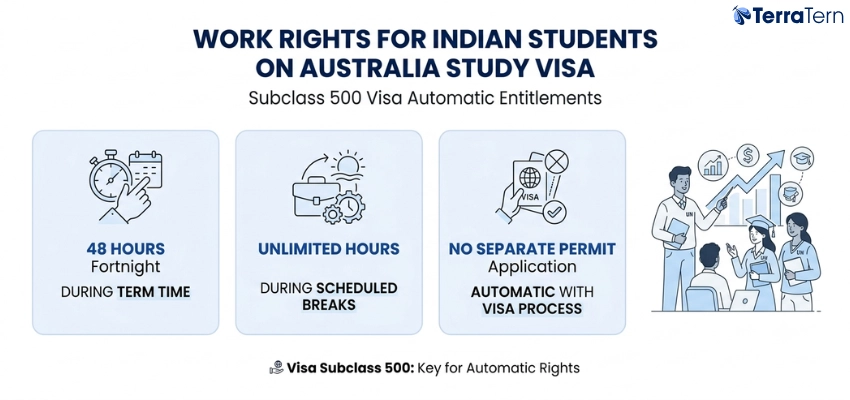
Under the Subclass 500 visa, study in Australia for Indian students get automatic work rights during the Australia study visa process. Students may work 48 hours per fortnight during school term time and as many hours as they choose during term breaks as scheduled by the school. There is no separate work permit application process in the Australia study visa process application.
Work Rights Summary:
|
Study Status |
During Semester |
During Scheduled Breaks |
|
Standard full-time student |
48 hours per fortnight |
Unlimited |
|
Master's / PhD by research |
Unlimited |
Unlimited |
|
Student in healthcare course |
Up to 48 hrs/fortnight |
Unlimited |
|
Student's partner (secondary applicant) |
48 hours per fortnight |
Unlimited |
Common Part-Time Jobs for Indian Students (AUD + INR):
|
Job Type |
Hourly Rate (AUD) |
Approx. Monthly Earnings (AUD) |
Approx. Monthly Earnings (INR) |
|
Retail / Cashier |
$24–$28 |
$1,152–$1,344 |
63,360–73,920 |
|
Food Service / Café |
$24–$30 |
$1,152–$1,440 |
63,360–79,200 |
|
Warehouse / Packing |
$27–$32 |
$1,296–$1,536 |
71,280–84,480 |
|
Tutoring / Teaching |
$30–$60 |
$1,440–$2,880 |
79,200–1.58 lakh |
|
IT Support / Helpdesk |
$28–$38 |
$1,344–$1,824 |
73,920–1.00 lakh |
|
Uber Eats / DoorDash |
$20–$30 (variable) |
$960–$1,440 |
52,800–79,200 |
Why Should Indian Students Choose to Study in Australia in 2026?
Study in Australia for Indian students has gained immense popularity among students due to its high-value education, work rights, job opportunities after completion of studies, and easy visa for permanent residency. With India being Australia's largest source of international students, the Australia study visa procedure is one of the most sought-after study abroad choices for Indian students.
Australia vs Other Study Destinations for Indians:
|
Factor |
Australia |
Canada |
UK |
USA |
|
Average tuition (Master's) |
AUD $22,000–$50,000 (INR 12.1–27.5L) |
CAD $18,000–$35,000 (INR 10.9–21.2L) |
GBP £15,000–£35,000 (INR 16.1–37.7L) |
USD $25,000–$60,000 (INR 20.8–49.9L) |
|
Post-study work visa |
2–4 years (485, open) |
1–3 years (PGWP, open) |
2 years (Graduate Route) |
1–3 years (OPT; STEM) |
|
PR pathway |
3–5 years; no per-country cap |
2–3 years (Express Entry) |
5 years |
Decades (per-country cap; H-1B lottery) |
|
English language requirement |
IELTS 5.5–7.0 |
IELTS 6.0–7.0 |
IELTS 6.0–7.0 |
TOEFL/IELTS equivalent |
|
Work rights during study |
48 hrs/fortnight |
20 hrs/week |
20 hrs/week |
On-campus only (OPT) |
|
Indian community |
700,000+ (second-largest Asian group) |
1.8 million (large, established) |
1.5 million (large) |
4.6 million (largest) |
|
Cost of living (single, monthly) |
AUD $2,500–$3,800 |
CAD $2,000–$3,200 |
GBP £1,500–£2,800 |
USD $2,500–$4,000 |
Top Reasons Indian Students Choose Australia:
-
No cap on the number of Indian nationals who can be granted a PR (as in the USA with the Green Card system, where it takes 50-80+ years for an Indian to get a PR)
-
7 universities in the world's top 100 — world-recognised degrees.
-
Work rights: Day 1 – 48 hrs/fortnight (semester), unlimited (breaks)
-
Public healthcare, which is not available for students in the UK or Canada, but is available for student visa holders in other countries, including Medicare.
-
Longer than the UK 2-year Graduate Route (2-4 year post-study visa)
-
Indian traditional food, Indian culture, and Indian festivals are held in all major cities, and there are 700,000+ Indians.
-
The time and distance of the location from India (10-14 hrs) compared tothe USA/Canada (16-22 hrs).
-
Visa application + 15 points for studying in regional Australia (4-year 485 visa vs 2-year metro visa)
Honest Challenges for Indian Students:
|
Challenge |
Reality |
|
Cost of living in Sydney/Melbourne |
Rent AUD $1,800–$2,800/month for 1BHK; significantly higher than Canada or UK |
|
Rental market crisis |
Housing shortage in major cities; finding accommodation 3–6 months in advance recommended |
|
2024 enrolment cap |
Government cap on new international student enrolments at some universities — apply early |
|
Cultural adjustment |
Australian directness and informality; distinct from Indian academic hierarchies |
|
Racism incidents |
Isolated but reported; major cities are multicultural and largely welcoming |
Also Read: Australia's Bold Step towards IELTS-Free Enrollment
What Is the Current Post-Study Visa and PR Pathway After Australia Study Visa?
Study in Australia for Indian students does not stop upon graduation. International students who have successfully finished an eligible Australian qualification are eligible to apply for the Temporary Graduate Visa (Subclass 485), which offers an open work visa and leads to a permanent visa. The Australian study visa process is the first step towards a long-term career in Australia for many Indian students.
What is The Temporary Graduate Visa (Subclass 485)?
The Temporary Graduate Visa enables eligible graduates to stay in Australia following their studies, and to work in any occupation, for any employer, without needing to be sponsored.
The subclass 485 visa offers a work visa for two to four years, depending on the visa qualification and the location of study.
Post-Study Pathway Timeline:
|
Timeline |
Milestone |
|
Year 0 |
Begin Australian study (Subclass 500 student visa) |
|
Year 1–3 |
Complete degree; work part-time (48 hrs/fortnight) |
|
Year 2–3 |
Graduate; apply for Subclass 485 Temporary Graduate Visa |
|
Year 2–5 |
Work in Australia on 485 (any employer, any role); build skilled employment |
|
Year 3–5 |
State nomination (Subclass 190) or regional nomination (491) |
|
Year 4–5 |
PR grant (Subclass 190) or conversion from 491 to Subclass 191 after 3 years regional work |
|
Year 5–6+ |
Australian citizenship eligibility (after 4 years PR, residing 1 year immediately prior) |
Also Read: PTE Smoothens the Road to Australia Study Visa
How Can TerraTern Help Indian Students with the Australia Study Visa Process in 2026?
With its comprehensive support system, TerraTern assists Indian students in their entire visa application journey to Australia, from selecting a course to securing a visa and beyond, while helping them plan their future post-study.
-
Career, Future and Budget based Course/University shortlisting.
-
Help in accepting offers and Confirmation of Enrolment (CoE).
-
Personalised GTE statement guidance and review.
-
Assistance in preparing and structuring financial documents.
-
Assistance with OSHC and health checks.
-
Support for applying for an ImmiAccount.
-
Guidance on Post-study subclass 485 visa.
-
State nomination and planning for pathway to PR.
-
Support from start to finish for an Australia studies visa.
Will the Australia Study Visa Process be a Good Fit for Your Plans?
The study visa Australia process provides you with an education that is recognised worldwide.
-
The average processing time is 29 days to 75 days.
-
The fee for applying for a student visa is AUD $710.
-
During study periods, students are able to work up to 48 hours per fortnight.
-
During the scheduled breaks, the work rights are unlimited.
-
A strong GTE statement is essential for the visa application.
-
Subclass 485 offers a 2-4 years of post-study work visa.
There are several career paths to choose from following graduation.
Students are advised to start the study visa process to Australia at least four months before intake.
2026 Industry Context
Latest Statistics & Developments:
-
India surpassed China in 2024 to become Australia's largest international student source country by new enrolments — over 120,000 Indian students commenced study in Australia in 2024–25 (Australian Department of Education, 2025)
-
The Australia student visa (Subclass 500) success rate for Indian applicants is approximately 85–92% in 2026, with GTE statement quality identified as the primary differentiator between approved and rejected applications
-
The median student visa processing time in 2026 is 29–75 days, with 90% of applications processed within 98 days — an increase from the pre-2023 median of 20–40 days due to higher application volumes
-
As of July 1, 2025, Australia abolished the visa remonstration procedure — rejected student visa applicants must now file a full new application or pursue merits review; no informal appeals pathway remains
-
Australia's Department of Home Affairs requires all Subclass 500 applications to be lodged online via ImmiAccount (immi.homeaffairs.gov.au) — paper applications are no longer accepted
-
International students in Australia can work up to 48 hours per fortnight during study and unlimited hours during scheduled course breaks — making part-time income achievable from Day 1
-
Australia's post-study Temporary Graduate Visa (Subclass 485) grants 2–4 years of unrestricted work permission after graduation — making Australia one of the most attractive post-study work destinations among English-speaking countries
CONCLUSION
By 2026, Australia study visa offers Indian students access to world-class education, part-time work opportunities, and robust post-study career prospects. The Australia study visa process is one of the most appealing study abroad opportunities for Indian students, with an 8-step process, 29-75 days processing time, and a work visa with 48 hours per fortnight.
The main keys to a successful Australia study visa process are a strong GTE statement, comprehensive documentation, and preparation at an early stage. Students are advised to start their application at least four months before the date of their intended entry to ensure their application is considered and a successful transition to study in Australia.
Contact TerraTern for more information on the Australia study visa process.
Conclusion
Navigating the Australia study visa process can be straightforward with the right information and preparation. By following this comprehensive guide, you'll be well on your way to starting your educational journey in Australia. Begin your application process early to ensure a smooth transition and maximise the opportunities that studying in Australia offers.
If you are a student who wishes to move to Australia for further studies, then TerraTern should be your guide. With services curated to make immigration easier, Terratern has experts on their team to make your move simple!