Key Highlights
- What Is an Australia Refusal Letter?
- What Are the Most Common Reasons for an Australia Refusal Letter?
- What Does an Australia Student Visa Refusal Letter Specifically Cover?
- Can You Appeal an Australia Refusal Letter?
- What Is the Difference Between Appealing and Reapplying After an Australia Refusal Letter?
- How Do You Reapply After an Australia Student Visa Refusal Letter?
- What Should You Do Immediately After Receiving an Australia Refusal Letter?
- 2025 Industry Context Section
- Conclusion
The Australia Department of Home Affairs issues an Australia refusal letter; the refusal letter is an official document for visa applicants that sets out in no uncertain terms why their application has been turned down. The department uses this correspondence to provide a full explanation of the decision, making clear which of the applicant’s failings in meeting the requirements caused the visa to be refused. It may also indicate whether the visa decision is reviewable. Australia student visa refusal letter 2026 for student visas usually highlight issues like student genuineness, financial capacity, and document authentication. Australia’s Administrative Review Tribunal (ART) provides a platform for reviewing visa decisions for eligible visa subclasses and lengths of stay; however, applicants must adhere to the time limits for applying for a review as outlined in the refusal letter. Always read the reasons for the visa refusal carefully before taking any further action.
Also Read: Work and Holiday Visa Australia: Latest Subclass 462 Guide
What Is an Australia Refusal Letter?
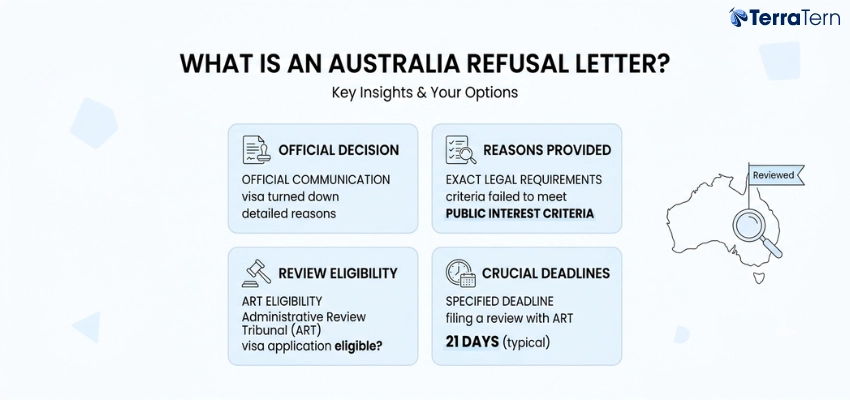
When the Department of Home Affairs issues an Australia refusal letter to a visa applicant, it is an official communication setting out why the visa has been turned down.
-
The document provides the exact legal requirements, criteria, or guidelines, such as the Public Interest Criteria, that the visa applicant has failed to meet for the visa to be granted
-
In addition, this is the document that determines whether the visa application is eligible for review by the Administrative Review Tribunal (ART).
-
Therefore, it is always essential to analyse the Australia refusal letter in detail to understand the options available for the visa application, including the possibility of applying for a review of the visa decision.
-
The Australia refusal letter also specifies the deadline for filing a review of the visa decision with the ART, which is typically 21 days but may vary for different visa subclasses
-
Only after carefully considering all reasons for the visa refusal and possible further steps should the visa applicant take any action about the visa application.
As per TerraTern Expert Shreya, Don't just skim your refusal letter for the headline reason; read it multiple times and list every individual concern raised separately, since a strong reapplication or appeal needs to address each one specifically, not just the most obvious issue.
Also Read: Australia Refusal Letter: Reasons, Requirements & More
What Are the Most Common Reasons for an Australia Refusal Letter?
When an Australia refusal letter is issued, it is usually for one of a few well-known reasons. The applicant has not met the Genuine Student (GS) standard, or there are questions over the financial evidence put forward, be it for lack of clarity or because it is simply not enough. Inconsistencies in the paperwork can also be to blame. Then there are the more serious matters of supplying false or bogus information, which falls under Public Interest Criterion 4020 (PIC 4020).
|
Refusal category |
What it means |
Common trigger |
Impact |
|
Genuine Student (GS) requirement |
The applicant must show they are a genuine temporary entrant whose course choice makes academic and career sense. |
Weak SOP, unclear study plan, or a course that does not match past education/work. |
Very common refusal reason. |
|
Financial evidence issues |
The applicant must prove they can pay tuition, living costs, and travel expenses. |
Savings below the required amount, unclear source of funds, or suspicious large deposits. |
Refusal risk is high if finances are not clear. |
|
Document inconsistencies |
Information across forms and supporting documents must match. |
Differences in names, dates, employment history, education records, or travel history. |
Can create doubt about credibility and lead to refusal. |
|
PIC 4020 (fraud or bogus info) |
False information or fake documents are treated as serious misconduct. |
Submitting forged documents or misleading details. |
Severe refusal ground; can lead to a mandatory three-year exclusion period. |
Important Note: If your refusal letter cites PIC 4020, treat it as meaningfully more serious than a standard GS or financial refusal. This category can trigger a multi-year exclusion period, and you should seek advice from a registered migration agent or migration lawyer before taking any next step.
What Does an Australia Student Visa Refusal Letter Specifically Cover?
Understanding your Australia student visa refusal letter requires looking beyond generic labels. Identifying the precise sub-reason within your Australia refusal letter is the essential foundation for building a robust and persuasive response, whether for an appeal or a fresh application.
-
For Subclass 500 (Student Visa) applications specifically, the refusal letter will reference the Genuine Student (GS) requirement far more often than any other single ground, given its position as the primary assessment criterion for student visa genuineness.
-
Within GS-related refusals, the letter will typically point to specific weaknesses: an unclear or generic study purpose statement, a course that doesn't demonstrate logical academic or career progression (for example, an unexplained shift from a bachelor's degree in one field to an unrelated diploma-level course), or insufficient evidence connecting the chosen course to your stated future goals.
-
The letter may separately or additionally cite concerns about financial capacity if bank statements, income evidence, or sources of funds were unclear or inconsistent.
-
Understanding precisely which of these sub-reasons applies to your case, rather than treating "GS refusal" as a single generic problem, is essential for building an effective response.
|
Specific refusal ground |
How it appears in the assessment |
|
Genuine Student (GS) failures |
An Australia student visa refusal letter often points to a generic study purpose, weak home ties, or insufficient evidence connecting the course to future goals. |
|
Course progression issues |
The letter may highlight an illogical academic pathway, such as an unexplained shift from a bachelor’s degree to an unrelated diploma-level course. |
|
Financial capacity concerns |
The refusal letter may explicitly cite inadequate bank statements, inconsistent income evidence, or unverified funding sources. |
Expert Tip: If your refusal letter cites the Genuine Student requirement, identify the specific sub-reason (unclear purpose, weak course progression, or insufficient future-plan evidence) rather than treating it as one generic issue; your response needs to target the precise gap the assessing officer identified.
Can You Appeal an Australia Refusal Letter?
You can appeal an Australia refusal letter through the Administrative Review Tribunal (ART)—the body replacing the former AAT only if you were onshore (inside Australia).
-
Your official document will explicitly state whether you hold review rights. Offshore applicants generally lack these rights and must submit a fresh application instead.
-
If eligible, you face a strict deadline, typically 21 days from the decision date; always confirm the precise timeframe in your letter.
-
The ART application fee is around AU$3,580 (indexed periodically). This is non-refundable if you lose, but 50% is refunded if your appeal succeeds.
-
Always verify current deadlines, review your rights, and check the exact fees stated in your personal Australia refusal letter rather than relying solely on generalised online estimates.
Expert Advice: Never assume your appeal deadline based on a generic online figure. Confirm the exact date stated on your own refusal letter immediately upon receiving it, since missing this window forfeits your review rights permanently, regardless of how strong your case might otherwise be.
Also Read: Australia Tourist Visa Rejection Rate Latest Guide
What Is the Difference Between Appealing and Reapplying After an Australia Refusal Letter?
Since the ART frequently decides cases "on the papers," appeals require airtight written evidence. Conversely, reapplying requires explicitly addressing every concern outlined in your Australia refusal letter to succeed.
|
Strategy |
Appealing to the ART |
Reapplying for a Visa |
|
Definition |
Asking the ART to legally review the original decision using your existing evidence, plus any new evidence you submit. The ART assesses your case completely fresh. |
Submitting a completely fresh visa application with new, substantially strengthened evidence. |
|
Eligibility |
Only available if you explicitly confirm you have review rights. Usually requires you to be onshore. Strict deadlines apply (often 21 days). |
Available to both onshore and offshore applicants, making it the primary route for offshore refusals or if you lack review rights (subject to Section 48 bar). |
|
Best Used When |
The original decision was factually incorrect, or you have strong new evidence that resolves the initial refusal grounds. You want to remain in Australia on a Bridging Visa. |
You need to significantly strengthen your documentation and fix specific weaknesses cited in the refusal, or your circumstances have fundamentally changed. |
|
2026 Process Note |
For certain temporary visas (especially student visas), decisions can now be made "on the papers" without an oral hearing. Written evidence must be extremely strong. |
You must directly address the exact reasons for the previous refusal to avoid another rejection. |
|
Cost & Time |
Upfront fee required (currently ~$3,580, with a 50% refund if successful). Processing can take 12- 36 months. |
Requires paying the standard visa application fee again. Standard processing times apply. |
Important Note: Never conceal a previous visa refusal on a new application, even if you believe it's irrelevant to your current circumstances. Immigration officers can see your visa history, and omitting a refusal can itself become a serious character or misrepresentation issue under PIC 4020.
How Do You Reapply After an Australia Student Visa Refusal Letter?
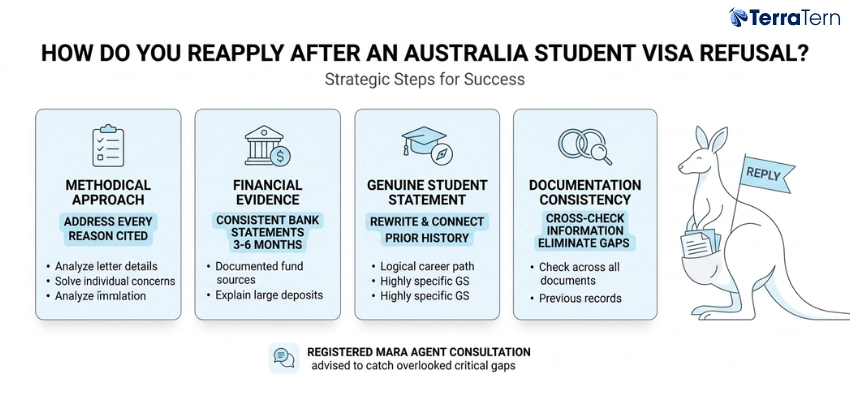
To overcome an Australia student visa refusal letter, you must methodically address every specific reason cited rather than making broad, generic improvements to your profile.
-
List each individual concern from your Australia refusal letter as a distinct, actionable problem to solve.
-
Strengthen financial evidence by providing three to six months of consistent bank statements, explicitly documented fund sources, and clear explanations for any large deposits.
-
Rewrite your Genuine Student (GS) statement to clearly connect your prior academic history to your chosen course, demonstrating a logical, highly specific career path.
-
Cross-check all information across your new application, supporting documents, and previous visa records to eliminate documentation inconsistencies.
-
Consult a registered migration agent (MARA) before resubmitting; a professional review is highly advisable to catch critical gaps applicants naturally overlook.
As per TerraTern Expert: Resist the urge to reapply immediately with only minor tweaks take the time (commonly a few weeks) to genuinely rebuild your weakest area, whether that's financial documentation or your Genuine Student statement, since a second refusal citing the same unresolved issue is significantly harder to recover from than the first.
What Should You Do Immediately After Receiving an Australia Refusal Letter?
Read your Australia refusal letter multiple times to identify every specific legal criterion cited, rather than just reacting to the main headline issue.
-
Check immediately if your letter grants you review rights for the Administrative Review Tribunal (ART) and carefully note the exact, time-sensitive deadline (often 21 days).
-
Resist the urge to panic and rush into a hasty reapplication; submitting a poorly revised application usually leads to a second refusal, which is severely damaging.
-
If your Australia refusal letter mentions complex issues like Public Interest Criterion 4020 (PIC 4020), character concerns, or health grounds, pause immediately.
-
Seek professional guidance from a registered migration agent (MARA) or a specialized migration lawyer before taking your next step to ensure you navigate the complex procedures safely.
Pro Tip: Don't rush to reapply within days of receiving your refusal letter; take the time to fully address every issue raised first, since a second refusal on the same unresolved grounds is significantly more damaging to your case than taking a few extra weeks to prepare properly.
Also Read: Australia Study Visa Requirements: Guide for Students
2025 Industry Context Section
The Administrative Appeals Tribunal (AAT) has been completely abolished and replaced by the Administrative Review Tribunal (ART), fundamentally updating how you appeal an Australia refusal letter.
-
The Genuine Temporary Entrant (GTE) test has been replaced by the Genuine Student (GS) requirement, which places greater emphasis on course relevance and logical career progression.
-
Financial capacity thresholds have increased significantly; student visa applicants must now demonstrate at least AU$29,710 in savings, plus travel and full tuition costs.
-
The ART now increasingly decides student visa reviews "on the papers" instead of holding in-person hearings, making your initial written evidence more critical than ever.
-
Because immigration regulations evolve rapidly, applicants must verify all current fees, rules, and appeal deadlines directly on their official Australia refusal letter.
Key Note: If any guide, forum post, or even a previous TerraTern article you've read refers to appealing to the "AAT," treat that as outdated; the AAT was replaced by the Administrative Review Tribunal (ART), and using the wrong terminology in your own appeal correspondence can signal an out-of-date understanding of the process.
Also Read: Australia PR Process: Step-by-Step Guide for Skilled Migrants
Conclusion
Once you get an Australia refusal letter for a visa, it’s not the end of the road. When you look at the refusal reason carefully, fill the gap in your documentation and when you follow proper steps like refiling or appeal, you can increase your possibility of success. To avoid future refusals, you need to understand the visa requirements, strengthen your Genuine Temporary Entrant (GTE) statement, and provide clear financial and supporting evidence. On top of that, engaging with immigration experts for advice further improves your application and helps you stay compliant with the newest regulations. Be informed, be quick to act, and you will overcome visa refusals and get to study or work in Australia!
If you want to avoid the challenges of an Australia visa refusal letter, having an expert like TerraTern by your side can ensure that your application is thorough and well-prepared, minimizing the risk of rejection.


 AI Summary