Key Highlights
- What Is the Current Australia Tourist Visa Rejection Rate in 2026?
- What are the Common Rejection Reasons for an Australian Visa in 2026?
- What are the Recent Trends About the Australian Visa in 2026?
- What are the Common Reasons for Australia Tourist Visa Rejection in 2026?
- What are the Additional Factors Affecting Australian Visa Approval in 2026?
- How Can You Improve Your Chances of Getting Australia Visa Approval in 2026?
- What to Do If Your Australia Tourist Visa Is Rejected in 2026?
- What to Expect After Submission of Your Australian Visa in 2026?
- How Does the Australia Tourist Visa Rejection Rate Vary by Country?
- What Are the Recent Trends Affecting Australia Tourist Visa Approvals in 2026?
- How Can You Improve Your Chances of Australia Tourist Visa Approval?
- What Should You Do If Your Australia Tourist Visa Is Rejected?
- How Does Australia Compare to Other Countries in Tourist Visa Rejection Rates?
- 2026 Industry Context Section
- Conclusion
There is no single official rejection rate for Indian applications for Australia tourist visa (Visitor subclass 600), but recent statistics indicate approximately 25-30% visa applications from India are rejected, with varying rates from country to country and on a case-by-case basis. The most common reasons for rejection are a lack of or inadequate evidence of ties to the home country, a lack of strong financial evidence, a lack of financial evidence that is inconsistent, an unclear travel purpose, a lack of travel history, and undisclosed refusals or previous negative criminal records.
To help prevent being rejected, make sure that your application is complete and consistent; clearly states your intended tourism purpose and means of return; includes 3–6 months of verified bank statements that match your income; and is a genuinely truthful application, a cover letter outlining your tourism purpose and planned date of return, and a submission of a complete and honest application with a clear itinerary and verified employment/family/property ties.
What Is the Current Australia Tourist Visa Rejection Rate in 2026?

-
Australia has no single official tourist visa (Subclass 600) rejection rate, but rejection rates are dependent on nationality, visa stream, and the type of visa.
-
The rate of approval for the Global 2025 visa was ~80%, meaning that on average 20% of Subclass 600 visas were rejected across all countries.
-
In late 2024-2025, some sources suggest that visas granted for visitors have had a ~9-10% refusal rate, but this could also cover all visas granted for visitors, not just applications for visitors to the offshore islands.
-
In fact, the rate of rejection of tourist visa applications has been increasing, with over 10% of applications being refused in the past few years.
-
The recent data shows that around 30% of all visa applications, including student and other visas, are refused in India.
-
The likelihood of being granted visa approval for Subclass 600 in 2025 varies significantly by country for applicants from the United States, with a 90% approval rate (10% rejection).
Also Read: Australia Tourist Visa Rejection Rate: Latest Guide
How Does the Rejection Rate Differ for Indian Applicants?
-
The rejection rate for Indian applicants is higher than the global average of ~20%, with a rejection rate of about 18% for tourist visas in 2025.
-
In fact, approximately 30% of all Indian applications for visas are rejected, regardless of the type of visa they apply for, whether it be student visas, temporary visas or other kinds.
-
In the first quarter of 2026, Indian student visas suffered a sharp drop to ~40% refusal rate, indicating that temporary visas from India were being closely monitored.
-
Rejections are mainly due to poor GTE proof, lack of funds, lack of good home ties or unclear travel purpose.
Expert Advice: While global rejection rates hover at ~10%, Indian applicants must treat their applications with added rigour, the average rejection rate for Indians across categories is nearly 3× the global visitor visa average, making thorough documentation non-negotiable.
What are the Common Rejection Reasons for an Australian Visa in 2026?
Several common reasons contribute to the high Australia tourist visa rejection rate. These include:
-
Insufficient Documentation: Many applications cannot continue to the next level because they are incomplete, or some vital documents are missing. It is advisable to attach all the documents that are needed in proper format; failure to which the Australia tourist visa rejection rate will influence your application.
-
Financial Instability: There must be evidence that the applicant has sufficient funds to meet personal expenses during their stay in Australia. The following consequences were identified in case of failing to follow the given recommendations: The potential rise of the Australia tourist visa rejection rate.
-
Failure to Meet Genuine Temporary Entrant (GTE) Criteria: The GTE criterion is meant to show that applicants are indeed embracing a temporary stay in Australia. It is essential to know that if the immigration authorities consider an applicant's purpose to be ill-motivated or suspicious in any way, the application can be rejected, resulting in a higher Australia tourist visa rejection rate.
What are the Recent Trends About the Australian Visa in 2026?
New trends show the tendencies by focusing more on applications from some countries, particularly those that have been rejected most of the time, such as India and Pakistan. This added pressure implies that candidates from such countries have to pay more attention while processing their documents to minimise instances that lead to a high Australian Tourist Visa rejection rate.
Also Read: Australia Tourist Visa Covering Letter: Latest Guide
What are the Common Reasons for Australia Tourist Visa Rejection in 2026?
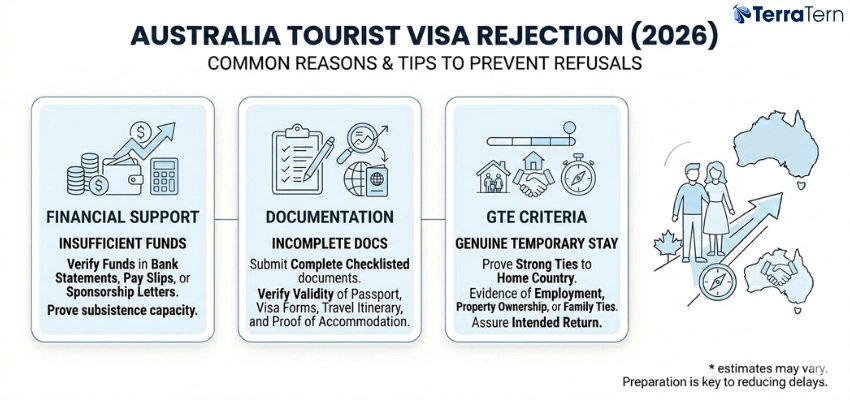
Here are some common reasons for your Australia tourist visa rejection rate:
1. Insufficient Financial Support
Among all the common grounds for refusal of the Australian tourist visa, the lack of evidence of sufficient funds for the trip is the most widespread. Australia's administrative authorities demand that visa holders prove they have enough funds for personal subsistence during their trip. This financial stability can be proven through various documents.
-
Bank Statements: Bank statements of the past three months with healthy balances and frequent credit transactions.
-
Pay Slips: Pay stubs that show that the borrower has a steady source of income, usually in the form of a remuneration package.
-
Sponsorship Letters: If a third party is sponsoring the trip, then a sponsorship confirming letter alongside the sponsor's bank statements is required.
More specifically, the following aspects are all essential: the words and numbers contained in the documents must be clear and easy to understand; each document should contain all the necessary information required for the reader to make an informed decision about the company's finances; and financial documents must be well structured and well arranged to present information coherently and efficiently. Any crack, shortage of funds, or failure in an attempt to justify one's financial capacity to the authorities increases the chances of having an Australia tourist visa rejection rate.
2. Incomplete Documentation
Another major cause that leads to a high Australia tourist visa rejection rate is the lack of proper documentation. There may be a need to ensure that every document needed is attached and well-completed as needed. Key documents typically required include:
-
Passport: That good passport with six months of validity remaining at least before the validity expiry.
-
Visa Application Form: An application form filled out and signed by the applicant.
-
Travel Itinerary: Any booked flight tickets, booked hotels, or any travelling itinerary.
-
Proof of Accommodation: Documentary evidence, confirmed hotel bookings, or an invitation letter from the host and/or sponsoring organisation/s in Australia.
To avoid rejection due to incomplete documentation, applicants should carefully follow the Australian Department of Home Affairs checklist, double-check each document, and consider seeking assistance from a migration expert if needed.
Also Read: Immigration To Australia: Everything You Need To Know
3. Lack of Genuine Temporary Stay Evidence
Meeting the Genuine Temporary Entrant (GTE) criteria is critical to the visa application process. The GTE criterion assesses whether the applicant genuinely intends to visit Australia temporarily and return to their home country after their visit. Evidence to support this includes:
-
Employment Ties: Employment contracts or employer letters confirming leave and return dates.
-
Property Ownership: Documents proving ownership of property in the home country.
-
Family Ties: Evidence of immediate family members residing in the home country.
Providing robust evidence of strong ties to the home country helps convince the visa officers of the applicant's genuine intention to return after their visit, potentially reducing the Australian tourist visa rejection rate.
What are the Additional Factors Affecting Australian Visa Approval in 2026?
Here are some factors which can affect your visa approval status:
1. Previous Visa History: Although several factors influence a decision to grant or refuse an applicant a new visa, visa history can set the tone for the decision on the visa application. Any applicant with previous visa rejections or who has violated their visa terms in other foreign countries might attract the negative attention of the rather strict Australian immigration department. It is, therefore, possible to display that previous compliance with the previous rules and regulations and being clean in one's travel records aids in decreasing the Australian tourist visa rejection rate.
1. Travel History: A good travel history, particularly to countries that require stringent measures on visa issuances, is a good indication of an applicant's credibility and skillfulness in meeting the stipulated visa rules. Those who have already visited these countries and then returned are considered more desirable since such behaviour would indicate that the applicant has no intention to disobey the visa regulations, which, in turn, can positively influence the Australian tourist visa rejection rate.
2. Health and Character Requirements: When applying for a visa to Australia, health and character requirements are always mandatory. As for the health examinations, the applicants have to pass them and submit police certificates to prove they meet the requirements. Pre-existing diseases that affect a person's physical or mental health, or that are proven infectious diseases or diseases of public health significance, are also reasons for refusal of a visa. Satisfactory health and character evidence needs to be provided and updated to help lower the Australian tourist visa rejection rate.
Also Read: Why Choose Australia Over Other Countries? 6 Top Reasons
How Can You Improve Your Chances of Getting Australia Visa Approval in 2026?
Here are some ways in which you can improve your chances of a visa approval:
1. Strengthening Financial Evidence
To enhance your financial evidence and improve your chances of visa approval, consider the following steps:
1. Consistent Income: Demonstrate a stable and consistent income through salary slips and bank statements.
2. Sufficient Savings: Ensure your bank statements reflect sufficient savings to cover travel expenses. This includes accommodation, meals, transportation, and other daily expenses.
3. Financial Planning: Plan your finances well before your application. Showing financial stability over time can positively impact your application.
2. Ensuring Complete and Accurate Documentation
Ensuring your documentation is complete and accurate is essential for a successful visa application. Follow these steps to avoid common pitfalls:
-
Checklist: Use a comprehensive checklist to ensure all required documents are included.
-
Double-Check: Carefully double-check all forms and documents for accuracy and completeness.
-
Seek Assistance: Consult a migration expert or a professional visa service to review your application and ensure all documentation is in order.
3. Proving Genuine Temporary Stay Intentions
Demonstrating your intention to return to your home country is crucial. Here are some strategies to effectively prove your genuine temporary stay intentions:
-
Employment Proof: Provide an employment contract or a letter from your employer confirming your leave and return date.
-
Property Proof: Submit documents proving ownership of property in your home country. This can include property deeds, mortgage statements, or rental agreements.
-
Family Proof: Include evidence of family ties, such as children's birth certificates, marriage certificates, and family photos.
What to Do If Your Australia Tourist Visa Is Rejected in 2026?
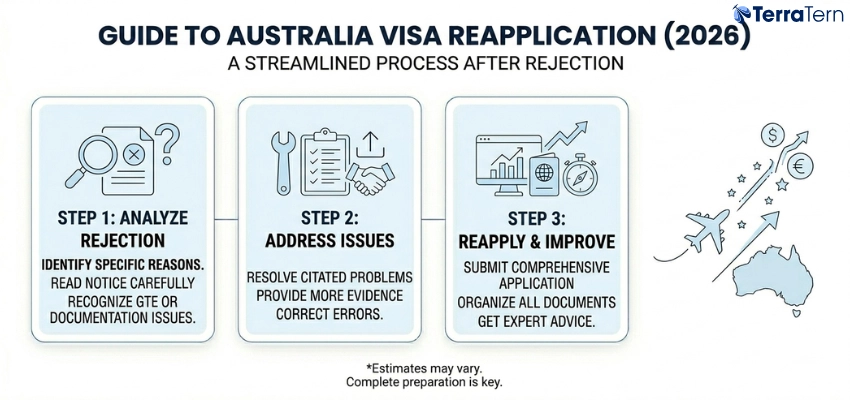
Here are some things you can do if your visa is rejected and how you can improve your chances for approval when you reapply:
1. Understanding the Rejection Notice
If your visa application is rejected, the rejection notice will provide details on the reasons for the decision. Understanding these reasons is the first step in addressing them. Here's what you should do:
- Read the Rejection Notice: It would be good to read through the rejection notice carefully so that they can identify the reasons why their application was rejected. The notice is usually particular as to why the decision was made, including issues with a lack of adequate supporting documents or failure to meet the GTE requirements.
- Identify Common Reasons: It may also include other reasons that are not specific to the candidate but are always included in rejection letters. These can help you deal with similar matters in your re-application.
Also Read: Explore Study in Australia for International Students
2. Steps to Reapply Successfully
Reapplying for a visa after a rejection involves addressing the reasons for the initial rejection and ensuring that your new application is comprehensive and error-free. Here are the steps to take:
-
Address Issues: Address the reasons cited in the rejection notice in your new application. This may involve providing additional documents, clarifying information, or correcting errors.
-
Consult an Expert: Consult a migration expert or a professional visa service to guide you through the re-application process. Their expertise can help identify and rectify any issues in your application.
-
Improve Documentation: Ensure all documents are complete, accurate, and well-organised. Provide any additional evidence required to address the reasons for your previous rejection.
Proactive Steps for a Strong Application
- Thorough Research: Research extensively on the various aspects of the Australian tourist visa application. They can prepare a good application by grasping all the requirements and expectations in detail. Collect information from the official Home Affairs Department of Australia and only from reliable and up-to-date migration services.
- Detailed Planning: Make specific arrangements on how and when you will travel before applying for the visa. This ranges from the arrangements of the flights and the accommodation to the daily schedule while on the trip. A proper and detailed plan of the intended stay in Australia and the plan of future stay in the home country after the trip also shows the immigration officer that one's intention is temporary.
- Strong Cover Letter: Do not forget to attach a good cover letter to your application. This letter should describe why you need to be there, for how many days, and assert how you will meet your travel costs. It is an opportune moment to answer possible questions a visa officer can have, such as occasional time intervals between foreign trips or fluctuations in income, and to submit supporting documents.
- Evidence of Social Ties: Apart from having monetary and occupational connections, evidence of social connections can also help bolster your case. This may include documents that prove your participation in any social activities, such as involvement in Associations and clubs, your social responsibilities that may compel you to visit your home country, etc. Friends and commitments can offer a visa officer more confidence that one will return to their country after the visit, thus possibly influencing the Australia tourist visa rejection rate positively.
Also Read: Apply Working Visa in Australia: Types, Benefits, Process
What to Expect After Submission of Your Australian Visa in 2026?
Here is some information on what you can expect after you submit your Australian Visa:
1. Application Processing Time: Familiarising oneself with the general time to process the tourist visa would also be important in dealing with the expectancy. The time it takes to process the application may also depend on the number of applications received and other circumstances of your application. Generally, the tourist visa application may take a few weeks to a few months.
2. Communication with the Department of Home Affairs: Once you have completed the application, the applicants may hear from the Department of Home Affairs to request more information or supporting documents. Any such requests should be responded to as soon as possible and appropriately so as not to delay your application's processing, which may increase the Australia visa rejection rate.
3. Monitoring Application Status: You can check the status of your visa application through the ImmiAccount. Thus, it might be helpful to check the status occasionally to see if the service requires more details from the client. It is good to keep track of your application status, and you can easily deal with it if there is a problem. Not doing so may lead to an increase in the Australia visa rejection rate.
Preparing for Your Trip to Australia
After your visa has been granted, it is time to plan your trip to Australia. Ensure that your papers are well arranged for travel. These include a passport, visa approval letter, and any other required form of identification. Before setting out on your trip, make sure you have a good plan of where to go, where to sleep, and what to do to avoid mishaps.
How Does the Australia Tourist Visa Rejection Rate Vary by Country?
There is no official, up to date rejection rate by country for tourist visa (Subclass 600) visas in Australia available based on the data available at the time of the writing of this guide. The information collected, however, reveals consistent trends by country and by type of visa:
Australia Visa Rejection Rate by Country (Most Recent Data)
|
Country |
Visa Type / Category |
Approx. Rejection Rate |
Notes |
|
India |
All visa types (including tourist) |
~30% |
More stringent checks, tourist visas increase because of GTE and money concerns |
|
India |
Student visa |
~40% |
Data from early 2026 and the worst in 20 years |
|
Nepal |
Student visa |
~60% |
Even higher than India |
|
Bangladesh |
Student visa |
~47% |
Significantly higher than in many countries |
|
China |
Student visa |
~3% |
Much lower rejection rate than those of South Asian countries. |
|
USA |
Visitor (tourist) visa 600 |
~10% (≈90% approval) |
Highest approval rate in the world |
|
Global avg. |
A tourist visa (for all countries) |
~20–25% |
Overall, 60% to 80% of respondents approved of the Subclass 600. |
|
Global avg. |
Visitor visa (late 2024–25) |
~9–10% |
Other sources indicate a decline in visitor visas for the year as a whole. |
Key Note: Australia uses a risk-tiered processing system - knowing where your country sits helps set realistic expectations and motivates the extra documentation effort that shifts an application from borderline to approved.
What Are the Recent Trends Affecting Australia Tourist Visa Approvals in 2026?
The following points highlight recent changes in the approval rates for Australia tourist visas (subclass 600) in 2026:
-
Streamlined and priority handling for well-prepared applications, and real-time tracking is now available for many applicants.
-
Stronger denials of incomplete or questionable applications are due to the more stringent penalty for errors and misrepresentation.
-
Higher scrutiny of financial documents, with tight scrutiny on bank statements, income sources, and fund viability.
-
Tightening of the requirements in the case of Genuine Temporary Entrant (GTE) for those applying from high-risk countries, such as India.
-
A significantly higher rejection rate for Indians, where approximately 30% of all visa applications from Indians were rejected across categories, including tourist.
-
Most visa applications take 8-30 days to process, although longer processing times for more complicated cases with weaker documentation.
-
Strict standards on accuracy and integrity (even minor inconsistencies in documents, dates, and even declared information).
-
Greater focus on post-arrival compliance – increased monitoring of visa conditions, shorter grace periods after visa expiry.
-
Harsher consequences for violations of visa conditions, impacting future visa eligibility and approvals.
-
However, Australia is still open to tourists after the pandemic, but with new and stricter criteria this year, along with additional compliance assessments.
Also Read: Germany Student Visa Success Rate- Trends, Rejection Reasons & More
How Has Australia's Migration Policy Impacted Indian Applicants Specifically?
-
In January 2026, Australia placed India in the highest-risk category “Evidence Level 3” for student visas, which has led to increased scrutiny and processing delays.In January 2026, Australia placed India in the highest-risk category “Evidence Level 3” for student visas, which has resulted in greater scrutiny and processing times.
-
Approximately 40% of Indian visa applications are now being rejected, and India's student visa approval rate is currently at 49% during early 2026.
-
The manual bank verification, further English proof and institutions' and referees' background checks are all included in stricter scrutiny.
-
The post study work visas are more restrictive, with shorter visa periods and increased visa fees (≈A$4,600), to weaken the long-term migration opportunities of Indian graduates.
-
In response to stricter policies and fees, the number of Indian students has dropped by ~50% over 2 years, from more than 109,000 in 2023 to ~15,000 in 2026.
Advice by our Expert: Australia's stricter immigration stance is systemic - applicants from India in 2026 must go above and beyond minimum requirements and treat every document as a chance to build credibility, not just meet a checklist.
How Can You Improve Your Chances of Australia Tourist Visa Approval?
-
Submit documents that are accurate, complete and have consistent information regarding dates, names and financial information.
-
Submit 6 months of bank statements that demonstrate regular savings, equivalent to your reported income and expenses for travel.
-
Make regular filing of income tax returns (ITRs): regular filing of ITRs demonstrates financial stability and credibility.
-
Have a cover letter that is clear and compelling, describing travel purpose, itinerary and a strong reason to return home.
-
Demonstrate very close ties to home: leave to work letter at home, family dependents, or current studies.
-
Demonstrate a clear travel plan: confirmed flight bookings and hotel reservations, and realistic day-by-day travel plan.
-
Employers will be impressed with your travel history, as it will demonstrate that you are following visa conditions.
-
Be truthful about everything including any visa denials, relationships and contacts in Australia – lying is a sure ticket to rejection.
-
Apply early to give adequate time for extra check before applying in haste and committing mistakes.
-
For "refused" and "complex" cases, it may be advisable to engage a registered MARA migration agent.
What Documents Should Indian Applicants Prioritise to Avoid Rejection?
-
A 6-month history of bank statements that demonstrate that you are saving money at a rate that is comparable to your travel expenses and your income.
-
The income Tax Returns (ITR) of last 2-3 years to establish regular income and financial stability.
-
A letter of employment indicating your position, salary, duration (or length) of employment and approved leave.
-
Passport has clear photo page, personal information and has a 6 months validity.
-
Evidence of assets: property deeds or fixed deposits or large investments with strong home ties.
-
Itinerary and confirmed air travel and accommodation information.
-
Family ties: marriage certificate, birth certificates of children or documents showing dependants.
-
Previous travel history (visas, entry/exit stamps) that would show compliance with visa regulations.
How Should You Write a Strong Cover Letter for an Australia Tourist Visa?
-
State clear purpose: Start with name, passport number and purpose of visit (tourism).
-
Describe travel plans: Dates; what you will do; destinations; activities you will do in Australia.
-
Demonstrate financial ability: Give your bank account, salary and ability to fund the entire trip without working to mention.
-
Demonstrate good ties with home country: State your employment, your family, your property, your education, or other reasons why you are going to return to India.
-
State that you are not coming to work: Make it clear that you are not coming to work, but not leaving Australia, and are leaving before the visa expires.
-
Attach documents: Include all documents (bank statements, ITR, employment letter, etc.) in a list.
Expert Advice: A well-crafted cover letter is your chance to pre-answer a visa officer's doubts before they become rejection reasons - Indian applicants with employment gaps, self-employment, or recent large financial transactions especially need to address these proactively.
What Should You Do If Your Australia Tourist Visa Is Rejected?
-
Take the time to read the refusal letter and understand exactly why the letter was refused.
-
Check if you have appeal rights: If you applied while in Australia, you can appeal to the Administrative Review Tribunal (ART/AAT) within 21 days.
-
Generally, if you applied to come to Canada without a sponsor, you will not have the opportunity to appeal and will need to resubmit your application with more evidence.
-
Avoid re-applying for another 2-4 weeks to rectify any reason for refusal and prevent rejections.
-
Tackle each denial with new, more compelling documents that directly quell the officer's concerns.
-
Write a clear refusal response letter stating the reasons for refusal and just how you have addressed them.
-
Enhance financial proof: Bank statements of 3-6 months, salary slips, and ITR for 3 years.
-
Show good ties at home: Provide a letter of authorization from work, property deed, business registration, family records, etc.
-
Contact a Registered Migration Agent (RMA) or migration lawyer for professional advice on reapplying or appealing.
-
Try other visas if you don't think your tourist visa will work out, but another visa type might apply to you.
-
Never push the refusal under the rug; always state in a new application that you refuse and do not lie about it.
Can You Reapply for an Australia Tourist Visa After Rejection?
-
Yes, it is possible to submit the new tourist visa right after; there is no official waiting period for reapplying for a new tourist visa.
-
Wait for 2-4 weeks before reapplying to collect better evidence to address the reasons for a refusal.
-
Reapplying without changes to the documents is likely to result in a further rejection and may be construed as “visa shopping.
-
For each refusal reason, include new financials, more home ties evidence, and a cover letter.
-
Tell about the previous refusal in your new application – it is better to tell about the refusal than to keep it secret.
What Is the AAT Appeal Process for Australia Tourist Visa Refusals?
-
Appeals: Appeals to the Administrative Appeals Tribunal (AAT/ART) are only permitted if refused onshore (in Australia).
-
Appeal must be filed within 21 days of the date of the refusal; the appeal will be forfeited.
-
Apply online: Apply through the ART/AAT website, pay an appeal fee of AU$3,374, and submit documents of your case.
-
A confirmation letter will be issued, and the AAT will then ask for files from Immigration.
-
Get ready: Collect all documents that support your case; hire a migration lawyer if necessary, and get ready for the hearing.
-
Go to the hearing: Go to the hearing and argue your case before an AAT member; you have witnesses and your attorney.
-
AAT decision: The AAT can seek further information and then make a decision to uphold, set aside, or remit the refusal.
-
Refund of fee: If the AAT rules in your favour, you may receive a 50% refund of the fee.
Pro Tip: Most offshore tourist visa refusals are not subject to AAT review – but reapplication with a substantially improved application is almost always a viable path. Spending resources on a professional review of the original rejection reasons pays higher dividends than an appeal.
Read More: How to Apply for Jobs in Australia from India? Latest Guide
How Does Australia Compare to Other Countries in Tourist Visa Rejection Rates?
-
The overall rejection rate for visa applications is ~20-25% for Australia, and it is estimated to fall to ~9-10% for 2024-25.
-
The percentage of visa refusals to receive tourist visas (B1/B2) from the USA is approximately 15-20%. The USA is more or less selective depending on the country.
-
Overall rejection rate for Schengen (EU) visas: ~10-15%; some countries have higher rejection rates, and others have lower.
-
The rejection rate for tourist visas to Canada is approximately 20-30% for all countries, which is similar to the overall rejection rate of Australia.
-
The rejection rate for visitor visas in the UK is ~25%, which matches or is slightly higher than Australia's average.
-
There are no official refusal rates in Australia by nationality, as there are in the US, which publishes detailed consular-level B1/B2 refusal rates.
-
The tourist visa rejection rate for Australia in India is ~18%, whereas the overall visa rejection rate is ~30%.
-
Compared to applicants from developed countries, there are far higher rejection rates for applicants from South Asian countries for Australian visas (between 30% and 60% for Australian student visas).
-
Like the US, UK, and Schengen countries, Dangerous/Nationality Bias: Australia uses country risk assessments of applicants.
-
Turist visa approval is generally more flexible and quicker in Australia compared to the US, UK, or Schengen, and the approval rate is approximately 80% worldwide.
Key Note: Australia remains one of the more transparent countries about its visa refusal rates - using official Home Affairs data in your application research puts you ahead of applicants who rely on anecdotal information alone.
Also Read: Navigating the Path to Canada Visa Rejection: Understanding Reasons
2026 Industry Context Section
Latest Statistics (with dates):
-
As of December 2024, the official refusal rate for the Australia Visitor Visa Subclass 600 was approximately 9.2%
-
Industry data suggests 2026 rejection rates exceed 10% due to tighter GTE scrutiny
-
Approximately 30% of all visa applications from India (across categories) are being denied as of early 2026
-
The rejection rate for Indian applicants specifically is cited at approximately 18% for tourist visas in 2026
-
Australia's Department of Home Affairs publishes bi-annual Visitor Visa Program Reports tracking approval/refusal data
Industry Developments (2026 Trends):
-
Australia tightened migration policies in late 2023–2024, introducing stricter document cross-checking
-
India was moved to the highest risk tier (Evidence Level 3) under the Simplified Student Visa Framework in 2026, signalling broader immigration scrutiny for Indian applicants
-
Financial documents and travel intent are now scrutinised more rigorously than pre-2023
Expert Insight:
"Most rejections happen due to documentation mistakes or weak applications, not because Australia is randomly rejecting people." - Visa industry assessment
Conclusion
Globally, Australia's tourist visa rejection rate is in the 20-25% range, but there is a wide disparity in rejection rates by country: tourist visa rejections for Indians are ~18%, student visa rejections for Indians are ~40%, and across all visa types, the rejection rate is ~30%. The primary grounds for rejection are that applicants do not have strong home ties, do not have enough financial backing, do not have a Genuine Temporary Entrant (GTE), their documents are not complete or consistent, their travel history is insufficient and poor, and they have been refused before, but their previous refusal(s) were not disclosed. To ensure that you're not rejected, pay attention to 6 months of consistent bank statements, ITR for the last 2-3 years, solid employment and family/property connections, a definite travel timetable, and a strong cover letter outlining your tourism plans and return date. If denied, reapply (no waiting period) or complain to the AAT if in Australia at the time of refusal within 21 days of refusal. India has been identified as the highest risk to be selected for the 2026 migration programme due to the tougher policies put in place by the Australian government, but this should not deter you if you're ready with a well-prepared application with proper documentation in order.
To learn more about Australian visas and how to apply, you must contact TerraTern. TerraTern offers immigration-related services that will make your move easier and faster!


 AI Summary