

Key Highlights
- Latest Facts & News (2026): Stay Ahead on Australia’s Temporary Work Visa
- What is a Temporary Work Visa Australia? (Subclass 400)
- What Are the Different Types of Temporary Work Visas in Australia?
- Who Is Eligible for the Temporary Work Visa Australia?
- What Documents Are Required for the Temporary Work Visa Australia?
- What Is the Temporary Work Visa Australia Cost?
- How Long Does the Australia Temporary Work Visa Processing Time Take?
- How to Apply for a Temporary Work Visa Australia Step by Step?
- What Is the Temporary Work Visa Australia for Indian Professionals?
- What Is the Stay Duration and Can the Temporary Work Visa 400 Be Extended?
- What Are the Common Reasons for Rejection and How to Avoid Them?
- What Are the 2026 Updates to the Temporary Work Visa Australia Rules?
- Conclusion
The Temporary Work Visa Australia is the most convenient and most effective visa for skilled workers who are totally proficient in a specific field that has been chosen to come to Australia for a brief-term assignment. The Temporary Work Visa Australia 400 is a visa granted to foreigners for a specific period of time to work in Australia for highly specialised occupations and is also sometimes referred to as the subclass 400 visa. This extensive guide provides all the information, eligibility, expenses, processing times, and 2026 rule changes.

Latest Facts & News (2026): Stay Ahead on Australia’s Temporary Work Visa
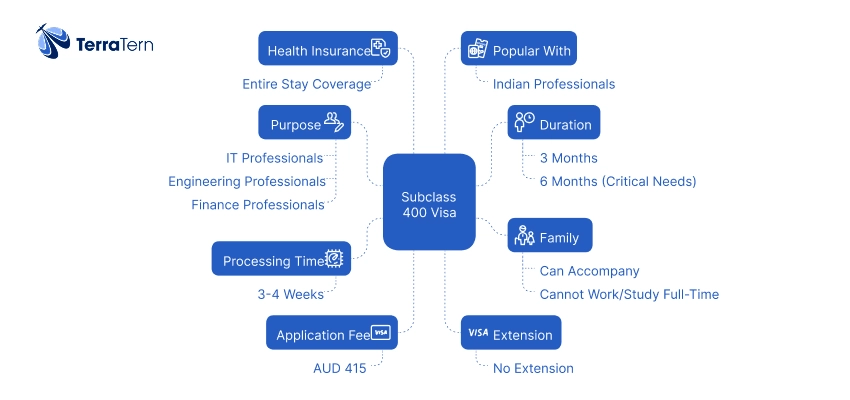
In 2026, Australia made several amendments to the temporary visa system in force to control and streamline it:
-
Tougher Stay Periods: Governments have now imposed more stringent restrictions on stay periods. The majority of the applicants can no longer enjoy the maximum stay of more than three months in a 12-month timeline unless they can prove solid business reasons. Next, only in extreme and reasonable business necessities are extended stays of up to six months permissible.
-
Updated Visa Charges: The existing cost charged on an application for a temporary work visa 400 Australia is at least 415 AUD, equivalent to about 23,869 Indian Rupees. Other expenses can be a result of biometrics, health examinations, and compulsory insurance.
-
Stricter Check on Applications: The immigration authorities have started to subject the applicants to a higher degree of scrutiny with regard to the nature of the visa that the applicants seek or the paperwork and the credentials of the employer that the applicants want to work under.
-
Visa Replacements: The Skills in Demand visa replaced the Temporary Skills Shortage (TSS) visa, even though the Subclass 400 is still applicable to short-term specialist jobs needing special overseas skills.
-
Average of Processing Time: The average time it currently takes to process cases is 3 to 4 weeks but can be delayed upon an apparent high volume of applications or an imperfect application.
-
Specific Eligibility: Applicants have to clearly show that they do not have the skills needed in Australia and that the work is not an ongoing one.
-
Popularity with Indians: Indian professionals, especially in the IT, infrastructure and engineering, are still one of the biggest groups of applicants.
-
Family Rules: The immediate family can follow a person with a principal visa, but they are not allowed to work or obtain full-time studies (however, with a few exceptions to language studies).
-
No Extendable Option: The Subclass 400 can not be extended as compared to some of the other long-term visas. It has to be renewed to allow further stay after its expiration.
-
Mandatory Health Insurance: To protect themselves and limit the health expenditure of the state, applicants will be required to provide documents with enough health coverage throughout the whole duration of the stay.
What is a Temporary Work Visa Australia? (Subclass 400)
Temporary Work Visa Australia (Subclass 400) is also a visa granted to the overseas nationals that are invited by an Australian organisation to fulfil a highly specialised job position in Australia that has a workforce shortage of qualified workers.
-
There is the fact that it is not a permanent or long-term visa, meaning it is not a visa that would be organised for a long-term/permanent position, and it is one of the fastest visas that can be applied for by a short-term specialist. There are two major streams
-
Highly Specialised Work Stream for professionals with specialised technical and professional skills.
-
Interests Stream For workers whose work role supports Australia's trade, diplomatic or international interests.
-
In contrast to most Australian work visas, the Temporary Work Visa Australia does not require Standard Business Sponsorship.
-
It is much easier and quicker to obtain a visa than a Subclass 482 (Skills in Demand) visa, as it only requires a formal invitation or support letter from an Australian organisation.
What Are the Different Types of Temporary Work Visas in Australia?
Australia offers several temporary work visa categories. Learning the distinction aids you in picking the right one. The skilled visa Australia subclass 400 is the most convenient and direct visa to apply f for most skilled workers with a short-term assignment. Another notable difference about the temporary work visa (400) Australia is that it does not need to be sponsored - this process saves time and eases administrative burden.
|
Subclass |
Name |
Stay Duration |
Sponsorship? |
Best For |
|
400 |
Temporary Work (Short Stay Specialist) |
3 - 6 months |
Invitation only |
IT/engineering specialists |
|
408 |
Temporary Activity |
Up to 2 years |
Some streams |
Entertainment/research |
|
403 |
Temporary Work (International Relations) |
Varies |
Required |
Diplomatic/labour programs |
|
482 |
Skills in Demand (ex-TSS) |
Up to 4 years |
Employer sponsor |
Ongoing skilled jobs |
|
491 |
Skilled Work Regional (Provisional) |
Up to 5 years |
State/territory |
Regional workers |
Important Note: Most Indian professionals confuse Subclass 400 with the Skills in Demand Visa (482). The key difference: Subclass 400 is for one-time, non-ongoing projects with no sponsorship needed; Subclass 482 is for ongoing employment and requires a formal employer sponsor.
What Is the Temporary Work Visa 400 in Australia?
The Temporary Work visa 400 Australia (Short Stay Specialist) Visa Australia 400 (Subclass 400) is for short-term, highly specialised, non-ongoing work which cannot be obtained by the local Australian workforce.
|
Feature |
Details |
|
Primary Purpose |
For highly specialised, non-ongoing work that cannot be sourced locally in the short term. |
|
Available Streams |
Single Stream: Activities relating to Australia's interests or specialised work (the "Invited Participant" stream remains defunct). |
|
Key Restrictions |
No study allowed; family members included in the application cannot work; must apply from outside Australia. |
|
Entertainment |
Strictly prohibited. Performers and support staff must use the Subclass 408 (Temporary Activity) visa. |
|
Stay Duration |
Generally up to 3 months. 6-month stays are now under intense scrutiny and require a strong business case. |
|
The "One-and-Done" Rule |
Generally limited to one stay period per 12-month window to prevent "backdoor" long-term employment. |
|
Cost (VAC) |
AUD 430 (as of the July 2025 hike, subject to further indexation). |
|
Processing Speed |
Fast-tracked for decision-ready apps: 75% in 7 days; 90% within 24 days. |
These are the most usual categories of occupations in the CBT cards:
-
IT & Software: Proficient in software and system commissioning, cyber security audits, and specialist software implementation.
-
Engineering & Scientific Research: Factory-certified equipment installation, Special shutdown work, and research collaboration.
-
Professional Badisane Consulting & Auditing: Enables clients to hire an expert for a project.Consulting & Auditing: Management consulting in the short term and financial auditing for specific projects.
-
Workplace training: Particular training that is fundamental to their job but not necessarily part of particular technical training by specialised specialists and experts authorised by the manufacturer (not general workplace training)
Expert Advice: The "Australia's Interests Stream" under Subclass 400 is often overlooked; it covers workers whose roles benefit Australia's trade, diplomatic, or international interests and may be subject to different scrutiny levels than the Highly Specialised Work stream.
Who Is Eligible for the Temporary Work Visa Australia?
To qualify for the Temporary Work Visa Australia (Subclass 400), you need highly specialised skills unavailable locally, an Australian organisation's invitation, short-term non-ongoing intent, and health/character checks (homeaffairs.gov.au).
Eligibility Checklist:
-
Highly specialised skills (e.g., niche IT/engineering).
-
Formal invitation letter.
-
Short-term, non-ongoing work.
-
Apply outside Australia.
-
Genuine Temporary Entrant (GTE): Prove return intent.
-
Health/character requirements.
-
Financial self-support.
-
No study intent.
-
Sign the Australian Values Statement.
Who is NOT Eligible?
-
Ongoing/permanent seekers.
-
Entertainment workers.
-
Onshore applicants (mostly).
-
Weak GTE.
Expert Tip: The GTE requirement is the most common reason for the rejection of Subclass 400 applications among Indian nationals. Your application must clearly show strong ties to India employment contracts, family, and property, demonstrating you will return after your assignment ends.
What Are the Specific Eligibility Requirements for Indian Applicants?
Indian professionals are among the most frequent applicants for the Temporary Work Visa Australia, particularly in sectors like IT, software development, engineering, financial auditing, and corporate training.
-
Certified English translations of all education certificates, degrees, and experience letters issued in regional Indian languages
-
Bank statements covering 3 - 6 months showing an equivalent of AUD 5,000 or more
-
Clear proof of ties to India: employment contract with Indian employer, property documents, family evidence
-
Comprehensive health insurance (not just travel insurance) covering the full duration of stay
-
A detailed personal statement explaining the assignment's scope and your confirmed post-assignment return plan
Important Tip: Indian applicants often submit inadequate GTE evidence. A detailed cover letter explaining the assignment's scope, your employer in India, and your confirmed post-assignment return plan can significantly increase approval chances.
What Documents Are Required for the Temporary Work Visa Australia?
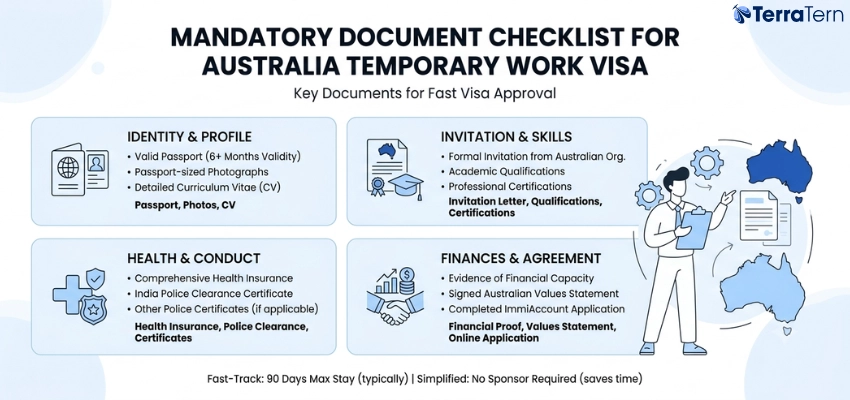
A thorough, well-organised application is the most reliable way to secure fast approval for the Temporary Work Visa Australia. Here is the complete document checklist:
Mandatory Documents:
-
Valid passport (minimum 6 months validity beyond your intended stay)
-
Completed online application via ImmiAccount
-
Formal invitation or support letter from the Australian organisation
-
Proof of specialised skills: academic qualifications, professional certifications, detailed CV
-
Comprehensive health insurance covering the full period of stay
-
Police clearance certificates from India and all countries resided in for 12+ months in the past 10 years
-
Evidence of financial capacity (bank statements, salary slips)
-
Passport-sized photographs as per specifications
-
Signed Australian Values Statement. Additional for Indian Applicants:
As per TerraTern Expert: The invitation letter from the Australian organisation is the single most important document in your Subclass 400 application. It must specifically state why your skills are unavailable locally, the exact scope of work, and the dates of engagement; generic letters are a primary cause of refusal.
Also Read: Australia Work Permit from India: Latest Guide
What Is the Temporary Work Visa Australia Cost?
The Temporary Work Visa Australia (Subclass 400) is one of the most cost-effective Australian work visas available. This makes the temporary work visa Australia 400 significantly more affordable than the Subclass 482, which carries an application fee of AUD 3,035 and requires a formal skills assessment and English language test on top of that.
Official Government Fees:
|
Applicant |
Fee (AUD) |
Approx. INR |
|
Primary |
415 |
22,800 |
|
Partner (18+) |
415 |
22,800 |
|
Child (<18) |
105 |
5,775 |
Additional Costs to Budget For:
|
Cost Item |
AUD Range |
INR Range (Approx.) |
|
Health Insurance |
AUD 50 - 150 / month |
INR 2,750 - 8,250 / month |
|
Police Clearance (India) |
AUD 15 - 30 |
INR 825 - 1,650 |
|
Document Translation |
AUD 100 - 300 |
INR 5,500 - 16,500 |
|
Medical Examination (if required) |
AUD 200 - 500 |
INR 11,000 - 27,500 |
|
Migration Agent (optional) |
AUD 1,500 - 2,500 |
INR 82,500 - 1,37,500 |
Pro Tip: Many Indian applicants underestimate the total cost by focusing only on the AUD 415 government fee. Factor in health insurance, document translation, and police clearances, your all-in cost is typically INR 32,000 - 45,000 for a straightforward solo application without an agent.
Are There Any Hidden Costs in the Temporary Work Visa 400 Application?
Beyond the official AUD 430 fee, applicants for a temporary work visa 400 australia must budget for health insurance, police clearances, document translations, and VFS biometrics.
-
Biometric Collection: Mandatory service fees at VFS Global (standard for Indian applicants).
-
Document Translation: Costs for NAATI-certified translations of non-English certificates.
-
Re-application Risk: Base fees are non-refundable; refusals require a full new payment.
-
Agent Fees: AUD 1,500 - 2,500 for standard files; up to AUD 4,000 for complex cases.
-
Exemptions: No skills assessment fees or IELTS/English test costs are required for this subclass.
Key Note: Unlike many other Australian visa types, Subclass 400 does NOT require a skills assessment or English language test, saving applicants INR 15,000 - 25,000 compared to Subclass 482 applications — a significant cost advantage for short-term assignments.
How Long Does the Australia Temporary Work Visa Processing Time Take?
One of the biggest advantages of the Temporary Work Visa Australia is its relatively fast processing timeline:
|
Type |
Time |
|
Decision Ready |
7 - 21 days |
|
Standard |
2 - 4 weeks |
|
Complex/6-mo |
4 - 8 weeks |
|
Applications for 6-Month Stay |
4 - 8 weeks (higher scrutiny) |
Tips to Accelerate Processing:
-
Submit a "Decision Ready" application with all required documents uploaded upfront
-
Lodge exclusively via ImmiAccount (paper applications are not accepted)
-
Respond to any requests for additional information within 48 hours
-
Avoid peak periods (October - January) where volumes are highest
-
Use a registered migration agent for complex or borderline cases
The 2026 updates introduced enhanced compliance screening for all Temporary Work Visa Australia applications. Applications with vague purpose statements, inadequate GTE evidence, or incomplete documentation now face significantly extended review periods.
As per TerraTern Expert, Divyansh, Applications for a 6-month stay on Subclass 400 have become significantly harder to get approved since the 2026 updates. The Department now requires compelling business justification. If you need more than 3 months, build a strong case from the outset or consider whether the Subclass 482 (Skills in Demand) is a better fit.
How Can I Check My Subclass 400 Visa Application Status?
Log in to ImmiAccount.
-
View "My applications."
-
Check statuses: Received/Review/Requested/Finalised.
-
Overdue? Enquiry via site (once only).
Contact: homeaffairs.gov.au.
Important Note: If your application exceeds the 90th percentile processing time published on the Department of Home Affairs website, you can submit a status enquiry,but do so only once to avoid flagging your application for unnecessary review.
How to Apply for a Temporary Work Visa Australia Step by Step?

Applying for the Temporary Work Visa Australia is a fully online process through the Department of Home Affairs' ImmiAccount portal. Here is the complete process. Always select "multiple entry" during your temporary work visa Australia 400 application. It costs no extra fee but gives you the flexibility to travel in and out of Australia during your assignment
-
Step 1: Confirm eligibility, verify your skills qualify as highly specialised and are unavailable locally
-
Step 2: Secure a formal invitation or support letter from the Australian organisation
-
Step 3: Gather all required documents (as listed above)
-
Step 4: Create or log into your ImmiAccount at immi.homeaffairs.gov.au
-
Step 5: Select "New Application" → "Temporary Work (Short Stay Specialist) - Subclass 400"
-
Step 6: Complete the online form, upload documents, and select single or multiple entry
-
Step 7: Pay the AUD 415 application fee by credit or debit card
-
Step 8: Complete biometrics at a VFS Global centre if required (Indian applicants can do this at centres in Mumbai, Delhi, Bengaluru, Chennai, Hyderabad, Kolkata, Ahmedabad, Pune, Chandigarh, or Jalandhar)
-
Step 9: Attend a medical examination if requested by the Department
-
Step 10: Await the decision via ImmiAccount and receive your electronic visa grant
Expert Advice: Selecting "multiple entry" during your Subclass 400 application costs no extra fee but gives you the flexibility to travel outside Australia during your assignment. Always opt for multiple entries unless your project is strictly a one-time visit.
Can I Apply for the Subclass 400 Visa From Inside Australia?
No offshore rule tightened.
-
General rule: You must be outside Australia when lodging your application
-
Rare exceptions: Onshore applications are accepted only in very limited circumstances
-
On another visa? Transitioning to Subclass 482 while onshore requires a Bridging Visa A (BVA)
-
Strongly recommended: Consult a registered migration agent before attempting any onshore lodgement
Expert Tip: Do not assume you can apply for Subclass 400 from within Australia. The Department of Home Affairs has tightened enforcement of the offshore lodgement requirement; attempting to lodge onshore without confirmed eligibility can result in immediate refusal.
What Happens If My Temporary Work Visa 400 Application Is Refused?
Weak GTE, vague letter, and gaps in the docs. No AAT review address in reapply. Disclose always.
-
Common refusal reasons: Weak GTE case, vague invitation letter, missing documents, unproven skill unavailability, or character/health issues
-
After refusal: Review the refusal notice carefully stated reasons are legally binding and must be fully addressed in any new application
-
No AAT review: Temporary work visa 400 Australia refusals are generally not reviewable by the Administrative Appeals Tribunal. Getting it right first time is critical
-
Re-application: A fresh application addressing every stated refusal reason can be lodged
-
Seek help immediately: Always consult a registered migration agent after any refusal
Important Tip: Subclass 400 refusals are generally NOT eligible for AAT review, unlike many other Australian visas. This means there is no appeals pathway, making a professionally prepared, complete first application absolutely critical. Do not risk a DIY application for high-stakes assignments.
Also Read: Australia Visa for Indians: Types, Costs, Checklist & More
What Is the Temporary Work Visa Australia for Indian Professionals?
Indian professionals can apply for the temporary work visa Australia (Subclass 400) through the same process as all nationalities, but should pay special attention to GTE documentation, certified translations, and comprehensive financial evidence.
-
Top Talent Pipeline: India is a leading source of IT and engineering professionals for Australia, with common projects including software implementation, equipment installation, corporate training, financial audits, and engineering inspections across IT/software, civil/mechanical engineering, healthcare, and finance sectors.
-
No English Test Required: Unlike Subclass 482, the 400 visa does not require IELTS or PTE, removing a significant barrier for Indian applicants.
-
Documentation Essentials: All educational documents in regional Indian languages must be certified and translated into English; bank statements must show INR equivalent of AUD 5,000+ for solo applicants as proof of financial capacity.
-
Mandatory Health Cover: Comprehensive health insurance is compulsory (not basic travel insurance), with VFS Global biometric appointments available across 10 Indian cities: Mumbai, New Delhi, Chennai, Bengaluru, Hyderabad, Kolkata, Ahmedabad, Pune, Chandigarh, and Jalandhar.
-
•ECTA Advantage: The 2022 Australia-India Economic Cooperation and Trade Agreement streamlined pathways for Indian service providers, making Subclass 400 a preferred route for Indian companies sending employees to Australian clients on project-based work.
-
Cost Breakdown in INR:
|
Item |
Cost in INR (Approx.) |
|
Visa Application Fee |
~INR 22,800 |
|
Health Insurance (1 month) |
~INR 2,750 - 8,250 |
|
Document Translation |
~INR 5,500 - 16,500 |
|
Police Clearance (India) |
~INR 825 - 1,650 |
|
Migration Agent (if used) |
~INR 82,500 - 1,37,500 |
As per TerraTern Expert: Indian IT companies outsourcing project delivery to Australia regularly use Subclass 400 for their on-site consultants. Under the ECTA framework, the movement of Indian service providers has been explicitly recognised. Ensure your invitation letter references the project's ECTA context to strengthen your application.
What Is the Stay Duration and Can the Temporary Work Visa 400 Be Extended?
The temporary work visa australia 400 allows a stay of up to 3 months, extendable to 6 months only in exceptional circumstances with strong business justification. The visa CANNOT be extended beyond 6 months; a fresh application must be lodged if more time is needed.
-
Standard stay: Up to 3 months for short-term, highly specialised work.
-
Extended stay: Up to 6 months requires compelling evidence, such as critical project importance, an absolute lack of local alternatives, and significant economic impact.
-
2026 update: 6-month approvals are increasingly scrutinised. The Department of Home Affairs now mandates explicit, documented justification for longer stays.
-
No onshore extensions: The visa is a "single-point" solution. Once the approved stay period ends, work must cease immediately, and the visa cannot be extended. A new application must be lodged, usually from offshore.
-
Family members: Dependents on accompanying visas are granted the same stay period as the primary applicant but have no work rights in Australia.
-
Long-term solutions: For those needing longer stays, pivot your strategy to the Subclass 482 (Skills in Demand) or explore the Subclass 408 (Temporary Activity) visa.
Pro Tip: Planning a project that might run for more than 3 months? Do NOT assume you can extend your Subclass 400. Plan your assignment timeline before applying. If there's any realistic chance the project will exceed 3 months, either structure the work within that window or explore a Subclass 482 visa from the outset.
What Is the Difference Between Subclass 400 and Subclass 482 (Skills in Demand)?
Choosing between the Temporary Work Visa Australia 400 and the Subclass 482 (Skills in Demand) depends entirely on your project's duration. The 400 is perfect for quick, specialised tasks without sponsorship or English tests. Conversely, the 482 requires formal employer sponsorship, skills assessments, and higher fees, but offers a multi-year stay and a direct pathway to permanent residency.
|
Feature |
Subclass 400 |
Subclass 482 (Skills in Demand) |
|
Stay Duration |
Up to 3 - 6 months |
Up to 4 years |
|
Sponsorship |
Not required |
Required (employer sponsor) |
|
Work Type |
Non-ongoing, highly specialised |
Ongoing employment |
|
Extension |
Cannot be extended |
Can be renewed |
|
PR Pathway |
No |
Yes (via Subclass 186) |
|
IELTS/English Test |
Not required |
Required |
|
Skills Assessment |
Not required |
Required for most occupations |
|
Processing Time |
2 - 4 weeks |
4 - 12 months |
|
Application Fee |
~AUD 430 |
~AUD 3,210+ |
Key Note: The Subclass 400 is significantly cheaper and faster than the Subclass 482, but it offers no path to permanent residency and cannot be renewed. It's the right choice for a defined, time-limited assignment; 482 is the right choice if there's any long-term employment potential.
What Are the Common Reasons for Rejection and How to Avoid Them?

Understanding why applications for the Temporary Work Visa Australia are refused is the most effective way to ensure your application succeeds:
-
Weak GTE evidence → Include employment contracts, property records, family ties
-
Vague or generic invitation letter → Ensure the letter specifically states why your skills are unavailable locally
-
Skills not demonstrably unique → Include certifications, portfolio, publications
-
Insufficient financial evidence → Provide 3 - 6 months of bank statements showing AUD 5,000+
-
Missing or inadequate health insurance → Obtain comprehensive cover before applying
-
Unclear scope of work → Attach a detailed project brief or statement of work
-
Undisclosed immigration history → Fully disclose all previous refusals or overstays
As per TerraTern Expert, Shreya, A refusal on your Subclass 400 application can have downstream consequences for all future Australian visa applications; every refusal must be disclosed. Investing in a professionally prepared application (AUD 1,500 - 2,500 for an agent) is far less costly than managing the consequences of a refusal.
Also Read: Australia Work Visa Requirements: Process, Benefits & More
What Are the 2026 Updates to the Temporary Work Visa Australia Rules?
The Temporary Work Visa Australia rules were updated in 2026 with the following key changes: The Australia-India Economic Cooperation and Trade Agreement (ECTA), signed in 2022, has created additional facilitation for Indian service providers. Indian IT companies sending consultants to Australian clients on project-based work can reference the ECTA context in their invitation letters to strengthen their temporary work visa 400 Australia applications
|
Change |
Impact / Action Required |
|
Stricter 6-month stay approvals |
Higher evidentiary threshold; the Department now defaults to 3 months. Plan for shorter stays unless a critical business case is proven. |
|
Fee Indexation (~3% increase) |
The base application fee is now AUD 430 (effective from the July 2025 indexation). |
|
Enhanced Compliance Screening |
Applications with vague "Genuine Temporary Entrant" (GTE) statements are subject to manual review and potential delays. |
|
Digital-First Processing |
No manual or paper-based alternatives; 100% of applications must be managed via the ImmiAccount portal. |
|
ECTA Framework |
Indian service providers and professionals benefit from streamlined facilitation under the Australia-India Economic Cooperation and Trade Agreement. |
Pro Tip: The 2026 rule changes make professional guidance more valuable than ever; stricter compliance screening means that incomplete or poorly argued applications face significantly longer processing times or outright refusal. Start your application preparation at least 4 - 6 weeks before your planned travel date.
Conclusion
The Temporary Work Visa Australia (Subclass 400) is a fast-track option for skilled specialists on short-term assignments. Key facts: AUD 415 fee (~INR 32,000 - 45,000 total), 2 - 4 weeks' processing, 3-month stay, no IELTS or sponsorship required. The temporary work visa 400 Australia offers no extension or PR pathway. For the temporary work visa Australia 400, a strong GTE case and a compelling invitation letter are decisive. Speak with TerraTern's migration experts for a personalised eligibility assessment before you apply.
Are you all set to file a Subclass 400 visa application? Begin the process of preparing your documents now and meet the world without failed visas and unjustified delays with TerraTern now.


 AI Summary