

Key Highlights
- What is Australia Family Sponsorship Visa Processing Time?
- What Are the Main Types of Australia Family Sponsorship Visas and Their Processing Times?
- What Factors Affect Australia Family Sponsorship Visa Processing Time?
- How Can Indian Applicants Speed Up Their Australia Family Sponsorship Visa Processing Time?
- What Is the Step-by-Step Process for Applying for an Australia Family Sponsorship Visa?
- What Are the Documents Required for the Australia Family Sponsorship Visa Application?
- How Much Does the Australia Family Sponsorship Visa Cost in 2026?
- How Can You Track Your Australia Family Sponsorship Visa Application Status?
- What Are the Common Reasons for Australia Family Sponsorship Visa Delays or Refusals?
- 2026 Industry Context
- Conclusion
Australia family sponsorship visa processing time remains one of the most frequently searched topics for people planning to reunite with family in Australia. With immigration laws and policies constantly evolving, it's important to stay current with dates and timelines to plan ahead, no matter how quickly application volumes are growing. This guide explains current processing times, the reasons for delays, and practical ways to improve your application.
What is Australia Family Sponsorship Visa Processing Time?
Australia family sponsorship visa processing time varies greatly and will be determined by the subclass of visa you apply under, how complete your visa application is, and many other factors.
-
An Australia visa for family sponsorship can take anywhere from 20 days if you are applying for the Subclass 600 sponsored visitor visa to over 30 years for the non-contributory visa, subclass 103, as a visa application for a parent.
-
Family sponsorship visa refers to a group of family visa categories sponsored by an Australian family member, such as the Subclass 600 (Sponsored Family), the Partner visa, and the Parent visas (Subclass 103 and 143).
-
Processing times are significantly different due to the fact that visas are of different priorities, there are limited places annually for some visas (which means long queues), and the institutions for onshore vs offshore, health/character checks, etc., also have different processing times.
-
Processing times displayed by the Department of Home Affairs are percentile figures, indicating that 50% of all applications took less time to process, and 90% took less time to process; these longer times relate to more complex cases.
-
Indian applicants who apply offshore (from India) have different offshore visa processing timelines than onshore applicants in Australia (both onshore and offshore visa entries differ for parent and partner visa streams).
|
Subclass |
Visa Type |
50% Processing Time |
90% Processing Time |
|
600 (Sponsored Family stream) |
Temporary visitor to see family |
~29 days |
~61 days |
|
103 |
Non-contributory Parent (permanent) |
~20+ years |
~30+ years |
|
143 |
Contributory Parent (permanent) |
~15 years (estimate for new applications) |
~15–20+ years |
|
309/100 |
Partner (offshore) |
~12–18 months |
~24–30 months |
As per TerraTern Expert Shreya, Processing times published by the Department of Home Affairs are based on recently decided applications, not your lodgement date. Always check the official dashboard monthly, as timelines shift significantly quarter to quarter.
Also Read: Family Sponsored Visa Australia: Requirements & Guide
What Are the Main Types of Australia Family Sponsorship Visas and Their Processing Times?
In Australia, there are a number of family visas, with processing times ranging from a few weeks for visitor visas to decades for parent visas (non-contributory). Australia family sponsorship visa processing time depends on various factors, such as the subclass, the applicant's location, and the application's completeness.
How Long Does the Subclass 600 Sponsored Family Stream Visa Take?
The Subclass 600 sponsored family stream visa is for immediate family members (including parents, grandparents, siblings, and others) who wish to enter Australia temporarily to visit. This is one of the quickest The Sponsored Family Stream is generally one of the fastest family-related visa options. and family sponsorship visa category, Immigration Australia.
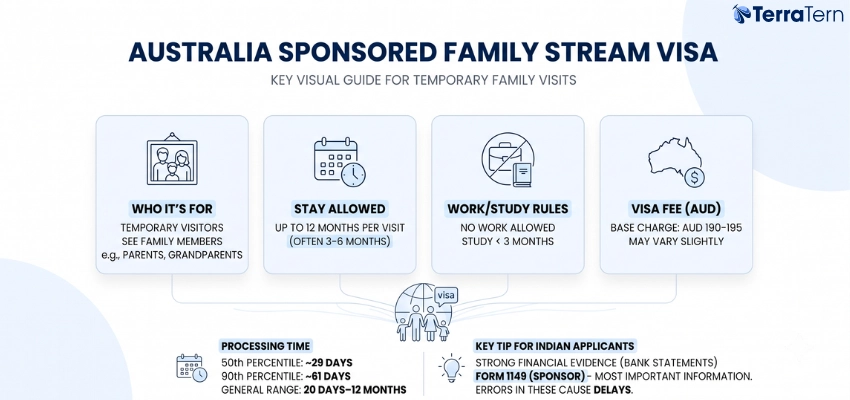
|
Aspect |
Details |
|
Who it’s for |
Temporary visitors to Australia to see family (parents, grandparents, siblings, etc.) |
|
Stay allowed |
Up to 12 months per visit (often 3–6 months granted) |
|
Work/study |
No work allowed; study limited to a maximum of 3 months |
|
Australia family sponsorship visa processing time |
~20 days to 12 months (50th percentile ~29 days; 90th percentile ~61 days for Sponsored Family stream) |
|
Visa fee (AUD) |
Around AUD 190–195 (base application charge; may vary slightly by year and stream) |
|
Key tip for Indian applicants |
Ensure strong financial evidence (bank statements, proof of income) and a correctly completed sponsor Form 1149; these are the most common triggers for delays. |
Important Note: The Subclass 600 Sponsored Family Stream is the fastest option for Indian families seeking a temporary reunion in Australia, but financial evidence must be thorough; incomplete financial documents are the #1 reason for refusal.
How Long Does the Partner Visa (Subclass 820 / 801 and 309 / 100) Take?
There are two phases of Australia's partner visa program: a temporary visa that serves as a pathway to a permanent visa when the relationship fulfils the criteria. The partner visas under the Australia family sponsorship visa processing time class is generally one of the longest and may take longer than two and a half year to get the visa.
-
The two-stage visa procedure is the grant of a temporary visa, followed by a permanent visa.
-
There needs to be a clear case of an ongoing and authentic friendship.
-
Processing depends on factors such as the length of the relationship, shared financial commitments, cohabitation, and supporting evidence.
-
Biometric collection for Indian applicants will be conducted at VFS Global centres (applicable only to those applying offshore).
-
Partner visa processing time Australia 2026 is a commonly searched term, as times keep shifting according to the number of applications.
Expert Tip: Indian offshore applicants on the 309 should account for additional time at Indian VFS Global centres for biometrics and build at least 4–6 extra weeks into their timeline.
How Long Does the Parent Visa (Subclass 143 and 103) Take in Australia?
Parent visas have one of the longest waiting periods in Australian migration. The Australia family sponsorship visa processing time can be affected by visa caps in addition to significant visa backlogs at any given time each year.
|
Visa Subclass |
Type |
Typical Processing Time (as of 2026) |
Approx. Fee (AUD) |
Notes |
|
143 |
Contributory Parent (permanent) |
~15 years for new applications (cases up to Nov 2018 being finalised) |
High (thousands + Assurance of Support) |
Faster than 103, but still very long |
|
103 |
Non-Contributory Parent (permanent) |
30+ years |
Lower than 143, but an extremely long queue |
Often not practical for new applicants |
|
804 |
Aged Parent (onshore permanent) |
~33 years for new applicants |
Lower than 864 |
Onshore only, very long wait |
Expert Advice: If your parents are elderly, the Subclass 870 Sponsored Parent (Temporary) visa is often the most practical option while your Subclass 143 application works its way through the queue. However, you cannot convert an 870 into a permanent parent visa.
How Long Does the Sponsored Parent (Temporary) Visa (Subclass 870) Take?
If a parent would like to stay in Australia longer but not for an extended period before joining the long waiting list for the permanent parent visa, the Sponsored Parent (Temporary) Visa is a good choice. Australia family sponsorship visa processing time (Subclass 870) is much shorter than the permanent (parent visa) processing time.
|
Aspect |
Details |
|
Processing time |
Typically 5–9 months (Subclass 870 processing time is generally faster than permanent parent visas) |
|
Stay duration |
3-year or 5-year stays; renewable up to a max of 10 years total |
|
Sponsor income requirement |
Sponsor must meet minimum income threshold (around AUD 83,454+ annually for one parent, indexed) |
|
Annual cap |
15,000 visas per program year (July–June) |
|
Key limitation |
Cannot apply for a permanent parent visa while on 870; you must leave Australia if your visa expires, and no permanent visa is granted |
Cost Table
|
Component |
Approx. Cost |
|
Visa application charge (3-year) |
Several thousand AUD |
|
Visa application charge (5-year) |
Higher than 3 years, still several thousand AUD |
|
Assurance of Support (if required) |
Additional bond/commitment |
Important Tip: The 870 is not a pathway to permanent residency; it is a temporary solution. Indian families should apply early in the program year (July–August) before annual caps are exhausted.
How Long Does the Child Visa (Subclass 101 / 802) Take in Australia?
The Child Visa enables certain children of Australian citizens, permanent residents, or eligible New Zealand citizens to apply to come to Australia with their parents. The Australia family sponsorship visa processing time is generally faster than for a partner visa or a parent visa.
|
Visa Subclass |
Location |
Typical Processing Time |
Approx. Fee (AUD) |
Notes |
|
101 |
Offshore |
Several months to over a year |
Moderate |
For children outside Australia |
|
802 |
Onshore |
Several months to a year |
Moderate |
For children already in Australia |
-
Eligibility: Child under 18, or under 25 if a full-time student and financially dependent, or any age if substantially disabled.
-
Common Delays: Missing or untranslated birth certificates, insufficient proof of sponsorship or dependency.
As per TerraTern Expert: For Indian applicants, ensure all birth certificates are translated by a NAATI-certified translator. This is a common document gap that triggers processing delays.
What Factors Affect Australia Family Sponsorship Visa Processing Time?
Several key factors can extend or shorten your Australia family sponsorship visa processing time, including application completeness, health and character checks, biometric collection, and the current demand for your specific visa subclass.
-
Completeness of the Application: Missing or unclear documents trigger an RFI (Request for Further Information), adding weeks or months to the process.
-
Health Examinations & Police Clearances: All applicants must complete overseas health exams (Indian applicants should use BUPA-approved clinics) and obtain PCCs from India and any country of residence; delays here are common.
-
Biometric Collection & Queue Volume: Indian applicants attend biometrics at VFS Global (availability varies by city), and for parent/partner visas, the sheer queue backlog is often the dominant factor.
-
Ministerial Direction 102 & Sponsor Issues: Compassionate/compelling circumstances can trigger prioritisation, while prior sponsorship breaches can result in a 5-year prohibition, blocking or delaying processing.
Pro Tip: Incomplete applications are the single most controllable source of delay. Submitting a thorough, well-organised application with certified translations from day one can save months of waiting.
How Can Indian Applicants Speed Up Their Australia Family Sponsorship Visa Processing Time?
Indian applicants can reduce delays and improve their Australia family sponsorship visa processing time by submitting complete documentation from the outset, attending health exams and biometric appointments promptly, and monitoring their ImmiAccount regularly for any requests.
-
Lodge a complete application with all documents rather than piecemeal uploads.
-
Book your HAP (Health Assessment Portal) appointment within days of lodgement at a DOHA/BUPA-approved clinic in India.
-
Obtain your Indian Police Clearance Certificate (PCC) before lodging, and attend biometrics promptly at VFS Global in your nearest city.
-
Respond to any RFI within 28 days, use NAATI-certified translators for Hindi/regional documents, and consider support from a MARA-registered migration agent.
-
For compassionate cases (e.g., an elderly parent's illness), an agent can help argue for the prioritisation of Ministerial Direction 102 through TerraTern’s consultation service.
Key Note: Booking your Health Assessment Portal (HAP) appointment on the same day you lodge your application is one of the most impactful steps Indian applicants can take ,health assessment delays are one of the top controllable processing bottlenecks.
Also Read: Australia Visa Processing Time: Tourist & Student Guide
What Is the Step-by-Step Process for Applying for an Australia Family Sponsorship Visa?
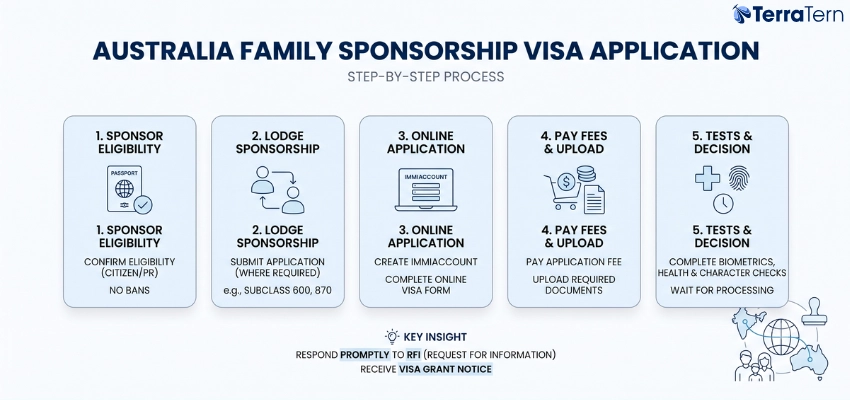
The Australia family sponsorship visa processing time application process involves the Australian sponsor submitting their sponsorship (where required), the overseas family member lodging their visa application through ImmiAccount, completing health and character checks, and then awaiting a decision.
-
Determine the correct visa subclass for your relationship (e.g., 600, 820/801, 309/100, 143, 103, 870, 101, 802).
-
Confirm the Australian sponsor’s eligibility (citizenship/PR status, no prior sponsorship bans).
-
Submit the sponsorship application (required for subclasses such as the 600 Sponsored Family stream and 870).
-
Create an ImmiAccount on the Department of Home Affairs portal and complete the online visa application form.
-
Pay the visa application fee and upload all required documents (proof of identity, relationship evidence, and financial proof).
-
Attend the biometric collection at VFS Global in India.
-
Attend the health examination at a DOHA-approved panel clinic in India.
-
Obtain your Police Clearance Certificate (PCC) from Indian authorities (and any other country of residence).
-
Wait for processing and respond promptly to any RFI within the given timeframe.
-
If approved, receive the visa grant notice by email and verify your visa details on VEVO.
As per our TerraTern Expert Divyansh, Indian applicants often underestimate the time required to obtain a Police Clearance Certificate. Apply for your PCC on the Indian Passport Seva portal at least 4–6 weeks before you lodge your visa application.
What Are the Documents Required for the Australia Family Sponsorship Visa Application?
Required documents vary by visa subclass but generally include identity documents, proof of relationship, financial evidence, sponsor details, health assessments, and police clearance certificates. While these documents don’t directly set Australia family sponsorship visa processing time, missing or incomplete paperwork often triggers RFIs that significantly delay processing.
1. Sponsor Checklist (Australian family member)
-
Australian passport or PR visa grant letter
-
Proof of Australian citizenship or permanent residency
-
Evidence of financial capacity (tax returns, recent payslips, bank statements)
-
Completed sponsorship form (e.g., Form 1149 for Subclass 600)
-
Declaration of no prior sponsorship bans
2. Applicant Checklist (Overseas family member)
-
Valid passport (6+ months validity)
-
Passport-sized photographs
-
Birth certificate with NAATI-certified English translation
-
Proof of relationship (marriage certificate, children’s birth certificates, etc.)
-
6 months of bank statements showing financial capacity
-
Letter of invitation from the sponsor
-
Evidence of ties to India (employment letter, property ownership, family ties)
-
Police Clearance Certificate from the Indian authorities
-
Health examination report from a DOHA panel clinic in India
Important Note: Every document in a regional Indian language must be accompanied by a NAATI-certified English translation; submitting unofficial translations is one of the top reasons documents are rejected for Indian applicants.
How Much Does the Australia Family Sponsorship Visa Cost in 2026?
Australia family sponsorship visa fees range from AUD 190–195 for a Subclass 600 visitor visa to over AUD 43,600 for the second instalment of the Contributory Parent Visa (Subclass 143). Higher fees often apply to visas with longer Australia family sponsorship visa processing time, such as permanent parent visas.
|
Visa Subclass |
Type |
Primary Applicant Fee (AUD) |
Notes |
|
600 (Sponsored Family Stream) |
Temporary Visitor |
AUD 190–195 |
Per applicant |
|
820/801 |
Partner (Onshore) |
AUD 9,095 (rising to ~9,365 after July 2026) |
Stage 1 + Stage 2 combined |
|
309/100 |
Partner (Offshore) |
AUD 9,095+ |
Similar to 820/801 |
|
143 |
Contributory Parent |
~AUD 4,765 (1st instalment) + AUD 43,600 (2nd) |
Paid in two stages |
|
103 |
Non-Contributory Parent |
~AUD 4,765 |
Lower fee, much longer wait |
|
870 |
Sponsored Parent (Temp) |
AUD 5,090 (3 years) or AUD 10,180 (5 years) |
Per sponsor child |
|
101/802 |
Child |
Varies |
Check Home Affairs for the current fee |
Expert Tip: Visa fees are indexed to inflation and typically increase on 1 July each year. If you are planning to apply in mid-2026, lodging before 1 July can save you up to 3% on your application fee.
Also Read: Sponsorship Visa Australia Requirements: Latest Guide
How Can You Track Your Australia Family Sponsorship Visa Application Status?
You can track the status of your Australia family sponsorship visa application through your ImmiAccount dashboard, and once granted, verify your visa details on VEVO (Visa Entitlement Verification Online). Monitoring your status helps you respond quickly to any requests that could otherwise delay Australia family sponsorship visa processing time.
1. Log in to ImmiAccount: on the Department of Home Affairs portal and go to “My Applications” to view your current status.
2. Common Status Labels:
- “Received” – Application lodged and in the system.
- “Under assessment” – An officer is reviewing your case.
- “Further information required” – An RFI has been issued.
- “Decision made” – Visa granted or refused; email notification will follow.
3. If You Receive an RFI (Request for Further Information):
- Respond within 28 days (failure can lead to refusal).
- Submit clear, complete documents via ImmiAccount.
4. To Verify Your Visa Grant:
- Use VEVO (a free online tool) to enter your passport and visa details.
- Check grant conditions, stay period, and work rights.
5. If Processing Exceeds Published Time Frames:
- Contact Home Affairs via their enquiry line or online form.
- Lodge a complaint via the Department’s feedback mechanism.
Pro Tip: If your application has exceeded the 90th percentile processing time published by the Department, you are entitled to contact the Department of Home Affairs directly ,TerraTern's advisors can assist Indian applicants in drafting a formal follow-up request.
What Are the Common Reasons for Australia Family Sponsorship Visa Delays or Refusals?
The most common reasons for delays or refusals in Australia family sponsorship visas include incomplete documentation, failure to meet financial requirements, doubts about genuine visitor intent, health issues, and sponsor eligibility problems. These issues directly extend Australia family sponsorship visa processing time by triggering RFIs, additional assessments, or refusals.
|
Common Issue |
Why It Causes Delays |
How to Avoid It |
|
Incomplete documents |
Triggers RFI, adds months |
Submit a complete application on day 1 |
|
Insufficient financial evidence |
Doubts about support capacity |
Include 6 months of bank statements + sponsor financials |
|
Lack of genuine visitor intent |
Officer doubts return to India |
Provide employment letter, property docs, and family ties evidence |
|
Health requirement failure |
The health condition requires extra assessment |
Book HAP early and disclose all conditions upfront |
|
Sponsor eligibility issues |
Prior breach triggers a 5-year ban |
Confirm the sponsor’s history before applying |
|
Incorrect/weak relationship evidence |
Weak proof of a genuine relationship |
Include statutory declarations, photos, and communication records |
|
No certified translation |
Hindi/regional documents rejected |
Use NAATI-certified translators only |
Key Note: A visa refusal is not always the end; Indian applicants can apply to the Administrative Appeals Tribunal (AAT) for merits review within 21 days of the refusal decision; professional legal advice at this stage is critical.
2026 Industry Context
Some of the key facts are:
-
The Department of Home Affairs updates processing times monthly (Source: immi.homeaffairs.gov.au, 2026)
-
Partner visa (820/801) Stage 1 currently takes approximately 11 months; Stage 2 takes 18–24 months (as of early 2026)
-
The Contributory Parent Visa (143) queue for new applicants is estimated at 15 years, with cases up to November 2018 being finalised as of February 2026
-
Non-contributory Parent Visa (103) wait time is 30+ years for new lodgements
-
Subclass 600 (Sponsored Family Stream) can be processed in as little as 20 days to 12 months
-
Sponsored Parent (Temporary) visa (870) processing is generally 5–9 months; limited to 15,000 grants per year
-
Australia's 2026 family stream allocation under the Migration Program cap continues to face heavy demand, creating significant backlogs
Also Read: Australia Dependent Visa Processing Time Guide
Conclusion
Understanding Australia family sponsorship visa processing time is essential for Indian families planning visits, reunions, or long-term migration. Processing can range from about 20 days for a Subclass 600 Sponsored Family visitor visa to over 30 years for a non-contributory parent visa, depending on the subclass, documentation quality, and queue demand. By submitting complete applications, meeting health and character requirements, and using professional guidance where needed, applicants can minimise avoidable delays and navigate the family visa system more confidently.
Contact TerraTern for more information on Australia Family Sponsorship Visa Processing Time: 2026 Guide.




 AI Summary