Key Highlights
- What is the 186 Visa in Australia?
- What Are the Latest 2026 Updates for the 186 Visa?
- What Are the Three Streams of the Australia Visa 186 in 2026?
- What Are the Current Eligibility Criteria for the 186 Visa Australia for Indians in 2026?
- How Much Does the 186 Visa Australia Cost in 2026 for Indians?
- What is the Current 186 Visa Application Process Step-by-Step?
- How Long Does the Current 186 Visa Take to Process?
- What Are the Latest 7 Benefits of the 186 Visa for Indians in 2026?
- Can You Include Family Members in the 186 Visa Application in 2026?
- What Are the Current Common Reasons for 186 Visa Refusal?
- What is the Latest Difference Between 186 Direct Entry and TRT Streams?
- What Are the Employer Obligations for 186 Visa Sponsorship in 2026?
- How Does the Current 186 Visa Lead to Australian Citizenship?
- What Latest Support Does TerraTern Provide for 186 Visa Applications in 2026?
- Conclusion
The 186 visa Australia Employer Nomination Scheme (ENS) Visa is among the highly demanded permanent residency (PR) programs in Australia among skilled foreigners. It enables talented employees who are nominated by an endorsed Australian employer to reside, work, and permanently remain in the nation.
This is the ultimate guide to the 186 Visa in 2026, which covers all the essentials of the 186 Visa, such as eligibility, requirements, application process, costs, and post-grant benefits.
What is the 186 Visa in Australia?
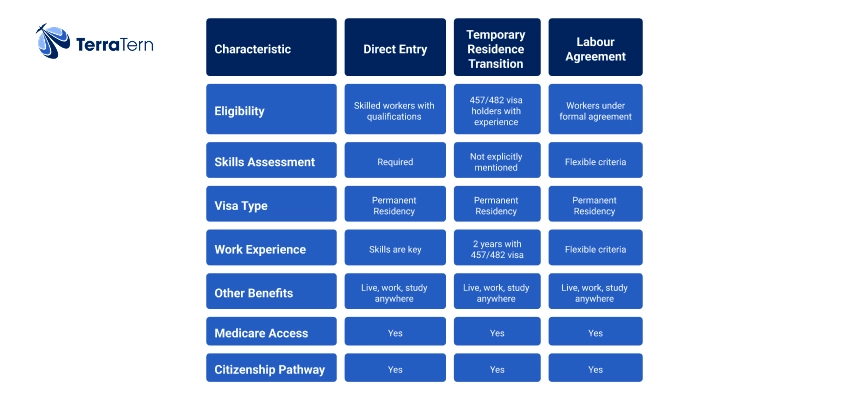
The Employer Nomination Scheme (ENS) Subclass 186 visa in Australia allows employers in Australia to sponsor high-skilled foreign workers to have permanent residence.
It is set to suit those professionals who are already in Australia on a temporary visa or those who are abroad with the skills that the employers in Australia need.
Key Features
-
On approval, it grants permanent residence.
-
Enables you to work, live, or study anywhere in Australia.
-
Facilitates family inclusion (spouse/ partner and dependent children).
-
Allows eligibility to apply for Australian citizenship by satisfying residency requirements.
What Are the Latest 2026 Updates for the 186 Visa?
The Australian Government is still undertaking the process of liberalising skilled migration in an attempt to solve the skilled labour force shortage.
By 2026, the trends that impact the 186 visa Australia are the following:
-
Shorter employment time of the TRT stream (3 to 2 years).
-
Increased access to pathways for 482 Visa holders.
-
MLTSSL to more occupations (e.g., renewable energy, advanced manufacturing).
-
Online lodgement and an increase in the rate of decision-making by the improved ImmiAccount system.
What Are the Three Streams of the Australia Visa 186 in 2026?
The 186 visa Australia is separated into three different streams, based on the employment status and the visa status of the applicant:
1. Temporary Residence Transition (TRT) Stream
The stream is for those who are applicants already in Australia on a Temporary Skill Shortage (TSS) Visa -Subclass 482 or a Visa 457 (or older) and have been employed by their employer over a set duration.
Key Points:
-
Has to have had a minimum of two years of employment with the sponsoring employer in the nominated position (2026).
-
The job should be listed on the Medium and Long-term Strategic Skills List (MLTSSL).
-
The employer has to provide actual ongoing full-time employment.
2. Direct Entry (DE) Stream
The Direct Entry stream applies to skilled workers who are not Australian or who do not qualify in the TRT stream.
Key Points:
-
Needs skills evaluation on the nominated occupation.
-
Not less than three years of work experience in the field is required.
-
The appropriate applicants are those who have never worked or worked only briefly in Australia.
3. Labour Agreement Stream
This stream can be accessed by workers whose employers have a labour agreement with the Australian Government.
Key Points:
-
The customisation to particular industries or jobs with labour shortages.
-
The specific labour agreement specifies the terms of eligibility.
-
May contain age concessions, English concessions, or skill concessions.
How Does the Current Direct Entry Stream Work?
The Direct Entry Stream is a stream that provides an opportunity to enter Australia as a permanent resident without a prior Australia visa 186.
You need:
-
One of the applicable occupations on the MLTSSL/OSL (2026 list).
-
A skills evaluation in that job is positive.
-
Relevant full-time experience of at least 3 years.
-
Age is under 45 years (there are exceptions to the age limit).
-
Good English, with IELTS 6.0 in all bands or higher.
-
Processing time is 3-12 months based on completeness and workload.
Who Qualifies for the Latest Temporary Residence Transition (TRT) Stream?
TRT Stream Applicants Current holders with the 482 (TSS) visa who have worked full-time with their nominating employer and have at least 3 years of experience in the same position are eligible.
If you have:
-
A valid 482 (or former 457) visa, and
-
3 years of first employment by the same sponsor,
-
Then you are eligible for the TRT Stream.
You benefit from:
-
None of the skills evaluation (in the majority of cases).
-
Lower English requirements
-
Smooth process of temporary to permanent residence.
-
Processing time: The majority of the applicants require between 6 to 10 months.
What is the Labour Agreement Stream in 2026?
The Labour Agreement Stream is applicable to employees who are sponsored by the special agreements between the employers and the Australian Government.
This applies if:
-
Your employer has a labour agreement at work.
-
Your profession or sector is experiencing a skills shortage that is not in the usual lists.
-
You fit the specified age, English, and competency demands in such a contract.
Impressive Industries: Healthcare, mining, hospitality, and regional.
Processing Time: 9–16 months
Also Read: Top Benefits Of Studying In Australia: Latest Guide
What Are the Current Eligibility Criteria for the 186 Visa Australia for Indians in 2026?
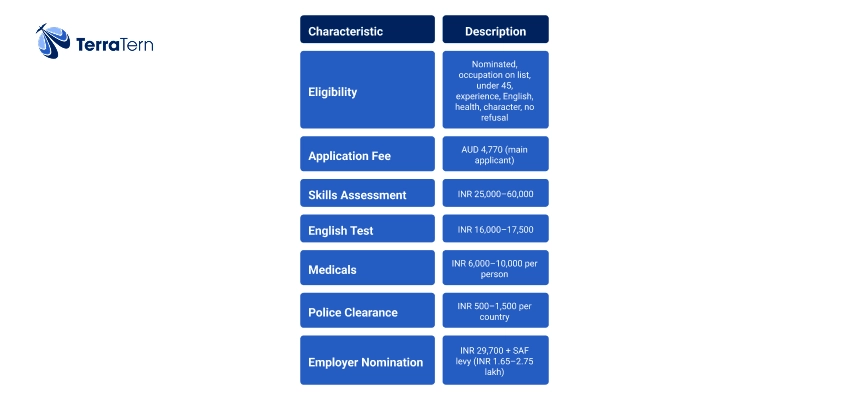
The conditions are different in each stream, although the following are the general eligibility requirements applicable to all three streams.
1. Approved Employer Nomination
The applicants have to be nominated by an Australian employer who:
-
It is actively trading in Australia.
-
No record of non-immigration or employment laws.
-
Is a valid applicant with a valid nomination application by the Department of Home Affairs.
2. Active in the Eligible List
- The occupation nominated should be listed in either the MLTSSL in Australia or should be mentioned in a labour agreement.
3. Skills and Experience
- In the case of the Direct Entry stream, skills assessment by the respective authority should be positive.
- Relevant and full-time work experience of at least three years is necessary.
4. Age Limit
- The maximum age of the Australia visa 186 applicants should be under 45 during the application.
- There are exemptions to some occupations, academic roles, and labour contracts.
5. Language Proficiency English
The applicants should show good English, which ordinarily occurs by way of:
-
IELTS: Scoring of 6.0 or more in all parts.
-
Equal scores in PTE, TOEFL, or OET exams.
6. Health and Character
- All applicants and dependents must meet the health and character requirements, including medical examinations and police certificates.
What Are the Latest Age Requirements for the 186 Visa in 2026?
The age of the 186 visa Australia applicants should not exceed 45 years.
You may be exempt if:
-
You are earning above the Fair Work High Income Threshold (est. AUD 175,000+).
-
You are an academic, researcher, or scientist who is being sponsored by a university or government agency.
-
You are an executive, or the regional concessions are covered by a labour agreement.
-
Your application is via the TRT Stream, with a long-term employment history.
What English Language Requirements Apply in 2026?
In order to be eligible to be granted the Subclass 186 visa in Australia, you have to demonstrate the skilful mastery of the English language, with at least IELTS 6.0 in every band or through any other similar test.
Accepted Equivalents:
-
PTE Academic: 50 in each section
-
TOEFL iBT: 12 (Listening), 13 (Reading), 21 (Writing), 18 (Speaking)
-
OET: Grade B in all parts
-
C1 Advanced: 169+ across the board
Exemptions:
- No examination is required when one has a UK, USA, Canada, Ireland, or New Zealand passport.
Validity:
- The validity of the results lasts 3 years and is subject to being valid once you submit your visa.
Also Read: National Innovation Visa Australia Subclass 858
Which Current Occupations Are Eligible for the 186 Visa?
Listed on the 2026 Occupation Shortage List (OSL), a consolidated list of MLTSSL and STSOL (450+ occupations), are eligible occupations.
Top Categories Include:
-
IT & Engineering: Software engineers (ANZSCO 261313), civil engineers (233211)
-
Healthcare: Registered Nurses (254499), Med Practitioners (253999)
-
Construction & Trades: Electricians (341111), Carpenters (331212)
-
Education: Secondary Teachers (241411), University Lecturers (242111)
How Much Latest Work Experience is Required?
In the case of the Direct Entry Stream, you need to possess full-time relevant experience in your nominated occupation of at least 3 years, all of which must be within 5 years.
Experience Calculation:
-
Full-Time = 38 hours/week
-
Part-Time = equal total in the long run
Proof Required:
Skilled-level employment letters, payslips, contracts, and tax documents.
What Skills Assessment is Required in 2026?
To the Direct Entry branch of the 186 visa Australia, you need to possess a positive skills assessment by the relevant designated authority to be employed in the nominated occupation. This verifies that your qualification and experience are Australian-based.
Assessing Authorities:
- Every occupation has a certain authority, such as Engineers Australia in the case of engineers, VETASSESS in the case of general professionals, and ACS in the case of the IT occupation.
Process Overview:
- You will be required to provide your academic transcripts, work references, and experience documentation. The authority checks the level of education and employment background to determine whether it is at the ANZSCO level.
Cost & Timeline:
- The prices are typically AUD 300-1,500, and the outcomes require approximately 4-12 weeks.
Exemptions:
In case you are applying under the Temporary Residence Transition (TRT) stream and are already employed by your sponsoring employer, the skills assessment can be dispensed with.
How Much Does the 186 Visa Australia Cost in 2026 for Indians?

The overall 186 visa Australia cost in 2026 will be between AUD 8,450 and 10,450, depending on the size of the family and the turnover of the employer.
Main 186 Visa Australia Cost
-
Nomination Fee (Employer): AUD 540
-
SAF Levy (Employer): AUD 3,000 (turnover less than $10M) or AUD 5,000 (turnover more than $10M)
-
Visa Fee (Main Applicant): AUD 4,910
-
Adult Dependent: AUD 2,455 each
-
Child Dependent: AUD 1,230 each
Additional Expenses
-
Skills Assessment: AUD 300–1,500
-
English Test: AUD 300–400
-
Health Exam: AUD 300–500 per person
-
Police Check: AUD 50–150
-
Migration Agent Fees (Non-Obligatory): AUD 4,400-6,500
What is the Current 186 Visa Application Process Step-by-Step?
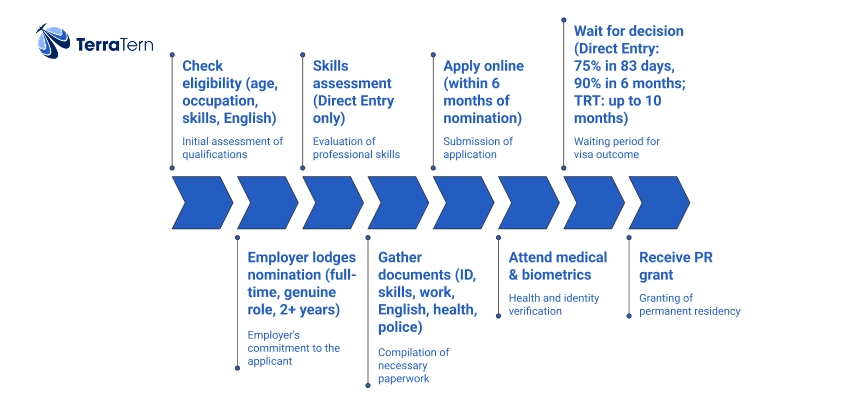
The 186 visa Australia will require two significant steps to be followed during the application process, including Nomination by the employer and the 186 visa Australia application by the employee.
Step 1: Employer Nomination
The employer in Australia should make a nomination of the position and the applicant first.
This includes:
-
Establishing the fact that the job is full-time.
-
Evidence of the financial ability of the business to hire the worker.
-
Making nomination fee and Skilling Australians Fund (SAF) payment.
After the applicant is approved, he or she is at liberty to apply for the visa.
Step 2: Visa Application
The visa application has to be lodged online via ImmiAccount within six months after the nomination approval is received by the applicant.
The documents normally needed include:
-
Passport and ID documents
-
Direct entry Skills assessment
-
Employment references
-
Evidence of English speaking
-
Health and character certificates
-
Relationship and dependent documents (when necessary)
Step 3: Processing of Applications
After submission:
-
Both nomination and visa applications are considered by the Department of Home Affairs.
-
The applicants can be requested to provide some extra documents or an interview.
-
This is done until a final decision is arrived at.
Step 4: Visa Grant
Once approved:
-
The notification about the grant of the 186 Visa is received with the conditions of the visa and the start date.
-
Immediately, you and your family are Australian permanent residents.
Also Read: Check Your Australia Visa Status Online Fast and Easy
How Does the Latest Employer Sponsorship Process Work?
The first step required by the employer before nominating any person to a 186 visa Australia is to get Standard Business Sponsorship (SBS) approval. To be eligible, the business has to demonstrate lawfulness in Australia, actual need for employees, financial ability, and compliance with training (Spending 1-2 per cent of payroll on training or spending 3000-5000 dollars on a training fund).
Sponsorship is valid for 5 years after approval, and it takes approximately 2-3 months to complete. The current sponsors have permission to use the same or renew them once they are gone.
What is the Current Nomination Application Process?
Once the SBS approval has been received, the employer should nominate a position, which requires payment of a nomination fee of $540 and the SAF levy (3000-5000).
They have to demonstrate that it is a valid position, and that it is TSMIT (minimum of 76515 in July 2025), and furnish facts of Labour Market Testing (LMT), 28 days of advertisements on websites such as Seek or Indeed.
Processing can take 2-4 months, and the most common refusals are due to a lack of LMT or a salary below market rate.
How Do You Lodge the Latest Visa Application?
After the nomination is passed, the applicant makes the visa application online through ImmiAccount.
The primary fee is 4,910, and there are some extra fees for the dependents. The documents needed are a passport, skills evaluation, results of the English test, employment references, health, and police certificates.
Applications should be decision-ready because important documents are not submitted, which may take a few months to be processed.
What Happens During Health and Character Assessments in 2026?
- All the applicants have to undergo health tests with panel physicians (price is 300-500 per person) and submit police clearance certificates of all the countries that they have resided in for at least 12 months since they were 16 years of age.
- Common medical examinations involve a general examination, chest x-ray, and blood tests. The uploading of the results occurs through the Health Assessment Portal (HAP) upon the lodging of the visa.
Honesty is of paramount importance - unknown criminal or visa problems may result in the visa rejection or the complete prohibition.
How Long Does the Current 186 Visa Take to Process?

Processing times can vary depending on the stream and workload.
As of late 2026, estimated average times are:
|
Stream |
75% of Applications Processed In |
90% of Applications Processed In |
|
Temporary Residence Transition |
6-8 months |
10-12 months |
|
Direct Entry |
8-10 months |
12-14 months |
|
Labour Agreement |
9-11 months |
13-15 months |
What Are the Latest 7 Benefits of the 186 Visa for Indians in 2026?

What is a 186 visa in Australia? The 186 visa Australia presents one of the most reliable and open-minded permanent residence programs to talented professionals.
Key benefits of the sponsorship visa Australia 186 include:
-
Instead, permanent residency on the first day.
-
Free working rights for you and your family.
-
Medicare (Public healthcare in Australia)
-
Scholarship entitlements at home rates.
-
Citizenship eligibility is based on fulfilling the residency criteria.
-
PR capacity to sponsor the eligible relatives.
-
Five years of freedom to travel in and out of Australia.
Can You Include Family Members in the 186 Visa Application in 2026?
Yes, you may also have your spouse or de facto partner in your 186 visa Australia application together with dependent children, stepchildren, and dependent grandchildren.
As long as you are lodging them, you may add them, or prior to the visa decision. New dependents also have to apply separately after a visa grant, which is more expensive and consumes time.
Dependents of the sponsorship visa Australia 186 include:
-
Partner is 12+ months in a married or de facto relationship.
-
Children under 18
-
Financially dependent children 1823 who are full-time students.
-
Youngsters of all ages have disabilities.
Every dependent has to fulfil health and character specifications.
There are other visa charges - 2455 and 1230 per adult and child, respectively (as of July 2025).
What Are the Current Common Reasons for 186 Visa Refusal?
Although this is an advantageous concept, there are cases in which applications are rejected because of preventable mistakes.
Common reasons for the refusal of a sponsorship visa in Australia 186 include:
-
Substandard or unequal documentation
-
Relates to the ineligibility or non-compliance of the business by the employer.
-
Incompetence in skills that are not relevant to occupational nomination.
-
Lack of ability to satisfy English, health, or character.
-
Scoring on the wrong stream.
Before applying or seeking the services of a migration expert, have a close look at the eligibility requirements.
What is the Latest Difference Between 186 Direct Entry and TRT Streams?
Direct Entry Stream is ideal when the skilled workers are not based in Australia, or they do not have a 482 visa. It involves a favourable skills evaluation, 3 years of appropriate experience, and employment on the eligible occupation list.
The TRT Stream is an initiative that is applicable to current 482 visa holders who have been employed with the same employer for over 3 years. It no longer requires skills assessment, has fewer English language requirements, and is also quicker for applicants already in Australia.
Also Read: Immigration To Australia: Everything You Need To Know
What Are the Employer Obligations for 186 Visa Sponsorship in 2026?
Employers must:
-
Retain endorsement of sponsorship over five years.
-
Make sure the job is actual, full-time, and that it is a permanent position of at least two years.
-
Pay a market-rate salary that is in line with TSMIT ($76,515+).
-
Donate 1-2 per cent of salary to education or remit SAF dues (3000 to 5000).
-
Retain employment and payroll documentation for two years.
-
Inform the Department about the changes within 28 days.
How Does the Current 186 Visa Lead to Australian Citizenship?
The 186 visa Australia holders would be eligible to become an Australian citizen once they have 4 years of lawful residence in Australia, including 12 months as a permanent resident.
You should not exceed 12 months' absence in total, do a citizenship test, English and character test, and you should intend to reside or have close relations in Australia.
What Latest Support Does TerraTern Provide for 186 Visa Applications in 2026?
TerraTern offers both employer and applicant services, including:
-
Elizabethan qualification and stream choice.
-
Employer subsidies and nomination advice.
-
Preparation, verification, and lodgement of documents.
-
Co-ordination of skills assessment and compliance checks.
-
The Department should receive post-lodgement communication.
Conclusion
The Subclass 186 visa Australia Employer Nomination Scheme (ENS) visa is considered to be one of the safest pathways to Australian permanent residency for skilled professionals. It provides long-term security, full work rights, and a clear path to citizenship, whether in the Direct Entry or the TRT stream.
The future of success is in proper documentation, skills testing, and compliance of the employer; hence, professional guidance is necessary. Make it easier through a one-stop end-to-end process, including eligibility checks to lodgement, that has decision-ready data to ensure speedier approvals and reduced errors.
Contact TerraTern for more information on the 186 visa for Australia.




 AI Summary