

Key Highlights
- What Are the Australia Study Visa Requirements After 12th?
- What Is the Australia Study Visa and Why Do Indian Students Need It After 12th?
- What Are the Eligibility Criteria for an Australia Study Visa After 12th?
- What Documents Are Required for an Australia Study Visa After 12th?
- What Is the Step-by-Step Process to Apply for Australia Study Visa After 12th?
- What Are the Financial Requirements for Australia Study Visa After 12th?
- What Are the Australia Study Visa Fees and Processing Time in 2026?
- What Courses Can Indian Students Pursue in Australia After 12th?
- What Are the Post-Visa Conditions for Australia Student Visa Holders?
- Why Do Australia Student Visas Get Rejected and How Can You Avoid It?
- How Does Australia Study Visa Compare to Other Popular Study Destinations After 12th?
- What Are the Top Australian Universities for Indian Students After 12th?
- How Can TerraTern Help You with Your Australia Study Visa After 12th?
- Conclusion
If you have just completed your Class 12 and want to study in Australia, understanding the Australia study visa requirements after 12th is the first step toward a smooth and successful application. India is now one of the largest sources of international students in Australia, with over 120,000 Indian enrolments and growing, and Australian universities are actively welcoming students straight out of school through foundation, diploma, and bachelor’s programmes.
The key is the Student Visa Subclass 500, which applies to every full-time international student in Australia, regardless of whether you pick a foundation course, diploma, or direct entry degree. In 2026, Australian authorities tightened checks on Genuine Students (the new GS requirement, replacing Genuine Student (GS)), financial proof, English scores and work rights compliance, so a clear, honest, and well documented application is essential from the very beginning.
What Are the Australia Study Visa Requirements After 12th?

If you are planning to study in Australia straight after Class 12, you must meet the Australia study visa requirements after 12th under the Student Visa Subclass 500 framework. The Student Visa Subclass 500 is the standard visa for full-time international study in Australia.whether you are joining a foundation programme, a diploma, or a direct entry bachelor’s degree. The basic structure is always the same: you must first secure admission to a CRIS registered course, then compile the required documents, and finally submit a complete online application through ImmiAccount with the right supporting evidence and fees.
What Is the Australia Study Visa and Why Do Indian Students Need It After 12th?
If you’ve completed your Class 12 and want to study in Australia, you will need to apply for the Student Visa Subclass 500, the only official visa for full-time international study in Australia.The Student Visa Subclass 500 covers foundation courses, diplomas, VET, and bachelor’s degrees, with exact requirements depending on the institution and course., which covers all study levels, including bachelor’s degrees, diplomas, vocational education and training (VET) courses, and foundation programmes. The governing authority, Australia’s Department of Home Affairs, issues the Subclass 500 student visa to students who are accepted by a CRICOS registered institution.
-
World-class Universities: Many Australian institutions rank high in global lists, especially in engineering, IT, business, and healthcare.
-
Work Rights: Most student visa holders may work up to 48 hours per fortnight during study periods, subject to current visa conditions.
-
Post-study Work and PR Pathways: Graduates may be eligible for the Temporary Graduate visa (Subclass 485), with stay length depending on qualification level and current rules.
-
Supportive Environment for Indian Students: Large Indian communities, familiar food and culture, and strong support on campus and online.
Also Read: English Jobs in Germany: Guide for International Job Seekers
What Are the Eligibility Criteria for an Australia Study Visa After 12th?
If you have just finished Class 12 and are planning to study in Australia, it’s important to understand the Australia study visa eligibility criteria under the Subclass 500 framework. These criteria are not the same for every student; they depend on your 12th-grade score, English level, age, health, financial capacity, and your ability to prove genuine study intent. The Australia study visa requirements after 12th are built around these key eligibility points, so checking them early will help you plan your course and documents properly for 2026.
What Academic Score Do You Need in Class 12 for Australia?
For most Indian students, the Australia study visa eligibility criteria require a minimum 65–70% aggregate in Class 12 from recognised boards like CBSE, ICSE, or state boards. Many popular universities ask for at least 65% or higher for direct entry into bachelor’s programmes, especially in competitive areas like engineering, IT, and health sciences. Some universities accept students with around 60% if they join a foundation or pathway programme, which then leads to direct entry into the main degree.
|
University |
Typical 12th Score Requirement (India) |
Notes |
|
University of Melbourne |
70%+ |
High for STEM and professional courses (engineering, medicine, law). |
|
University of Sydney |
65–70% |
Common for engineering and computer science; higher for health-related fields. |
|
Monash University |
65%+ |
Flexible with pathway and foundation options for lower scores. |
|
Australian National University (ANU) |
70%+ |
Strong focus on research-oriented and science programmes. |
|
UNSW Sydney |
65–70% |
Tech and engineering focused; competitive for IT and engineering. |
What English Proficiency Score Is Required for Australia Student Visa?
The Australia study visa requirements after 12th do not fix a single English score; instead, the IELTS score required for an Australia student visa (and other tests) is defined by your university and course through the Confirmation of Enrolment (CoE). In practice, most Australian universities expect at least IELTS 6.0–6.5 overall, with no band below 5.5–6.0, for undergraduate programmes.
|
Test |
Minimum Score |
Who Accepts It |
|
IELTS Academic |
6.0–6.5 overall |
Most universities, including Go8 institutions. |
|
PTE Academic |
50–58 |
Top-tier and mid-tier universities; fast-track option. |
|
60–79 |
Many universities accept this; cut-offs vary by course. |
|
|
Duolingo English Test |
50–105 (approx.) |
Some universities and colleges accept Duolingo instead of IELTS/PTE. |
Are There Any Age or Other Personal Eligibility Requirements?
Beyond academics and English, the Australia study visa eligibility criteria include age, health, character, and intent.
-
Minimum Age: Legally, the Subclass 500 starts from 6 years, but for Indian students after 12th, the practical age for undergraduate study is 17–18 years.
-
Students Under 18: Must have approved welfare arrangements in Australia (e.g., guardian, custodian, school-based housing) before the visa is granted.
-
Criminal Record and Character: You must meet character requirements under the Migration Act, which means no serious criminal history and a clean police record.
-
Health Requirements: A medical check, including a chest X-ray and general health examination at a Home Affairs-approved panel physician in India.
-
Genuine Temporary Entrant (Genuine Student (GS)): The Genuine Student (GS) requirement asks you to prove you intend to study in Australia temporarily and return to India afterwards. This is shown through career plans, family ties, financial stability, and course to job alignment.
What Documents Are Required for an Australia Study Visa After 12th?
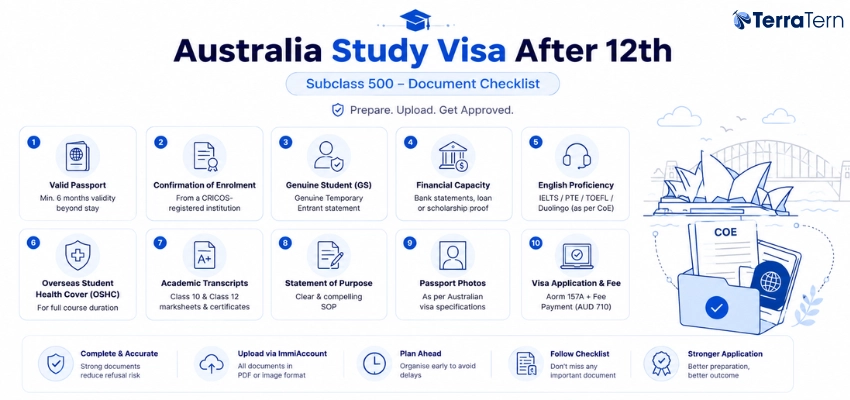
To apply for an Australia study visa after 12th, you must prepare a clear and complete set of documents that meet the Australia study visa requirements after 12th under the Subclass 500. The Australia student visa documents checklist is one of the most important parts of your application, because missing or weak papers are a major reason for delays or refusals. You will upload everything through your ImmiAccount on the Department of Home Affairs portal, so organise your files in advance and keep them in PDF or image format.
-
Valid passport (minimum 6 months validity beyond intended stay)
-
Confirmation of Enrolment (CoE) from a CRICOS-registered institution
-
Genuine Temporary Entrant (Genuine Student (GS)) / Genuine Student statement
-
Proof of financial capacity (bank statements, education loan sanction letter, or scholarship proof)
-
English proficiency scores (IELTS, PTE, TOEFL, or Duolingo as per your CoE)
-
Overseas Student Health Cover (OSHC) policy for the full course duration
-
Academic transcripts (Class 10 and Class 12 mark sheets and certificates)
-
Statement of Purpose (SOP)
-
Passport-sized photographs as per Australian visa specifications
-
Completed online visa application form (Form 157A) and visa fee payment confirmation (AUD 710)
Also Read: New Requirements By the Australia Government On English Language Test For Visas
What Is the Step-by-Step Process to Apply for Australia Study Visa After 12th?
The Australia study visa requirements after 12th are not just about documents; they also depend on following a clear Australia student visa application process through the official ImmiAccount portal. For Indian students, the process is mostly the same whether you pick a foundation programme, diploma, or bachelor’s course, so understanding these steps in advance helps avoid last-minute errors and visa delays.
How Do You Apply for Australia Student Visa Through ImmiAccount?
The immigration to Australia student visa application process after 12th can be broken into 10 main steps. If you plan your timeline well, you can comfortably complete everything 3–4 months before your course start date.
1. Get Admission to a CRICOS-registered institution: Research universities or colleges in Australia and apply for a course (foundation, diploma, or bachelor’s) that appears on the CRICOS register (CRICOS Education). Submit your Class 12 marks, English test score, and other course-specific documents to the university. Once accepted, you will receive an offer letter from the institution.
2. Accept the Offer and Receive your CoE: Pay the first semester tuition fee (or the required deposit) as mentioned in the offer. After fee payment, the institution will issue a Confirmation of Enrolment (CoE), which is the core document for your Australia study visa after 12th. Keep the CoE secure and check all details (course name, duration, start date).
3. Purchase Overseas Student Health Cover (OSHC): Buy OSHC from an approved Australian provider such as Medibank, Bupa, or Allianz. The policy must cover your entire course duration. OSHC is mandatory for the Subclass 500 visa and must be uploaded with your visa application.
4. Create an ImmiAccount: Visit the official Department of Home Affairs portal at immi homeaffairs and create your ImmiAccount. This is the only place where you can submit your Australia student visa application; you cannot apply offline. Save your login ID and password safely.
5. Complete the Online Visa Application Form (Form 157A): Under ImmiAccount, select Student Visa (Subclass 500) and fill in Form 157A. Enter personal details, course details (from your CoE), financial information, and contact details. Double-check all fields for spelling and accuracy.
6. Upload All Required Documents: Attach scanned copies of the following documents:
-
Valid passport
-
CoE
-
Genuine Student (GS) / Genuine Student statement
-
Proof of financial capacity (bank statements, education loan letter, scholarship proof)
-
English proficiency test scores (IELTS/PTE/TOEFL/Duolingo)
-
OSHC policy
-
Class 10 and Class 12 academic transcripts
-
Statement of Purpose (SOP)
-
Passport-sized photographs
-
Ensure all files are clear, not rotated, and saved in the correct format.
7. Pay the Visa Application Fee: The current Subclass 500 visa fee is AUD 710 (approx. INR 38,000–40,000 as of 2026, depending on exchange rate). Payment must be made online through ImmiAccount and is non-refundable, even if the visa is refused. After payment, you will receive a confirmation and a temporary reference number.
8. Complete the Health Examination: Book an appointment with a Home Affairs-approved Panel Physician in India for your medical check-up and chest X-ray. Inform the clinic that the test is for an Australian Subclass 500 student visa. Keep the medical report PDF handy in case Home Affairs requests it during processing.
9. Provide Biometrics (if required): In some cases, the visa officer may ask you to submit biometrics (fingerprints and photo) at a designated VFS or visa centre in India. You will receive an email instruction from ImmiAccount if biometrics are needed. Attend the appointment on time and carry your passport and appointment letter.
10. Await your Visa Decision and Track Status: Standard processing time for the Australia student visa after 12th is 4–8 weeks, but it can extend to 8–12 weeks during peak February and July intakes. You can track your application status through ImmiAccount and the VEVO (Visa Entitlement Verification Online) system after the grant.
What Are the Financial Requirements for Australia Study Visa After 12th?
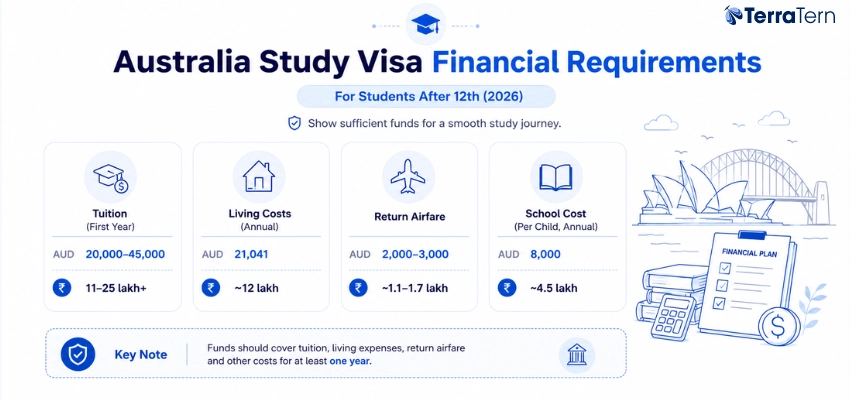
To meet the Australia study visa requirements after 12th, Indian students must prove they have enough funds to cover tuition, living costs, and return airfare for at least one year. The Australia student visa financial requirements are strict because the Department of Home Affairs wants to see that you can support yourself without overstaying or working illegally.
|
Category |
Amount in AUD (2026) |
Approx. Amount in INR |
|
Tuition (first year) |
20,000–45,000 |
11–25 lakh+ |
|
Living costs (annual) |
21,041 |
~12 lakh |
|
Return airfare |
2,000–3,000 |
~1.1–1.7 lakh |
|
School cost (per child, annual) |
8,000 |
~4.5 lakh |
What Are the Australia Study Visa Fees and Processing Time in 2026?
For Indian students planning to study in Australia after 12th, the Australia study visa requirements after 12th include clearly understanding the Australia student visa fees from India and the expected processing time. The main cost is the Subclass 500 student visa fee, which is the same for all international students, but additional charges for health tests, OSHC, and service centres also add to your total budget.
Australia Student Visa Fee (Subclass 500)
The Australia student visa (Subclass 500) fee is AUD 710 (approximately INR 38,000–40,000 in 2026, depending on the exchange rate). This amount is non-refundable, even if your visa is refused. Once you pay, the fee is linked to your application and cannot be transferred or reused.
|
Cost Component |
Amount in AUD |
Approx. Amount in INR |
|
Subclass 500 visa fee |
710 |
38,000–40,000 |
|
OSHC (per year) |
600–700 |
34,000–40,000 |
|
Medical check-up (India) |
– |
8,000–12,000 |
|
Biometric fee |
85 (USD) |
~6,500 |
|
VFS service charges (India) |
– |
2,000–4,000 |
Processing Time and Visa Validity
The Australia student visa processing time after 12th is usually 4–8 weeks for most applications. However, during peak intake periods for February and July, processing can stretch to 8–12 weeks, so it is safer to apply at least 3–4 months before your course start date.
-
February Intake: Aim to submit by October–November of the previous year.
-
July Intake: Apply by March–April to stay ahead of the rush.
Also Read: Top 10 Best Regional Areas In Australia For PR
What Courses Can Indian Students Pursue in Australia After 12th?
If you have completed Class 12 and are exploring options under the Australia study visa requirements after 12th, you will be pleased to know that Australia offers a wide range of courses and education pathways for Indian students. These courses are all delivered through CRICOS-registered institutions, which is mandatory for your Australia student visa (Subclass 500).
-
Indian students who have completed Class 12 can choose from multiple pathways under the Australia study visa requirements after 12th, including foundation, diploma, bachelor’s, and associate degree programmes.
-
All courses must be offered by CRICOS-registered institutions, as this is mandatory for the Australia student visa (Subclass 500).
-
Popular options include Computer Science/IT, Engineering, Commerce/Finance, Business Administration, Nursing/Health Sciences, and Hospitality & Tourism.
-
Students with lower 12th scores can start with foundation or pathway programmes (6–12 months) and then move into a bachelor’s degree.
-
Diploma programmes (1–2 years) and associate degrees (2 years) offer shorter study routes with possible credit into full bachelor’s degrees.
What Are the Post-Visa Conditions for Australia Student Visa Holders?
Once your Australia study visa after 12th is granted, you must follow strict visa conditions, subclass 500, to stay legally in Australia. These rules are shown in your VEVO (Visa Entitlement Verification Online) and are tied to your Student Visa (Subclass 500). If you break them, the government can cancel your visa. Key Australia student visa work rights and attendance conditions for 2026 include:
-
You must remain enrolled in a CRICOS-registered course and not drop out or change course without approval. This is linked to Condition 8202. Meet course requirements.
-
You must maintain satisfactory attendance (usually 80% or higher) and academic progress; poor attendance can lead to visa risk.
-
You must inform your institution of any address change so your records on VEVO stay updated.
-
You must keep OSHC (Overseas Student Health Cover) active for your entire visa period under Condition 8501 – Maintain adequate health insurance.
-
You must not work more than 48 hours per fortnight during your study term. Student visa work conditions currently allow up to 48 hours per fortnight during study periods, subject to the latest visa settings.
-
During official university breaks (summer/winter holidays, semester breaks), you can work unlimited hours.
Why Do Australia Student Visas Get Rejected and How Can You Avoid It?
The Australia study visa requirements after 12th are achievable only if you avoid the most common reasons for Australia student visa refusals. In 2026, refusal rates for Indian students have risen, with many applications rejected due to weak Genuine Student evidence, poor financial proof, and incomplete documentation. To improve your chances, it helps to understand the top problems and how to fix them before you apply.
-
Australia study visa requirements after 12th can be met successfully only if you avoid common mistakes that lead to Australia student visa refusals.
-
In 2026, refusal rates for Indian students have increased, often because of a weak Genuine Student statement, unclear financial proof, and missing or incorrect documents.
-
Popular rejection reasons include low IELTS/PTE scores, unfinished or inconsistent academic records, and applying too close to the course start date.
-
To reduce the risk of refusal, focus on preparing a strong, honest, Genuine Student statement, clear and verified financial documents, and a complete checklist that matches the official Australia student visa documents guidelines.
How Does Australia Study Visa Compare to Other Popular Study Destinations After 12th?
For Indian students weighing Australia study visa requirements after 12th against other options, it helps to compare Australia with Canada, the UK, and Germany on key parameters like visa type, tuition, English scores, work rights, and PR opportunities.
|
Parameter |
Australia |
Canada |
UK |
Germany |
|
Student Visa |
Subclass 500 |
SDS / Regular |
Student Visa |
National Visa (Type D) |
|
Avg. Tuition/Year |
AUD 20–45K |
CAD 15–35K |
GBP 10–26K |
EUR 0–3K (public) |
|
IELTS Required |
6.0–6.5 |
6.0–6.5 |
6.0–7.0 |
6.0–6.5 |
|
Work Rights |
48 hrs/fortnight |
20 hrs/week |
20 hrs/week |
20 hrs/week |
|
Post Study Aborad |
2–4 years (485 visa) |
1–3 years (PGWP) |
2 years (Graduate visa) |
18 months |
|
PR Pathway |
Strong |
Strong |
Moderate |
Strong |
What Are the Top Australian Universities for Indian Students After 12th?
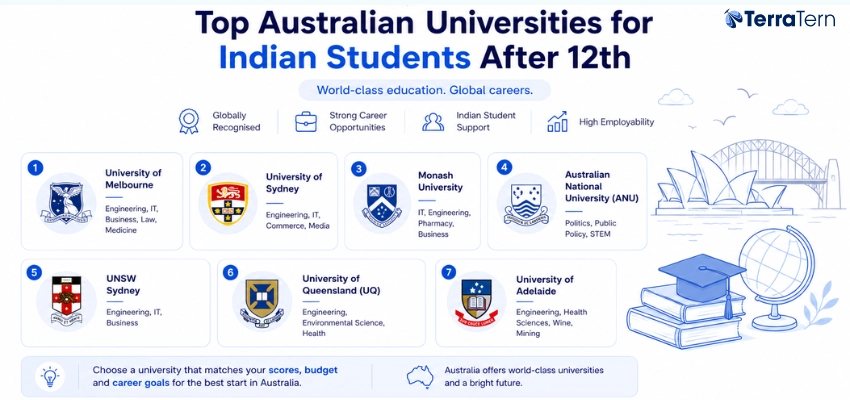
If you are exploring Australia study visa requirements after 12th, one of the first steps is shortlisting universities that match your Class 12 score, budget, and career goals. The top universities in Australia for Indian students after 12th include both the elite Group of Eight (Go8) and mid-tier institutions that are more flexible but still offer strong job prospects and Indian student support.
-
University of Melbourne: Strong in engineering, IT, business, law, and medicine; globally recognised and highly competitive.
-
University of Sydney: Popular for engineering, IT, commerce, and media; excellent industry links in Sydney.
-
Monash University: Strong in IT, engineering, pharmacy, and business; known for industry internships.
-
Australian National University (ANU): Research-heavy; strong in politics, public policy, and STEM.
-
UNSW Sydney: Leader in engineering, IT, and business with strong placement numbers.
-
University of Queensland (UQ): Good for engineering, environmental science, and health programmes.
-
University of Adelaide: Strong in engineering, health sciences, wine, and mining.
Also Read: Apply for a Working Visa in Australia: Types, Benefits, Process
How Can TerraTern Help You with Your Australia Study Visa After 12th?
If you are feeling confused about Australia study visa requirements after 12th from eligibility, documents, and Genuine Student (GS) writing to visa fees and processing timelines TerraTern is designed to simplify the entire journey for Indian students. With over 10,000+ visa approvals across 50+ global destinations, TerraTern’s AI-powered guidance and human-driven counselling help you avoid common mistakes and build a strong, refusal-proof application.
-
Clear Eligibility Assessment: TerraTern evaluates your Class 12 board, marks, and English test score and suggests suitable universities and pathways (foundation, diploma, or direct entry) that match your profile and budget.
-
End-to-end Visa Documentation: Expert counsellors help you prepare a complete Australia student visa documents checklist, review your bank statements, OSHC, IELTS or PTE scores, and academic transcripts, so there are no missing or weak spots.
-
Genuine Student (GS) and Statement of Purpose (SOP) Support: TerraTern assists you in writing a personalised Genuine Student Statement (GTE) and an SOP that clearly link your course, career goals, and return plans to India, which is critical under current Australia study visa requirements after 12th.
Conclusion
Australia study visa requirements after 12th are clear and achievable if you plan carefully and follow the right steps from choosing a CRICOS registered university and preparing strong documents to writing a genuine Genuine Student (GS) statement and maintaining compliance after visa grant. By understanding the Subclass 500 student visa rules, financial proof, and work rights conditions, you can position yourself as a strong candidate for Australia’s 2026 intakes.
If you want personalised guidance on eligibility, course shortlisting, and application preparation, TerraTern can help you build a robust, refusal-resistant profile so you can focus on your studies and future career in Australia with confidence. For the most accurate and official information on the Australia study visa requirements after 12th, always refer to the Australian Government’s official student visa page.




 AI Summary