Key Highlights
- Which Are the Top IT Companies in Germany Right Now?
- Which German IT Startups Are Worth Watching?
- What Are the Top IT Consulting Companies in Germany in 2026?
- What Do IT Jobs Pay at Top IT Companies in Germany?
- What Tech Trends Are Shaping Germany's IT Sector in 2026?
- Which Companies Sponsor Visas for International IT Professionals in Germany?
- Conclusion: Germany's Position as a European IT Powerhouse
Germany, known for its robust economy and industrial powerhouse, is rapidly establishing itself as a global leader in the tech sector. That's why lots of top IT companies in Germany come into existence. The country is becoming a major player in the global tech scene. With a strong economy and a growing focus on digital innovation, German IT companies are leading the way in areas like software development, cloud computing, and cybersecurity.
In 2026, top IT companies in Germany are not only expanding their influence within Europe but are also making significant strides on the global stage.

Which Are the Top IT Companies in Germany Right Now?
Germany's IT business is currently led by such industry giants as SAP, Siemens, Bosch, T-Systems, Software AG, Bechtle, DATEV, and Celonis, covering enterprise software, industrial IT automation, IT services, and process mining.
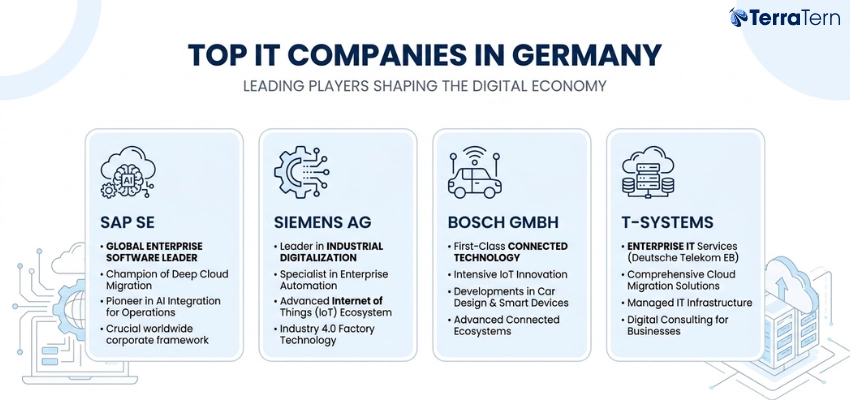
Such top IT companies in Germany are often analysed along with specific IT technical partners by their industry leaders and enterprise clients when considering the market landscape. The major key players are:
-
SAP: a global leader in enterprise software, a pioneer in deep cloud migration and in developing AI integration for its operations, the country's top speaker. In the East, SAP, a world leader in enterprise software and the current champion of deep cloud migration and artificial intelligence integration, was the country's top speaker. It is one of the leading IT companies in Germany and is still pivotal in the worldwide corporate framework.
-
Siemens: a central leader in industrial digitalisation and a specialist in the Internet of Things (IoT) ecosystem and factory technology relating to Industry 4.0.
-
Bosch: a first-class provider of connected technology and IoT, heavily used for innovation in car design and smart-device developments.
-
T-Systems: Deutsche Telekom (DT) enterprise IT business (EB business), offering enterprise IT solutions of all types that include comprehensive cloud migration, managed infrastructure, and digital consulting services.
-
Software AG: A key enterprise infrastructure vendor for business process management solutions, enterprise middleware and enterprise data integration platforms.
-
Bechtle: one of Germany's most sustainable digital e-commerce platforms in R&D hardware and software procurement platforms and a large IT systems integrator in Europe.
-
DATEV: As a cooperative provider, DATEV offers market-leading financial, accounting, and tax software solutions for Germany's SMEs.
-
Celonis: A global leader in the field of process mining and one of the top IT companies in Germany, Celonis uses artificial intelligence to uncover and resolve hidden business inefficiencies.
As per our TerraTern Expert, Divyansh, keep this as the definitive "established" list; don't also list Celonis under startups further down, since it's a $13B+ valued company, not an emerging one.
Also Read: Software Engineer Jobs in Germany: Latest Guide
Which German IT Startups Are Worth Watching?
Climate tech software, HR tech, and fintech are some of the key verticals where Germany's startup scene is creating some of the top IT companies in Germany. The following entrepreneurs are remarkable for their investment and growth capabilities, as well as their market needs.
-
N26: Europe's redefining mobile banking solution. It is one of the most familiar fintech brands and is listed as one of the innovative top IT companies in Germany
-
Personio: is a rapidly growing HR tech company purpose-built for small and mid-sized businesses, providing payroll, recruiting, and employee management solutions and reporting on employee performance. It is one of Germany's most important business software brands due to its cloud-based solution.
-
Trade Republic: Commission-free investing, Trade Republic has made investing in stocks and ETFs more child-friendly for younger generations and on-the-go users. It continues to influence the retail fintech sector in Germany and throughout Europe.
-
Tanso: An exciting climate tech firm with artificial intelligence solutions to enhance energy efficiency and reduce emissions in industry. Its importance is increasing as manufacturers have more stringent sustainability requirements.
-
Zolar: Zolar concentrates on the residential market for solar energy and helps make clean energy more accessible and accessible to those who want to go green in their home.
-
Climatiq: Carbon accounting APIs and emissions data tools, provided by Climatiq. It is hard to identify whether these are the most promising digital innovators for the next round of investments, and with top IT companies in Germany, the list is impossible to rank.
Important Note: drop Bitkom (it's a trade association, not a startup) and Ayar Labs (it's a US company). If you want to keep the list at a round number, Wefox (insurtech) or Contentful (content infrastructure) are genuine, verifiable German-founded scale-ups worth checking as replacements.
Also Read: Software Developer Salary Germany: Roles, Pay & More
What Are the Top IT Consulting Companies in Germany in 2026?
When discussing enterprise transformation, many buyers compare consulting leaders with the top IT companies in Germany to find the right strategic and technical partner.
In 2026, a few firms clearly lead the market. These firms consistently rank near the top IT companies in Germany conversation because of their deep local presence and global delivery models. For enterprises comparing the top IT consulting companies in Germany, these five remain the most visible names among the top IT companies in Germany.
-
Accenture: Widely seen as one of the strongest digital transformation players in Germany, with major capabilities in cloud, AI, cybersecurity, SAP, and large-scale modernisation programmes across industries.
-
McKinsey Digital: Combines high-level strategy with practical technology execution. It is especially strong in transformation design, data strategy, and digital operating model changes for large enterprises.
-
Boston Consulting Group (BCG): A leading advisor for digital transformation, product innovation, and agile delivery. BCG is often shortlisted by companies seeking growth-led technology consulting support.
-
KPMG: Particularly strong in IT governance, ERP, risk, compliance, and SAP implementation. German enterprises often turn to KPMG for complex transformation programs with regulatory and operational depth.
-
Deloitte Digital: Known for blending consulting, technology, and customer experience. It is a strong choice for firms looking to improve digital products, commerce platforms, and brand-led transformation.
Expert Tip: The current live page names specific client relationships for each firm (Accenture Volkswagen, McKinsey, L'Oréal, etc.) with no source. Either verify each pairing against a public case study/press release before republishing, or drop the named clients and describe the type of work generically; an unverified client claim is a bigger credibility risk than no claim.
The same goes for the comparison table: if every firm offers every service, the table isn't adding information; differentiate by strength/specialisation instead of a flat Yes/Yes/Yes grid.
Also Read: Average Salary in Germany for a Software Engineer: Latest Guide
What Do IT Jobs Pay at Top IT Companies in Germany?
The German technology sector offers some of the most competitive compensation packages in Europe. Salaries in this region are heavily influenced by role, seniority, and location, with major hubs like Munich, Berlin, and Hamburg leading the market. When looking at the top IT companies in Germany, compensation reflects the high demand for specialised talent capable of driving digital transformation.
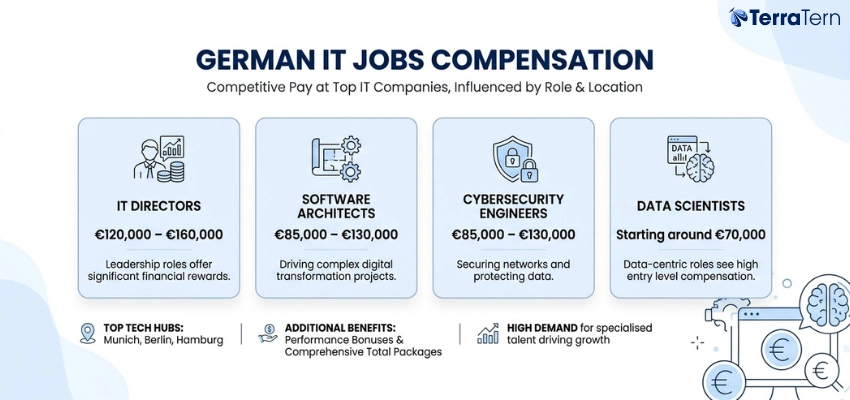
For leadership roles, the financial rewards are significant. An IT director at one of the top IT companies in Germany can expect a salary ranging from €120,000 to €160,000. Meanwhile, senior technical roles such as software architects and cybersecurity engineers typically see earnings between €85,000 and €130,000. Even for data-centric roles, the floor remains high, with data scientists starting around €70,000. Beyond base pay, the top IT companies in Germany often provide performance bonuses and comprehensive benefits, making the total package even more attractive for international talent.
|
Role |
Average Annual Salary (EUR) |
|
IT Director |
€120,000 – €160,000 |
|
Software Architect |
€85,000 – €130,000 |
|
Cloud Solutions Architect |
€85,000 – €120,000 |
|
Cybersecurity Engineer |
€85,000 – €120,000 |
|
Data Scientist |
€70,000 – €110,000 |
|
Blockchain Developer |
€75,000 – €100,000 |
|
IT Project Manager |
€70,000 – €100,000 |
Expert Advice: Keep the existing table structure; it's clean and useful. Just re-verify the ranges against a current source before republishing, and drop the INR conversion column or clearly date-stamp the exchange rate used, since it will go stale faster than anything on the page.
Also Read: Top Freight Forwarding Companies in Germany: New Guide
What Tech Trends Are Shaping Germany's IT Sector in 2026?
As we move through 2026, the digital landscape is being redefined by rapid advancements in automation and infrastructure. The top IT companies in Germany are prioritising resilience and efficiency, often collaborating with top IT consulting companies in Germany to implement these complex changes.
The following four trends are currently dominating the investment and hiring strategies of the top IT companies in Germany:
-
AI and Machine Learning: These technologies are no longer experimental; they are driving core automation and predictive analytics. This is particularly evident in the automotive and manufacturing sectors, where AI optimises supply chains and vehicle software.
-
IoT & Industry 4.0: Germany remains a global leader in smart factories. By utilising real-time production data, giants like Siemens and BMW are setting the standard for the top IT companies in Germany in terms of industrial connectivity.
-
Cloud & Edge Computing: Enterprise adoption has peaked, with most businesses running on hybrid cloud models. Led by SAP and Deutsche Telekom, the focus has shifted toward edge computing to process data closer to the source, reducing latency for autonomous systems.
-
Cybersecurity: Driven by strict GDPR compliance and an evolving global threat landscape, investment in cybersecurity is at an all-time high, creating a surge in demand for specialists who can safeguard critical infrastructure.
Which Companies Sponsor Visas for International IT Professionals in Germany?
For international IT professionals, Germany is one of the most accessible destinations in Europe due to a significant domestic talent shortage. Identifying which organisations offer sponsorship is a crucial step for skilled migrants seeking to relocate.
The following points highlight the landscape for visa sponsorship among the top IT companies in Germany:
-
Established Corporate Giants: Large enterprises like SAP, Siemens, and T-Systems are among the top IT companies in Germany that routinely sponsor work visas and the EU Blue Card. These organisations have dedicated relocation teams to handle the legal complexities for international hires.
-
Consultancy Hubs: Many of the top it consulting companies in Germany, including Bechtle and global firms like Accenture, rely heavily on international expertise. They frequently hire non-EU citizens for high-demand roles in cloud architecture and cybersecurity.
-
Infrastructure for Recruitment: Because these top it companies in Germany have well-funded HR departments, they can often expedite the sponsorship process faster than smaller startups, which may lack in-house immigration support.
-
Priority Roles: Sponsorship is most readily available for specialised roles, including Software Developers, Data Scientists, and Cloud Engineers.
-
The EU Blue Card Pathway: This is the most common route for degree-holding professionals. Large firms ensure that salary offers meet the required thresholds to qualify for this expedited residency permit.
-
Shortage-Based Hiring: Germany's proactive immigration policies mean that if a candidate possesses the right technical skills, most major tech employers are willing and able to navigate the sponsorship process.
Pro Tip: This section doesn't exist on the live page at all; it's the one addition worth prioritising, since it's the only part of the page that connects to what TerraTern's actual readers are likely trying to figure out.
Also Read: Top 10 Software Companies in Germany: Latest 2026 Rankings
Conclusion: Germany's Position as a European IT Powerhouse
Germany’s digital economy continues to gain momentum, making the country one of Europe’s most attractive markets for technology investment, enterprise innovation, and high-value IT careers. From global leaders in software, cloud, cybersecurity, and industrial automation to fast-rising startups in fintech, HR tech, and climate tech, the top IT companies in Germany are shaping how businesses modernise and grow. These firms are not only driving digital transformation but also creating strong demand for specialists in AI, data science, cloud engineering, product development, and cyber defence.
Overall, Germany stands out as a mature yet forward-looking tech ecosystem where innovation, talent demand, and digital transformation converge, making it a market for companies, investors, and professionals alike.
Contact TerraTern for more information on Top IT Companies in Germany: Leading the Tech Revolution.