



Key Highlights
- What are Teaching Jobs in Canada for Indian Teachers?
- Why Should Indian Teachers Choose Canada for Their Career?
- What Are the Eligibility Requirements for Teaching Jobs in Canada for Indian Teachers?
- What Are the Best Immigration Pathways for Indian Teachers to Work in Canada?
- How Can Indian Teachers Get Provincial Teaching Certification in Canada?
- Which Canadian Provinces Are Easiest for Indian Teachers to Get Certified?
- What Are the Best Teaching Roles and Their Salaries for Indian Teachers in Canada?
- How Can Indian Teachers Find and Apply for Teaching Jobs in Canada?
- What Are the Common Challenges Indian Teachers Face When Moving to Canada?
- What Benefits Do Indian Teachers Enjoy After Moving to Canada?
- How Can TerraTern Help Indian Teachers Get a Teaching Job in Canada?
- 2026 Industry Context Section
- Conclusion
The opportunities for teaching jobs in Canada for Indian teachers in 2026 appear bright, even though the country is facing a shortage of teachers and immigration channels, such as Express Entry. Overview for Indians seeking for secondary or elementary jobs with an average salary range of CAD 60000 to 90000 per year, with qualification, visas and job searching strategies and provincial licensing information.
What are Teaching Jobs in Canada for Indian Teachers?

Can Indian teachers secure teaching jobs in Canada for Indian educators? Yes, Indian teachers can secure teaching jobs in Canada if they meet four key requirements:
-
Recognised Education Degree: A relevant bachelor’s degree, often combined with a B.Ed. or equivalent teacher training.
-
Provincial Certification: Earn OCT (Ontario) or BCCT or other provincial certification through exams and/or training.
-
English Proficiency: IELTS 7+ (CLB 9) or CELPIP in order to be eligible for Express Entry, PNPs, or employer-sponsored work permits may be available depending on your profile and current selection categories.
-
Eligible Work Authorisation: Express Entry (Education Category), PNP or employer-sponsored permit. There are opportunities in STEM, ESL, and special ed in Canada, with salaries ranging from CAD 46K to 95 K.
Also Read: Teaching Jobs in Canada for Indians: Latest Guide
Why Should Indian Teachers Choose Canada for Their Career?
Acute job shortage, high demand for skilled teachers and immigrant support, which is better than the UK/Australia in terms of PR speed, are the reasons why teaching jobs in Canada for Indian teachers stand out.
-
Teacher Shortage Crisis: Ontario and British Columbia continue to face teacher shortages, especially in STEM, ESL, and special education.
-
Why Indian Teachers Excel: B.Ed. training, strong subject knowledge, and math/science skills are valued by schools.
-
Quality of Life Boost: Public healthcare, family-friendly immigration pathways, and strong salaries that are significantly higher than in India.
-
Previously, PR Pathways Edge: Canada’s PR pathways can be more accessible than some other destinations, depending on your profile and the current immigration rules.
As per TerraTern Expert, Divyansh, Canada's teacher shortage is most acute in rural and Northern provinces. Indian teachers willing to consider these regions often receive faster certification approval and additional immigration points through PNPs.
What Are the Eligibility Requirements for Teaching Jobs in Canada for Indian Teachers?
Teaching jobs in Canada for Indian teachers require a recognised B.Ed., provincial certification, IELTS 6.5+, a valid PR/work permit, and a clean police check streamlined for India's skilled educators
What Education Qualifications Do Indian Teachers Need for Canada?
Indian B.Ed. Holders qualify for K-12 teaching jobs in Canada for Indian teachers after a WES/ECA evaluation.
|
Teaching Level |
Required Qualification |
Indian Equivalent |
|
Elementary (K-8) |
4-year B.Ed. |
B.Ed. + 50% bachelor's |
|
Secondary (9-12) |
B.Ed. + subject major |
B.Ed. in math/science |
|
Post-Secondary |
Master's/PhD |
M.Ed./PhD + ECA |
Important Note: Indian B.Ed. Holders must complete an ECA through WES before applying for provincial certification; skipping this step is the #1 reason for delays in Indian teacher applications.
What Language Proficiency Score Is Required for Teaching in Canada?
IELTS General 6.5–7.0 unlocks teaching jobs in Canada for Indian teachers; Quebec needs French TEF.
|
Province |
Minimum Language Score |
|
Ontario |
IELTS 7.0 overall |
|
BC |
IELTS 6.5 + CLB 9 |
|
Quebec |
TEF B2 + IELTS 6.0 |
|
Nova Scotia |
CLB 7 (IELTS 6.0) moving2 |
Expert Advice: Scoring IELTS Band 8.0 or above significantly boosts CRS points under Express Entry. Indian teachers who invest in language preparation before applying gain a compounding advantage.
Do Indian Teachers Need Canadian Teaching Experience to Get Certified?
No, Indian teachers do not always need Canadian teaching experience to get certified in Canada.
-
Most Canadian provinces accept Indian teaching experience; 1–2 years is usually preferred
-
Some provinces may require additional practice teaching, bridging coursework, or supervised classroom experience.
-
STEM, Special Education, and ESL teachers have higher demand and better job opportunities
-
Canadian teaching experience helps in hiring, but it is not mandatory for certification in many provinces
Expert Tip: Indian teachers with 3+ years of STEM or ESL teaching experience are priority candidates in provinces such as Alberta and Manitoba, and should proactively highlight this in their applications.
What Are the Best Immigration Pathways for Indian Teachers to Work in Canada?
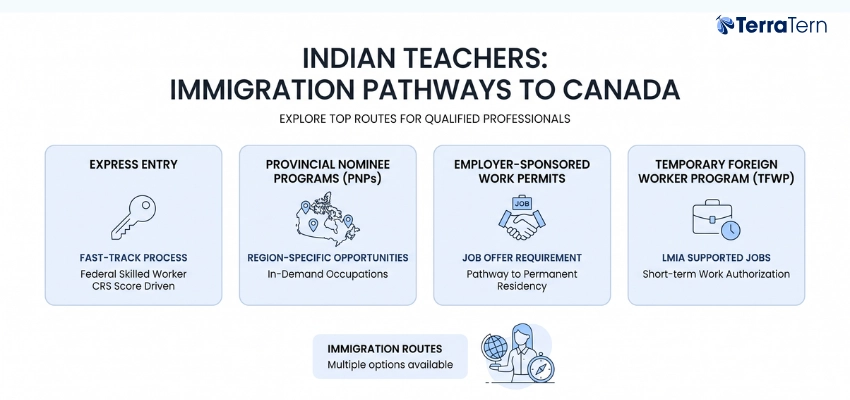
Indian teachers can apply for teaching jobs in Canada for Indian professionals through multiple immigration pathways, including Express Entry, Provincial Nominee Programs (PNPs), employer-sponsored work permits, and the Temporary Foreign Worker Program (TFWP). The best option depends on teaching qualifications, work experience, CRS score, and the province where teachers plan to work.
How Does Express Entry Work for Indian Teachers?
Express Entry is Canada’s main PR pathway for skilled workers
1. CRS (Comprehensive Ranking System) scores candidates based on age, education, experience, and language skills
2. The 2026 Education Occupation Category prioritises qualified teachers
3. Important teacher NOC codes:
- NOC 41220 — Elementary and kindergarten teachers
- NOC 41221 — Secondary school teachers
- NOC 41200 — University professors and lecturers
- NOC 42202 — Early childhood educators
4. Target CRS score for 2026 draws: 470+
5. Process flow:
Create Express Entry profile → Enter pool → Receive ITA → Apply for PR
Important Tip: A job offer may improve your immigration prospects, but the CRS impact depends on the current Express Entry rules. This single step can be the difference between receiving an ITA and waiting indefinitely in the pool.
Which Provincial Nominee Programs (PNPs) Are Best for Indian Teachers?
Indian teachers applying for teaching jobs in Canada for Indian applicants can benefit from province-specific immigration programs where teacher shortages remain high.
|
Teaching Role |
Annual Salary (CAD) |
In INR (approx.) |
|
Early Childhood Educator |
$35,000 – $55,000 |
INR 22L – INR 36L |
|
Elementary School Teacher |
$50,000 – $85,000 |
INR 33L – INR 56L |
|
Secondary School Teacher |
$55,000 – $95,000 |
INR 36L – INR 63L |
|
Special Education Teacher |
$50,000 – $85,000 |
INR 33L – INR 56L |
|
ESL Teacher |
$40,000 – $65,000 |
INR 26L – INR 43L |
|
College Instructor |
$65,000 – $90,000 |
INR 43L – INR 59L |
|
Teaching Assistant |
$20,000 – $35,000 |
INR 13L – INR 23L |
As per TerraTern Expert: PNPs often have lower CRS score requirements than federal Express Entry draws. Indian teachers with scores in the 400–450 range should prioritise PNP-aligned provinces for faster processing.
Can Indian Teachers Get a Work Permit Without PR to Teach in Canada?
Yes, Indian teachers can work in Canada before getting a PR
-
TFWP allows Canadian schools to hire foreign teachers temporarily
-
Most employers require an LMIA (Labour Market Impact Assessment)
-
International Mobility Program (IMP) offers some LMIA-exempt work permits
-
Teachers can later apply for PR through the Canadian Experience Class (CEC)
-
Typical pathway:
Work Permit → 1 Year Canadian Experience → CEC PR Application
Pro Tip: Starting on a work permit and transitioning to PR through CEC is a proven strategy. Indian teachers who accumulate 1 year of full-time Canadian teaching experience become eligible for Canadian Experience Class PR, often with higher success rates.
Also Read: Teaching Jobs Abroad: Expert Guide for Indian Educators
How Can Indian Teachers Get Provincial Teaching Certification in Canada?
Indian teachers seeking teaching jobs in Canada must apply for provincial teaching certification through the regulatory body of the province in which they intend to teach. Because education in Canada is managed provincially, there is no single nationwide license.
What is the Step-by-Step Process to get teaching certification in Canada?
To successfully secure teaching jobs in Canada for Indian educators, follow this clear six-step process:
-
Choose your Target Province: Each Canadian province and territory has its own specific certification body and set of regulations.
-
Get Your ECA Done: Obtain an Educational Credential Assessment through WES, ICAS, or province-specific evaluation bodies (like Pathways to Teach Canada or the OCT).
-
Prepare Language Proof: Secure the necessary IELTS or CELPIP scores as dictated by your chosen provincial requirements (typically CLB 7 or higher).
-
Apply to the Provincial Certification Authority: Submit your full application, transcripts, and fees directly to bodies like the Ontario College of Teachers (OCT) or Alberta Education.
-
Complete Any Additional Requirements: You may need to undertake bridging courses, specific sexual abuse prevention training, or supervised practice teaching hours (e.g., Alberta requires 10 weeks of student teaching).
-
Receive your Certificate of Qualification (CoQ): Once approved, this certificate validates your legal authority to apply for and accept teaching positions.
|
Province |
Certification Authority |
Website Link |
|
Ontario |
Ontario College of Teachers (OCT) |
oct.ca |
|
Alberta |
Alberta Education |
alberta.ca/teacher-certification |
|
Manitoba |
Professional Certification Unit (PCU) |
edu.gov.mb.ca |
|
Nova Scotia |
Office of Teacher Certification |
certification.ednet.ns.ca |
|
British Columbia |
Ministry of Education and Child Care |
gov.bc.ca |
Key Note: Indian teachers often underestimate the bridging course requirement; provinces like Ontario may require additional coursework before granting full certification, adding 3–6 months to the timeline.
Which Canadian Provinces Are Easiest for Indian Teachers to Get Certified?
When searching for teaching jobs in Canada for Indian professionals, certain provinces offer more accessible pathways. Alberta provides a streamlined approach for foreign-trained educators through dedicated diploma programs. Manitoba actively recruits international teachers using the centralised Pathways to Teach Canada assessment.
|
Province |
Certification Time |
Ease Rating |
Demand Level |
|
Alberta |
4–6 Months |
High |
Very High |
|
Manitoba |
3–5 Months |
High |
High |
|
Nova Scotia |
4–6 Months |
Moderate |
High |
As per TerraTern Expert, Shreya, Alberta and Manitoba consistently rank as the most accessible provinces for Indian teacher certification, both have active international teacher pipelines and fewer bridging course requirements than Ontario.
What Are the Best Teaching Roles and Their Salaries for Indian Teachers in Canada?
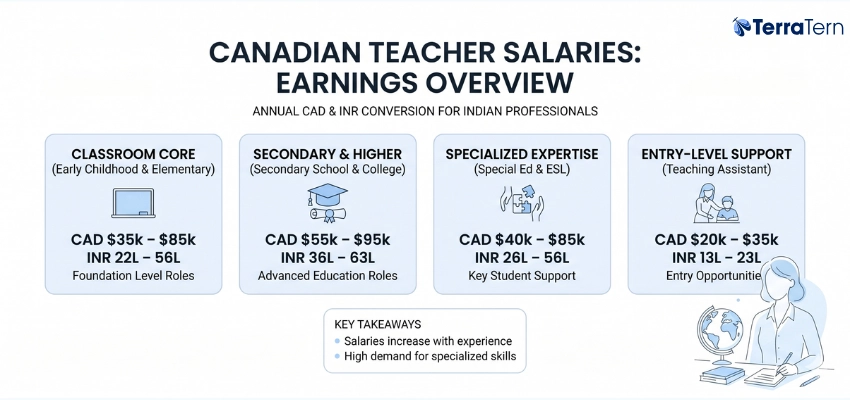
Indian teachers in Canada can earn roughly CAD 35,000 to CAD 95,000 per year, depending on the role, province, and experience level. For teaching jobs in canada for indian applicants, STEM, secondary, and special education roles usually offer the strongest pay and demand.
What Is the Average Salary for Indian Teachers Working in Canada?
The average salary for indian teachers in Canada are:
|
Teaching Role |
Annual Salary (CAD) |
In INR (approx.) |
|
Early Childhood Educator |
$35,000 – $55,000 |
INR 22L – INR 36L |
|
Elementary School Teacher |
$50,000 – $85,000 |
INR 33L – INR 56L |
|
Secondary School Teacher |
$55,000 – $95,000 |
INR 36L – INR 63L |
|
Special Education Teacher |
$50,000 – $85,000 |
INR 33L – INR 56L |
|
ESL Teacher |
$40,000 – $65,000 |
INR 26L – INR 43L |
|
College Instructor |
$65,000 – $90,000 |
INR 43L – INR 59L |
|
Teaching Assistant |
$20,000 – $35,000 |
INR 13L – INR 23L |
Important Note: Secondary school STEM teachers in Alberta can earn up to CAD 95,000 annually. Indian engineers or science graduates with a B.Ed. are among the highest-earning new immigrant teachers in Canada.
Which Teaching Roles Are Most in Demand for Indian Teachers in Canada (2026)?
STEM teachers, special education teachers, and secondary school teachers usually have the best combination of salary and demand. For teaching jobs in canada for indian candidates, ESL and early childhood roles can also be strong entry points, especially if you already have relevant certifications or experience.
|
Role |
Province |
Demand Level |
|
STEM Teachers |
Alberta, Manitoba, Ontario, British Columbia |
Critical |
|
ESL / English Language Teachers |
British Columbia, Ontario, Alberta, Nova Scotia |
High |
|
Special Education Teachers |
All provinces |
Critical |
|
Early Childhood Educators |
Ontario, British Columbia, Nova Scotia, Alberta |
High |
|
French Immersion Teachers |
New Brunswick, Ontario, Manitoba, Quebec |
High |
Expert Advice : French-language certification gives Indian teachers a double advantage; it adds CRS points under Express Entry and makes them eligible for higher-demand French Immersion teaching positions in Ontario and New Brunswick.
Also Read: Jobs in Foreign Countries for Indian Freshers Guide
How Can Indian Teachers Find and Apply for Teaching Jobs in Canada?
Indian teachers can find teaching jobs in canada for indian applicants through official job portals, school board websites, and trusted recruitment platforms. A confirmed job offer can also strengthen a permanent residence or work permit application.
Where Should Indian Teachers Search for Teaching Jobs in Canada?
-
Job Bank Canada, the official government job portal.
-
LinkedIn, for direct outreach to school board HR teams.
-
School board recruitment pages, such as TDSB and YRDSB in Ontario.
-
Apply to Work in Canada for employer-linked opportunities.
-
Pathways to Teach Canada, for internationally educated teachers.
-
Indeed, Canada and Workopolis are using teacher-specific filters.
-
TerraTern, if you want immigration support plus job matching.
Expert Tip: Pathways to Teach Canada is a portal that helps internationally educated teachers navigate provincial certification requirements.
What Documents Do Indian Teachers Need to Apply for Teaching Jobs in Canada?
The documents indian teachers need to apply for teaching jobs in canada are
|
Document |
Purpose |
|
Valid passport + immigration documents |
Confirms identity and legal work status. |
|
ECA report (WES or ICAS) |
Shows your foreign education is equivalent to Canadian standards. |
|
Provincial teaching certificate or proof of application |
Proves eligibility to teach in that province. |
|
IELTS/CELPIP score report |
Demonstrates English-language proficiency. |
|
Academic transcripts |
Verifies your degrees and coursework. |
|
Official translations of transcripts |
Required if documents are in Hindi or another regional language. |
|
Teaching experience letters |
Confirms your prior classroom experience. |
|
Police Clearance Certificate from India |
Supports background and security checks. |
|
Canadian-format CV/resume |
Presents your profile in a format Canadian employers expect. |
|
Reference letters from previous employers |
Strengthens your application and credibility. |
Important Tip: Having all documents notarised and translated before leaving India can save 4–6 weeks in the certification timeline. Indian teachers should prepare a complete documentation dossier before initiating any immigration application.
What Are the Common Challenges Indian Teachers Face When Moving to Canada?
Indian teachers often face challenges related to credential recognition delays, provincial licensing requirements, CRS score competition, and adapting to Canada’s student-focused teaching style. Understanding these barriers early can improve success rates for securing teaching jobs in Canada for Indian teachers.
How Long Does It Take for Indian Teachers to Get a Job in Canada?
Pre-arranged job offers can significantly speed up the process for teaching jobs in Canada for Indian professionals
-
Month 1–3: Complete ECA and IELTS preparation
-
Months 3–6: Create an Express Entry profile or apply through PNP
-
Month 6–12: Receive ITA and submit PR application
-
Month 12–18: PR approval and relocation to Canada
-
Month 18–24: Provincial teacher certification and job search
As per TerraTern Expert, Shreya, Indian teachers who begin the ECA and IELTS process while still in India—parallel to their immigration application, consistently achieve the fastest timelines to their first Canadian teaching role.
What Are the Most Common Reasons Indian Teachers Get Rejected for Teaching Jobs in Canada?
Incomplete or unrecognised ECA report
-
IELTS score below provincial eligibility requirements
-
Missing or outdated teaching licence application
-
Lack of Canadian references or professional networking
-
Resume not formatted according to Canadian standards
-
Applying in provinces with low demand for their teaching subject
-
These issues commonly affect applications for teaching jobs in Canada for Indian teachers
Pro Tip: The most avoidable reason for rejection is a non-Canadian resume format. Indian teachers must rewrite their CVs to emphasise outcomes, student results, and technology integration, not just job duties.
What Benefits Do Indian Teachers Enjoy After Moving to Canada?
Indian professionals pursuing teaching jobs in Canada for Indian teachers benefit from strong salaries, healthcare coverage, pension plans, paid leave, permanent residency pathways, and excellent work-life balance. Canada’s multicultural education system also creates a welcoming environment for internationally trained teachers.
|
Benefit Category |
Canada Benefits for Teachers |
Comparison in India |
|
Salary |
Competitive annual salaries with regular increments |
Lower average salary growth |
|
Healthcare |
Public health insurance plus dental benefits in many cases |
Mostly dependent on employer or private coverage |
|
Pension |
Government-backed teacher pension plans |
Limited pension availability |
|
Work-Life Balance |
Paid vacations and school holidays |
Longer work schedules in many schools |
|
PR & Citizenship |
Clear pathways to permanent residence and citizenship |
Not applicable |
|
Professional Development |
Paid teacher training and certification support |
Often self-funded |
|
Multicultural Environment |
Diverse classrooms and inclusive policies |
Less internationally diverse in many schools |
|
Family Benefits |
Spouse's work rights and child education benefits |
Limited immigration-linked benefits |
As per TerraTern Expert: Canadian school boards often fund professional development and additional certification courses for immigrant teachers — Indian educators who leverage these programs can accelerate to senior or department head roles within 5–7 years.
Also Read: How to Apply for Jobs Abroad? Experts Career Guide
How Can TerraTern Help Indian Teachers Get a Teaching Job in Canada?
TerraTern supports Indian educators throughout the journey of securing teaching jobs in Canada for Indian professionals.
-
Guidance for Educational Credential Assessment (ECA)
-
IELTS preparation referrals and documentation support
-
Express Entry profile creation and optimisation
-
Provincial Nominee Program (PNP) consultation
-
Teacher licensing and provincial certification assistance
-
Resume building based on Canadian hiring standards
-
Job search support and interview preparation
-
End-to-end visa and PR application guidance
Key Note: Working with a regulated immigration consultant from day one avoids the most common documentation errors. TerraTern's specialisation in teacher immigration means your profile is built specifically for education category draws, not generic skilled worker streams.
2026 Industry Context Section
5 Current Facts Indian Teachers Must Know (2026):
-
Latest Statistic: Canada has continued to face labour shortages in several sectors, including education, especially in high-demand teaching areas.
-
Salary Range (2026): Teacher salaries in Canada now range from CAD 55,000 to CAD 100,000 annually for experienced educators, up from previous years (Remitly, 2026).
-
Policy Development: Canada launched the Express Entry Education Occupation Category in 2026, creating a direct fast-track for foreign-trained teachers with eligible NOC codes.
-
Indian Teacher Advantage: Multilingual ability and international teaching experience can strengthen an Indian teacher's profile in Canada.
-
High-Demand Subjects: STEM (Science, Technology, Engineering, and Math), Special Education, and ESL instructors are in critical short supply across multiple provinces in 2026.
-
CRS Score Tip: A confirmed Canadian school job offer can add up to 200 CRS bonus points, dramatically improving an Indian teacher's odds of being selected in an Express Entry draw.
-
Timeline: From credential assessment to first job offer in Canada typically takes 12–24 months for a well-prepared Indian teacher applicant.
Conclusion
Canada offers excellent career opportunities for educators seeking stable employment, permanent residency, and long-term growth. With strong demand across provinces, competitive salaries, and supportive immigration pathways, teaching jobs in Canada for Indian professionals are becoming increasingly accessible. Indian teachers who prepare their credentials, improve language scores, and understand provincial certification requirements can successfully build rewarding teaching careers in Canada while enjoying a high quality of life and global professional exposure.
Contact TerraTern for more information on H1: Teaching Jobs in Canada for Indian Teachers: Your Comprehensive Guide.