Key Highlights
- Is Study in Norway for Indian Students Possible?
- Why Should Indian Students Study in Norway in 2026?
- What Are the Eligibility Requirements to Study in Norway for Indian Students?
- Which Are the Best Universities in Norway for Indian Students?
- How Much Does It Cost to Study in Norway for Indian Students?
- How Do Indian Students Apply for a Norway Student Visa?
- What Scholarships Are Available for Indian Students in Norway?
- Is IELTS Required to Study in Norway for Indian Students?
- Can Indian Students Work While Studying in Norway?
- What Are the Job and PR Opportunities After Studying in Norway?
- Is Norway Safe and Good for Indian Students to Live In?
- 2026 Industry Context Section
- Conclusion
Interested in studying at one of the highest-quality academic institutions in Scandinavia? Studying in Norway is still worth considering. While it is not free, the availability of English-taught courses, high post-graduation salaries, and the quality of life make it a great place to study abroad. In 2026, this will require careful financial planning.
This guide includes the latest tuition fees, living expenses, and a simple step-by-step visa process to get you started on your academic journey.
Is Study in Norway for Indian Students Possible?

As of 2026, it is definitely possible to study in Norway, but it will require some strategic planning.
-
Update: Since autumn 2023, public universities in Norway have remained state-funded but are no longer tuition-free for non-EU/EEA students. Indian and other non-European students must now pay programme-specific fees.
-
Proof of Funds: You must show NOK 170,368 (~INR 16 Lakhs) for your 2026/2027 student visa.
-
Work: Offset against high living costs; work 20 hours/week.
Also Read: Jobs in Norway with Visa Sponsorship: Guide for Indians
Why Should Indian Students Study in Norway in 2026?
Indian students who choose to study in Norway receive a top-notch European education with several key benefits:
-
200+ Master's Programs Documented in English: Best learning in a small-cohort interactive environment.
-
Fluency in English: If you speak English, it is spoken by nearly 90% of the Norwegian population, which means that you will have little difficulty with the locals.
-
Unmatched Quality of Life: Top 10 in the world in terms of high human development index, brought about by a high quality of life, and reinforced by personal safety.
-
High Career ROI: The flexibility in post-study opportunities helps to mitigate up-front costs.
Important Note: Don't oversell "free education; it's the #1 outdated claim across the SERP and actively damages trust with 2026-informed readers. Lead with the nuanced fee picture instead.
What Are the Eligibility Requirements to Study in Norway for Indian Students?
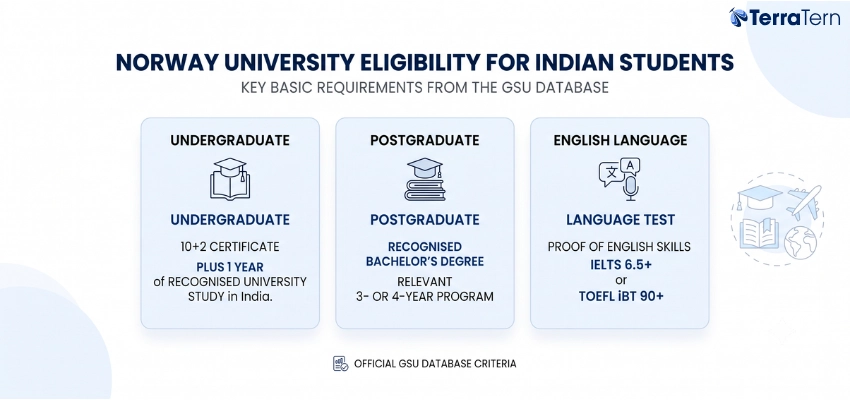
To study in Norway, the basic eligibility for Indian students is laid out in the official GSU database, which includes the following:
-
Undergraduate: 10+2 certificate + 1 year of recognised University study in India.
-
Postgraduate: Recognised relevant 3- or 4-year Bachelor's degree.
-
Language Test: IELTS 6.5 or TOEFL iBT 90 or higher as proof of English skills.
What Academic Documents Do Indian Students Need?
The academic documents checklist is shown below:
-
Class 10 and Class 12 mark sheets and certificates
-
Transcripts and certificates for a bachelor's degree (if applying for PG)
-
If writing a Statement of Purpose (SOP), it must be included with the CV and should be updated.
-
Students are required to have two Letters of Recommendation (LORs).
-
English proficiency test scorecard (IELTS/TOEFL)
-
Valid passport copy
Do CBSE/ISC Students Need an Extra Year Before Applying to Norway?
Yes. For direct admission to undergraduate courses, a CBSE or an ISC Class 12 certificate alone is not sufficient in Norway under the GSU Framework. Indian students are required to do one extra year in the university (even the 1st year of the Bachelor's in India). Requirements can vary by institution, so always confirm the exact CBSE/ISC requirements directly with the college or university you plan to apply to.
Expert Advice: The CBSE/ISC "extra year" rule is one of the most-missed details by Indian applicants; flagging it early prevents a wasted application cycle.
Which Are the Best Universities in Norway for Indian Students?
Some of the best universities in Norway for Indian students are:
|
University |
QS Rank 2026 |
Notable For |
Approx. Non-EU Fee/Year |
|
University of Oslo |
#119 |
Data Science, Health & Social Sciences |
NOK 204,000 – 295,000 |
|
NTNU |
#267 |
Engineering, Tech & Renewable Energy |
NOK 170,000 – 205,600 |
|
University of Bergen |
#287–291 |
Life Sciences, Humanities & Research |
NOK 197,000 – 401,700 |
|
BI Norwegian Business School |
N/A (Triple-Crowned) |
MBA, Management, Finance |
NOK 100,000 – 220,000 |
University of Oslo: Courses, Ranking & Fees
Global ranking holds an impressive QS 2026 rank of #119, making it the highest-ranked institution to study in Norway for Indian students
-
Standout Programmes: World-renowned for Master's degrees in Data Science, Health Economics, and Biosciences.
-
Non-EU Tuition Band: Approximately NOK 204,000–295,000 (~INR 19L–INR 29L) per year.
-
Scholarships & Waivers: Direct university fee waivers are very limited post-2023; students primarily rely on external or bilateral global grants.
-
Semester Fee: A nominal administrative fee of roughly NOK 600.
NTNU (Norwegian University of Science and Technology): Best for Engineering & Tech
Global ranking placed at #267 in the QS standings, it is the premier STEM destination for those wanting to study in Norway for Indian students .
-
Standout Programmes: Highly competitive degrees in Chemical Engineering, Materials Science, and Renewable Energy Systems.
-
Non-EU Tuition Band: Roughly NOK 170,000 – 205,600 (~INR 13L–INR 15.8L) per year.
-
Scholarships & Waivers: General scholarships are scarce, but specific tuition exemptions exist for applicants with prior long-term Norwegian residency or ties.
-
Semester Fee: Standard fee of approximately NOK 700.
University of Bergen: Best for Research & Life Sciences
Global ranking holding the QS 2026 rank of #287–291, it offers a deeply research-driven curriculum.
- Standout Programmes: Exceptional offerings in Marine Biology, Global Health, and Climate Dynamics.
- Non-EU Tuition Band: NOK 197,000 for Humanities/Social Sciences; up to NOK 226,000 for STEM and Life Sciences.
- Scholarships & Waivers: Master's level waivers are exceptionally rare, though PhD candidates are recruited as fully funded, salaried employees.
- Semester Fee: Approximately NOK 600.
BI Norwegian Business School: Best for MBA/Management
Global ranking unranked on general lists; it holds the elite "Triple Crown" (AMBA, EQUIS, AACSB) accreditation, making it a globally competitive choice to study in Norway.
-
Standout Programmes: Elite MSc in Business, Master's in Finance (highly ranked by the Financial Times), and Executive MBA.
-
Non-EU Tuition Band: Ranges from NOK 111,000 to NOK 140,000+ (~INR 8.5L–INR 11L) annually.
-
Scholarships & Waivers: Features highly attractive funding, specifically the BI Presidential Scholarship, which offers up to a 100% tuition fee waiver for top-tier applicants.
-
Semester Fee: Typically bundled directly into the total programme administrative costs.
Also Read: Europe Job Consultancy in India: Gov. Approved List
Expert Tip: Don't rank universities purely by QS position; match the recommendation to the student's field (NTNU for engineering, UiB for life sciences, BI for business) since that's what actually drives outcomes.
How Much Does It Cost to Study in Norway for Indian Students?
Tuition at Norwegian public universities is no longer automatically free for non-EU/EEA students. Fees now typically range from around NOK 130,000 to 340,000 per year, with some universities temporarily charging lower bands (about NOK 80,000–160,000) during the 2025–26 transition period.”The average cost to study in Norway is illustrated in the table below:
|
Cost Category |
Approximate Annual Cost |
|
Public University Tuition (STEM/Business) |
NOK 130,000 – 250,000 (~INR 11L – 21L) |
|
Public University Tuition (Humanities) |
NOK 80,000 – 160,000 (~INR 6.7L – 13.4L) |
|
Private University Tuition |
NOK 80,000 – 160,000 (~INR 6.7L – 13.4L) |
|
Mandatory Semester Fee |
NOK 600 – 1,000 (~INR 5,000 – 8,400) |
Norway's Tuition Fee Timeline (2023–2026) Explained
The fee structure has undergone massive changes in a short period:
|
Period |
Tuition Fee Policy & Impact on Indian Students |
|
Pre-Autumn 2023 |
Fully free. Indian students only paid a minor semester fee (~NOK 600-1,000). |
|
Autumn 2023 |
Mandatory full-cost fees were introduced for all non-EU/EEA students by the parliament, ranging from NOK 130,000 to 390,000 per year. |
|
June 2025 |
The government proposed reversing the strict "full cost" rule, aiming to give universities flexibility. |
|
August 2026 Onward |
Subject to parliamentary approval, universities can set their own fees. Some institutions (like Nord University) are already planning significant reductions or zero fees. |
What Is the Cost of Living in Norway for Indian Students?
Norway’s high standard of living comes with matching costs. Regardless of tuition fee waivers, the government strictly requires proof of minimum living funds (NOK 166,859 for a 2025/2026 academic year, or ~INR 14–15.8 Lakhs) to issue a student visa. Living costs vary heavily by city tier. Oslo and Bergen sit at the higher end, while Trondheim, Stavanger, and Tromsø are slightly more affordable.
On average, the budget is between NOK 12,000 and 15,000 (~INR 1L–1.25L) per month.
|
Monthly Expense Category |
Estimated Cost (NOK) |
Estimated Cost (INR) |
% of Budget to |
|
Accommodation (Student housing/Shared) |
NOK 4,000 – 8,000 |
INR 34,000 – INR 67,000 |
~35-40% |
|
Food & Groceries |
NOK 2,500 – 4,500 |
INR 21,000 – INR 38,000 |
~25% |
|
Transport (Student Pass) |
NOK 400 – 800 |
INR 3,400 – INR 6,800 |
~5% |
|
Utilities (if not included in rent) |
NOK 500 – 1,000 |
INR 4,200 – INR 8,400 |
~5-10% |
|
Personal & Entertainment |
NOK 1,500 – 3,000 |
INR 12,700 – INR 25,000 |
~15-20% |
Important Note: Tell students to get the programme-specific fee in writing from the university before financial planning; country-level averages can be off by 2–3x for specific courses like medicine or MBA.
How Do Indian Students Apply for a Norway Student Visa?
To study in Norway, you must obtain a study residence permit through the Norwegian Directorate of Immigration (UDI), rather than a short-term Schengen tourist visa.
-
Online Portal: Register and apply via the official UDI portal before travelling.
-
VFS Appointment: Submit biometrics at a VFS Global centre in India.
-
Standard Timeline: Processing generally takes 4–10 weeks.
Norway Student Visa Document Checklist
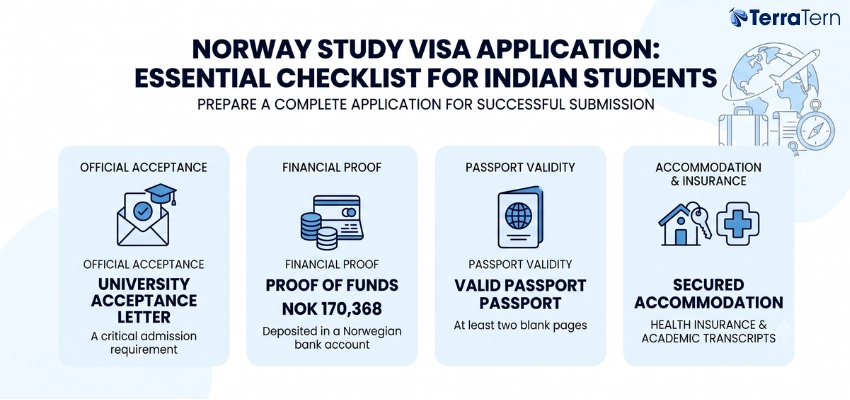
Submitting a complete application is the most critical step to successfully study in Norway for Indian students . Prepare the following essential documents:
-
Official university acceptance letter
-
Proof of funds (NOK 170,368 deposited in a Norwegian account)
-
Valid passport (with at least two blank pages)
-
Proof of secured accommodation
-
Health insurance and previous academic transcripts
How Long Does the Norway Student Visa Take to Process?
Timelines can fluctuate, so early preparation is vital to study in Norway for Indian students .
-
Realistic Range: Most applications are processed within 4 to 10 weeks.
-
Peak Season Delays: During the summer rush, processing can occasionally stretch up to 3 months.
-
Recommendation: Submit your visa application the moment you receive your unconditional university offer and secure your funding.
Also Read: Civil Engineering Jobs in Europe: Updated Guide
As per Terra Tern Expert, Indian students can't open a Norwegian bank account before arrival; funds must go through the university's designated deposit account, and that confirmation letter is what actually unlocks the visa application. Missing this step is a common, avoidable delay.
What Scholarships Are Available for Indian Students in Norway?
Since Norway's original Quota Scheme was phased out, Indian students looking to study in Norway can pursue NORPART-linked institutional partnerships, university-specific fee waivers (e.g., NTNU, UiO, UiB), the BI Presidential and Merit Scholarships, and Erasmus Mundus Joint Master's exemptions.
-
University Fee Waivers: Exceptional candidates can target institution-specific schemes such as the NTNU tuition fee waiver, UiO International Scholarship, and UiB fee waivers.
-
BI Norwegian Business School: This offers the competitive Presidential Scholarship (granting up to an approximate 50% tuition reduction) and Merit Scholarships (offering a 20–30% reduction).
-
NORPART Partnerships: Serving as the practical successor to the old Quota Scheme, these bilateral institutional exchange programmes offer vital funding for students from the Global South.
-
Erasmus Mundus: Joint Master's programmes connected with Norwegian partner universities offer fully funded exemptions.
-
The PhD Route: Postgraduate applicants should note that PhD study in Norway is normally a salaried employee position rather than a traditional "scholarship," making it a distinct and highly funded alternative.
Pro Tip: Don't wait for a "Norway scholarship" search to turn up a silver bullet; most funding for Indian students in Norway now comes through university-level fee waivers and PhD salaried positions, not a single national scheme like the old Quota programme.
Is IELTS Required to Study in Norway for Indian Students?
Most English-taught programmes require IELTS (commonly around 6.5) or TOEFL (around 90), but a growing number of Norwegian universities accept a Medium of Instruction (MOI) certificate in place of IELTS for students who completed prior education in English.
-
Typical Requirements: For standard bachelor's and master's degree admissions, expect to need an IELTS Academic band of 6.5 or a TOEFL iBT score of 90+ to study in Norway for Indian students .
-
MOI Waivers: Institutions such as the University of Oslo, NTNU, and BI Norwegian Business School commonly accept a Medium of Instruction certificate from recognised Indian universities. However, this list changes frequently, so always verify the current policy directly with your programme's admissions office.
-
Alternative Tests: If an MOI waiver isn't applicable, universities widely accept Pearson PTE Academic and Cambridge English qualifications as direct IELTS alternatives.
Key Note: An MOI waiver, where available, can save months of test prep, but always get it confirmed in writing from the admissions office before skipping IELTS prep entirely.
Can Indian Students Work While Studying in Norway?
Yes, international students on a Norwegian study permit can work up to 20 hours per week during term time and full-time during official holiday periods.
-
Part-Time Work Rules: The 20-hour weekly limit is strictly enforced during active academic semesters to prioritise your studies, but you can transition to unlimited full-time hours during summer, Christmas, and Easter holidays.
-
Typical Student Jobs: To successfully afford to study in Norway, Indian students often take up roles in cafes, retail, warehousing, cleaning, or as university teaching assistants.
-
Proof of Funds Interaction: While income generated from your part-time job can legally be factored into your permit renewals, it should never replace the upfront proof-of-funds requirement (NOK 170,368) required to secure your initial student visa.
Important Tip: Treat part-time work as a supplement to your budget, not a funding plan. Norway's visa authorities want to see your core costs already covered before you arrive.
What Are the Job and PR Opportunities After Studying in Norway?
Graduates who study in Norway can apply for a 12-month Job Seeker Residence Permit to find skilled work within their field.
-
Job Seeker Permit: This is a one-time, non-renewable 12-month visa designed specifically for recent graduates, requiring proof of living funds (approx. NOK 140,000).
-
Skilled Worker Permit: To transition, you must secure a full-time job matching your exact field of study that meets Norway's minimum graduate salary thresholds.
-
PR Timeline: Permanent residency generally requires 3 years of continuous legal work on your skilled permit, alongside passing mandatory Norwegian language and social studies tests.
-
Realistic Salaries: In-demand sectors like tech, renewable energy, and engineering offer exceptionally strong starting salaries, realistically ranging from NOK 550,000 to over NOK 700,000.
Key Note: The 12-month job seeker permit is a one-shot, non-extendable window; students who start networking and applying for roles in their final study year have a real head start over those who wait until graduation.
Is Norway Safe and Good for Indian Students to Live In?
Yes, Norway consistently ranks among the world's safest, highest-quality-of-life countries. It features widespread English proficiency and strong institutional support for international students, making daily life incredibly secure. However, the famously high living costs and long, dark Scandinavian winters are real adjustment factors you must prepare for when choosing to study in Norway for Indian students.
-
Safety & Support: Beyond minimal crime rates, local Samskipnad (student welfare organisations) ensure you have direct access to heavily subsidised student housing, counselling, and healthcare.
-
Everyday Language: With the vast majority of the population fluent in English, navigating bureaucracy, finding part-time jobs, and socialising is remarkably frictionless.
-
Climate Reality: The extreme, dark winters require a proactive approach to mental health, including taking vitamin D supplements and staying socially active.
-
Cost Reality Check: Norway's pristine environment comes at a premium; meticulous budgeting and financial discipline are essential.
Pro Tip: Budget for the psychological adjustment as seriously as the financial one. Winter daylight hours and a higher cost of living are the two most common "wish I'd known" comments from Indian students in Norway.
2026 Industry Context Section
Some of the latest facts are:
-
Latest Statistic: Norway has 6 universities in the QS World University Rankings 2026, with the University of Oslo the highest-ranked at #119.
-
Policy Development (2025→2026): From autumn 2023, Norway introduced tuition fees for non-EU/EEA students at public universities. In June 2025, the government proposed removing the fixed "full-cost" requirement; from 1 August 2026, universities can set their own fees. Several (e.g., Nord University, NTNU) have already announced reductions for 2026/27.
-
Enrolment Trend: Non-European enrolment reportedly dropped by a large margin after the 2023 fee introduction, which is part of what's driving the 2026 policy softening, a directly relevant "why now" hook for Indian applicants.
-
Cost of Living (2026–27): Norway's official estimate is roughly NOK 15,488/month (~NOK 170,368/year) for a student budget, per Norway's national study-cost office.
-
Work Rights: International students can work up to 20 hours/week during term and full-time during holidays.
-
Post-Study Pathway: Graduates can apply for a 12-month Job Seeker Residence Permit, then transition to a skilled-worker permit, with permanent residency eligibility typically after 3 years of continuous, legal residence, including qualifying work.
As per TerraTern Expert Shreya, this section alone is the piece's strongest differentiator; no competitor page currently packages the fee-reform timeline this clearly. Keep it updated at least quarterly through 2026/27 as more universities announce fee decisions.
Conclusion
Choosing to study in Norway for Indian students in 2026 means navigating a genuinely reformed tuition landscape. While public education is no longer automatically free, the investment delivers world-class QS-ranked universities, an unparalleled quality of life, and a highly structured post-study pathway to permanent residency.
With realistic cost planning and the right academic strategy, Scandinavia offers a phenomenal launchpad for a career. For personalised application and visa guidance, connect with TerraTern’s expert consulting team today.
Contact TerraTern for more information on studying in Norway for Indian students: Costs & Visa Guide.




 AI Summary