

Key Highlights
- What Is a Singapore Work Visa for Indians and Who Actually Needs One?
- What Are the Different Types of Singapore Work Visas for Indians?
- What Are the Singapore Work Visa Requirements for Indian Citizens in 2026?
- What Is the COMPASS Framework and How Does It Affect Indian Applicants?
- What Documents Do Indian Applicants Need for a Singapore Work Visa?
- How Much Does a Singapore Work Visa Cost for Indians in 2026?
- What Is the Step-by-Step Application Process for a Singapore Work Visa?
- How Long Does It Take to Get a Singapore Work Visa from India?
- What Are the Minimum Salary Requirements for Each Singapore Work Pass?
- Can Indian Work Visa Holders Bring Their Family to Singapore?
- Why Do Singapore Work Visa Applications Get Rejected and How Can Indians Avoid It?
- What's Changing for Singapore Work Visas in 2027?
- How Does a Singapore Work Visa Compare to Canada, Australia, or Germany for Indians?
- How Can Indian Professionals Improve Their Singapore Work Visa Approval Chances?
- 2026 Industry Context Section
- Conclusion
Singapore’s strong economy, pro-business policies, and high living standards continue to drive demand for skilled foreign workers. For Indian professionals, it’s crucial to understand how Singapore work passes work and how to apply. The guide includes the details of Singapore work visa requirements for Indians, such as visa eligibility, documents required, and the process of applying for the Singapore work visa. It also provides a detailed breakdown of the Singapore work visa cost for Indian citizens.
What Is a Singapore Work Visa for Indians and Who Actually Needs One?
Singapore work visa for Indians is officially referred to as a “work pass” issued by the Ministry of Manpower of the Republic of Singapore prior to actual employment.
-
Work pass vs. work visa: MOM's term is "work pass", and Indians use "work visa" as their search term.
-
All foreign nationals in paid employment are required to have one, regardless of the type of work they perform.
-
No exemptions: No one in paid employment; tourist/business visa means no work.
-
There are six main work passes relevant to Indian professionals: Employment Pass, S Pass, Work Permit, EntrePass, Personalised Employment Pass (PEP), and ONE Pass.
As per our Terra Tern Expert Shreya, Working in Singapore on a visit pass, even unpaid "trial" work, is a violation that can trigger a re-entry ban; never start work before the pass is physically issued, or the notification letter is received.
Also Read: How to Get a Job in Singapore from India in 2026? Latest Guide
What Are the Different Types of Singapore Work Visas for Indians?
Singapore work visa for Indians offers five passes, depending on salary, qualifications, and job role: Employment Pass, S Pass, Work Permit, EntrePass, and Personalised Employment Pass.
|
Pass Name |
Best For |
Minimum Salary |
Validity |
COMPASS Applies? |
Singapore Work Visa Cost for Indian |
|
Employment Pass (EP) |
Salaried Indian professionals, managers, and executives |
SGD 5,600/month (SGD 6,200 for Financial Services); scales up with age |
Up to 2 years (Initial); up to 3 years (Renewals) |
Yes (Must score 40+ points) |
SGD 330 (SGD 105 application + SGD 225 issuance) |
|
S Pass |
Mid-skilled Indian technicians and associate professionals |
SGD 3,300/month (SGD 3,800 for Financial Services); scales up with age |
Up to 2 years (Initial); up to 3 years (Renewals) |
No (Subject to quota & monthly employer levy) |
SGD 205 (SGD 105 application + SGD 100 issuance) |
|
Work Permit (WP) |
Semi-skilled Indian workers in construction, marine, or manufacturing |
No fixed salary floor (Market rate applies) |
Up to 2 years |
No (Strict sector quotas & source country restrictions) |
SGD 70 (SGD 35 application + SGD 35 issuance) |
|
EntrePass |
Indian entrepreneurs and tech founders with venture backing |
No fixed salary floor (Must meet innovation criteria) |
1 year (Initial); 2 years for subsequent renewals |
No (Evaluated on business milestones) |
SGD 330 (SGD 105 application + SGD 225 issuance) |
|
Personalised Employment Pass (PEP) |
High-earning Indian professionals wanting employer flexibility |
SGD 22,500/month (Fixed monthly salary) |
3 years (Strictly non-renewable) |
No (Exempt due to high salary threshold) |
SGD 330 (SGD 105 application + SGD 225 issuance) |
|
ONE Pass |
Top-tier global talent in business, arts, sports, or academia |
SGD 30,000/month (Or outstanding track record) |
5 years (Renewable) |
No (Exempt due to elite track record) |
SGD 330 (SGD 105 application + SGD 225 issuance) |
Which Singapore Work Visa Fits Most Indian Professionals?
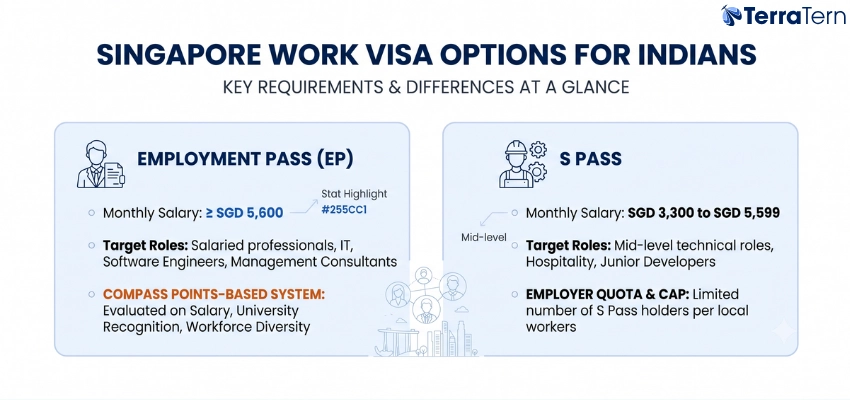
The Employment Pass is mostly taken up by salaried Indians who have an overseas job offer of more than SGD 5600/month, while the S Pass is mainly for mid-level technical roles with a monthly salary below SGD 5600. Knowing the exact Singapore work visa for Indians is essential before your employer lodges your application.
-
The Employment Pass (EP) Route: For Indian IT professionals, software engineers, and management consultants, it's your go-to option. In addition to the salary minimum requirement, you have to pass the points-based COMPASS (Complementarity Assessment Framework) system, which awards points based on your salary level relative to the industry, your university's recognition, and the level of your employer's workforce diversity.
-
The S Pass Track: If you are being offered between SGD 3,300 and SGD 5,599 per month, you will be vying for an S Pass. This is typical in the hospitality industry, among junior developers, or in specific roles within the lab. Note that your employer has a cap (quota) on the number of S Pass holders that he or she may recruit compared to local workers.
Important Note: Don't self-select a pass by salary alone; COMPASS scoring (covered next) can still block an EP application even when the salary threshold is technically met.
What Are the Singapore Work Visa Requirements for Indian Citizens in 2026?
Singapore work visa requirements for Indian citizens vary by pass type, but typically include a confirmed job offer from a MOM-registered employer, recognised qualifications, relevant work experience and meeting the minimum qualifying salary for the pass.
-
Employment Pass: Degree/diploma, qualifying salary, COMPASS score 40+.
-
S Pass: Diploma/technical qualification, qualifying salary, quota compliance.
-
Work Permit: Employer-sponsored, sector-specific, medical exam, security bond.
-
EntrePass: Viable, innovative business plan; not degree-dependent.
Expert Tip: "Meeting the salary threshold" and "being eligible" are not the same thing in 2026. COMPASS turns eligibility into a points contest, detailed next.
What Is the COMPASS Framework and How Does It Affect Indian Applicants?
COMPASS is MOM's points-based system for Employment Pass applications, central to Singapore work visa requirements for Indian citizens. 40 points are needed across four criteria for a Singapore work visa for Indians.
-
C1: Salary vs. local benchmark.
-
C2: Qualifications recognised degree.
-
C3: Diversity in nationality is under 5% of the staff.
-
C4: Local Support employer's record of hiring locals.
-
Exemption: SGD 22,500+/month skips COMPASS.
-
Use MOM's: Use MOM’s online self-assessment calculator to estimate your COMPASS score before the employer submits the Employment Pass application.
Expert Advice: Because Indian nationality often makes up a larger share of an employer's foreign workforce than average, the C3 diversity criterion is frequently where Indian applicants lose points; a stronger salary offer can offset this.
What Documents Do Indian Applicants Need for a Singapore Work Visa?
Core documents for a Singapore work visa for Indians: valid passport, photos, degree certificates, experience letters, updated CV, signed offer, plus a medical exam, per Singapore work visa requirements for Indian citizens.
-
Before Applying: Passport, photos, degree, CV, experience letters.
-
IPA Stage: Signed offer, certificate verification, employer documents.
-
After Entry: Medical exam, biometrics, pass collection.
-
India Tip: Unlisted-institution degrees need attestation; reissuing lost certificates takes weeks.
Important Tip: Document delays, not eligibility, are the most common reason Indian applications slip past their expected timeline; start the attestation process in parallel with salary negotiations, not after.
How Much Does a Singapore Work Visa Cost for Indians in 2026?
When factoring in the overall Singapore work visa cost for Indian professionals, it’s important to know that the Ministry of Manpower (MOM) splits charges into an initial application fee and a final issuance fee. For example, the total Employment Pass cost consists of an ~SGD 105 application fee paid upon submission and an ~SGD 225 issuance fee paid once the pass is approved.
|
Pass Type |
Total Government Fee (SGD) |
Total Estimated Fee (INR)* |
|
Work Permit |
~SGD 70 |
~INR 5,150 |
|
S Pass |
~SGD 205 |
~INR 15,150 |
|
Employment Pass (EP) |
~SGD 330 |
~INR 24,300 |
|
EntrePass / PEP |
~SGD 330 |
~INR 24,300 |
|
Dependant's Pass |
~SGD 105–330 per dependant |
~INR 7,750–INR 24,300 |
As per Our TerraTern Expert: Government fees are genuinely low; the real cost driver for most Indian applicants is document attestation and any agency/consultancy service fee, not MOM's own charges.
What Is the Step-by-Step Application Process for a Singapore Work Visa?
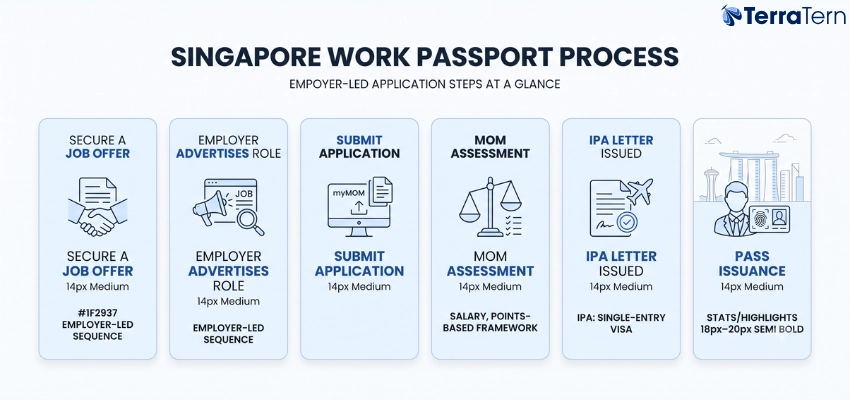
The employer submits the pass application via the myMOM Portal; MOM issues an In-Principle Approval (IPA) letter if successful; the applicant enters Singapore on the IPA, and the physical pass is issued after biometrics/medical checks. Securing a Singapore work visa for indians follows a strict, employer-led sequence:
-
Secure a Job Offer: You must have a confirmed offer from a Singapore-registered entity before any paperwork begins.
-
Employer Advertises the Role: The employer must post the role on MyCareersFuture for 14 to 28 days (if required for an EP) to ensure local candidates are considered fairly.
-
Employer submits application: The hiring company or its authorised employment agent submits your details, credentials, and the application fee via the myMOM Portal.
-
MOM Assessment: The government assesses the application against strict salary criteria and the COMPASS points-based framework.
-
IPA Letter Issued: If successful, MOM issues an In-Principle Approval (IPA) letter, which serves as a pre-approved, single-entry visa to enter the country.
-
Applicant Enters Singapore: You travel to Singapore using the IPA and undergo a medical examination if stipulated in your approval letter.
-
Pass Issuance and Biometrics: Your employer pays the issuance fee to release the pass. You then register your fingerprints and photo at the EP Services Centre to receive your physical card.
Key Note: The applicant cannot submit an Employment Pass or S Pass application independently; it must come from the employer or a licensed employment agent; be wary of any "guaranteed" self-application service.
How Long Does It Take to Get a Singapore Work Visa from India?
Most Employment Pass applications take 3–8 weeks, the S Pass takes around 3 weeks, and the Work Permit takes 1–2 weeks, though straightforward digital EP cases can clear in as little as 10 business days. A Singapore work visa for Indians can have processing timelines significantly delayed by verification checks. Document attestation hurdles and mandatory background credential checks for degrees from unlisted or unfamiliar universities often add weeks to the final approval timeline.
|
Pass Type |
Typical Processing Time |
|
Employment Pass (EP) |
3–8 weeks (as fast as 10 days for simple cases) |
|
S Pass |
~3 weeks |
|
Work Permit |
1–2 weeks |
As per TerraTern Expert Divyansh, build in a minimum 8–10-week buffer between accepting an offer and the planned relocation date to account for document and attestation delays, even though MOM's own processing can be faster.
What Are the Minimum Salary Requirements for Each Singapore Work Pass?
The minimum qualifying salary for a Singapore work visa for Indians depends on the work pass type, the applicant's age, and the industry. As of 2026, the Employment Pass (EP) starts at SGD 5,600/month (or SGD 6,200 for financial services), while the S Pass starts at SGD 3,300/month (or SGD 3,800 in financial services). Although these thresholds determine eligibility, they do not affect the Singapore work visa cost for Indian applicants, as visa fees are paid separately.
|
Pass Type |
Current Minimum Salary (2026) |
New Minimum (Effective Jan 1, 2027)* |
|
Employment Pass (General) |
SGD 5,600 (scales to ~SGD 10,700 at 45+) |
SGD 6,000 (scales to ~SGD 11,500 at 45+) |
|
Employment Pass (Finance) |
SGD 6,200 (scales to ~SGD 11,800 at 45+) |
SGD 6,600 (scales to ~SGD 12,700 at 45+) |
|
S Pass (General) |
SGD 3,300 (scales to ~SGD 4,800 at 45+) |
SGD 3,600 (scales to ~SGD 5,100 at 45+) |
|
S Pass (Finance) |
SGD 3,800 (scales to ~SGD 5,650 at 45+) |
SGD 4,000 (scales to ~SGD 5,650 at 45+) |
Important Note: If your current offer sits between SGD 5,600 and SGD 6,000, ask your prospective employer now how they plan to handle your 2028 renewal under the higher threshold; don't wait until the renewal is due.
Can Indian Work Visa Holders Bring Their Family to Singapore?
Employment Pass (EP) and Personalised Employment Pass (PEP) holders earning at least SGD 6,000 per month can sponsor eligible family members through a Dependant's Pass, while those who do not meet the salary requirement may qualify for a Long-Term Visit Pass (LTVP) for certain dependants. These family sponsorship rules are separate from the Singapore work visa cost for Indian applicants and are an important consideration when planning a Singapore work visa for Indians.
-
Eligibility: Employment Pass, Personalised Employment Pass, and ONE Pass holders who earn at least SGD 6,000 per month can sponsor a legally married spouse and unmarried children under 21 via a Dependant’s Pass.
-
Long-Term Visit Pass (LTVP): Eligible for certain family members, such as common-law spouses, stepchildren, or parents (subject to higher salary requirements and eligibility conditions).
-
Required Documents: Marriage certificates, birth certificates, and other Indian-issued civil documents should be properly attested and, where required, translated.
-
Processing Time: Family pass applications are typically processed within 3–5 weeks, depending on the verification of documents.
-
Working Rights: Dependent Pass holders may work in Singapore if they qualify under the applicable employment rules, including obtaining a Letter of Consent where eligible.
-
Definition Box: Dependant's Pass is designed for spouses and children of eligible work pass holders, while the LTVP covers other qualifying family members and generally provides more limited residency rights.
Expert Advice: Attest spouse and children's Indian-issued certificates before applying; this is the most common Dependant's Pass delay for Indian families, mirroring the applicant's own degree-attestation issue.
Also Read: Top Jobs in Singapore for Indian: New Pay, Scope & More
Why Do Singapore Work Visa Applications Get Rejected and How Can Indians Avoid It?
Most Singapore work visa for Indians applications are rejected because applicants fail to meet salary requirements, COMPASS criteria, qualification standards, or employer eligibility conditions. These issues are usually fixable, making a rejection an opportunity to strengthen the application rather than the end of the process. The Singapore work visa cost for Indian applicants remains unchanged when an employer submits a corrected application.
|
Common Rejection Reason |
Why It Happens |
How to Avoid or Fix It |
|
Salary below the qualifying threshold |
The offered salary does not meet the strict, age-adjusted minimum EP or S Pass requirement. |
Negotiate a qualifying salary before application or apply under the appropriate lower work pass category if applicable. |
|
COMPASS score below 40 |
The application fails to meet the required points across salary, qualifications, diversity, and local workforce criteria. |
Ask the employer to review the COMPASS assessment breakdown and improve the weakest scoring area before resubmitting. |
|
Unrecognised or unrelated qualifications |
The degree or professional qualification does not align with the job role or is not recognised by MOM. |
Submit recognised academic credentials, undergo verification via MOM-approved agencies, and include relevant work experience supporting the role. |
|
The employer exceeds the foreign-worker quota |
The hiring employer has reached its permitted foreign workforce limit (which primarily applies to S Passes and Work Permits). |
Confirm the employer's quota availability before submitting the application, or wait until local hiring expands its quota capacity. |
|
Incomplete or inconsistent documentation |
Missing employment records, inaccurate information, or document mismatches across applications. |
Double-check all documents for consistency and ensure all Indian certificates are formally attested before submission. |
|
Weak employment justification |
The employer cannot demonstrate why a foreign candidate is required over a local professional. |
Ensure the employer provides a clear business case, a detailed job description, and satisfies the MyCareersFuture advertising requirements. |
Expert Tip: A first-time EP rejection is common and rarely final; identify the specific low-scoring COMPASS criterion before resubmitting rather than reapplying unchanged.
What's Changing for Singapore Work Visas in 2027?
The Budget 2026 announcement confirmed upcoming salary hikes that will directly impact the Singapore work visa cost for indian professionals:
-
Higher Minimums (Jan 1, 2027): New Employment Pass applications must meet a base salary of SGD 6,000 (general) or SGD 6,600 (financial services).
-
Renewal Deadlines: Passes expiring on or after January 1, 2028, must comply with these increased thresholds.
-
Negotiation Strategy: If your current offer is between SGD 5,600 and SGD 6,000, push for the 2027 minimum now to guarantee the future renewal of your Singapore work visa for indians.
Important Tip: If you're negotiating a Singapore offer now for a 2027 start, ask for the higher threshold up front; it avoids a renewal-eligibility problem 12–24 months later.
How Does a Singapore Work Visa Compare to Canada, Australia, or Germany for Indians?
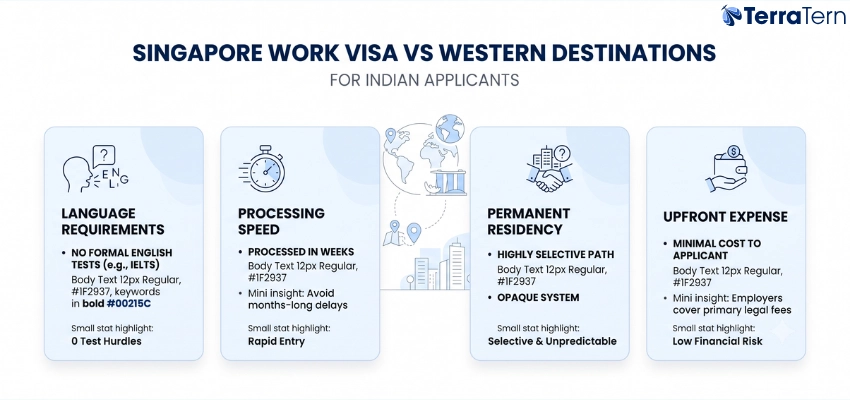
Securing a Singapore work visa for indians offers rapid entry but distinct long-term differences compared to Western destinations:
-
Language Requirements: Singapore does not formally require English-language testing (such as IELTS), unlike the strict mandates in Canada and Australia
-
Processing Speed: Singapore processes passes in weeks, bypassing the months-long delays common in Germany.
-
Permanent Residency: Singapore maintains a highly selective, opaque PR path that contrasts sharply with Canada's predictable points-based system.
-
Upfront Expense: The upfront cost of a Singapore work visa for Indian applicants is minimal, as employers cover the primary legal application fees.
Pro Tip: Choose Singapore for speed-to-employment and zero language testing; choose Canada or Australia if permanent residency, not just a work stint, is the end goal.
How Can Indian Professionals Improve Their Singapore Work Visa Approval Chances?
To secure a Singapore work visa for indians without delay, take these practitioner-level steps before your employer submits the paperwork:
-
Run the COMPASS self-assessment: Verify that your age-adjusted salary, degree, and the hiring firm's diversity ratios score the mandatory 40 points.
Get an early credential evaluation: If your degree is from an unlisted institution, initiate background verification through a MOM-approved agency immediately. -
Start document attestation early: Begin legally attesting your educational and civil certificates the exact moment you receive a verbal offer.
Key Note: The applicants who move fastest aren't the most qualified on paper; they're the ones who started their document and attestation process in parallel with salary negotiations rather than after signing.
2026 Industry Context Section
Some of the latest industry facts are:
-
Latest Statistic: EP minimum salary is SGD 5,600/month (general) / SGD 6,200 (financial services) as of 2026.
-
Confirmed 2027 Development: Budget 2026 raises EP minimums to SGD 6,000/6,600 for new applications from 1 January 2027; renewals expiring from 1 January 2028 must also comply.
-
Framework Update: COMPASS has applied to all new and renewing EP applications since September 2023, requiring a minimum of 40 points (waived above SGD 22,500/month).
-
Demographic Trend: Singapore's population growth is slowing amid record-low fertility (0.87 TR), a structural driver of continued reliance on skilled foreign talent, including Indian professionals, providing useful context for the "why is Singapore still hiring foreigners" framing.
-
PR Pathway Data Point: Singapore approves roughly 33,000–40,000 new Permanent Residencies annually across all nationalities, positioning the work-visa route as a realistic (if selective) pathway to PR.
-
Currency Context: SGD/INR is approximately INR 73–74 as of mid-2026, materially higher than the INR 61–65 range used in older competitor content, which is a reason to present current-year INR conversions.
Conclusion
Navigating the Singapore work visa requirements for Indian citizens ultimately comes down to early preparation and strategic negotiation. From understanding the split employer-paid Singapore work visa cost for Indian applicants to ensuring your salary meets the strict 2027 MOM thresholds, proactive planning helps prevent rejections. By running the COMPASS self-assessment, securing an eligible job offer, and attesting your credentials immediately, you can confidently secure a Singapore work visa for Indians and transition smoothly into one of Asia’s top global economic hubs.
Contact TerraTern for more information on the Singapore Work Visa for Indians: Complete 2026 Guide.




 AI Summary