Key Highlights
- What Exactly Is a Multiple Entry Visa Australia, and How Does It Work?
- Latest Facts and News on Multiple-Entry Visas for Australia in 2026
- What are the Benefits of a Multiple Entry Visa Australia for Indians in 2026?
- What is a Multiple Entry Visa in Australia?
- What are the Types of Multiple Entry Visa Australia Available for Indians in 2026?
- How to Apply for a 3-Year Multiple Entry Visa in Australia in 2026?
- Who Is Eligible for the 3 Year Multiple Entry Visa Australia?
- What Documents Do You Need for the Multiple Entry Visa Australia Application?
- How Much Does the 3 Year Multiple Entry Visa Australia Cost?
- What Are the Conditions You Must Follow on a Multiple Entry Visa Australia?
- What Are the Key Benefits of Getting a 3 Year Multiple Entry Visa Australia?
- What Are the Most Common Reasons for Multiple Entry Visa Australia Rejection?
- How Does the 3 Year Multiple Entry Visa Australia Trial for Indians Work?
- How Can TerraTern Help You Get Your Multiple Entry Visa Australia?
- What Should You Know Before Travelling to Australia on a Multiple Entry Visa?
- Conclusion
A Multiple Entry Visa Australia enables Indian citizens to enter Australia multiple times inside the visa validity term without having to reapply for the visa each time.
This visa is valuable to those who travel to Australia regularly for business, have close family and friends here or are looking for longer visits to Australia. The multiple entries field normally allows a maximum stay of 3 months per visit, the validity of which is generally 1-3 years.
What Exactly Is a Multiple Entry Visa Australia, and How Does It Work?
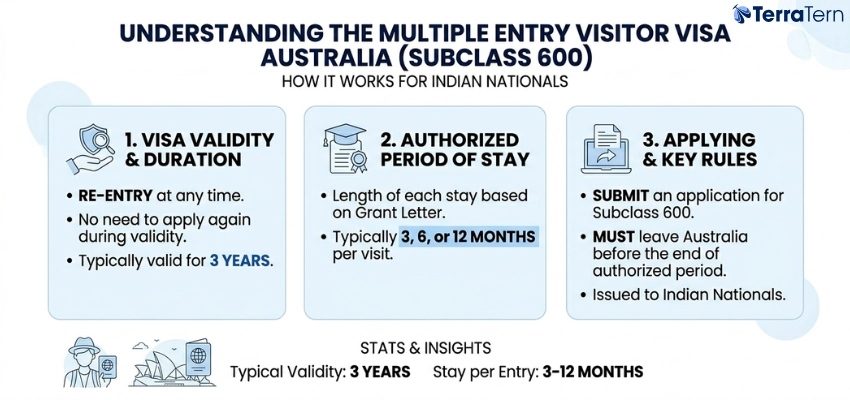
The multiple entry visa Australia (Visitor Visa Subclass 600) is a visa for multiple entries in to Australia for the duration of the visa as granted each time (typically 3 years). A multiple entry visa is valid for a number of entries to Australia and a single entry visa is only valid for one entry to Australia. You can stay for how many days (typically 3, 6 or 12 months) as indicated on your visa grant letter, every time you travel. This will be issued to Indian nationals as a 601 visa (visa subclass 600) as the above visas (visa subclass 601 and 651) are not available.
-
Submit an application to come to Australia on a subclass 600 visa.
-
Remain within the allowed time range (as detailed in the grant letter)
-
Leave Australia prior to the end of your authorised period of stay.
-
Enter and re-enter at any time during the visa's validity period without needing to apply again.
|
Aspect |
Single Entry |
Multiple Entry |
|
Number of entries |
One visit only |
Unlimited visits within validity |
|
Visa validity |
Expires after first exit |
|
|
Reapplication needed |
Yes, for each trip |
No, until the visa expires |
As per TerraTern Expert, Divyansh, for Indian nationals, Subclass 600 is the only eligible multiple-entry visa pathway and getting it right the first time by understanding its structure saves significant time and reapplication costs.
Latest Facts and News on Multiple-Entry Visas for Australia in 2026
-
New Visa Trials: Australia recently conducted a trial for a three-year multiple-entry visa aimed at frequent travellers from India, Thailand, Vietnam, and Chile.
-
Visa Flexibility: The Subclass 600 Visitor visa allows for multiple entries for up to five years.
-
Tourism Growth: Introducing multiple-entry visas is part of Australia's strategy to boost tourism.
What are the Benefits of a Multiple Entry Visa Australia for Indians in 2026?
Here are a few key benefits of a multiple-entry visa in Australia:
1. Flexibility in Travelling
2. Cost-Effective
3. Extended Stay Options
4. Family Visits Possible
5. Long-Term Planning
6. Tourist-Friendly

What is a Multiple Entry Visa in Australia?
A multiple entry visa in Australia is a type of visa that allows travellers to enter and exit multiple times using that particular visa. It has a certain validity period within which travellers can come and go from Australia, however often they want. Generally, there is a validity of a 3-year multiple entry visa in Australia. This multiple-entry visa in Australia is beneficial, particularly for business people or those with family reasons. It saves them time when compared to the normal visa application process. They can get this visa and use it according to the terms and conditions of each visit.
What are the Types of Multiple Entry Visa Australia Available for Indians in 2026?
There are different types of multiple-entry visas in Australia that cater to the needs of all individuals. Here’s a brief overview of the types of 3-year multiple-entry visas available for foreigners in Australia.
|
Visa Type |
Description |
Validity |
Maximum Stay Limit |
|
Visitor Visa (Subclass 600) |
For tourists, business visitors, or to visit family. |
Up to 12 months |
Up to 3, 6, or 12 months |
|
Electronic Travel Authority (Subclass 601) |
For short-term visits for tourism or business purposes. |
12 months |
3 months |
|
eVisitor (Subclass 651) |
This is for European citizens visiting for tourism or business purposes. |
12 months |
3 months |
|
Work and Holiday Visa (Subclass 462) |
This is for young people from eligible countries who want to go on holiday and work. |
12 months |
3 months |
|
Student Visa (Subclass 500) |
This is for students enrolled in a registered course in Australia. |
Up to 5 years |
Up to 3 months |
|
Business Innovation and Investment Visa (Subclass 188) |
This is for business owners and investors managing businesses or investments in Australia. |
Up to 5 years |
Varies based on conditions |
|
Temporary Work (Short Stay Specialist) Visa (Subclass 400) |
For short-term, highly specialised work. |
Up to 3 months |
Up to 3 months |
Note: This data is based on our team members' latest research. Do check the official account of the Australian Department of Home Affairs for the latest updates and checks.
How to Apply for a 3-Year Multiple Entry Visa in Australia in 2026?
Follow the given steps to apply for a 3-year multiple entry visa in Australia with ease:
1. Determine Visa Type
Have thorough research about the various types of multiple-entry visas in Australia. Identify the visa suiting your individual travel needs. Ensure that the visa type selected has multiple entry visas in Australia. After checking all this data, select only any visa type.
2. Check Eligibility Requirements
Research the eligibility requirements for the selected visa type. The requirements are available on the Australian Department of Home Affairs website. After ensuring you meet all the requirements, you can proceed with the visa application.
3. Collect Required Documents
Gather all the required documents essential for multiple entry visa Australia application, such as a valid passport, passport-sized photos, health insurance, bank statements, etc.
4. Create an ImmiAccount
Register for an ImmiAccount on the Australian Department of Home Affairs website. This account will help you to fill out the visa application online. After successfully logging in to the account, select your visa type and fill out an application for a 3-year multiple-entry visa in Australia.
5. Visa Application
After submitting the application fees and correctly filing all the information, submit the visa application online. This is to ensure that all the data filled in is correct for the successful approval of the visa application.
Also Read: Australia PR Invitation Rounds: Trusted Expert Analysis

Who Is Eligible for the 3 Year Multiple Entry Visa Australia?
To qualify for a 3 year multiple entry visa Australia, you must satisfy both general eligibility criteria and stream-specific requirements. The Department of Home Affairs assesses each application individually, and a 3-year grant is never guaranteed; it is a privilege extended to applicants who demonstrate exceptional compliance and genuine temporary intent.
-
Valid passport with a minimum of 6 months' validity beyond your intended stay
-
Clear, genuine purpose of visit: tourism, business, or family reunion
-
Sufficient funds to support your entire stay (bank statements, payslips, employer letter)
-
Health and character requirements, a medical certificate, and police clearance if requested
-
Clean visa history, no prior visa cancellation or refusal in Australia (or disclosure if applicable)
-
Strong home ties to India are compelling evidence that you will return
-
Genuine Temporary Entrant (GTE) criterion satisfied beyond doubt
Expert Tip: The "Genuine Temporary Entrant" test is the single biggest determinant of approval; the more convincingly you document your intent to return to India, the stronger your application.
What Does "Genuine Temporary Entrant" Mean for Indian Applicants?
The Genuine Temporary Entrant (GTE) criterion is the cornerstone of every assessment. In plain terms, Australian immigration officers must be satisfied that you genuinely intend to stay temporarily and will return to India at the end of your visit.
1. Key factors officers assess:
-
Current employment situation in India: Stable job, approved leave, career progression
-
Family ties in India: Spouse, children, parents who remain in India
-
Property or business ownership: Assets that anchor you to India
-
Previous travel history: Compliance with past visas (Australia, US, UK, Schengen, etc.)
-
Reason for requested entries/duration: Why multiple entries? Why 3 years?
2. What strengthens your GTE profile:
-
Previous Australian visits with full compliance
-
Long-term employment with the same Indian employer
-
Multiple property holdings or significant investments in India
-
Dependent family members who do not accompany you
3. What weakens your GTE profile:
-
Minimal employment history or frequent job changes
-
No property or significant assets in India
-
Previous visa overstays or breaches in any country
-
Vague or inconsistent travel purpose statements
Expert Advice: An applicant who has previously visited Australia (or other countries) and complied with visa conditions has a significantly stronger GTE profile — travel history is a silent but powerful approval signal.
What Documents Do You Need for the Multiple Entry Visa Australia Application?
A successful multiple entry visa Australia application rests on comprehensive documentation. All documents must be in English or accompanied by certified translations. Scanned colour copies are acceptable; originals are not submitted unless specifically requested.
1. Identity Documents:
-
Valid passport (bio-data page scan, minimum 6 months validity)
-
Recent passport-size photographs as per Department of Home Affairs specifications
2. Financial Documents:
-
Bank statements (last 6 months, showing consistent balance — avoid sudden large deposits)
-
Salary slips (last 3 months)
-
Income Tax Returns (ITR) — last 2 years
-
Form 16 / CA certificate (for self-employed applicants)
3. Employment / Business Proof:
-
Employer letter on company letterhead (designation, salary, approved leave period)
-
Business registration certificate (for self-employed)
-
GST registration certificate
4. Travel Documents:
-
Travel itinerary (flight plan confirmed tickets not required at application stage)
-
Hotel booking confirmation or accommodation proof
5. Home Ties Documentation:
-
Property ownership documents (sale deed, tax receipts)
-
Family documents (marriage certificate, children's birth certificates)
-
Dependent family documents remaining in India
6. Other Documents (if applicable):
-
Invitation letter (if visiting family/friends in Australia)
-
Sponsor letter and financial statement (for Sponsored Family Stream)
-
Medical certificate and police clearance (if requested by the Department of Home Affairs)
Important Tip: Financial documents alone are not enough; a strong application pairs solid bank statements with equally strong evidence of home ties. Many rejections occur because applicants show they have money but can't explain why they'll return to India.
Are There Any Special Document Requirements for Indian Applicants Specifically?
Indian applicants face several unique procedural requirements when applying for documents.
-
Biometrics Requirement: As per current regulations, Indian applicants must enrol their biometrics at a VFS Global centre in Delhi, Mumbai, Bengaluru, Chennai, Hyderabad, Kolkata, or Ahmedabad. This is a mandatory step for most applicants.
-
No Passport Submission Required: Australia operates a fully digital visa system. You do not submit your physical passport; the multiple entry visa for Australia is electronically linked to your passport number.
-
No Physical Stamp: Applicants do not receive a visa stamp or sticker in their passport. You must carry a printed copy of your visa grant notification email when travelling, as some Indian airports and transit points may request physical documentation even though the visa is digitally linked.
-
VFS Global Role: VFS Global collects biometrics and supporting documents, but has no authority to grant or reject visas. All decisions are made solely by the Australian Department of Home Affairs.
As per TerraTern Expert: Since Australia no longer stamps passports, always carry a printed copy of your visa grant notification letter. Some Indian airports and transit points may ask for it even though it's digitally linked.
How Much Does the 3 Year Multiple Entry Visa Australia Cost?
Understanding the complete fee structure for a 3 year multiple entry visa Australia is essential for proper budgeting. Australian visa fees are non-refundable regardless of outcome, making accurate preparation financially critical.
|
Stream |
Base Application Fee (AUD) |
INR Approximate* |
Notes |
|
Tourist Stream (Subclass 600) |
AUD 200 |
₹11,000–₹11,500 |
Standard tourist/VFR visits |
|
Business Visitor Stream |
AUD 200 |
₹11,000–₹11,500 |
Short-term business activities |
|
Sponsored Family Stream |
AUD 200 + bond |
₹11,000 + bond |
Security bond: AUD 5,000–15,000 |
|
Frequent Traveller Stream |
AUD 1,480 |
₹81,000–₹85,000 |
Longer validity, frequent travellers |
Additional potential costs:
-
VFS Global service fee (India): Approximately AUD 40–80 equivalent
-
Biometric collection fee (if applicable)
-
Health examination (if required): AUD 300–500
-
Professional translation fees: AUD 40–80 per document
-
Card payment surcharge via ImmiAccount: 1.40% for Visa/Mastercard
Pro Tip: Australian visa fees are non-refundable, even if your visa is rejected. Submitting a complete, well-documented application the first time is not just good practice; it's financially important.
Also Read: Australia Tourist Visa from India: Guide for Indians
How Long Does the Multiple Entry Visa Australia Processing Take for Indians?
Processing times for a multiple entry visa Australia vary based on application volume, completeness, and individual circumstances.
|
Application Status |
Processing Time |
Strategic Planning Recommendation |
|
75th Percentile |
20–30 days |
The "standard" window. Most complete applications are approved within this month-long period. |
|
90th Percentile |
45–62 days |
The "safety" window. Buffer your travel dates by at least 8 weeks to account for seasonal spikes. |
|
Worst Case Scenario |
75–90 days |
The "peak" window. Necessary for planning during high-volume months or if documents require extra verification. |
As per TerraTern expert Shreya, processing times posted on the Department of Home Affairs website are updated in real time. Check them before submitting, especially during peak periods like April–June and October–December.
What Are the Conditions You Must Follow on a Multiple Entry Visa Australia?
Every multiple entry visa Australia (Subclass 600) carries specific conditions that holders must strictly observe. Breaching these conditions can result in visa cancellation, future refusal, and potential entry bans.
|
Condition |
Number |
What It Means in Practice |
Strategic Planning Impact |
|
No Work |
8101 |
You cannot accept paid employment or provide services to any Australian organisation. |
Proof of Funds: Border Force may ask for bank statements upon entry to prove you can support yourself without working. Unpaid volunteer work is sometimes permitted under strict rules. |
|
Study Limit |
8201 |
Short-term study or training permitted for up to 3 months only. |
Course Planning: Ideal for short English courses or certifications. If you plan to transition to a university degree, you must apply for a proper Student Visa (Subclass 500). |
|
No Further Stay |
8503 |
You cannot apply for another visa while in Australia (except in limited circumstances). |
Exit Strategy: You must depart Australia before your visa expires. Waivers for this condition are only granted in exceptional, unforeseen circumstances (e.g., severe medical emergencies). |
|
Total Stay Limit |
8558 |
You cannot spend more than 12 months in Australia in any 18-month period. |
Date Tracking: Crucial for frequent travellers or parents visiting family. You must meticulously track your entry and exit stamps to ensure cumulative days do not breach the 12-month cap. |
Important Note: Condition 8503 ("no further stay") is the most misunderstood — it means you cannot extend your stay by applying for another visa from within Australia, so always plan departures before your allowed stay period ends.
What Are the Key Benefits of Getting a 3 Year Multiple Entry Visa Australia?
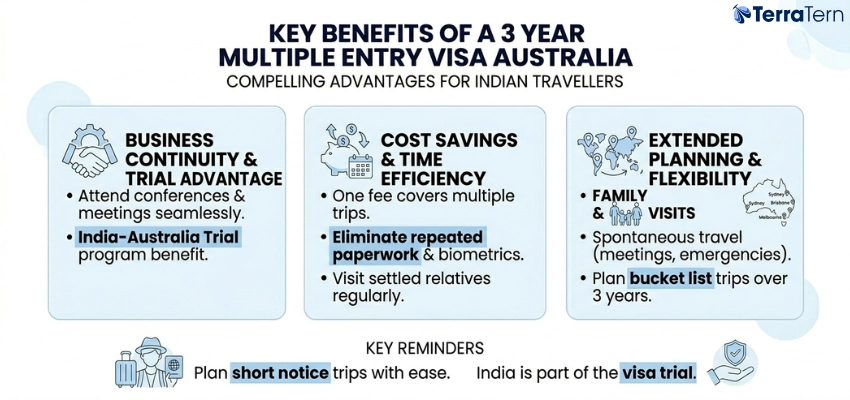
A 3 year multiple entry visa Australia offers compelling advantages for Indian travellers, particularly those with ongoing business, family, or tourism connections to Australia.
-
Travel Flexibility: Plan trips on short notice without waiting for visa approval each time. Spontaneous business meetings or family emergencies become manageable.
-
Cost Savings: One visa fee covers multiple trips. Consider: 3 separate single-trip visas × AUD 200 = AUD 600, versus one entry visa to Australia at AUD 200 (Tourist Stream) or AUD 1,480 (Frequent Traveller Stream).
-
Time Efficiency: Eliminate repeated document gathering, form filling, biometrics appointments, and processing waits for every trip.
-
Business Continuity: Attend conferences, client meetings, trade shows, and negotiations seamlessly without visa-related delays.
-
Family Convenience: Visit children, parents, or relatives in Australia regularly, particularly valuable for families with members settled in Sydney, Melbourne, or Brisbane.
-
Extended Planning Horizon: Three years of validity allows long-term travel planning for bucket list trips, milestone celebrations, or multi-year business strategies.
-
India-Australia Trial Advantage: India is specifically included in Australia's trial programme alongside Thailand, Vietnam, and Chile, making Indian applicants especially well-positioned to receive this extended validity grant.
Expert Tip: For Indian families with members settled in Australia, a 3-year multiple-entry visa is one of the most practical and cost-effective visa options, and the India-Australia trial programme has made it significantly more accessible.
Also Read: Tourist Visa for Australia from India: Guide & Updates
What Are the Most Common Reasons for Multiple Entry Visa Australia Rejection?
Understanding rejection triggers helps you avoid costly mistakes when applying for a multiple entry visa Australia. Most refusals are preventable with thorough preparation.
1. Insufficient Financial Proof
-
Problem: Bank balance doesn't reflect the ability to fund the trip, or sudden large deposits appear suspicious.
-
Fix: Maintain a consistent balance for at least 6 months before application. Document the source of all significant funds.
2. Weak Home Ties
-
Problem: No clear, documented reason to return to India.
-
Fix: Include employment letter, property documents, and family tie documentation together — never rely on just one category.
3. GTE Concern
-
Problem: The officer is not convinced you will leave Australia.
-
Fix: Write a detailed cover letter explaining your travel purpose, itinerary, and explicit intention to return to India.
4. Mismatch in Documents
-
Problem: Discrepancy between form details and uploaded documents.
-
Fix: Cross-check every field in the application form against your submitted documents before lodging.
5. Previous Visa Refusal (Undisclosed)
-
Problem: Not declaring a prior refusal from any country.
-
Fix: Always disclose previous refusals; honest concealment is treated far more seriously than the refusal itself.
6. Incorrect Stream Selection
-
Problem: Applying under the Tourist Stream for what is clearly a business trip.
-
Fix: Match your stated purpose to your stream and supporting documents precisely.
7. Incomplete Application
-
Problem: Missing documents or unanswered fields.
-
Fix: Use a pre-submission checklist and review twice before lodging.
Expert Advice: A strong cover letter that directly addresses the GTE criterion, stating your purpose, ties to India, and travel history, can often be the difference between approval and rejection, especially for first-time Australian visa applicants.
How Does the 3 Year Multiple Entry Visa Australia Trial for Indians Work?
Australia's 3 year multiple entry visa Australia trial represents a significant bilateral initiative specifically benefiting Indian travellers. First announced in 2016 and continuing into 2026, this programme targets frequent short-term travellers from India, Thailand, Vietnam, and Chile.
Key aspects of the trial:
-
Eligible Indian applicants under Subclass 600 can receive a visa with an Australia validity grant
-
Each stay remains limited to up to 3 months per entry
-
The trial applies to both Tourist and Business Visitor streams
-
This is not a guaranteed outcome; visa officers still assess each application individually
-
Strong applications from Indian nationals, particularly business visitors and frequent family visitors, are more likely to receive 3-year grants under this initiative
Important Tip: India's inclusion in Australia's 3-year visa trial signals a stronger bilateral travel relationship. Indian applicants with a consistent travel history and strong home ties are well-positioned to receive the maximum 3-year validity grant.
How Can TerraTern Help You Get Your Multiple Entry Visa Australia?
TerraTern provides end-to-end expert management to streamline your multiple entry visa australia application. We ensure a high success rate through:
-
Document Review: Meticulous verification to eliminate submission errors.
-
Stream Guidance: Selecting the optimal Subclass 600 route.
-
GTE Preparation: Crafting compelling cover letters that prove genuine intent.
-
Full Management: Handling ImmiAccount setup and real-time tracking.
-
Appeals Support: Specialist assistance for post-rejection re-applications.
Pro Tip: The difference between a 3-month grant and a 3-year grant often comes down to how an application is packaged. Experienced immigration consultants understand exactly what officers look for.
Also Read: Australia Visa for Indians: Types, Costs, Checklist & More
What Should You Know Before Travelling to Australia on a Multiple Entry Visa?
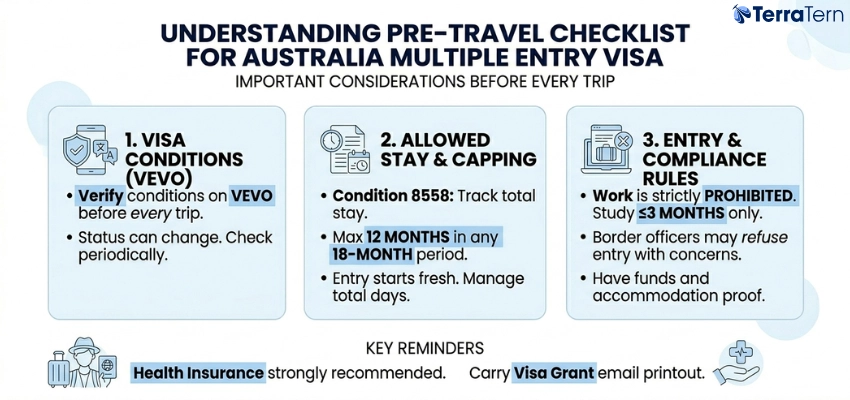
Once your multiple entry visa is granted, proper pre-travel preparation ensures smooth entry and compliance throughout your visits.
Pre-Travel Checklist:
-
Verify visa conditions using VEVO before every trip. Conditions can be checked at any time
-
Carry your visa grant notification email printout; no passport stamp is issued
-
Remember, each entry starts a fresh "allowed stay" period
-
Track your total stay cap: maximum 12 months in any 18-month rolling period (Condition 8558)
-
Arrange health insurance, which is not mandatory but strongly recommended, given Australia's high medical costs
-
Short-term study (up to 3 months) is permitted, but work is strictly prohibited
-
Understand that entry may be refused at the border, even with a valid visa, if an officer has reasonable grounds for concern
Key Note: VEVO (Visa Entitlement Verification Online) is your most important tool as a visa holder. Check it before every entry to Australia to confirm your current conditions and remaining allowed stay.
Conclusion
Multiple entry visa Australia remains your best pathway to repeated Australian travel in 2026. Subclass 600 is the sole option for Indian passport holders, with 3-year validity achievable through the right stream, thorough documentation, and a compelling Genuine Temporary Entrant case. India's inclusion in the bilateral trial programme offers a significant advantage. Preparation, accuracy, and expert guidance dramatically improve your chances of approval. Start your application with TerraTern's expert guidance today.
Contact TerraTern for more information on the Multiple Entry Visa Australia: Your Complete 2026 Guide for Indians.


 AI Summary