


Key Highlights
- What Is an MS in Finland for Indian Students in 2026?
- Which Are the Best Universities in Finland for an MS Degree?
- What Are the Top MS Specialisations and Courses to Study in Finland?
- What Are the Eligibility Requirements for an MS in Finland for Indian Students?
- How Much Does an MS in Finland Cost for Indian Students?
- What Is the Cost of Living in Finland for Indian Students?
- What Scholarships Are Available for Indian Students Pursuing an MS in Finland?
- How Do Indian Students Apply for a Finland Student Visa (Residence Permit) for MS?
- Can Indian Students Work While Studying MS in Finland?
- What Are the Job Prospects and Salary After an MS in Finland?
- MS in Finland vs Germany vs Canada vs Australia: Which Is Better for Indian Students?
- 2026 Industry Context Section
- Conclusion
With its reputable education, English-taught courses, and excellent post-graduation job prospects, Finland is an attractive destination for Indian students pursuing an MS. Finnish universities offer English-taught master’s programmes in subjects such as technology, business, health sciences, sustainability, and the natural sciences. Many Finnish universities are known for programmes related to sustainability, technology, education, and research.
Tuition fees typically range from €8,000 to €20,000 per year (≈ INR 8.4–21 lakh), with living costs around €700–€1,200 per month. Scholarships and tuition-fee waivers are offered by individual universities. They are competitive and may cover part or all of tuition, while students generally remain responsible for living costs. After completing a degree in Finland, graduates may apply for a residence permit to look for work or start a business in Finland, subject to Migri’s conditions.
What Is an MS in Finland for Indian Students in 2026?

MS in Finland for Indian students are offered by universities and Universities of Applied Sciences (UAS). Research-university master’s degrees are generally academic and research-oriented, while UAS master’s programmes are professionally oriented and often require relevant work experience.
Finland offers English-taught master’s programmes and a post-graduation residence permit option for eligible graduates seeking work or starting a business.
-
MS vs MA/MBA in Finland: MS (Master of Science) is thesis/research based in fields of data, STEM, and engineering, while MA/MBA is more in the humanities and social sciences with varying final tasks/capstone.
-
Number of Academic Institutions: 13 research universities (thesis/research track) and 22 UAS (practice-oriented, industry projects). Many UAS master’s programmes require at least two years of relevant work experience, but applicants should check each programme’s eligibility criteria.
Why do Students from India want to Attend Universities in Finland?
-
Lower tuition costs for equivalent QS-ranked programs in the US/UK/Australia.
-
Finland is frequently recognised in international comparisons for quality of life, safety, and gender equality; use current named sources if retaining these claimS.
-
Indian student associations and university support groups can help new students build community after arrival.
-
Programme availability changes by university and intake. Check Studyinfo.fi and university websites for current English-taught options.
-
Finland has major employers in technology, engineering, energy, and manufacturing, but internship and graduate job availability varies by field, location, language skills, and employer.
-
Studying in Finland can be a practical study-abroad option for students whose budget, academic goals, and career plans align with the country’s programmes.
Pro Tip: Finland's appeal for Indian MS applicants isn't just cost; it's the combination of English-taught programmes, a 2-year post-study work permit, and a national policy push to triple international enrolment by 2030, which together makes admission cycles comparatively less competitive than in the UK or US right now.
Also Read: Finland Study Visa Requirements: Docs, Funds & More
Which Are the Best Universities in Finland for an MS Degree?
Aalto University and the University of Helsinki are tied for first place in the country in the rankings for indian students, both ranking #126 in the QS World University Rankings 2027, followed by LUT University with a ranking of #126, Tampere University with #121, and the University of Turku with #120.
This makes studying in Finland an attractive proposition for Indian students for a combination of highly ranked degrees and the post-study options here. Please note that the ranks are available from the QS World University Rankings 2027, published on 20 June 2026.
The following are top MS universities in Finland (QS 2027):
|
University |
QS World Ranking 2027 |
Known for |
Approx. Tuition for MS (Non-EU) |
|
University of Helsinki |
#126 |
Largest university; wide English-taught MS portfolio |
€13,000–€18,000/year |
|
Aalto University |
#126 |
Tech, business & design; innovation-focused |
€14,000–€25,000/year |
|
University of Oulu |
#360 |
Technology & natural sciences |
€10,000–€18,000/year |
|
LUT University |
#126 |
Engineering, sustainability, business |
€10,000–€20,000/year |
|
University of Turku |
#120 |
Diverse research-based programmes |
€8,000–€12,000/year |
|
Tampere University |
#121 |
Interdisciplinary, societal-impact focus |
€10,000–€15,000/year |
|
University of Jyväskylä |
#521 |
Education, psychology, sports sciences |
€8,000–€12,000/year |
|
University of Eastern Finland |
#626 |
Health & social sciences |
€8,000–€12,000/year |
|
Åbo Akademi University |
#670 |
Humanities, social & natural sciences |
€8,000–€12,000/year |
Which Finnish university is best for an MS in Computer Science?
For the computer science field, Aalto University or the University of Helsinki will be a good choice to pursue an MS in Finland because both of them have up-to-date courses on CS, AI, and data science.
It's worth noting that there are great research groups and industry contacts in a Finland-based study at Aalto's “Machine Learning, Data Science and Artificial Intelligence” (also known as the Mada-type ML/DS/AI track) and the CS Department at Helsinki, ideal for study in Finland for Indian students looking for tech careers.
Key Note: Don't select a university by QS rank alone. Aalto's strength is tech/business/design, while Helsinki's breadth suits students still deciding between specialisations; match the university to the specialisation, not just the ranking number.
What Are the Top MS Specialisations and Courses to Study in Finland?
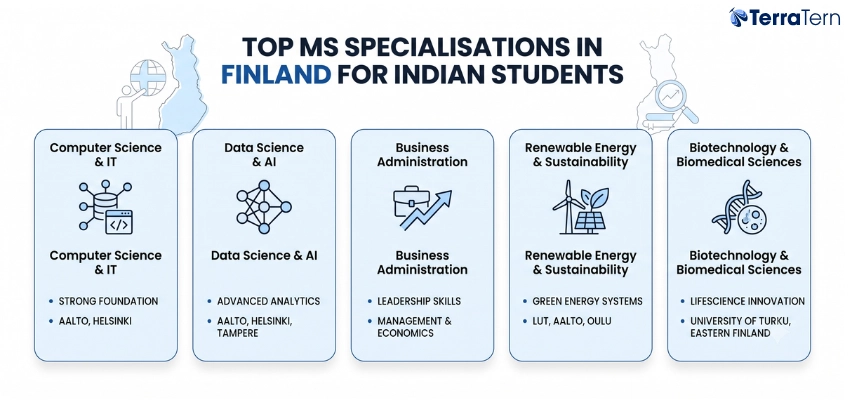
The most in-demand MS specialisations in Finland for Indian students are Computer Science & Data Science/AI, Business Administration, Renewable Energy Engineering, Environmental Sciences, and Biotechnology. Some Finnish employers recruit in technology, engineering, energy, life sciences, and sustainability-related fields, although employment prospects depend on job demand, Finnish or Swedish skills, and the applicant’s experience.
-
Computer Science & IT – Aalto, University of Helsinki. Suitable backgrounds vary by programme. Applicants should check the required prior studies, credits, and subject-area prerequisites on the official programme page.
-
Data Science & Artificial Intelligence – Aalto, Helsinki, Tampere; for CS, math, statistics, or engineering graduates.
-
Business Administration/Management-type MS – Business, management, economics, and finance master’s programmes
-
Renewable Energy & Sustainability – LUT, Aalto, Oulu; for mechanical, electrical, energy, or environmental engineering backgrounds.
-
Environmental Science & Sustainability Studies – University of Helsinki, University of Eastern Finland; for life sciences, chemistry, geography, or environmental engineering graduates.
-
Biotechnology & Biomedical Sciences – University of Turku, Eastern Finland; for BSc/BE in biotech, biology, pharmacy, or biomedical engineering.
-
Mechanical/Electrical/General Engineering – Aalto, Tampere, Oulu; for core engineering bachelor’s degrees (ME, EE, ECE, production).
-
Design & Digital Media – Aalto, Tampere: for design, media, architecture, or CS/IT with strong portfolios.
-
Health Sciences & Public Health – Turku, Eastern Finland; Health and public-health programmes may have specific prior-degree, professional-registration, or work-experience requirements; check each programme carefully.
-
Education & Pedagogy – University of Oulu, University of Helsinki; for BA/BSc in education, psychology, or related social sciences
As per our TerraTern Expert Divyansh, Renewable Energy and Data Science/AI specialisations currently see comparatively lower application volume than Computer Science at the same universities, worth considering for applicants prioritising admission odds over program name recognition.
What Are the Eligibility Requirements for an MS in Finland for Indian Students?
For an MS in Finland for indian students, Eligibility requirements vary by programme, but universities commonly assess relevant prior studies, academic performance, English-language proficiency, and required application materials.
1. Academic Background
- Completed a Bachelor’s degree (3–4 years) in a relevant field for the chosen MS.
- Minimum grade/percentage as per each university (often “good”/above-average performance).
- Strong alignment between your UG major and the MS specialisation you apply for.
2. Document checklist
- Official transcripts and Bachelor’s degree certificate.
- Provide recommendation letters only if the selected programme specifically requires them
- Submit the motivation letter, portfolio, interview task, entrance examination, or other materials required by the specific programme.
- Updated CV/resume.
- Passport copy and digital photo.
- Applicants who are not citizens of an EU/EEA country or Switzerland generally pay a €100 application fee through Studyinfo.fi. The fee does not guarantee admission.
3. English Proficiency
- English-language requirements vary by programme. Check the accepted tests, minimum scores, component requirements, validity period, and waiver criteria on the university’s official admissions page.
- A waiver may be possible if your full Bachelor’s was taught in English and the university accepts this as proof.
Is the GRE or GMAT Required for an MS in Finland?
Many technical and science master’s programmes do not require GRE or GMAT scores, but requirements vary by programme and admissions group.
1. When GRE/GMAT is Required?
- Mainly for certain Business School programmes and economics/finance tracks.
- Often under “Admission Group 2” for applicants without a prior Finnish bachelor’s in a related field.
2. When GRE/GMAT is not Required?
- Most Computer Science, Engineering, natural sciences, data/AI, and many social science MS programmes do not require GRE or GMAT at all.
- Universities assess applicants according to programme-specific criteria, which may include prior studies, grades, relevant credits, entrance exams, portfolios, interviews, or motivation tasks.
Important Note: Most Indian engineering and CS graduates applying to Finnish universities can skip GRE/GMAT entirely. Confirm this per programme on Studyinfo.fi before spending months prepping for a test that may not be required.
Also Read: Finland Study Visa Requirements: Docs, Funds & More
How Much Does an MS in Finland Cost for Indian Students?
For an MS in Finland for indian students, the typical cost is €10,000–€25,000 per year in tuition (about INR 9–22 lakh), plus €800–€1,700 per month in living expenses. Total costs vary by tuition, city, lifestyle, exchange rate, insurance, travel, and scholarship. Provide illustrative calculations only with an exchange-rate date and stated assumptions.
Estimated Annual Cost for Indian Students
|
Cost Component |
Annual Cost (EUR) |
Annual Cost (approx. INR) |
|
Tuition fees |
€10,000–€25,000 |
INR 9,00,000–INR 22,00,000 |
|
Books & supplies |
€500–€1,000 |
INR 44,000–INR 87,000 |
|
Student union fees |
€80–€120 |
INR 7,000–INR 10,000 |
|
Health insurance |
€300–€600 |
INR 26,000–INR 52,000 |
|
One-time university application fee (2026) |
€100 |
INR 8,700 |
Expert Tip: Tuition is the variable. Indian families over-focus on living costs in Helsinki alone can add up to €1,580/month, more than double a regional city like Tampere or Oulu, so city choice affects total cost as much as university choice does.
What Is the Cost of Living in Finland for Indian Students?
The cost of living in Finland for Indian students doing an MS in Finland typically ranges from about €800 per month in smaller cities to €1,700 in Helsinki, covering accommodation, food, transport, utilities, and personal expenses. For a study residence permit, Migri requires students to have at least €800 per month at their disposal.
For an MS in Finland for indian students, Helsinki is the most expensive, while cities like Oulu, Turku, and Jyväskylä are often cheaper yet still host strong universities.
City-wise Monthly Living Cost (Indicative)
|
City |
Accommodation (€) |
Food (€) |
Transport (€) |
Utilities/Internet (€) |
Personal & Misc (€) |
Total Monthly (€) |
|
Helsinki |
500–900 |
250–350 |
60–80 |
80–120 |
150–250 |
1,040–1,700 |
|
Tampere |
400–700 |
220–320 |
50–70 |
70–100 |
130–220 |
870–1,410 |
|
Oulu |
350–650 |
220–320 |
50–70 |
60–90 |
120–200 |
800–1,330 |
|
Turku |
350–650 |
220–320 |
50–70 |
60–90 |
120–200 |
800–1,330 |
|
Jyväskylä |
350–600 |
200–300 |
50–70 |
60–90 |
120–200 |
780–1,260 |
-
Visa Baseline (Migri): Show at least €800/month in your own bank account for the residence permit (minimum survival level.
-
Comfortable Budget: Planning around €900–€1,200/month gives more realistic room for housing, food, transport, and some leisure.
What Scholarships Are Available for Indian Students Pursuing an MS in Finland?
For MS in Finland for indian students, the main scholarships for Indian students in Finland are the national Finland Scholarship, plus university-specific tuition waivers and research fellowships.
|
Scholarship Name |
Type |
Typical Coverage |
Eligibility Note |
|
Finland Scholarship |
National, first-year award |
Up to 100% tuition waiver + €5,000 relocation/living grant for year one. |
Non-EU/EEA master’s entrants with strong academics. |
|
Aalto University Scholarships |
University-specific |
50–100% tuition waiver for MS, sometimes multi-year based on performance. |
High-merit non-EU/EEA applicants to Aalto’s English-taught master’s. |
|
University of Helsinki Scholarships |
University-specific |
50% or 100% tuition fee waivers for the full programme duration. |
Excellent non-EU/EEA students liable to pay tuition. |
|
Tampere University Scholarships |
University-specific |
50–100% tuition waiver. Most university scholarships focus on tuition fees. Check each university’s current scholarship rules to see whether any living-cost support is available. |
Merit-based for fee-paying international master’s students. |
|
LUT University Scholarships |
University-specific |
50–100% tuition waivers, sometimes combined with small stipends |
Strong academic profile in engineering/business MS. |
|
EDUFI Fellowships |
Government/agency, research track |
Monthly stipend for research-focused master’s/doctoral projects. |
Primarily for research-track or doctoral-level students with a supervisor in Finland. |
How to apply (typical sequence for Indian students)
-
Research suitable MS programmes and scholarship options at each university.
-
Prepare documents (transcripts, SOP, CV, recommendation letters, English test scores).
-
Submit your MS application and indicate interest in scholarships on the same form (usually via Studyinfo.fi).
-
Wait for admission and scholarship decisions, which are usually communicated together or shortly after.
-
Accept the offer, confirm tuition and scholarship details, and then use these to support your Migri residence permit application.
-
For an MS in Finland for indian students, the key point is that you normally apply for scholarships together with the MS application, not later after admission, which many applicants misunderstand.
Expert Advice: Apply for university-specific scholarships in the same cycle as your MS application (most have no separate form). Missing this timing is the most common reason eligible Indian applicants lose out on tuition waivers.
Also Read: How to Get a Job in Finland from India? Visa, Pay & More
How Do Indian Students Apply for a Finland Student Visa (Residence Permit) for MS?
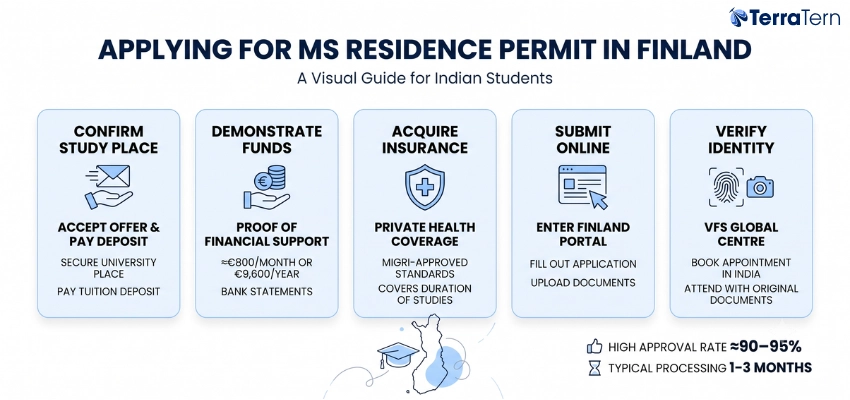
For an MS in Finland for indian students, you apply for a residence permit for studies (not a traditional “student visa”) via the Enter Finland portal, with a 2026 fee of €600 online (€750 for paper) and typical processing of 1–3 months and approval rates around 90–95%.
1. Terminology Clarity: Finland issues a residence permit for studies for programmes longer than 90 days; people often call this a “Finland student visa for Indian students,” but the correct document is a residence permit from Migri.
2.Step-by-Step Application Sequence
- Accept your MS admission offer and confirm your study place (and pay any required tuition deposit).
- Arrange proof of funds (around €800/month or €9,600/year as Migri’s baseline) and valid health insurance.
- Create an account on the Enter Finland portal and fill out the student residence permit application.
- Pay the Finland student visa fees for 2026: €600 online or €750 on paper.
- Book a biometrics/identity-verification appointment at a VFS Global centre or Finnish mission in India.
- Attend the appointment with the originals (passport, admission letter, proof of funds, insurance, etc.).
- Wait for the decision; track your application online.
3. Document Checklist
- Your passport must be valid for the period required by Migri and the Finnish mission. Check the current document instructions before applying.
- Official admission/acceptance letter from the Finnish university.
- Proof of funds bank statements showing roughly €800/month or €9,600/year (plus tuition if not yet paid).
- Obtain private insurance that meets Migri’s required coverage, deductible, and validity conditions for the planned duration of studies.
- Biometric appointment confirmation and printed Enter Finland application summary.
4. Processing Time & Approval Rate
- Typical Processing: Processing time varies by season, application completeness, and verification needs. Check Migri’s current processing time before applying.
- Reported approval rates for genuine student applications are roughly 90–95%, with rejections usually due to insufficient funds or documentation issues
Important Tip: Apply for your residence permit the moment you accept your offer, not after you've finalised travel plans. 2026's processing volumes are running slower against higher fees, and the 1–3-month window can extend during peak intake periods (June–August for autumn intake).
Can Indian Students Work While Studying MS in Finland?
Yes, for Ms in Finland for indian students, those on a residence permit for studies can work an average of 30 hours per week during term time. Students may work in paid employment in any field for an average of 30 hours per week over the year. They may work more in some weeks if the annual average remains within the limit.
1. Work-Hour Rule
- Thirty hours per week averaged across a full year is approximately 1,560 hours, but students should follow Migri’s current wording and their permit conditions, not a strict weekly cap; you can work more in some weeks if you work less in others
- Internships, practical training, and thesis projects required by your MS programme are exempt from this 30-hour average.
2. Typical Part-Time Jobs & Pay
- Common roles: retail assistant, hospitality staff, café/restaurant crew, campus support jobs, customer support, and junior IT/data roles (especially in bigger cities).
- Hourly pay varies by sector, collective agreement, role, and experience. Check vacancy notices and applicable collective agreements.
3. Link to Post-Study Work: After completing your MS, you can apply for a post-study residence permit to seek full-time work in Finland. After graduating, eligible students may apply for a residence permit to look for work or start a business. Part-time work can provide experience, but it does not guarantee a post-study permit or employment.
Pro Tip: The 30-hour limit is a yearly average, not a weekly ceiling. You can work more during a light-coursework week and less during exams, as long as your total stays under 1,560 hours for the year.
What Are the Job Prospects and Salary After an MS in Finland?
For an MS in Finland for indian students, MS graduates typically earn starting salaries of €30,000–€55,000/year (INR 27–48 lakh), with the strongest demand in IT, engineering, and renewable energy, and can stay via a post-study residence permit valid for up to two years to seek work or start a business. For an MS in Finland for indian students, this two-year window is the main bridge from study to long-term career and PR in Finland.
Starting Salaries by Profession (MS Graduates)
|
Profession |
Starting Salary (EUR/year) |
Starting Salary (INR/year) |
|
Software Developer |
€35,000–€50,000 |
INR 30.6–43.8 lakh |
|
Data Scientist |
€40,000–€55,000 |
INR 35.0–48.1 lakh |
|
Mechanical Engineer |
€35,000–€45,000 |
INR 30.6–39.4 lakh |
|
Electrical Engineer |
€35,000–€50,000 |
INR 30.6–43.8 lakh |
|
Environmental Consultant |
€30,000–€40,000 |
INR 26.2–35.0 lakh |
|
Business Analyst |
€35,000–€45,000 |
INR 30.6–39.4 lakh |
-
Top Recruiters in Finland: Examples of major employers in Finnish technology, energy, manufacturing, research, and digital sectors include Nokia, KONE, Wärtsilä, Neste, ABB, and others. Check current vacancies and language requirements directly.
-
Post-Study Work Permit: After your MS, you can apply for a residence permit to seek work/start a business, valid for up to two years, then transition to an employment-based residence permit and, after around 4 years of continuous residence, become eligible for permanent residence (PR).
Key Note: Securing a job offer before your student permit expires lets you switch directly to an employment-based residence permit; you only need the 2-year job-seeking permit as a fallback, not a default plan.
Also Read: Finland Work Visa Requirements: New Pay, Tips & More
MS in Finland vs Germany vs Canada vs Australia: Which Is Better for Indian Students?
For an MS in Finland for indian students, Total study costs vary by tuition, city, housing, exchange rates, scholarship availability, and personal spending. Compare programme-specific budgets rather than country-wide averages. Tuition is comparable to Germany’s fee-charging states, and the applicant pool is less saturated, but the Indian alumni network is smaller; the best choice depends on whether you prioritise cost, competition level, or post-study migration pathway.
For an MS in Finland for indian students, the trade-off is: lower cost and competition vs. a smaller Indian community. Post-study work options differ by country and can change. Compare the current rules for Finland, Germany, Canada, and Australia before applying
Finland vs. Germany vs. Canada vs. Australia (MS for Indian Students)
|
Country |
Avg. Tuition/Year (EUR) |
Avg. Living Cost/Month (EUR) |
Post-Study Work Permit |
Visa Approval Rate (approx.) |
GRE/GMAT Norm for MS |
|
Finland |
€10,000–€20,000 |
€800–€1,200 |
Up to 2 years |
~90–95% |
Usually not required (except some Business School tracks) |
|
Germany |
€0–€4,000 (public; some states higher) |
€850–€1,200 |
18 months (job seeker) |
~85–90% |
Rarely required |
|
Canada |
€12,000–€30,000 |
€1,000–€1,500 |
Up to 3 years (PGWP) |
~85–90% |
Required for some business/management MS |
|
Australia |
€18,000–€35,000 |
€1,200–€1,800 |
2–4 years (depending on degree) |
~85–90% |
Required for some business/management MS |
-
Cost: Finland is cheaper than Australia and most of Canada, similar to or slightly higher than low-fee German public universities, but lower-living-cost cities in Finland can narrow the gap.
-
Competition: Finland’s applicant pool is smaller and less saturated than that of Canada, Australia, and top German universities.
-
Post-Study Pathway: Canada and Australia offer longer initial post-study permits; Finland offers up to two years plus a clear PR route after ~4 years of continuous residence.
-
GRE/GMAT: Finland mostly does not require GRE/GMAT for technical MS, making it attractive for students without these tests.
Pro Tip: If minimising GRE/GMAT prep and total 2-year cost are the priority, Finland and Germany's fee-charging states are closely matched; the deciding factor is usually the language environment (Finland is English-first for study; Germany often expects at least basic German for daily life and part-time work).
2026 Industry Context Section
(5–7 dated, sourced facts , positioned right after the immediate answer, before the main H2 sections)
-
Residence permit fees rose on 1 January 2026: the online fee for a first residence permit for studies increased from €450 to €600; the paper application fee rose from €550 to €750 (Finnish Immigration Service / Migri, effective 1 Jan 2026).
-
New €100 non-EU application fee , starting with 2026 admissions, non-EU/EEA applicants pay a one-time €100 application fee to Finnish universities.
-
QS World University Rankings 2027 (published June 2026) place the University of Helsinki at #123 and Aalto University at #126 globally; both climbed into the top third of over 1,500 ranked institutions worldwide.
-
Over 2,600 Indian students are currently enrolled in Finnish higher education (Government of India figures), within a total international student body exceeding 22,000. Indian enrolment has nearly doubled over the past few years.
-
Finland has set a formal national target to triple its international student intake by 2030, actively expanding intake seats, a tailwind for applicants over the next few admission cycles.
-
Visa approval rate remains high at roughly 90–95% for Indian applicants, among the best globally for a European study destination.
-
Work rights stayed at an average of 30 hours/week (raised from 25 in April 2022) , unchanged through the 2026 admission cycle, with unrestricted holiday work.
Conclusion
An MS in Finland for indian students is a strong 2026 option, offering QS-ranked universities (Helsinki #123, Aalto #126), moderate total cost (~INR 22–45 lakh over 2 years before scholarships), mostly GRE/GMAT-free English-taught admissions, and a 2-year post-study work window, all as Finland aims to triple international enrolment by 2030.
Start by checking your eligibility, shortlist 3–4 universities, and apply for scholarships with your MS applications. For personalised guidance on shortlisting and documents, consider TerraTern’s dedicated eligibility assessment and university-mapping counselling.
Contact TerraTern for more information on MS in Finland for Indian Students: Cost, Universities & Visa.




 AI Summary