
Key Highlights
- Mechanical Engineering Jobs in Canada
- What Is the Current Demand for Mechanical Engineering Jobs in Canada?
- What Salary Can You Expect from Mechanical Engineering Jobs in Canada?
- Which Are the Top Provinces and Cities for Mechanical Engineering Jobs in Canada?
- What Are the Top Industries Hiring Mechanical Engineers in Canada?
- What Skills and Qualifications Do You Need for Mechanical Engineering Jobs in Canada?
- How Can Indian Engineers Get Mechanical Engineering Jobs in Canada with Visa Sponsorship?
- What Are the Immigration Pathways for Mechanical Engineers to Get Canada PR?
- How to Apply for Jobs in Canada as a Mechanical Engineer from India?
- What Is the Scope and Future Outlook for Mechanical Engineering Jobs in Canada?
- Conclusion
The demand for mechanical engineering jobs in Canada is strong in 2026, with a moderate labour shortage and projected growth, making it a great opportunity for skilled mechanical engineers from India. The average salary is approximately CAD 84,000-$92,000 per year, and NOC 21301 is eligible for Express Entry STEM draws.
Routes for work permits include LMIA and LMIA-exempt, and for PR, Express Entry and PNP. While P.Eng is not a requirement for immigration, it enhances employability. Opportunities for mechanical engineering jobs in Canada with visa sponsorship are widely available, as are roles at mechanical companies in Canada.
Mechanical Engineering Jobs in Canada
The prospects for mechanical engineering jobs in Canada are very favourable for 2026, as this field is well-positioned in industries such as design, manufacturing, HVAC, automotive, energy, and project management.
-
On average, salaries are in the range of CAD 84,000-92,000/year, depending on province, experience and industry.
-
Among the best places for work in Canada are Ontario, Alberta, British Columbia and Quebec.
-
Most job openings are in LMIA occupations, and some LMIA-exempt occupations.
-
Express Entry, PNP and STEM category draws are usually a part of PR pathways.
-
Canada has always been a realistic option for skilled immigration for Indian engineers.
Also Read: Mechanical Engineering Jobs in Canada Salary & Insights
What Is the Current Demand for Mechanical Engineering Jobs in Canada?
Mechanical engineering jobs in Canada are in growing demand, with Job Bank Canada’s 2026 outlook showing a positive market for NOC 21301 and an estimated 11% employment increase by 2033.
-
Moderate labour shortage across Canada for 2024–2033.
-
There are currently 44,900 mechanical engineers in Canada.
-
Strong hiring in Ontario, Alberta, British Columbia, and Quebec.
-
Key industries: oil and gas, clean energy, manufacturing, aerospace, HVAC, construction, and transportation.
-
Western Canada, especially Calgary, Edmonton, and Vancouver, shows the highest demand and salary levels.
-
Demand is rising due to ageing infrastructure, net-zero targets, automation, and the need for assistive technology.
Key Note: Despite thousands of open roles, only half can currently be filled by domestic candidates, making Indian mechanical engineers a highly sought-after talent pool, especially in Alberta and Ontario.
What Salary Can You Expect from Mechanical Engineering Jobs in Canada?
The average salary for mechanical engineering jobs in Canada ranges from CAD 84,000 to CAD 92,500 per year. It can top CAD 120,000 per year for experienced mechanical engineers in Alberta and British Columbia.
Salary by Experience
|
Experience level |
CAD/year |
INR equivalent (~₹62/CAD) |
|
Entry-level (0–2 yrs) |
CAD 65,000–77,000 |
₹40–48 lakh |
|
Mid-level (3–7 yrs) |
CAD 84,000–100,000 |
₹52–62 lakh |
|
Senior (8+ yrs) |
CAD 110,000–125,000 |
₹68–77 lakh |
|
Specialist / P.Eng. |
CAD 130,000+ |
₹80 lakh+ |
Salary by Province
|
Province |
Average CAD/year |
INR equivalent |
|
Alberta (Calgary, Edmonton) |
CAD 110,000–125,000 |
₹68–77 lakh |
|
British Columbia (Vancouver) |
CAD 100,000–115,000 |
₹62–71 lakh |
|
Ontario (Toronto, Mississauga) |
CAD 90,000–105,000 |
₹56–65 lakh |
|
Quebec (Montreal) |
CAD 80,000–95,000 |
₹50–59 lakh |
Pro Tip: Western Canadian provinces offer salaries 20–35% higher than eastern cities. If salary maximisation is your goal, targeting roles in Calgary or Edmonton as a first step is a smart strategic move.
Which Are the Top Provinces and Cities for Mechanical Engineering Jobs in Canada?
Mechanical engineering jobs in Canada are strongest in Alberta and British Columbia in terms of demand and salaries, while Ontario has the largest concentration of mechanical engineers, with 21,000+.
-
Alberta (Calgary, Edmonton): Best for oil & gas, industrial engineering, and clean-energy projects; also one of the highest-paying provinces.
-
British Columbia (Vancouver): Good for clean technology, aerospace, and construction, with strong compensation despite a higher cost of living.
-
Ontario (Toronto, Mississauga, Ottawa): Canada’s biggest engineering hub for automotive, HVAC, aerospace, and manufacturing.
-
Quebec (Montreal): Strong in aerospace and manufacturing; French can help with jobs and immigration points.
-
Atlantic provinces: Smaller market, but employer-supported hiring through regional immigration pathways can help.
-
Saskatchewan and Manitoba: Solid options for oil & gas, agriculture machinery, and growing engineering roles.
-
Mechanical companies in Canada are especially active in these provinces, where industry clusters create more hiring opportunities.
As per our TerraTern Expert, Divyansh, Quebec's French-language requirement can initially seem like a barrier, but learning basic French (TEF/TCF) adds 30–50 CRS points to your Express Entry profile and unlocks access to a high-demand province with strong aerospace opportunities.
What Are the Top Industries Hiring Mechanical Engineers in Canada?
Mechanical engineering jobs in Canada are strongest in oil & gas, aerospace, HVAC/building systems, and manufacturing, with clean energy growing fastest as Canada pushes toward net-zero goals. Here is a scannable sector breakdown:
|
Industry |
Typical roles |
Key employers |
|
Oil & Gas and Energy |
Process engineering, pipeline systems, equipment integrity |
Enbridge, TC Energy, Suncor, Cenovus |
|
Aerospace and Defence |
Structural analysis, propulsion systems, systems integration |
Bombardier, Airbus Canada, MDA Space |
|
HVAC and Building Systems |
Mechanical design, BIM coordination, thermodynamics, Revit-based design |
Major construction, MEP, and consulting firms |
|
Manufacturing and Automation |
Robotics, CNC, process optimisation, production engineering |
Ford, GM, Magna International |
|
Clean Energy and Renewables |
Solar, wind, and hydrogen fuel cell development |
FuelCell Energy, AtkinsRéalis, Bruce Power |
Oil & Gas and Energy
Alberta leads this sector, especially in Calgary and Edmonton, where mechanical engineers work on pipelines, plant systems, and asset integrity. As Canada shifts toward cleaner fuels, hybrid roles in the energy transition are also increasing.
Aerospace and Defence
Montreal and Toronto are major aerospace hubs, with roles in structures, propulsion, and systems integration. Defence positions often need security clearance, which can narrow the hiring pool but improve long-term stability.
HVAC and Building Systems
Demand remains high across major cities due to green building projects and upgrades to older infrastructure. Skills in thermodynamics, BIM, and Revit are especially valuable for these roles.
Manufacturing and Automation
Ontario dominates this space through automotive and advanced manufacturing work. Employers want engineers who can handle robotics, CNC systems, CAD/CAM, and process improvement.
Clean Energy and Renewables
This is the fastest-growing area, supported by Canada’s net-zero transition and federal clean-tech investment. Engineers in solar, wind, hydrogen, and nuclear-adjacent projects often work on design, testing, and system optimisation.
Important Note: Clean energy is the most future-proof sector for mechanical engineers in Canada — engineers with experience in renewable systems or energy efficiency will have the strongest long-term career trajectory.
What Skills and Qualifications Do You Need for Mechanical Engineering Jobs in Canada?
To qualify for mechanical engineering jobs in Canada, you typically need a bachelor’s degree in mechanical engineering, strong CAD/CAM skills, and familiarity with Canadian engineering standards. P.Eng licensing is not required for immigration, but it is highly valued for career growth and senior-level roles.
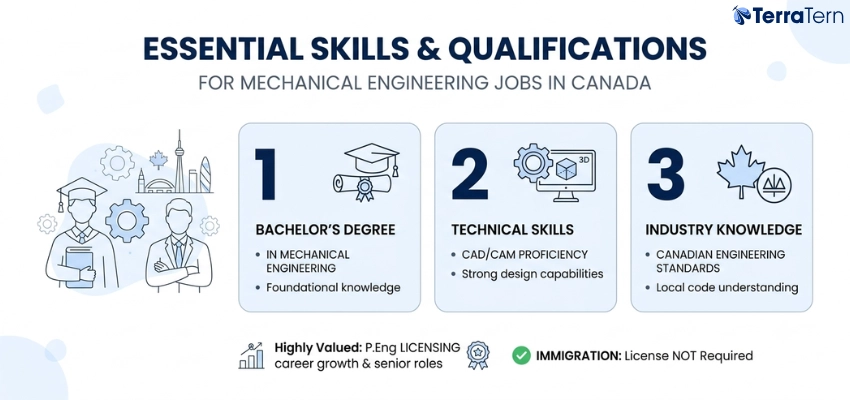
Technical Skills Most Demanded by Canadian Employers
CAD/CAM software: SolidWorks, AutoCAD, CATIA, and Revit.
-
Simulation and analysis: MATLAB, ANSYS, FEA, and CFD modelling.
-
BIM modelling for building systems roles.
-
Thermodynamics, fluid mechanics, and HVAC system design.
-
Project management tools, technical documentation, and reporting.
Soft Skills That Make Indian Engineers Stand Out
Cross-disciplinary collaboration with civil, electrical, and aerospace teams.
-
Strong written and verbal English communication.
-
Problem-solving under regulatory and safety constraints.
-
Adaptability to Canadian workplace culture and standards.
What Is P.Eng Licensing and Do You Need It?
P.Eng means Professional Engineer, regulated by provincial bodies such as PEO, EGBC, and APEGA.
-
It is required to sign off on engineering drawings and reports.
-
Foreign-trained engineers usually need an ECA, provincial assessment, and supervised experience.
-
NOC 21301 does not require a P.Eng for immigration, but employers often prefer it for mid- to senior roles.
-
Start early, because the process can take 1–3 years after arriving in Canada.
Expert Tip: Indian engineers with an ECA completed before arriving in Canada and who begin their P.Eng application within the first year have a significantly faster track to senior roles and higher salaries.
How Can Indian Engineers Get Mechanical Engineering Jobs in Canada with Visa Sponsorship?
Indian professionals can secure mechanical engineering jobs in Canada with visa sponsorship mainly through two pathways: the Labour Market Impact Assessment (LMIA)-based Temporary Foreign Worker Program (TFWP) and the LMIA-exempt International Mobility Program (IMP).
What Is LMIA and How Does It Work for Mechanical Engineers?
An LMIA (Labour Market Impact Assessment) is a document showing that a Canadian employer could not find a qualified Canadian citizen or permanent resident to fill the role.
-
Labour Market Impact Assessment (LMIA): the employer proves that no qualified Canadian candidate is available.
-
Work permit eligibility: a positive LMIA enables an employer-specific work permit for mechanical engineering jobs in Canada with visa sponsorship.
-
Processing timeline: standard LMIA applications take 3 to 5 months, though expedited streams also exist.
-
CRS boost: a positive LMIA adds 50 to 200 Express Entry points.
What Is the LMIA-Exempt Route (IMP/Global Talent Stream)?
For some mechanical engineering jobs in Canada with visa sponsorship, employers can hire foreign professionals without an LMIA through eligible immigration programs.
-
International Mobility Program (IMP): Allows LMIA-exempt hiring where the employment provides significant economic, social, or cultural benefits to Canada.
-
Global Talent Stream (GTS): Eligible STEM employers may receive work permit processing in as little as two weeks for qualifying roles, including certain engineering occupations under Category B.
-
CUSMA (formerly NAFTA): Facilitates work permits for eligible professionals from the United States and Mexico and is relevant for multinational engineering firms operating across North America.
Step-by-Step Process to Find a Sponsored Mechanical Engineering Job in Canada
Create an ATS-friendly Canadian resume that quantifies engineering achievements and follows Canadian formatting standards.
-
Obtain an Educational Credential Assessment (ECA) through organisations such as WES to verify your qualifications.
-
Search for mechanical engineering jobs in Canada with visa sponsorship on Job Bank Canada, LinkedIn, Indeed, and Glassdoor using filters such as "visa sponsorship available."
-
Target employers known to hire international engineers, including Thales, AtkinsRéalis (formerly SNC-Lavalin), Bombardier, Magna International, Fluor, and Stantec.
-
After receiving a job offer, the employer submits the LMIA application if required.
-
Once the LMIA is approved, apply online for a Canadian work permit through IRCC (current fee: CAD 155 plus CAD 85 for biometrics, where applicable).
-
After arriving in Canada, begin the P.Eng. (Professional Engineer) licensing assessment with the provincial engineering regulator to advance your long-term engineering career.
Expert Advice: Don't wait for a job offer to start your ECA, credential assessment from WES takes 7–10 weeks and is required by both employers and IRCC. Complete it before you begin applying.
What Are the Immigration Pathways for Mechanical Engineers to Get Canada PR?
Mechanical engineers in Canada can get PR through Express Entry STEM draws, PNPs, and the Atlantic Immigration Program, with NOC 21301 now included in the STEM category. This gives skilled engineers a targeted route even when general draw scores are higher.
What Is the Express Entry STEM Category for Mechanical Engineers?
Express Entry STEM category
-
In February 2026, NOC 21301 was added to the STEM category list.
-
STEM draws can have lower cut-offs than general draws.
-
You need an active profile under FSWP, CEC, or FST.
-
The main advantage is a more direct path to PR for engineers with moderate CRS scores.
|
Pathway |
Eligibility |
Processing Time |
CRS Needed |
|
Express Entry – FSWP |
Overseas experience, degree, language |
6–12 months |
~491+ in STEM draws |
|
Express Entry – CEC |
1 year of Canadian work experience |
About 6 months |
Lower, since Canadian experience helps |
|
Provincial Nominee Program |
Province-specific job or profile match |
12–18 months |
Not applicable after nomination |
|
Atlantic Immigration Program |
Job offer in the Atlantic provinces |
12–18 months |
Not applicable |
Which PNP Streams Are Best for Mechanical Engineers?
The Ontario Immigrant Nominee Program is useful for engineer-focused profiles.
-
The Alberta Advantage Immigration Program works well for oil and gas engineers.
-
BC PNP is strong for engineering occupations.
-
Manitoba regularly invites engineers with lower CRS scores.
-
A PNP nomination adds 600 CRS points, which usually secures an invitation.
How Does the Canadian Experience Class Work for Engineers?
After 1 year of skilled Canadian work experience, engineers can apply through the CEC.
-
Canadian experience improves CRS and boosts PR chances.
-
A strong strategy is to enter on a work permit, gain experience, and then apply through CEC or PNP.
-
Many mechanical companies in Canada support this route by hiring through work permits first.
Important Tip: The Feb 2026 addition of NOC 21301 to STEM draws is the most significant development for Indian mechanical engineers in years. It opens PR even for those with CRS scores below 500.
How to Apply for Jobs in Canada as a Mechanical Engineer from India?
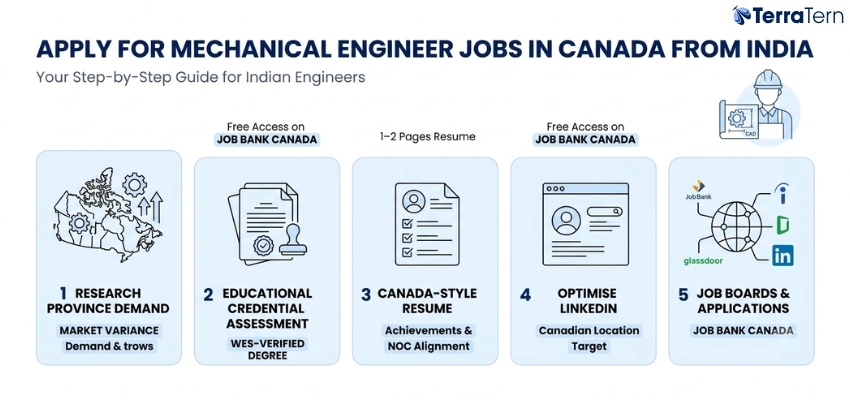
Research the best province first, because demand varies by market and industry.
-
Complete your ECA through WES to verify your degree for Canadian employers.
-
Build a Canada-style resume: 1–2 pages, no photo, no DOB, and clear NOC 21301-aligned achievements.
-
Optimise LinkedIn with Canadian keywords and set your location target to Canada.
-
Apply through Job Bank Canada, Indeed Canada, Glassdoor Canada, LinkedIn, Workopolis, Randstad, and Hays Engineering.
-
Target LMIA-friendly employers like AtkinsRéalis, Bombardier, Thales, Fluor, Stantec, Worley, MDA Space, Westpower, and FuelCell Energy.
-
Network actively and prepare for technical interviews focused on CAD, projects, and safety culture.
Pro Tip: Applying through Job Bank Canada (the government's official job board) is free and gives Indian engineers direct access to LMIA-approved postings, making it the most reliable platform for visa-sponsored roles.
What Is the Scope and Future Outlook for Mechanical Engineering Jobs in Canada?
The outlook is strong through 2033, especially in clean energy, automation, and sustainable infrastructure.
-
Fast-growing areas include hydrogen systems, predictive maintenance, EV powertrains, BIM for green buildings, and nanotechnology.
-
Canada’s net-zero 2050 push is creating more demand for engineers across energy transition projects.
-
AI and automation are changing tools, not replacing engineers, so digital twin and simulation skills matter more.
-
Many mechanical companies in Canada are expanding hiring in renewables, heat pumps, solar, and wind projects.
Key Note: Indian mechanical engineers who invest in upskilling in CFD modelling, digital twin platforms, or hydrogen systems before arriving in Canada will find themselves in the fastest-growing sub-sectors of the job market.
Conclusion
Now, you know everything you need about mechanical engineering jobs in Canada. Mechanical engineering is one of the top fields in the world, and Canada is a leading country in this field. If you want to pursue this career, there are very few countries as good as Canada for mechanical engineering. So, pursue a career in mechanical engineering in Canada today!
For any queries or questions, you can always contact us at TerraTern.