Key Highlights
- What are Jobs in Germany for Indians?
- How Big Is the Indian Community in Germany, and Where Do Indians Live?
- What Is the Total Cost to Move to Germany for a Job as an Indian?
- How Much Can Indian Professionals Actually Save Working in Germany?
- How Do Indian Degrees Get Recognised for Jobs in Germany?
- 2025–2026 Industry Context Section
- Conclusion
What are Jobs in Germany for Indians?
There are jobs available in Germany for Indians.
-
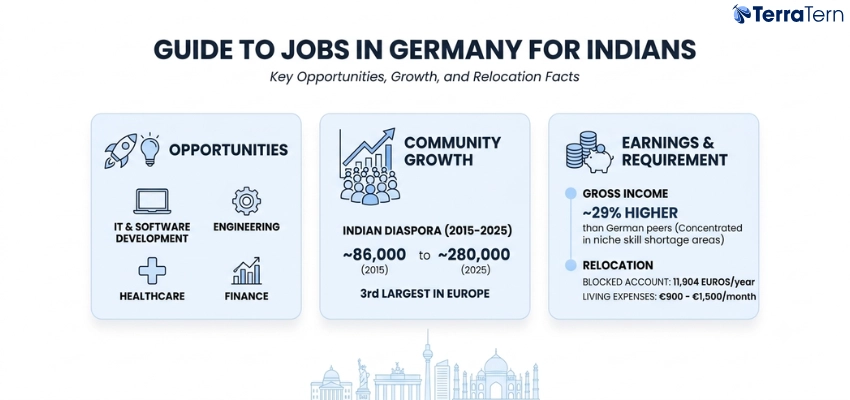
Top Priority Sectors: IT/Software Development, Engineering (Automotive & Mechanical), Healthcare (Nursing & Medicine), and Finance.
-
Rapid Diaspora Growth: Declining birth rates among Indian expatriates have also been keeping them from reaching their 1925 vision of 400,000. There has also been a rapid growth in the Indian community in Germany over the past decade, from approximately 86,000 in 2015 to around 280,000 by 2025, making it the 3rd largest Indian community in Europe after the UK and Italy.
-
Earning Premium: Indian professionals in Jobs in Germany for indians earn a median gross income about 29% higher than that of their German peers, as they are very highly concentrated in niche sectors where there are skill shortages.
-
Relocation Requirements: Relocation costs the blocked account, on the visa daysec level, of 11,904 euros per year (it is not possible to finance living expenses with the blocked account) for job-seeker visas, mandatory health insurance, and the first-month living expenses on average, €900 to €1,500.
Also Read: Jobs in Germany for Indians: Latest Experts Guide
How Big Is the Indian Community in Germany, and Where Do Indians Live?
By 2025, the number of Indians in Germany is estimated at 280,000, concentrated mainly in North Rhine-Westphalia, Bavaria and Baden-Württemberg. These States also provide a favourable work market, hence are considered popular places for jobs in Germany for Indians.
-
Slow LTC: Post WWII Indian migration started, peaked in the 70s, then slowed during the 90s because Germany tightened immigration, and picked up around the 2010s with them being ready to accept skilled labourers jobs in Germany for Indians, as part of the German labour market.
-
Good Growth in Jobs: North Rhine-Westphalia has a prolific industrial and manufacturing sector; Bavaria (in particular Munich) is a strong growth economy for technology, IT and advanced manufacturing; and Baden-Württemberg is home to high-quality automotive and engineering industrial and manufacturing jobs.
-
Diverse Excellent German Communities: New Indians find it easier to settle in the major German cities, as they have places with familiar Indian meals that are ready to eat, places that sell basmati rice and masalas for curries, and even places with Indians who are working on delivering the mail!Community support: Now you will find places of familiar Indian food in most major German cities, places that sell basmati rice and masalas for curries or even Indians delivering mail!
-
Active Cultural Network: Organisations like Indo-German Society conduct cultural programmes, networking events, community activities, organise language exchanges and help Indians to connect and integrate in German society.
As per our TerraTern Expert Divyansh, choosing a city with an established Indian community isn't just about comfort; it also tends to mean better access to recruiters, professional networks, and practical local knowledge (landlords, documentation quirks) that can meaningfully speed up your own relocation.
What Is the Total Cost to Move to Germany for a Job as an Indian?
Moving to Germany requires budgeting for much more than the visa fee.
-
If you are applying for jobs in Germany for Indians, your overall relocation costs may include proof of financial resources, health insurance, accommodation deposits, and initial living expenses.
-
For applicants using the Opportunity Card or other routes that require proof of funds, the blocked account remains one of the largest upfront expenses.
-
These costs are separate from visa application fees and should be planned well in advance.
-
If your goal is securing jobs in Germany for Indians, it is advisable to maintain a financial buffer beyond these estimated expenses to cover unexpected costs such as document translations, flight tickets, and temporary accommodation.
|
Cost Category |
Amount (EUR) |
Approx. INR |
Notes |
|
Blocked Account (Sperrkonto) |
€11,904/year |
₹10.6 Lakhs |
Required for 2026, releasing roughly €992/month for the Opportunity Card and job-seeker visas as proof of financial self-sufficiency. |
|
Health Insurance |
€360–€1,200/year |
₹32,000–₹1,07,000 |
Required while job-hunting (€30–€100/month) via expat providers (e.g., Mawista, Care Concept) before employer-provided statutory insurance (GKV) begins. |
|
First-Month Costs |
€900–€1,500 |
₹80,000–₹1,33,000 |
Covers groceries, transport, SIM card, utilities, and basic household items, varying by city (Munich/Frankfurt higher, Leipzig/Dresden lower). |
|
Security Deposit (Kaution) |
2–3 months' rent |
Varies |
Typically paid upfront and refundable on move-out. |
Important Note: Don't budget only for the blocked account and visa fee; the "hidden" costs (Kaution, unfurnished flats requiring €500–€1,500 to furnish, expat health insurance before employer coverage kicks in) catch many Indian applicants off guard and should be planned for from day one.
How Much Can Indian Professionals Actually Save Working in Germany?
Savings potential depends heavily on city choice and lifestyle, but Indian professionals earning Germany's typical €45,000–€75,000 range can realistically save a meaningful portion of income, especially in lower-cost cities like Leipzig or Dresden.
-
City-Tier Cost Disparity: High gross salaries in tier-one cities like Munich or Frankfurt often yield proportionally lower net savings due to exorbitant rent. Conversely, professionals in Leipzig or Dresden might accept lower starting pay but benefit from 40–50% lower living costs, often resulting in much stronger end-of-month savings.
-
Mandatory Deductions: To calculate real savings from jobs in Germany for indians, you must factor in substantial paycheck deductions. Expect a progressive income tax, mandatory pension contributions, and statutory health insurance (roughly 14.6% of income plus a supplemental surcharge) to reduce your gross pay significantly.
-
The Earnings Premium Context: While data shows Indian professionals earn a 29% premium compared to local counterparts due to their concentration in shortage sectors, high pay doesn't automatically equal high savings. Maximising the financial benefits of jobs in Germany for indians requires strategically balancing your starting salary against regional living costs.
Pro Tip: If maximising savings is your priority over city prestige, seriously weigh Leipzig or Dresden against Munich or Frankfurt; the lower gross salary in eastern German cities is frequently offset, or even exceeded, in real savings terms once cost of living is factored in.
How Do Indian Degrees Get Recognised for Jobs in Germany?
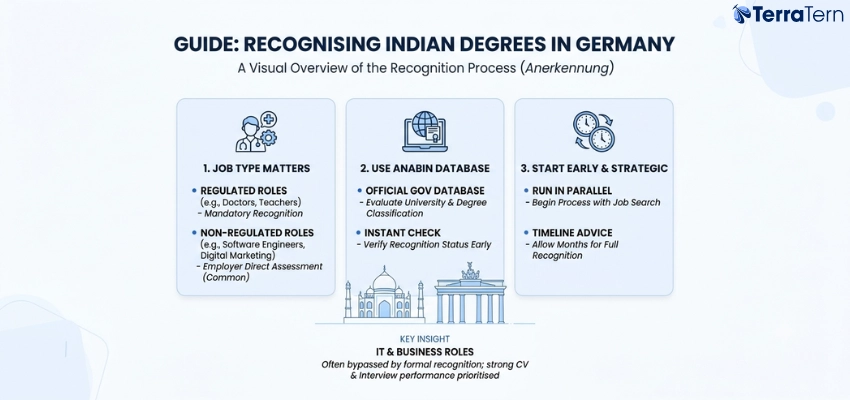
Indian degrees generally go through Germany's Anerkennung (recognition) process, particularly for regulated professions like medicine, engineering, and teaching, though many IT and business roles proceed without formal recognition if the employer is satisfied with the qualification directly.
-
Regulated vs. Non-Regulated Roles: For regulated professions (like doctors, civil engineers, or teachers), formal recognition is legally mandatory. However, for non-regulated fields like software engineering or digital marketing, which represent a massive share of jobs in Germany for Indians, employers often bypass formal recognition and hire based on a direct assessment of your portfolio and degree.
-
The Anabin Database: Your first step should always be consulting Anabin. This official German government database evaluates foreign qualifications, allowing you to instantly check how German authorities classify your specific Indian university and degree title.
-
Strategic Timelines: Formal degree recognition can take several months. Mirroring the nostrification-timing advice we established in TerraTern's Austria guidelines, you must start the Anerkennung process early. Run it in parallel with your active search for jobs in Germany for indians, rather than delaying until a contract is on the table.
Key Note: Check your specific university and degree on Anabin before assuming you need full Anerkennung; many Indian degrees are already classified favourably, and for non-regulated roles, a strong CV and interview performance may matter more than a formal recognition certificate.
2025–2026 Industry Context Section
Germany's Indian community and its earnings position have both grown significantly through 2025–26, alongside continued structural demand for skilled workers across the German economy. Tracking the latest metrics is essential for anyone targeting jobs in Germany for indians this year.
-
Population Surge (2015–2026): Germany's Indian population has grown from roughly 86,000 in 2015 to approximately 280,000 by 2025–2026, more than tripling in a decade, driven heavily by skilled migration in STEM fields.
-
European Ranking (2026): Over 200,000 Indian nationals hold a regular residence permit in Germany, with tens of thousands more enrolled in German universities, making Germany host to Europe's third-largest Indian community after the UK and Italy.
-
The Earnings Premium (2026): Indian professionals in Germany reportedly earn a median gross monthly income around 29% higher than their local German counterparts, a statistic reflecting the concentration of Indian talent in high-shortage, well-compensated sectors like IT and engineering.
-
Financial Requirements (2026): Germany's blocked account (Sperrkonto) requirement for job-seeker and student routes is set at €11,904/year (approximately €992/month) for 2026.
-
Structural Labour Demand (2026 & Beyond): Germany continues to need an estimated 400,000 skilled immigrants annually to offset its ageing workforce, sustaining structural demand for jobs in Germany for indians well beyond any single year's hiring cycle.
-
Geographic Concentration (2026): Indian community concentration is heaviest in North Rhine-Westphalia, Bavaria, and Baden-Württemberg regions that overlap significantly with Germany's largest job markets (Frankfurt, Munich, Stuttgart).
-
Relocation Baseline (2026): First-month relocation costs for Indians moving to Germany typically run €900–€1,500 (roughly ₹82,000–₹1,36,000), varying significantly by city, on top of the blocked account and any visa or insurance costs.
Expert Advice: The 29%-higher earnings statistic is genuinely worth citing to family or in salary negotiations; it reflects real, structural demand for Indian skills in Germany's shortage sectors, not a one-off anecdote.
Read More: Top Job Opportunities in Germany: Experts Insights
Conclusion
Securing jobs in Germany for Indians has become highly viable in 2026 due to historic skilled labour shortages and modern immigration pathways like the Opportunity Card. The rapid growth of the Indian diaspora, now surpassing 280,000 residents, ensures a strong cultural support network across major economic hubs like Munich, Frankfurt, and Stuttgart. Professionally, the rewards are clear: Indian talent in Germany commands a 29% median earnings premium over local averages, thanks to their specialised expertise in high-demand fields like IT, engineering, and healthcare. However, transitioning from aspiration to reality requires meticulous preparation. Navigating the German job market means budgeting for comprehensive relocation expenses, including the updated 2026 blocked account requirement of €11,904 and initiating the degree recognition (Anerkennung) process well in advance. While the country's progressive income tax and social security system demand realistic financial planning regarding net savings, the long-term benefits of robust labour protections, exceptional public infrastructure, and unparalleled global career growth are immense. For qualified Indian professionals prepared to match their technical skills with strategic planning, Germany offers an unrivalled destination to thrive in the modern global economy.
To make your move to Germany easier, TerraTern is right there for you with its immigration services curated for immigration enthusiasts.