


Key Highlights
- What are the Top 10 Job in Europe for Indian Freshers in 2026?
- What Makes Europe a Top Destination for Indian Freshers in 2026?
- Why Is 2026 the Best Year to Find a Job in Europe for Indian Freshers?
- Which European Countries Offer the Best Jobs in Europe for Indian Freshers?
- What Are the Best Jobs in Europe for Indians with Visa Sponsorship in 2026?
- How Can Indian Freshers Find Free Recruitment Jobs in Europe?
- Best Job Portals for Indian Freshers
- What Are the Visa Requirements for Jobs in Europe for Indian Freshers in 2026?
- What Is the EU Blue Card, and Can Indian Freshers Apply?
- Germany vs Ireland vs Netherlands: Which Is Best?
- What Salary Can Indian Freshers Expect from Jobs in Europe in 2026?
- How Can Indian Freshers Apply for Jobs in Europe Step-by-Step in 2026?
- Common Mistakes Indian Freshers Make
- What Skills Do Indian Freshers Need for Jobs in Europe in 2026?
- Companies Hiring International Freshers
- What Challenges Do Indian Freshers Face When Seeking Jobs in Europe in 2026?
- Top Certifications That Increase Hiring Chances
- How Can TerraTern Help You Find a Job in Europe for an Indian Fresher?
- Your Gateway to Europe: Why 2026 is the Year for Indian Job Seekers?
- 2026 Industry Context Section
- Conclusion
By 2026, Job in Europe for Indian fresher can have on their sights booming industries in other friendly countries such as Germany, Ireland, the Netherlands and Poland, where skilled immigration acts and EU Blue Cards simplify entry-level work with a visa. Begin with a short EU-style resume, focusing on credentials on sites such as Coursera or Google, and submit applications through EURES, LinkedIn, or company websites as you develop language proficiency (e.g. German B1 in career-relevant fields) and develop contacts to obtain sponsorship.
Find employment opportunities to expedite work permits (4-6 weeks to process), get health insurance and accommodations, and cash in on high-demand sectors such as software development or nursing with salaries starting at €30,000-45,000 a year and making ambitious opportunities a reality in Europe due to talent shortages.
What are the Top 10 Job in Europe for Indian Freshers in 2026?
India offers strong potential for fresh graduates in Europe's high-demand sectors, such as IT, healthcare, and engineering, in 2026, driven by labour shortages and visa pathways, including the EU Blue Card and Opportunity Card.
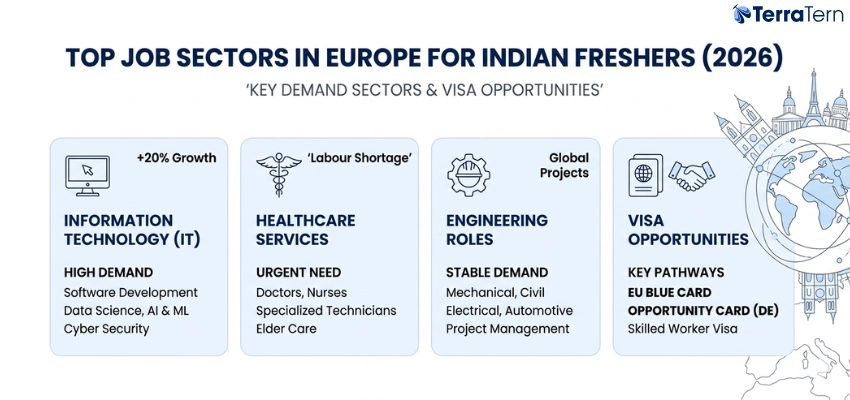
Top 10 Jobs in Europe for Indian Freshers:
|
Rank |
Job Role |
Key Countries |
Avg Starting Salary (€/month) |
Visa Sponsorship Notes ​ |
|
1 |
Software Developer |
Germany, Ireland, Netherlands |
3,200- 4,800 |
EU Blue Card for €50k+ roles; high demand in tech hubs ​ |
|
2 |
Data Analyst/Scientist |
Netherlands, Germany, Ireland |
3,200- 4,500 |
Skills lists qualify freshers; English sufficient ​ |
|
3 |
Registered Nurse |
Germany, Ireland |
3,000- 4,500 |
Skilled Immigration Act; credential recognition needed ​ |
|
4 |
Mechanical Engineer |
Germany, Netherlands |
3,200- 4,800 |
Opportunity Card; internships boost entry ​ |
|
5 |
Cybersecurity Specialist |
Germany, Sweden |
3,500- 5,500 |
Shortage occupations; EU-wide demand ​ |
|
6 |
Cloud Architect/Engineer |
Ireland, Netherlands |
4,000- 6,000 |
Highly Skilled Migrant Visa; remote options ​ |
|
7 |
AI/ML Specialist |
Germany, Finland |
4,000- 6,500 |
Booming digital transformation; fresher programs ​​ |
|
8 |
Healthcare Assistant |
Germany, Poland |
2,200- 3,200 |
Fast-track for caregivers amid aging population ​ |
|
9 |
Logistics/Warehouse Op |
Poland, Germany |
1,800- 3,000 |
Easy work permits; entry-level with job offer ​ |
|
10 |
Renewable Energy Tech |
Germany, Denmark |
3,000- 4,500 |
Green energy push; engineering freshers qualify ​ |
Target EURES and LinkedIn for applications; basic English/German aids success.
Also Read: Top Europe Job Consultancy in India: Experts List
What Makes Europe a Top Destination for Indian Freshers in 2026?
Indian freshers prefer Europe as:
-
Higher starting salaries than India
-
Strong work-life balance
-
Long-term PR pathways
-
Employer-sponsored visas
-
English-speaking opportunities
Salary Comparison
|
Country |
Average Fresher Salary (EUR) |
|
Germany |
35,000- 50,000 |
|
Netherlands |
35,000- 48,000 |
|
Ireland |
35,000- 55,000 |
|
Sweden |
32,000- 45,000 |
|
India |
INR 4-8 lakh |
Why Is 2026 the Best Year to Find a Job in Europe for Indian Freshers?
2026 is a good year in which to find a job in Europe for Indian Fresher, as there is an acute shortage of labour, policy changes and expansion of sectors that are friendly to entry-level talent.
|
Reason |
Key Details |
Impact on Indian Freshers |
|
Severe Labour Shortages |
More than 800,000 jobs are available in Germany; unemployment in the EU is at a 5.9% low. |
IT, healthcare, and logistics hiring has no experience requirements. |
|
Immigration Reforms |
The visas are made easier in Germany in the Opportunity Card and Skilled Act; Poland gives fast tracks. |
Fewer entry barriers, sponsorship, and PR in 3-5 years for new graduates. |
|
Economic Growth Surge |
Infrastructure, rebuilding Ukraine; Ukraine requires employees. |
The lowest-level jobs in the construction industry, renewable, pay between €800 and 1,800. |
|
Aging Population |
Reducing the local labour force due to low birth rates and the need for caregiving. |
Emphasises flexible Indian talent that is trained. |
|
Tech & Sector Boom |
IT and engineering growth in Ireland and the Netherlands. |
Newer-friendly occupations that give variations to English proficiency rather than higher learning. |
Advice by our Expert: The combination of Germany's Opportunity Card, expanded EU Blue Card eligibility, and 400,000+ unfilled vacancies makes 2026 historically significant for Indian freshers—delaying your job search could mean missing a peak opportunity.
Which European Countries Offer the Best Jobs in Europe for Indian Freshers?
Germany, Ireland and the Netherlands offer the best jobs in Europe for indian fresher due to the lack of labour and availability of an accessible visa.
|
Country |
Top Jobs for Freshers |
Avg Starting Salary (€/month) |
Key Visa Advantages |
Language Requirement |
|
Germany |
Engineering, IT, Nursing |
3,000- 4,500 |
Skilled Immigration Act, Opportunity Card. |
English + German preferred |
|
Ireland |
IT Support, Fintech, Teaching |
3,000- 4,500 |
Quick work, English speaking permits ​ |
English |
|
Netherlands |
Tech, Logistics, Engineering |
3,200- 4,800 |
Highly skilled migrant visa, EU blue card. |
English |
|
Poland |
Logistics, Manufacturing |
1,800- 3,000 |
Sponsorship: easy-breezy, cheap living. ​ |
English |
|
Sweden |
IT, Engineering |
3,500- 5,000 |
Skilled freshers' work permits. |
English |
Why Is Germany the Top Destination for Indian Freshers Seeking Jobs in Europe?
- Indian freshers are most likely to go to work in Germany, where the country has 1.8 million vacancies in IT, engineering and healthcare due to skills shortage.
- Streamlined Skilled Immigration Act and Opportunity Card allow job seeker visas with no offers to expedite the EU Blue Card and PR.
- The Austbildung programs are paid training, with starting salaries reaching up to 2,500-3,500 a month, with the value of Indian skills and English in the first place.
What Makes the Netherlands Attractive for Jobs in Europe for Indian Freshers?
- Indian freshers are being attracted to the Netherlands with 100,000+ vacancies in IT, logistics and engineering, among labour shortages.
- Highly Skilled Migrant Visa provides rapid sponsorship of graduates with annual incomes of at least 2800+ and avenues to PR through the EU Blue Card.
- English hegemony in multinationals such as Philips and ASML is fresher-friendly; pro migrant reforms open flowing industries to ITI/ diploma holders.
- It is ideal because of high salaries (4500 to 5000), work-life balance and easy entry.
Why Should Indian Freshers Consider Ireland for Entry-Level Jobs in Europe?
- On top of this, Ireland is the best place where Indian freshers can find an English-speaking environment and tech boom in Dublin, which hosts giants such as Google and Accenture.
- The number of entry-level IT, finance, and support positions is also high, with salaries of between €35,000 and €49,500 per year and fast Critical Skills Employment Permits when graduating.
- There are no language barriers, colourful job markets and a post-study work visa, which allows smooth transitions between studies and careers.
Are Jobs in Poland and Romania Good Options for Indian Freshers?
Indian Fresher can find good opportunities in Europe, although the entry-level jobs available in Poland and Romania are limited.
-
Poland: 100,000+ IT, logistics, manufacturing jobs vacancies; unskilled jobs, such as warehouse (€1,0001500/month) with sponsorship, low prices.
-
Romania: Rising IT, construction business, fast work permits, pay starting at €800 1200, English-friendly in Bucharest.
Perfect for beginners, but with lower wages than Western Europe, access to mobility within the EU.
How Do Sweden and Denmark Compare for Fresh Graduate Jobs in Europe?
Both Sweden and Denmark present a good opportunity to fresh graduates, yet Denmark leads in terms of lower unemployment and accelerated employment.
|
Aspect |
Sweden |
Denmark |
|
Job Market |
500,000 and more jobs in IT, engineering; 7.4-10% unemployment rate. |
Good tech, renewable demand; 2.9% unemployment |
|
Entry Salaries (€) |
€3,000–€4,500 monthly (SEK 500k–800k/year) |
€3,300–€4,500 monthly (DKK 40k–63k/year) |
|
Visa Ease |
Skilled grads work permits; English OK |
Quick sponsorship Positive List visas. |
|
Key Sectors |
IT, health, sustainability. |
IT, engineering, green energy |
|
Fresher Appeal |
Home and work; increased competition |
Greater accessibility, good living standards. |
Key Note: Germany should be your primary target due to the Opportunity Card and massive IT shortages, but Ireland offers the path of least resistance for English-only speakers seeking tech roles.
Top European Cities Hiring Indian Freshers
|
City |
Country |
Major Industries |
|
Berlin |
Germany |
Tech, Startups |
|
Munich |
Germany |
Engineering |
|
Dublin |
Ireland |
Technology |
|
Amsterdam |
Netherlands |
IT, Finance |
|
Rotterdam |
Netherlands |
Logistics |
What Are the Best Jobs in Europe for Indians with Visa Sponsorship in 2026?
A job in Europe for Indian Fresher is sponsored on a visa in Germany, the Netherlands, and Ireland, and occupies positions in IT engineering and healthcare. Here are the Jobs in Europe for Indians with visa sponsorship:

|
Job Role |
Key Countries |
Avg Salary (€/month) |
Visa Type |
|
Software Developer |
Germany, Ireland, Netherlands. |
3,200- 4,800 |
EU Blue Card, Critical Skills ​ |
|
Nurse/Caregiver |
Germany, Ireland |
3,000- 4,500 |
Skilled Immigration Act ​ |
|
Data Analyst |
Netherlands, Ireland |
3,200- 4,500 |
Highly Skilled Migrant ​ |
|
Logistics/Warehouse |
Poland, Germany |
1,800- 3,000 |
Work Permit ​ |
|
Mechanical Engineer |
Germany, Netherlands |
3,200- 4,800 |
Opportunity Card ​ |
Siemens, Accenture, and Amazon are some of the firms that sponsor freshers during labour shortages. Either English proficiency facilitates applications through portals such as EURES.
Why Are IT and Software Jobs in Europe Most Accessible for Indian Freshers?
The leading jobs in Europe where Indian Fresher will find the highest accessibility are IT and software jobs because of the acute shortages- more than 1 million jobs as a result of digital transformation, and India excels in the STEM talent pool.
|
Factor |
Details for Indian Freshers |
|
High Demand |
IT openings have increased 43 per cent; 30 percent+ companies employ devs. |
|
English Sufficiency |
Tech hubs (Ireland, Netherlands) speak English; there was no local language required at first. |
|
Visa Sponsorship |
EU Blue Card for positions of 50k and above; freshers receive it through lists of skills. |
|
Low Experience Barrier |
No more than a basic knowledge of Python /Java, and multinationals, such as Google, sponsor graduates. |
Salaries €2,800–€4,000/month, easy entry.
What Healthcare Jobs in Europe Offer Visa Sponsorship for Indian Freshers?
European health care opportunities which provide visa sponsorship to Indian freshers are primarily in the nursing and care-giving fields due to shortages in other countries such as the UK, Germany, Ireland, and Luxembourg. The job requirements include a degree (e.g. GNM/B.Sc.), awareness of English and, in some cases, elementary local language skills; freshers with internship experience can also be sponsored under employer-sponsored skilled worker visas.
The best alternative would be the NHS nursing jobs in the UK (starting at £40k) and full sponsorship, relocation, and a salary of between £ 50k and 70k-70k in Luxembourg. Germany and Ireland are also on the hunt for entry-level care assistants. Applications through Check NHS Jobs, EURES or consultancies.
Which Engineering Roles in Europe Sponsor Visas for Indian Freshers?
The number of engineering jobs in Europe that are sponsored by a visa for Indian freshers is scarce, whereas in software, IT support, QA, and electronics engineering, there is a lack of workers, and the sponsors intend to hire freshers. Germany has an EU Blue Card for skilled positions through sites such as englishes jobs.de and arbeitnow.com; the UK offers Skilled Worker visas to graduate engineers in companies like Sulzer and Siemens.
Entry-level technological engineering is listed under the Critical Skills of Ireland. They require a bachelor's degree, proficiency in English and internships; apply on Indeed, LinkedIn and EURES. Salaries start at €40k-50k-50k.
Are There Finance and Business Jobs in Europe for Indian Fresh Graduates?
Europe has limited business and finance employment opportunities for Indian fresh graduates sponsored on a visa, since the country tends to employ only experienced employees. Luxembourg has few entry-level opportunities, such as fund accountants or fund analysts at banks (J.P. Morgan, BNP Paribas), available on the EU Blue Card; a degree and English/French language skills are required; salary up to 60k. Barclays graduate programs in the UK take a business/finance track sponsorship. A small number of these are listed by the Netherlands and Germany through LinkedIn/Arbeitnow. Strong academics/internships required of Freshers; apply on Indeed/EURES.
What Unskilled and Semi-Skilled Jobs in Europe Sponsor Indian Freshers?
European jobs in skilled and semi-skilled sectors that sponsor visas for Indian freshers revolve around the deficit of labour in the fields of the warehouse, agriculture and hospitality. Other countries such as Germany, Poland, Spain and Ireland have seasonal permits or work permits which require a job offer and minimum skills.
|
Job Type |
Countries |
Salary Range (€/month) |
Requirements |
|
Warehouse Packer |
Germany, Poland |
1,800- 2,800 |
Job offer, passport ​ |
|
Farm Picking |
Ireland, Spain |
1,500- 2,500 |
Seasonal permit, fitness ​ |
|
Factory Assembly |
Romania, Italy |
1,600- 2,800 |
Basic training ​ |
|
Cleaning/Hotel |
Luxembourg, Finland |
2,000- 3,500 |
Language basics ​ |
Key Note: IT and software roles remain the fastest pathway due to high demand and English-friendly environments, but healthcare offers exceptional job security for freshers willing to meet language requirements.
How Can Indian Freshers Find Free Recruitment Jobs in Europe?
By considering reputable free and no-fee websites rather than the paid ones, Indian freshers can get themselves a free Job in Europe for Indian Fresher with regards to recruitment. Take simple measures and be cautious of fraud.
Official European Portals Should be Used
-
Register in EURES and European job days free of charge to vacancies across countries and direct recruitment by trusted employers.
-
Eurojobs and Europass offer internships, entry-level positions and visa-sponsoring positions by category and country.
Target Job Boards are Graduate-Oriented
-
Establish profiles on Graduateland and JobTeaser, the two graduate recruitment leaders and university-style recruitment in Europe.
-
Create email notifications of entry-level, graduate programme and visa sponsorship so that you can get complimentary targeted jobs.
Optimise CV and Filters
-
Combine an ATS-friendly Europass CV in English and give it a slight modification to suit each application.
-
Search filters such as relocation support, work permit support or visa sponsorship on the major job boards and company career pages.
Avoid Paid Agents and Scams
-
NO recruiter should require registration fees, processing fees, or offer-letter fees; real-life employers and government portals never charge job seekers.
-
Check the names of companies on LinkedIn and official websites before submitting documents or taking interviews.
What Is EURES, and How Can Indian Freshers Use It for Free Jobs in Europe?
The EURES portal is the European Employment Services portal, which is a free network in the EU connecting jobseekers with verifiable vacancies in 31 countries (EU/EEA + Switzerland). It provides millions of search results, job search, resume applications, lifestyle/work information, and advisory services- free to users.
-
Register free at eures. Europa.eu, prepare a Europass CV, and choose a preference for entry-level/visa-sponsoring jobs.
-
Filter with visa sponsorship or relocation, and apply to a virtual job fair.
-
Use non-EU advice EURES advisers; in the shortages lists, freshers are aimed at unskilled/semi-skilled vacancies.
Which Job Portals Offer Free Listings for Jobs in Europe for Indian Freshers?
A number of free portals can allow Indian freshers to access European jobs without incurring agent fees and listing fees. Target big, reputable and graduate-friendly sites.
Main free European portals
-
Europass job search verified vacancies in the EU/EEA and Switzerland, EURES (European Job Mobility Portal).
-
Eurojobs.com, EuropeJobs.org, and Europe Language Jobs, where jobs are based in multiple countries, such as entry-level and multilingual jobs.
Graduate-focused job boards
-
Graduateland and JobTeaser are focused on fresh graduates and junior positions in Europe in the field of business, IT, engineering, and so on.
-
Apply with such filters as entry-level, graduate programme and visa sponsorship when using India in the search.
How Can Freshers Access Graduate Programmes at European Companies?
Access to European graduate programmes is done through freshers via specific job boards, company websites and even events. These are 12-24 months structured programmes which provide rotations, training and sponsorship of the best Indian talent.
Key Access Steps
-
Create an account on Graduateland, JobTeaser, and EURES to see graduate-specific vacancies in companies such as Airbus, Arup, and Roche.
-
Post on company careers websites (e.g. Volvo, Nestle, Capgemini) when there is an autumn intake; customise Europass CVs according to specifications.
-
Visit virtual European Job Days fairs and create a graduate programme + filter with visa.
What Are MEA-Licensed Recruitment Agencies for Jobs in Europe?
MEA probably means the Ministry of External Affairs (India)-approved agencies, although there is no single list to indicate the MEA-approved jobs in Europe; Indian companies instead use the Protector of Emigrants (POE)-approved designation. Caution with the scams, use free public portals such as EURES.
Licensed Agencies Recommended
-
Ajeets (India-oriented, POE-approved): Provides unskilled/semi-skilled to Europe (Germany, Poland); no registration fee, employer compensated.
-
Oman Agencies: Recruits to Europe (Italy, Germany); factory/ warehouse manpower.
-
Blu Selection: EU-based on entry-level positions, including relocation.
- Check emigrate.gov.in; do not pay advance payments.
How Can Indian Freshers Avoid Job Scams When Searching for Jobs in Europe?
The best way to avoid European job scams is by checking the sources and disregarding the red flags by Indian freshers.
-
Always use free official portals such as EURES, Europass and company sites- never pay agents an advance fee, processing fee or guarantee fee.
-
Apply to eMigrate.gov.in to check eMigrate MEA/ POE approval; do not follow WhatsApp/ SMS offers without official emails.
-
Check out employers through LinkedIn, Glassdoor, and Google Maps; type into the search engine [company] scam.
-
Suspects of violation of the Protector of Emigrants; justifiable employment should not request a tourist visa or bank documents early.
Advice by our Expert: EURES should be your first stop—it's the EU's official portal with verified listings—and any agency asking for money upfront is almost certainly a scam.
Best Job Portals for Indian Freshers
|
Portal |
Best For |
Free |
Visa Sponsorship Filter |
|
EURES |
EU- wide jobs |
Yes |
Yes |
|
|
Professional roles |
Yes |
Yes |
|
EuroJobs |
Entry- level roles |
Yes |
Yes |
|
Relocate.me |
Tech jobs |
Yes |
Yes |
|
Honeypot |
Developers |
Yes |
Yes |
|
Glassdoor |
Reviews+ jobs |
Yes |
Limited |
What Are the Visa Requirements for Jobs in Europe for Indian Freshers in 2026?
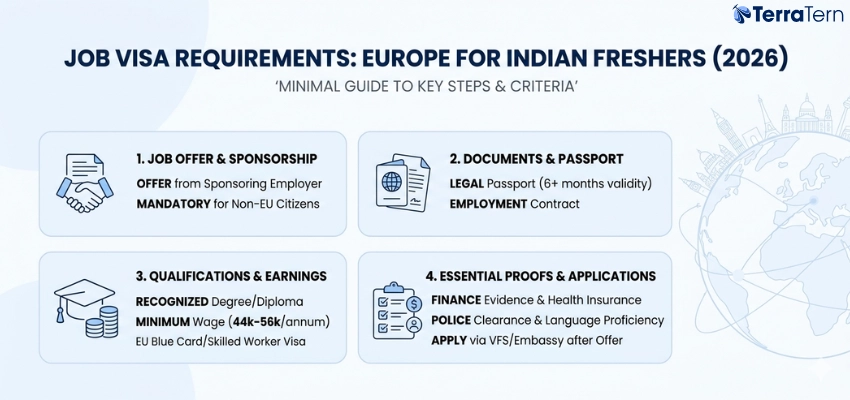
Most of the European work visas require that Indian freshers be offered a job by a sponsoring employer since non-EU citizens are rigidly governed.
-
Legal passport (validity of 6 months and above) and employment contract with a legal employer.
-
Recognised degree/diploma or 5 years or more experience, minimum wage is 44k-56k/annum.
-
Evidence of finances, health insurance, police clearance and language proficiency (English/German).
-
Apply through VFS / embassy after offer; other options, such as EU Blue Card (Germany/Netherlands) or Skilled Worker Visa (UK/Ireland).
Recruitment Target shortage positions through EURES to ensure expediency.
What Is the EU Blue Card, and Can Indian Freshers Apply?
EU Blue Card: This is a residence and working permit for highly skilled non-EU country workers, which is valid in 25 EU countries (except the UK, Ireland, and Denmark). It eases admission of shortage jobs such as IT, engineering and health care, and also provides family reunification and mobility after 18 months.
Eligibility of Indian Freshers.
-
The freshers in India generally do not apply directly, as this needs a known degree (Bachelor's in most cases without equivalent) and a binding employment offer of 1+ year at minimum salary (€43k-56k, less in cases of shortages).
-
New graduates must have 5 years of experience or a Master's, and apply after employment via the embassy.
-
Target Germany/Netherlands through EURES; the processing time is 90 days.
How Does Germany's Opportunity Card Help Indian Freshers Find Jobs?
In 2024, Germany introduced the Opportunity Card (Chancenkarte), which enables skilled non-EU citizens, such as Indian freshers, to enter the country without a job offer to job hunt for up to 1 year. It has a points system (min. 6 points) according to the qualifications, age (less than 35 years), experience (2 years and more), and language (A1 German/B2 English).
-
Part-time work (20 hrs/week) or trial employment and search through EURES/LinkedIn.
-
Move to a work visa/PR once full-time employed in shortages such as IT/engineering.
-
Evidence of finances (1,000/month) and health cover was needed; apply at the German embassy.
What Are Country-Specific Work Visas for Indian Freshers in Europe?
The young Indians experience difficulties in obtaining European work visas because of the employment opportunities conditions, yet there are other sectors of scarcity, such as IT and engineering. Germany has the EU Blue Card (degree + salaries exceeding 45,000 +) and Job Seeker Visa (6-month search). The Highly Skilled Migrant Permit in the Netherlands aims at tech positions with wage levels. The Talent Passport of France is designed to fit a contented freshman in technology (salary of at least €53,000). The paths of remote work are easier in Portugal and Estonia for digital nomads. Always verify via embassies.
What Documents Do Indian Freshers Need for European Work Visas?
These are the most important documents required by Indian freshers to do European work visa; valid passport (6+ months of validity), job/ employment contract by a EU employer, education degrees/ diplomas, demonstration of qualifications/ experience, health/ travel insurance, bank statements with funds, police clearance certificate, and language proficiency testing (i.e. IELTS/TOEFL or German B1). Other included documents are CV, medical examination and visa form. Different countries have different requirements, such as Germany or the Netherlands- check embassies.
How Long Does Visa Processing Take for Jobs in Europe from India?
The processing of a European work visa in India is normally 4-12 weeks, depending on the country and the type. The process of obtaining an EU Blue Card or skilled worker visas takes 6-12 weeks in Germany. In Spain, the permits take between 2 and 5 months in total, with a consulate period of 15-60 days. Highly skilled jobs have an average of 4-8 weeks in the Netherlands and France. Peak seasons (Dec-Jan) have arrears- apply 3 months prior. Check VFS/embassy trackers.
Pro Tip: Germany's Opportunity Card is revolutionary for freshers—it's the only major programme allowing you to search for jobs on European soil without a prior offer, giving you a massive advantage.
Germany vs Ireland vs Netherlands: Which Is Best?
|
Factor |
Germany |
Ireland |
Netherlands |
|
Salary |
35,000- 50,000 |
35,000- 55,000 |
35,000- 48,000 |
|
Language |
Germany helpful |
English |
English |
|
Visa Route |
Opportunity Card |
Critical Skills |
Highly Skilled Migrant |
|
PR Path |
Strong |
Strong |
Strong |
What Salary Can Indian Freshers Expect from Jobs in Europe in 2026?
The entry-level salaries of Job in Europe for Indian Fresher would differ depending on the country and the industry, such as IT, engineering, and healthcare. These are the gross annual figures in euros, which are usually high in shortage occupations.
|
Country |
IT/Engineering (€) |
Healthcare (€) |
Average Monthly (€) |
|
Germany |
38,000- 58,000 |
40,000- 60,000 |
3,200- 4,800 |
|
Netherlands |
40,000- 60,000 |
45,000- 65,000 |
3,400- 5,000 |
|
France |
35,000- 50,000 |
40,000- 60,000 |
3,000- 4,500 |
|
Sweden |
40,000- 60,000 |
45,000- 65,000 |
3,500- 5,000 |
|
Ireland |
40,000- 65,000 |
42,000- 70,000 |
3,500- 5,500 |
How Do Entry-Level Salaries in Europe Compare to India?
In Europe, freshers earn considerably more than in India because the economies are stronger, and skills are scarce, with entry-level salaries 5-10 times the purchasing power parity levels.
|
Country/Region |
Annual Gross (€/INR equiv.) |
India Entry-Level (INR) |
Ratio (Europe: India) |
|
Germany |
38,000- 58,000 (INR 36-55 lakh) |
4-8 lakh |
5-9x |
|
Netherlands |
40,000- 60,000 (INR 38-57 lakh) |
4-8 lakh |
5-10z |
|
France |
35,000- 50,000 (INR 33-48 lakh) |
4-8 lakh |
4-8x |
|
Average Europe |
38,000- 58,000 (INR 36-55 lakh) |
5 lakh average |
7-10x |
Europe has superior benefits, such as healthcare, which subsidises the high living expenses.
What Are IT Fresher Salaries Across European Countries?
The salaries of IT fresher in Europe differ depending on the country, with Switzerland and Ireland leading in terms of higher remuneration. The unskilled positions (0-2 years experience) usually vary between 30 and 000-50,000 gross yearly, keeping cost of living.
|
Country |
Salary Range (€) |
Avg. Monthly (€) |
|
Switzerland |
60,000- 85,000 |
5,000- 7,100 |
|
Ireland |
40,000- 65,000 |
3,500- 5,500 |
|
Germany |
38,000- 58,000 |
3,200- 4,800 |
|
Netherlands |
40,000- 60,000 |
3,400- 5,000 |
|
Sweden |
40,000- 60,000 |
3,500- 5,000 |
|
France |
35,000- 50,000 |
3,000- 4,500 |
Aspects such as skills (e.g. Python, Java) escalate compensation; taxes eradicate net by 30-40%.
What Benefits Do European Employers Offer Beyond Salary?
Compensation in the form of benefits besides salary is extensive and is required by law, and is made competitive by European employers. These include 25 and up to paid vacation days, health insurance, pensions, and parental leave.
-
Health & Wellness: Mandatory health insurance, gymnastics, mental health assistance, sick days (e.g. full pay 77 days in Luxembourg).
-
Work-Life Balance: Flexible working hours, work-from-home (France), 8% leave of paid holidays (Netherlands).
-
Monetary Benefits: Bonuses, stock options, transport allowances and meal vouchers.
-
Development: Training budgets, work development.
Such benefits tend to supersede increased US wages for freshers.
How Much Can Indian Freshers Save from European Salaries?
Indian freshers in Europe will be able to save on taxes and living expenses of between 800 and 1,800 Euros monthly, which is much higher than in India, as the salaries are better.
Savings (IT Fresher, Annual Gross saving of $40,000)
|
Country |
Net Monthly (€) |
Living Costs (€) |
Monthly Savings (€) |
|
Germany |
2,500- 3,500 |
1,300- 2,000 |
1,000- 1,800 |
|
Netherlands |
2,700- 3,800 |
1,500- 2,300 |
1,000- 1,800 |
|
France |
2,300- 3,300 |
1,400- 2,100 |
800- 1,500 |
|
Sweden |
2,600- 3,700 |
1,400- 2,000 |
1,000- 1,800 |
Remittance to India produces 5-8 times the value upon conversion.
Key Note: Focus on net salary, not gross—Germany's higher tax rate means a €60,000 gross salary yields similar take-home pay to a €50,000 salary in lower-tax countries like Ireland.
How Can Indian Freshers Apply for Jobs in Europe Step-by-Step in 2026?
Indian freshers have a formal way of getting a Job in Europe, for Indian Fresher in the form of IT/engineering-based jobs under visa sponsorship. Use platform-specific applications such as LinkedIn and EURES.
Application Guide- Step by Step.
-
Research Markets: Concentrate on shortage areas in Germany, the Netherlands and Ireland in IT and engineering; verify visa regulations on official websites.
-
Optimise Profile: Build LinkedIn (open to work set); create Europass CV (1-2 pages, skills-focused, photo required in Germany/ France).
-
Earn Certifications/Skills: B1 English/German; Python, AWS certification through Udemy/Google.
-
Strategic Application: LinkedIn, Indeed, EURES, company websites, 5-10 applications per day, cold email, HR customised cover letters.
-
Networking: Participate in LinkedIn groups; study online evaluations/technically oriented interviews.
-
Secure Offer and Visa: Get work contract; employer finances work permit (e.g. EU Blue Card); send papers through VFS / embassy (4-12 weeks).
-
Move: Find a place to live/insurance; follow up on Excel.
Step 1: How Should Indian Freshers Research the European Job Market?
The marketing approach that Indian freshers should take to explore the European job market is to focus on high-need areas such as IT, engineering, and healthcare in such countries as Germany, the Netherlands and Ireland. Get the right insights using official portals and tools.
-
Find Shortage Areas: Research the EURES portal and national (e.g., Make it in Germany) sites (ex, Visa-sponsored positions required); target IT ( Python, AWS ) and Ausbildung (training initiatives).
-
Examine Job Portals: Search LinkedIn, Indeed. Eu, Relocate.me, and Glassdoor to find entry-level posts; select visa sponsorship and record salary scales (50k- 30k).
-
Visa Regulations to study: Check embassy websites on work permits (e.g. EU Blue Card needs degree + work offer); monitor labour shortages using OECD reports.
-
Network: Join LinkedIn groups (Indians in Germany) and Reddit (r/cscareerquestionsEU), and also participate in virtual job fairs such as TechJobs Fair.
Monitor the progress made in a spreadsheet within 2-4 weeks to apply.
Step 2: How to Adapt Your CV for Jobs in Europe as an Indian Fresher?
Indian freshers have to conform to European standards of CVs: concise (1-2 pages), skills-oriented, and ATS-compliant, as opposed to detailed Indian ones. Standardise with the use of the Europass template.
-
Format Basics: Chronological (reverse order); using clear fonts (Arial 10-12pt); sections: Contact (name, phone+code, LinkedIn, nationality, no photo except Germany/France), Summary, Experience, Education, Skills, Languages.
-
Customise Content: Measure results (e.g. 20 per cent code efficiency improvement); reference actual projects/internships; include EU-accepted certifications (AWS, Python). No details about personal experience, such as age/marital status.
-
Per Country Customise: Germany- elaborate duties; Netherlands- brief skills; add visa eligibility note. Proofread; apply such tools as Europa ss.eu.
Test with Jobscan for ATS.
Step 3: How to Optimise LinkedIn for European Job Search?
LinkedIn is maximised by Indian freshers, who have a profile made recruiter-friendly, rich in keywords, and Europe-oriented, to enhance their visibility in searches.
-
Headline and Photo: Use a catchy headline such as: IT Fresher | Python Developer Open to Germany/Netherlands | Visa Eligible; include a professional photo ( smart clothing, plain backdrop).
-
Approach: 3-5 paragraphs (e.g. skills, e.g. AWS, Java), project, relocation preparedness; use keywords such as EU Blue Card, remote Europe.
-
Experience & Skills: List internship/projects with metrics; add 50 skills (top 5 endorsed); receive endorsements through contact.
-
Location & Network: Choose a location target city (e.g., Berlin); turn on Open to Work (recruiters only); match 50 or more Europeans each week with personalised notes.
-
Action: Posts weekly (job insights), commenting on EU tech posts, groups, such as Indians in Germany Jobs.
- Goal: to become an All-Star; monitor views per week.
Step 4: Where Should Indian Freshers Apply for Jobs in Europe?
Germany, the Netherlands, and Ireland are the entry-level IT/engineering work destinations of the Indian freshers because they have a shortage of skills and provide favourable English-speaking environments.
-
Germany: IT centres (Berlin, Munich); EU blue card with salary over 45k; Make it in Germany, StepStone.
-
Netherlands: Tech Amsterdam; Highly Skilled migrant visa; LinkedIn, Undutchables.
-
Ireland: Dublin tech (Google, Meta); Critical Skills Permit; Jobs.ie, IrishJobs.
-
Agencies: EURES (EU-wide, sponsorship filters), Relocate.me, Indeed.eu (50+ apps/week).
Target visa sponsors; follow-up spreadsheet.
Also Read: The EU's Bold Step: Facilitating Migrants to Work and Live in Europe
Step 5: How Should Indian Freshers Prepare for European Job Interviews?
Indian freshers are training to be interviewed in Europe, with preferences being on multi-stage approaches (HR screen, coding tests, technical, behavioural, team fit), technical depth, product mindset and cultural fit. Training: through LeetCode, mock interviewing on Pramp.
-
Research Company & Role: Research JD, company tech stack (e.g., React in the Netherlands), news; write STAR stories to use on behavioural questions, such as why Europe? Or "Team conflict?"
-
Technical Mastery: Crack 200+ LeetCode mediums (trees, arrays); develop projects on GitHub; anticipate 4-6 hour take-homes, pair programming. Review Agile, KPIs.
-
Mock Practice: Interviewing.io; the practice 3-4 rounds; emphasise visa eligibility, relocation readiness. Wear business casual clothes when on video calls.
-
Soft Skills: Be flexible, English proficiency (B2 +); ask about scalability, ethics. Send follow-up emails with thanks.
The higher the number of the mocks (20 or more), the better the rate of success.
Step 6: What Happens After Receiving a Job Offer in Europe?
The process followed by Indian freshers after they get an offer of a job in Europe: look through the terms of the contract (salary: 30k and more, benefits), negotiate, if necessary, and begin the visa process.
-
Review/ Sign: Check probation (3-6 months), notice period; obtain employer sponsorship.
-
Application for a visa: Work permit is filed by the employer; present the passport, degree, and contract through VFS/embassy (4-12 weeks).
-
Pre-Relocation: Health insurance, flights; EU bank account (N26) opened.
-
Arrival: Register residence (Anmeldung in Germany, 2 weeks); receive tax ID.
Prepare 2 months before for a smooth transition.
Step 7: How to Apply for a Work Visa After Securing a Job in Europe?
Indian freshers seek European work visa applications after an employment offer through employer-sponsored programs, such as EU blue card or national permits. Arrange paperwork with HR; timeframes range from 4 to 12 weeks.
-
Employer Action: Obtain permission to work permit initially (e.g. Federal Employment Agency, Germany); show evidence of job contract/salary.
-
Bring Documents: authentic passport (6 months and above), degree certificates, resume, police clearance, health insurance, bank statements and language proof (when necessary). Translate/apostille when necessary.
-
Apply: Book an embassy/VFS appointment in India; complete the online application, pay a fee of 75100, and hand in biometrics.
-
Be Present at the Interview: Respond to job position, finances, affiliations, and medical test where required.
-
Track and Collect: Internet control of status; receive visa/sticker; record residence on arrival.
Step 8: How to Prepare for Relocation to Europe After Visa Approval?
The Indian freshers are ready to move to Europe after a visa by arranging funds, accommodation, and to move in smoothly. Arrange with the employer to support such things as flights or temporary housing.
-
Paperwork & Resources: take passport, visa, contract, degrees (apostilled), insurance, bank documentation; scan them; include medicines, adapters, cold weather clothing.
-
Housing & Finances: Get short-term Airbnb/WG-Gesucht (Germany): acquire N26/Revolut remote; spend €1,200-2,000/month on living expenses; use Wise to transfer the money.
-
Travel & Arrival: Book one flight; look up public transport (DB app); become an expat member (Facebook group: Indians in Berlin); apply to Anmeldung within 2 weeks.
-
Health & Integration: Buy EHIC/Global insurance; study the fundamentals through Duolingo; buy spices in India through Amazon.de.
Checklists in 1-2 months.
Pro Tip: Start the visa application process immediately upon receiving your job offer—waiting even two weeks can delay your start date by months due to embassy appointment backlogs.
Common Mistakes Indian Freshers Make
Some common mistakes that Indian freshers make are:
Applying Without Research
Focus on shortage occupations.
Ignoring Visa Requirements
Understand sponsorship eligibility.
Sending Generic CVs
Customize each application.
Applying to Non-Sponsoring Companies
Filter for sponsorship roles only.
Ignoring LinkedIn Networking
Referrals significantly improve response rates.
What Skills Do Indian Freshers Need for Jobs in Europe in 2026?
Europe requires Indian freshers to have a combination of technical, soft, and language skills to compete in the job market, particularly in IT/engineering jobs where they are sponsored by the visa. Focus on the demanded tech stacks and cultural flexibility.

Essential Skills
-
Technical Skill: Programming (Python, Java, C++), cloud (AWS, Azure, GCP), DevOps (Docker, Kubernetes), data (SQL, ML basics using TensorFlow).
-
Certifications: AWS Solutions Architect, Google Cloud, PMP; create GitHub projects with DSA/LeetCode solutions.
-
Soft Skills: Multicultural team problem-solving, multicultural team communication, adaptability, Agile/Scrum expertise.
-
Languages: English B2+ (IELTS 6.5); non-English positions (e.g. Goethe B1) require German/French/Dutch A2-B1.
-
Domain Knowledge: Cybersecurity, AI/ML, full-stack (React, Node.js); customisation to shortages through EURES.
Which Technical Skills Are Most In-Demand for Jobs in Europe for Indian Freshers?
Indian freshers aiming for Europe require technical expertise in in-demand shortage fields such as IT, artificial intelligence, and cloud to get sponsored to work on a visa: Python, cloud, and DSA are the top entry-level skills to be successful.
-
Programming: Python, JavaScript (full-stack with React/Node.js).
-
Cloud computing: AWS, Azure, GCP certifications.
-
AI/ML: TensorFlow, data analysis (SQL, R), NLP basics.
-
DevOps/Cybersecurity: Docker, Kubernetes, tools of ethical hacking.
-
Statistics: Big Data (Hadoop), visualisation (Tableau).
Create GitHub portfolios; in 2030, 90 per cent of all jobs will demand digital skills.
What Language Skills Do Indian Freshers Need for European Jobs?
Most European tech/IT jobs require high proficiency in English (B2+ CEFR, IELTS 6.0-7.0) because English is the major business language in any multinationals in Germany, the Netherlands, and Ireland.
-
English Essential: Fluent speaking /writing interviews, Agile teams, no local language required, 70 per cent of IT jobs in Ireland/Netherlands/Sweden.
-
Local Boosters: German B1(Goethe), Germany manufacturing/healthcare; French/Dutch A2-B1 client-facing positions in France/Belgium.
-
Prove techniques: IELTS/TOEFL/Duolingo visa; emphasis in resume (e.g. English C1, German A2).
Local fluency facilitates integration/networking.
Which Soft Skills Help Indian Freshers Succeed in European Workplaces?
The success of Indian freshers in European workplaces is attributed to the display of soft skills, which are consistent with collaborative and flat hierarchies as well as the cultures of work-life balance. Multicultural teams are characterised by communication and adaptability.
-
Communication: Good command of English; active listening; cultural sensitivity in multicultural teams (e.g. direct feedback in Germany).
-
Adaptability: Ability to work hybridly, use new technology; ability to endure change-intensive environments.
-
Emotional Intelligence: empathy, self-management, and dealing with stress in Agile sprints.
-
Teamwork & Critical Thinking: Teamwork instead of hierarchy; Multiple points of view problem-solving.
-
Cultural Intelligence: Observing punctuality, the right to disconnect, and establishing rapport among nationalities.
Practice through Toastmasters, mocks.
What Certifications Boost Job Prospects for Indian Freshers in Europe?
Indian freshers increase the employment opportunities in Europe through globally accepted IT credentials that confirm skills for visa-sponsored jobs in the shortage regions. AWS and Azure are in outstanding cloud demand.
-
AWS Certified Solution Architect: Entry-level cloud solution; mandatory 40 per cent IT positions in Germany/Netherlands (€35k+ positions).
-
Microsoft Azure Essentials: Win fast: Azure-intensive companies such as Siemens; 30-point CV boost.
-
Google Cloud Associate: Google aims at GCP users in Ireland/Sweden; it is matched with Python projects.
-
CompTIA Security +: Cybersecurity entry; demand soaring with EU data regs.
-
PMP/CAPM: Agile team project management; good for freshers who have an internship.
Finished through Coursera/Udemy; displayed on LinkedIn/GitHub.
Advice by our Expert: English proficiency opens 70% of European tech job opportunities, but learning German to B1 level can double your options in Europe's largest economy—invest 6 months in language learning before applying.
Companies Hiring International Freshers
|
Company |
Country |
Sector |
|
Siemens |
Germany |
Engineering |
|
SAP |
Germany |
IT |
|
Accenture |
Ireland |
Technology |
|
Amazon |
Europe- wide |
Operations |
|
Philips |
Netherlands |
Engineering |
|
ASML |
Netherlands |
Technology |
What Challenges Do Indian Freshers Face When Seeking Jobs in Europe in 2026?
The competition, regulations, and cultural differences are some of the challenges that Indian freshers encounter in their job search within Europe. One of the obstacles towards skill shortages is visa sponsorship.
-
Visa Sponsorship: Employers are very unwilling to sponsor non-EU freshers and have no experience; they need an offer of employment beforehand, which is not the case in India.
-
Language Barriers: IT requires English, but integration/ manufacture requires B1 German / French; local was the choice of languages.
-
Recognition: Qualification Degrees must be evaluated by apostille/EQPR; Indian qualifications are frequently reviewed in regulated professions such as engineering.
-
Competition/networking: Large applications; being able to access the EU does not favour remote Indians compared to the locals/EU graduates.
-
Cultural/Experience Fit: Flat hierarchies require initiative; freshers are regarded as dangerous without internship or EU-project experience.
How Can Indian Freshers Overcome Visa Sponsorship Challenges?
Indian freshers are also circumventing the visa sponsorship hurdles by focusing on high-demand sectors and creating strong profiles, which make them less risky to the employer. Concentrate on the IT shortage in Germany and the Netherlands to qualify under the EU Blue .rd.
-
Filter Sponsorship Jobs: Add keywords missing filters like visa sponsorship to LinkedIn, EURES, Relocate.me and apply to 50 or more jobs weekly in cloud/AI careers.
-
Signal Preparedness: Add AWS certs, GitHub projects, "EU Blue Card excellent" to CV; emphasise relocation willingness.
-
Network Recruiters: Networking through LinkedIn to HR in MNCs (SAP, Accenture) and also through expat networks in LinkedIn to get referrals.
-
Leverage Agencies: Use Jobbatical or Eurostaffs to have matches on sponsorship.
Persistence yields will be provided within 3-6 months.
What Language Barriers Do Indian Freshers Face in Europe?
In Europe, Indian freshers face language barriers in the face of English dominance in IT/ multinationals, since English is not the only language that controls integration, non-technical work and day-to-day activities.
-
Language Barriers in the Locality: German B1+ qualified in Germany in manufacturing/healthcare (not including IT); French/Dutch in France/Netherlands restrict the client functions.
-
Academic/Job Communication: Lectures and team meetings require fluent local speech; English language is enough to get 70 per cent tech but wastes networking.
-
Cultural Subtleties: Accents and idioms make communication difficult; bureaucracy (e.g., Anmeldung) requires reading/writing.
-
Visa/Retention Hurdles: B1 evidences to extensions; (lack of local skills) results in job seeker visa rejections or return.
Reduce through Duolingo/Goethe pre-move.
How Does Degree Recognition Work for Indian Freshers in Europe?
The degrees of Indian freshers need to be recognised in Europe through country-specific methods, such as the Anabin/ZAB database in Germany, wherein they are equivalent to domestic standards, such as visas/jobs.
Recognition Process
-
Check Database: University/degree status (H+ recognised). Checks: Anabin (Germany); EU-wide, through the ENIC-NARIC network.
-
Apply Evaluation: ZAB (€200, 2-3 months) requires apostilled transcripts, syllabi; translations required.
-
Professional Areas: Controlled employment (engineering, medicine) should be approved in full; IT is frequently excused.
-
Visa Impact: Evidence of Blue Card/Job Seeker Visa; conditional in case of a gap (e.g., Studienkolleg).
Directly recognised tier-1 Indian universities (IITs, NITs).
How Do Indian Freshers Compete with EU Graduates for European Jobs?
Indian freshers can compete with EU graduates based on the advantages such as cost-effective talent pools, high technical skills provided by stringent Indian education (IITs/NITs), and international certifications in the context of the skills shortages of IT/AI in Europe.
Competition Strategies
-
Niche in Weaknesses: Focus on cloud/DevOps/ML, where EU graduates are underperforming; AWS certs and GitHub projects beat generalists.
-
Empirical Evidence Build Global Proof: Internships at MNCs (TCS/Infosys overseas), LeetCode rankings indicate preparedness in the local networks.
-
Visa-Ready Profiles: Blue Card eligible; reduced expectations of salary initially (35k+) aids sponsors.
-
Network Digitally: LinkedIn contacts recruiters in the EU; expats contact recruiters to circumvent local preference.
The gap is bridged in 3-6 months through persistence.
What Cultural Adjustments Should Indian Freshers Expect in European Workplaces?
Extremely flat hierarchies, more strict time constraints, and stronger work-life balance in Europe than in India tend to be positive and new to Indian freshers.
Workplace culture shifts
-
Direct communication and honesty are expected, as well as indirect, hierarchical styles; the managers are result-oriented, not time-oriented.
-
Workmates depart punctually, defend evenings/weekends and openly discuss individual engagement on work messaging with no trepidation.
-
Independence and initiative are appreciated; freshers are supposed to work on their own and ask well-crafted and concise questions about the assigned tasks.
This can be facilitated by learning the rudimentary local etiquette and watching teammates at work to ease this transition.
Key Note: The biggest mistake Indian freshers make is applying broadly without targeting—focus on 5-10 companies known for international hiring rather than sending 100 generic applications.
Top Certifications That Increase Hiring Chances
The certificates that increase hiring chances are:
Technology
-
AWS Solutions Architect
-
Microsoft Azure Fundamentals
-
Google Cloud Associate
Data & AI
-
Google Data Analytics
-
IBM Data Science
Project Management
-
CAPM
-
PMP
Cybersecurity
-
CompTIA Security+
-
CEH
How Can TerraTern Help You Find a Job in Europe for an Indian Fresher?
TerraTern also helps Indian freshers with the help of end-to-end consultancy services in the field of IT, engineering and healthcare. Their specialisation is in Germany, the Netherlands and other EU countries on visa sponsorship.
-
Job Matching: The benefits of accessing unique job posts through employer networks; Recommendations tailored to candidates with specific skills, such as Python/AWS.
-
CV / Interview Prep: Optimised resumes (ATS), mock interviews, and European-coached interviews.
-
Visa Support: Advice on European Union Blue Card/ Job Seeker visas, paperwork, and Sponsorship.
-
Relocation Aid: Accommodation, cultural training, linguistic training (German B1), and settling-in service.
-
Free Consultations: Bengaluru-based; 10K+ visas track record, including fast approvals (e.g. 7 days to Opportunity Card).
Also Read: Will a New "Pact" of Ten Laws Help Europe Ease Its Migrant Woes?
Your Gateway to Europe: Why 2026 is the Year for Indian Job Seekers?
Latest Statistics (2026):
-
400,000+ job vacancies currently unfilled across Europe (Eurostat 2026)
-
43% increase in IT job openings for Indian professionals in the last year
-
137,000+ Indian professionals now working in Germany alone (2024 data)
-
89,390 EU Blue Cards issued in Germany in 2022—highest in EU history
Industry Developments (2026 Trends):
-
Germany's Chancenkarte (Opportunity Card) launched in June 2024, allowing job search without an offer
-
EU Blue Card scheme expanded to more professions with lower salary thresholds (€45,300)
-
Language requirements relaxed in tech and IT sectors across multiple countries
-
Remote-first hiring enables pre-relocation employment verification
Expert Insights (Quotable Statements):
"The European job market presents a golden opportunity for Indian freshers. With 2.9 million job openings and simplified visa processes, 2026 is the optimal time to begin your European career journey." — Immigration Policy Analysis, 2026
Trend Analysis: The evolution from 88,968 Indians in Europe (1990) to 525,891+ (2024) demonstrates a six-fold increase, with acceleration expected through 2030 due to demographic shifts in the European workforce.
2026 Industry Context Section
Latest Statistics (2026)
-
Over 2.8 million job vacancies remain unfilled across Europe.
-
Demand for IT, AI, cybersecurity, and cloud professionals continues to grow rapidly.
-
Germany remains Europe's top destination for skilled foreign workers, including thousands of Indian professionals.
-
Germany issues the highest number of EU Blue Cards in the EU.
-
Healthcare shortages continue to drive hiring across Germany, Ireland, Sweden, and the Netherlands.
Key Industry Trends
-
Germany's Opportunity Card allows qualified professionals to job hunt without a prior offer.
-
The EU Blue Card now covers more professions with easier eligibility requirements.
-
More European employers are hiring English-speaking international candidates.
-
Remote recruitment enables candidates to secure jobs before relocating.
-
Green energy, AI, and cybersecurity are among Europe's fastest-growing sectors.
Conclusion
By carefully pursuing IT skills shortages in Germany and the Netherlands, the Indian freshers will be able to get their first European job by 2025: master Python/AWS, optimise Europass CVs and LinkedIn to sponsorship filters, network through expat groups, and train for multi-round interviews with LeetCode mocks. Win visa wars with certifications and visa agencies such as TerraTern, with average salaries of between 30k and 50k-50k, with good prospects of making high savings despite cultural changes to work-life balance. Spend 6 months on 50+ applications per week- perseverance brings success to those with competence.




 AI Summary