

Key Highlights
- What Is the J-1 Visa and Who Is It For?
- What Are the Different Types of J-1 Visa Categories?
- Who Is Eligible to Apply for a J-1 Visa from India?
- What Documents Are Required for a J-1 Visa Application from India?
- How to Apply for a J-1 Visa from India: Step-by-Step Process
- What Are the 2026 J-1 Visa Social Media Rules Indian Applicants Must Know?
- What Are the Rules and Restrictions for J-1 Visa Holders from India?
- How Does the J-1 Visa US Compare to the F-1 and H-1B Visa for Indians?
- What Are the Top Tips to Prepare for a J-1 Visa Interview in India?
- Can a J-1 Visa Lead to a Green Card or Permanent Residency for Indians?
- What Are the Most Common Reasons J-1 Visa Applications from India Are Denied?
- 2026 Industry Context Section
- Conclusion
The J1 visa is the Exchange Visitor Visa of the United States for Indian students, scholars, and interns to study, train, or work temporarily through approved programs. The application process from India typically takes 1 to 5 weeks and is managed by the relevant sponsors, who complete Form DS-2019. For 2026 applicants, you must take note of the Department of State's strict vetting rules for online social media, which require that all social media be set to "public" before your interview. This is a great thing for Indian nationals, as the two-year home residency requirement was scrapped for most Indians on December 9, 2024, making it easier to transition to a long-term career in the United States.
What Is the J-1 Visa and Who Is It For?
A J1 visa is a non-immigrant United States visa for foreign nationals (including citizens of India) who participate in a US exchange visitor program for a specific, approved duration.
-
The J1 visa, a program of the Bureau of Educational and Cultural Affairs (ECA) under the US Exchange Visitor Program (EVP), is designed to promote cultural exchange and understanding between the United States and the world.
-
It is a non-immigrant visa, and Indian citizens should be able to demonstrate strong ties to their home country and a desire to return after completing the program.
-
The program is very diverse, attracting about 300,000 participants from more than 200 countries and territories worldwide every year.
-
It serves all types of the Indian professional and academic community, typically including researchers, short-term scholars, university students, and physicians seeking advanced medical education.
-
It also provides for structured vocational and cultural occupations, such as internships, training, school teachers, au pairs, and camp counselors.
As per TerraTern Expert Divyansh, the J-1 visa is fundamentally a cultural and educational exchange tool, not a work visa. Indian applicants should always frame their applications around the exchange and learning purpose of their program, not the economic opportunity.
Also Read: How the J-1 Visa Program Lost Its Purpose and Became America’s Hidden Labour System
What Are the Different Types of J-1 Visa Categories?
The J-1 visa covers multiple exchange visitor categories, each with its own duration limits and eligibility criteria (from research scholars to interns, au pairs to camp counselors).
-
Research Scholar, Intern/Trainee and Physician are the most common positions taken by Indian applicants, with younger university students applying for Summer Work Travel. There are very specific sponsor requirements for each category.
The following table represents the categories
|
Category |
Who it’s for |
Max Duration |
|
Research Scholar |
University or research institution researchers |
Up to 5 years |
|
Professor |
Teaching at U.S. universities |
Up to 5 years |
|
Short-Term Scholar |
Lecturing, observing, consulting |
Up to 6 months |
|
Intern |
Students or recent graduates in practical training |
Up to 12 months |
|
Trainee |
Professional training in the field of expertise |
Up to 18 months |
|
Physician |
Graduate medical education or training |
Program duration, usually up to 7 years |
|
Teacher |
K-12 school teachers |
3 years |
|
Student (College/University) |
Academic students in exchange programs |
Program duration: practical training can extend longer, depending on the level |
|
Summer Work Travel |
Students working temporary jobs during breaks |
Up to 4 months |
|
Camp Counselor |
Summer camp work |
Up to 4 months |
|
Specialist |
Experts in specialized fields |
1 year |
|
Au Pair |
Childcare with a U.S. host family |
1 year, extendable in some cases |
|
Government Visitor |
Government-sponsored official exchange |
Up to 18 months |
|
International Visitor |
U.S. government-sponsored cultural exchange |
Up to 12 months |
Expert Tip: Indian applicants who hold a postgraduate degree in STEM or medicine are most commonly eligible for the Research Scholar, Trainee, or Physician categories; these also carry the most significant career and immigration advantages post-program.
Which J-1 Visa Category Is Best for Indian Professionals?
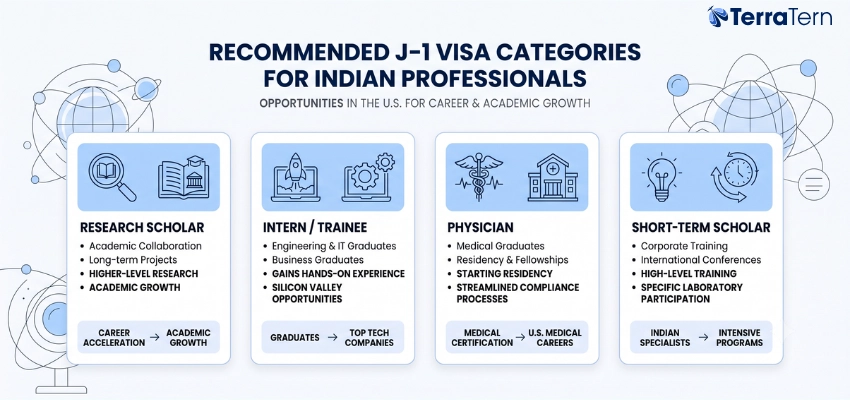
For Indian professionals, the following category of J-1 visa is best:
-
Research Scholar: Suitable for Indian academics collaborating with US academics, such as a PhD student from IIT working with MIT on higher-level, long-term research projects.
-
Intern/Trainee: Ideal for Indian Engineering, IT, or Business graduates who want to gain hands-on experience in the corporate world at leading Silicon Valley tech companies.
-
Physician: Concise and designed for medical graduates who are starting their residency or fellowships in the U.S., avoiding the previous cumbersome compliance processes for Indian physicians.
-
Short-Term Scholar: Designed for Indian specialists who are participating in high-level corporate training, international conferences, or for short-term and specific laboratory participation.
Important Note: Choosing the wrong J-1 category, one that doesn't match your actual activities, is one of the top reasons J-1 applications are denied; always confirm your category with your designated sponsor before applying.
Who Is Eligible to Apply for a J-1 Visa from India?
Indian nationals can apply for a J1 visa if they are sponsored by a US Department of State-designated organization and can prove English skills, financial support, and ties to India to ensure their return after the program.
-
Sponsorship & Documentation: Official acceptance into an exchange program is required by the school, and you must have an official sponsor who will provide you with the required Form DS-2019.
-
Institutional Funding: At least 51% of your total program funding must come from your institution, corporate or government funds and not from your own funds or family assistance.
-
Language Proficiency: The applicant needs to demonstrate adequate English proficiency by passing a standard English-language exam (such as IELTS, TOEFL, or PTE) or by being assessed during an interview conducted by the host institution.
-
Nonimmigrant: Intent shall be established by clear evidence of binding ties to India, including family ties, property, or a final job offer in India.
-
Category Credentials: Applicants need to meet certain criteria for each category, e.g., a degree in a relevant field for the Research Scholar track, a medical qualification for the physician training track.
-
No Restrictions: Rest assured that India does not have any active geopolitical travel ban affecting the issuance of J-1 visas, which provides a clear and uniform pathway for qualified applicants.
Expert Advice: Having "ties to India" is the most commonly scrutinized eligibility factor at J-1 interviews. Indian applicants should prepare documented evidence, such as property ownership, ongoing employment contracts, or family responsibilities, to present at their consular interview.
What Is the Two-Year Home Residency Rule, and Has It Changed for Indians
Historically, the INA §212(e) rule required exchange visitors to leave the United States for two years before they could apply for H-1B, L-1, and immigrant visas.
-
As of 9th December 2024, the Department of State lifted the restriction and removed India from the Skills List, exempting most Indian J-1 holders from the two-year home residency requirement before applying for H-1B, L-1, or an immigrant visa.
-
If your program is designed to include any government funding or U.S. graduate medical training, you will remain restricted.
-
However, the candidates with any affected will have to obtain a No Obligation to Return to India (NORI) from the Indian consulates.
-
Obtaining a NORI certificate is a required step before submitting a formal waiver application to the US government.
-
To learn how to do this step by step, check out expert US visa advice from India.
Important Tip: The December 2024 elimination of the two-year rule is the single biggest J-1 policy change for Indian professionals in a decade. If you previously held back from applying for a J-1 because of this restriction, it no longer applies to most Indian participants in research and academic programs.
What Documents Are Required for a J-1 Visa Application from India?
The core documents needed for a J-1 visa from India are the DS-160 online application, a DS-19 form issued by your sponsor, your passport, the SEVIS fee receipt, financial support documents, and supporting documents from your home country, India.
-
If you are entering as an Intern or Trainee, you need to bring your Form DS-7002 (Program Taxonomy) and your original, signed Form DS-2019 (Certificate of Eligibility), which is the key document that outlines your program's scope and timeline from your U.S. sponsor.
-
Core Application Proofs: Bring a printed copy of your DS-160 confirmation page, your valid Indian passport (with at least 6 months' validity past the end of the program), and your appointment confirmation letter.
-
The Fee Receipts to be Brought Are: the Visa Application (MRV) fee (required for visa application) and the Student and Exchange Visitor Information System (SEVIS) I-901 fee (required for visa application).
-
Financial & Academic Evidence: Submit all the liquid financial documents, such as bank statements, scholarship letters received as part of your DS-2019 funding, and academic documents like degrees, CV, employment documents, property documents, etc., showing your plans to return to India.
-
With This Deadline in Mind, here is a Strict One for Social Media: Your submitted DS-160 should fully disclose all accounts you have had in the last 5 years (including deleted accounts), and all active public profiles should match your application information perfectly.
As per our TerraTern Expert Divyansh, the DS-2019 form is the single most critical document in your J-1 application; without it, you cannot proceed to the visa interview stage. Always check that the dates, program details, and funding amounts on your DS-2019 exactly match your passport before submitting.
How to Apply for a J-1 Visa from India: Step-by-Step Process
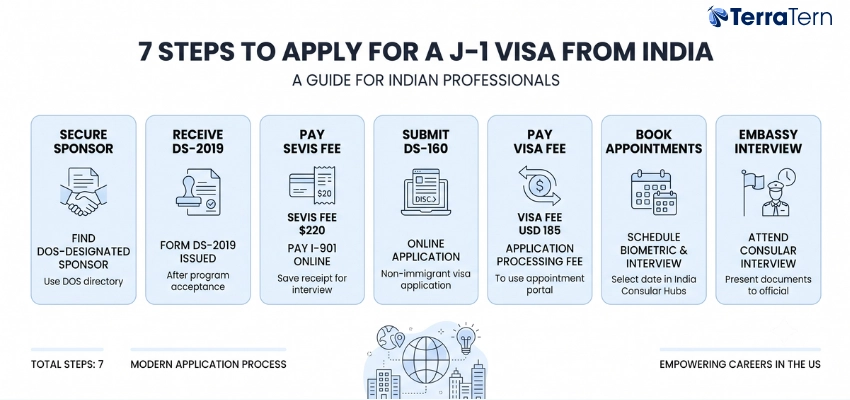
The seven steps required to apply for a J1 visa from India are: Securing a DOS Designated Sponsor, being accepted into their program, receiving your DS-2019 form, paying the SEVIS fee, filling out your DS-160 online application, scheduling and attending your interview with a U.S. Embassy in India, and waiting for the Embassy to issue your visa.
-
Step 1: Identify and approach a Sponsor: Find a match in the official DOS-designated sponsor directory via the public exchange.
-
Step 2: Get Your DS-2019: Receive Your DS-2019 After Program Selection.
-
Step 3: Pay the I-901: Pay the SEVIS I-901 Fee online, and save a printable copy of your receipt to take to your embassy appointment. The required fee (I-901) is $220 (approx. INR 19,859).
-
Step 4: Submit the Form DS-160: Submit the electronic non-immigrant visa application, which includes all personal history and required disclosure information about social media.
-
Step 5: Pay Application Fee: Pay the required non-petition J-1 visa processing fee (currently USD 185, roughly INR 17,760) to use the appointment portal.
-
Step 6: Book Consular Appointments: Schedule your Biometric appointment at the Visa Application Center and your formal interview at one of India's 5 Consular Hubs.
-
Step 7: Embassy Interview: Present your complete document file to the Embassy official. If accepted, your Passport will be released through designated collection points.
Pro Tip: In India, visa interview wait times at some US consulates stretch to several months. Always begin your J-1 application at least 3–6 months before your program's intended start date, and check the US Embassy in India website frequently for newly released appointment slots.
What Are the J-1 Visa Fees in India (USD and INR)?
Here’s a clear fee breakdown for a J1 visa in India. INR amounts are approximate and can change with exchange rates, and some sponsor programs may cover the SEVIS fee, so always verify with your sponsor
|
Fee type |
USD |
Approx. INR |
|
SEVIS I-901 Fee |
$220 |
INR 19,859 |
|
Non-immigrant Visa Application Fee (MRV) |
$185 |
INR 14,443 |
|
Optional J-1 Waiver Fee (DS-305) |
$120 |
INR 10,832 |
|
Extension Fee (new DS-2019) |
$367 |
INR 33,117 |
A few Important Notes:
-
The INR values are approximate and depend on the exchange rate at the time of payment.
-
Some J-1 sponsor programs pay the SEVIS fee on behalf of applicants.
-
There is no reciprocity fee for Indian nationals applying for a J-1 visa.
Key Note: Always pay the SEVIS I-901 fee at least 3 business days before your visa interview to ensure the payment appears in the consular officer's system. Unpaid or unverified SEVIS fees are a common reason for interview delays.
How Long Does J-1 Visa Processing Take from India?
Here’s a practical timeline for J1 visa processing from India.
|
Phase |
Typical time |
|
DS-2019 from sponsor |
A few days to several weeks, depending on the sponsor |
|
SEVIS registration |
Near-instant, once the sponsor submits the record |
|
DS-160 submission |
Same day, online |
|
Interview appointment wait time in India |
Highly variable; often several weeks to months in 2024–2026, depending on the city |
|
Post-interview processing and passport return |
A few days to a few weeks |
|
Administrative processing, if triggered |
Unpredictable; can add extra days or weeks |
|
Total end-to-end |
Usually 5 weeks to 2–3 months |
A few points matter a lot in India:
-
Appointment availability can change quickly by location, so the interview wait is often the biggest variable.
-
Demand-driven backlogs have made timing less predictable in recent years, especially around appointment pauses and reopenings.
-
If your case goes into administrative processing, the timeline can extend without warning.
-
For planning purposes, most applicants should budget at least 2 months from sponsor paperwork to visa issuance, with longer timelines possible if the interview queue is heavy or extra checks are required.
As per TerraTern Expert Shreya, Administrative processing (also called "221(g)") is a common source of delay for Indian J-1 applicants, particularly researchers and STEM professionals; if your application is placed in administrative processing, you may need to wait 2–8 additional weeks without a guaranteed outcome date.
What Are the 2026 J-1 Visa Social Media Rules Indian Applicants Must Know?
From June 2026, all J1 visa applicants, including Indian nationals, must disclose all social media accounts used in the past five years on their DS-160 form and must set those profiles to "public" before their consular interview, or risk visa refusal.
-
-Mandatory Disclosure: You must list every handle, pseudonym, and platform used over the last five years on your DS-160 form, including deactivated or deleted accounts.
-
-Public Profile Rule: The US Department of State explicitly mandates that all active accounts be switched to "public" or "open" well before your consular interview.
-
-Identity & Intent Check: Consular officers will audit your public feed to verify that your employment history, dates, and educational details exactly match your J-1 visa application.
-
-Avoid Evasion Tactics: Mass-deleting posts, omitting minor profiles, or reverting accounts to private right after filing triggers intense scrutiny and potential administrative delays.
-
-Consequences of Omission: Failing to disclose accounts or leaving your privacy settings locked fully can result in immediate visa refusal on the grounds of material misrepresentation.
Expert Tip: Indian applicants should conduct a "social media audit" at least 4 weeks before their J-1 interview, review all past content for anything that could appear to support extremist views or be perceived as derogatory; even historical posts from school or college years can surface in a consular review.
What Are the Rules and Restrictions for J-1 Visa Holders from India?
Strict program rules bind J1 visa holders: they may only perform the activities listed on their DS-2019 form, must maintain valid insurance, must report changes to their program sponsor, and, in some cases, must return to India for 2 years after their program ends before applying for other US visas.
-
-Program Fidelity: You must strictly adhere to the approved study, training, or research activities detailed explicitly on your active Form DS-2019.
-
-Work Restrictions: Outside employment is prohibited; however, student J-1 visa holders may engage in authorized on-campus work up to 20 hours per week.
-
-Mandatory Insurance: Both primary exchange visitors and their accompanying J-2 dependents must maintain medical insurance that meets the Department of State's minimum standards.
-
-Strict Reporting: To maintain a lawful status, you must report any changes to your residential address, sponsor, or program structure within the designated timelines.
-
-J-2 Employment: Accompanying spouses and children can travel on J-2 visas, and spouses are legally entitled to request an Employment Authorization Document (EAD) independently.
-
-Residual 2-Year Rule: Despite widespread baseline exemptions, Indian citizens remain subject to the 2-year home residency rule if they are tied to government funding or specialized medical fields.
-
-Status Termination: Intentionally violating program rules or allowing mandatory insurance to lapse causes immediate status termination and significantly bars future US immigration eligibility.
Important Note: Purchasing the minimum required health insurance coverage is not just a visa rule; inadequate coverage in a US medical emergency can result in bills exceeding INR 50 lakh. Always choose a plan that explicitly meets J-1 DOS minimum standards, not just any international travel insurance.
How Does the J-1 Visa US Compare to the F-1 and H-1B Visa for Indians?
The J1 visa is built for structured exchange programs, the F-1 is for full-time study, and the H-1B is for skilled U.S. employment. For Indians, the big J-1 difference is that the two-year home residency rule was removed for most Indian holders in December 2024, making it more flexible than before
|
Feature |
J-1 |
F-1 |
H-1B |
|
Purpose |
Exchange, training, research, teaching, and cultural programs |
Full-time academic study |
Skilled U.S. employment |
|
Who issues / sponsors |
DOS-designated sponsor |
SEVP-certified school |
Employer petition + USCIS |
|
Work authorization |
Program-specific; depends on category and sponsor rules |
On-campus work, CPT, OPT, STEM OPT |
Full-time employment for the sponsoring employer |
|
Duration |
Program-specific |
For the academic program duration, with limited practical training options |
Up to 3 years initially, extendable to 6 years total |
|
Path to a green card |
Historically limited, now improved for most Indians after Dec 2024 |
Usually indirect via OPT/STEM OPT and later work visas |
Common route via EB-1, EB-2, or EB-3 sponsorship |
|
Annual cap |
No fixed annual cap |
No cap |
85,000 annual cap with lottery |
|
Home residency rule |
Removed for most Indians in Dec 2024 |
None |
None |
Expert Advice: For Indian STEM professionals considering a US career path, the J-1 → waiver pathway historically offered one of the fastest routes to H-1B; with the December 2024 two-year rule removal, the J-1 now competes even more directly with the F-1 as a strategic gateway to US career opportunities.
What Are the Top Tips to Prepare for a J-1 Visa Interview in India?
The J1 visa interview is a fast-paced, one-on-one meeting with a consular officer lasting roughly 3 to 5 minutes at one of India's five hubs (New Delhi, Mumbai, Chennai, Hyderabad, or Kolkata). Officers face heavy time constraints, meaning your first impression and initial answers are absolutely paramount.
10 Crucial Interview Questions & Strategic Model Answers
1. What is the J-1 visa, and what are your responsibilities as a holder?
Answer: "It is a non-immigrant exchange visa allowing me to gain specific skills. My responsibilities are to complete my program with my sponsor and strictly maintain my required health insurance coverage."
2. Tell me about your exchange program and sponsoring organization.
Answer: "I am joining the Research Scholar track sponsored by [Organization Name]. I will be working directly in their advanced AI lab, focusing on data modeling."
3. Who is funding your program?
Answer: "My program is fully funded by a stipend from the host institution as outlined on my DS-2019, combined with my family's personal savings back in India."
4. What will you do after the program ends?
-Answer: "I am returning to Bangalore to rejoin my previous employer as a senior data analyst, leveraging the niche skills acquired in the US."
5. Why did you choose this specific US institution over Indian options?
Answer: "The host university houses a specialized neural network testing facility and proprietary research tools that are not currently available at institutions in India."
6. Do you have family in the US?
Answer: "No, my entire immediate family, including my parents and siblings, resides here in India."
7. Have you previously traveled to the US?
-Answer: "Yes, I visited once on a B2 tourist visa in 2022 and returned to India strictly on time according to my scheduled flight."
8. How will you cover your living expenses if emergencies arise?
Answer: "Beyond my monthly program compensation, I hold fixed deposits and a dedicated parental emergency fund totaling INR 15 Lakhs."
9. What ties do you have to India?
-Answer: "My primary ties include my family obligations, a residential property registered in my name, and an active professional network within India's growing tech market."
10. What social media accounts do you use? (New June 2026 Focus)
Answer: "I actively use LinkedIn and Instagram. All my handles are fully disclosed on my DS-160 and have been set to public view for verification."
Important Tip: The single most important thing to convey in a J-1 visa interview is a clear, credible intent to return to India. Consular officers are trained to assess "nonimmigrant intent," so preparation of specific, documented reasons for your return (job, family, property) is as important as your academic or professional credentials.
Can a J-1 Visa Lead to a Green Card or Permanent Residency for Indians?
A J1 visa does not directly lead to a green card. Still, following the December 2024 elimination of the two-year home residency requirement for most Indian J-1 holders, it is now significantly easier for Indian professionals to transition from J-1 to H-1B and subsequently pursue employer-sponsored green card pathways.
-
Nonimmigrant Baseline: The J1 visa is strictly a temporary exchange visa with no automatic path to U.S. permanent residence.
-
Transition Pathways: Due to the December 2024 DOS regulatory updates, eligible Indian holders can now seamlessly change status from J-1 to H-1B without having to meet a two-year home departure requirement.
-
Employer Sponsorship: Once on an H-1B dual-intent visa, your US employer can initiate a permanent residency application through the standard EB-2 or EB-3 employment-based streams.
-
Residual Waiver Paths: For those still bound by government funding conditions, transitioning requires obtaining a No Obligation to Return to India from the Indian Ministry of External Affairs or a waiver from an Interested Government Agency (IGA).
-
Conrad 30 Program: Indian medical professionals subject to the residency rule can use the specialized Conrad State 30 program to bypass the requirement by practicing in underserved American medical zones.
-
Backlog Reality Check: While changing visa categories is now much simpler, applicants must remember that the actual wait times for employment-based green cards for Indian nationals can span several decades.
Pro Tip: The December 2024 two-year rule removal is a genuine game-changer for Indian J-1 researchers and scholars, but the green card backlog for Indian nationals under employment-based categories remains one of the longest in the world, so plan your US career strategy with realistic multi-decade timelines in mind, or explore skilled worker routes in countries with faster pathways.
What Are the Most Common Reasons J-1 Visa Applications from India Are Denied?
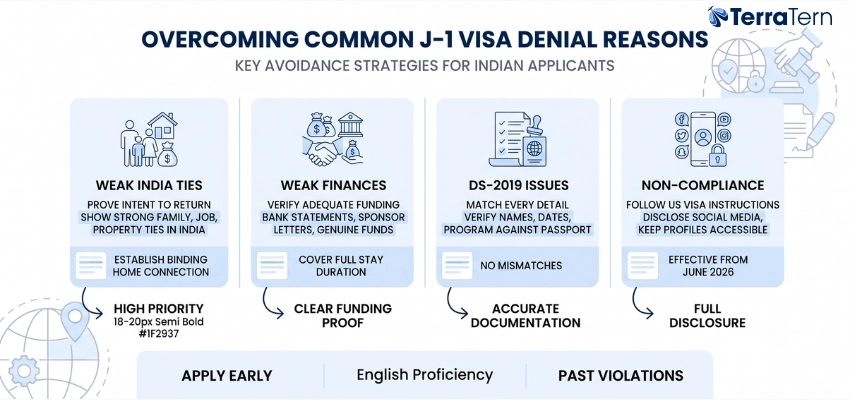
The common reasons J-1 visa applications are denied include:
-
Weak India Ties: Failure to prove you’ll return after the program is a common reason for refusal. Avoid it: show strong family, job, property, study, or business ties in India.
-
Weak Finances: Missing or unclear funding can hurt the case. Avoid it: provide bank statements, sponsor letters, and proof that the funds are genuine and cover the full duration of the stay.
-
DS-2019 Issues: Mismatched names, dates, or program details create doubt. Avoid it: verify every field against your passport and sponsor documents.
-
Social Media Non-Compliance: From June 2026, applicants must avoid undisclosed accounts and keep profiles accessible as required. Avoid it: follow the latest U.S. visa instructions exactly.
-
Low English Proficiency: Poor documentation of English ability can raise concerns. Avoid it: submit TOEFL/IELTS or sponsor evidence showing you can handle the program.
-
221(g) Delays: Administrative processing can delay your start date. Avoid it: apply early and keep backup dates with your sponsor.
-
Past violations: Overstays, status violations, or prior refusals can lead to denial. Avoid it: disclose accurately, fix issues first, and reapply only with a stronger case.
Key Note: The vast majority of J-1 rejections from India mostly result from documentation gaps that an experienced immigration consultant can identify and correct before the interview, making professional guidance one of the highest-ROI investments in the application process.
2026 Industry Context Section
Latest Statistics & Developments (2026):
-
Program Scale: The J-1 Exchange Visitor Program hosts approximately 300,000 participants from over 200 countries annually (BridgeUSA, US Department of State, 2026)
-
2022 Baseline: The State Department issued 284,486 J-1 visas in 2022, with numbers recovering post-pandemic (Wikipedia/DOS data)
-
May–June 2026 Policy Disruption: On May 27, 2026, the State Department temporarily halted new J-1 interview appointments; appointments resumed by mid-June 2026 with enhanced social media vetting procedures
-
Social Media Mandate (June 2026): All new J-1 applicants must now list all social media accounts used in the past five years on Form DS-160 and must set profiles to "public" before their interview
-
India-Specific Major Win (December 2024): Effective December 9, 2024, the US Department of State eliminated the two-year home residency requirement for most Indian J-1 holders, a significant change opening faster pathways to H-1B and green card applications.
-
Duration of Status Proposal (August 2026): DHS submitted a proposed rule in August 2026 that may replace the open-ended "duration of status" with fixed admission periods for J-1 holders; not yet finalized as of June 2026
-
India NOT on Travel Ban List: India is not among the 38 countries subject to the June 2026 Presidential Proclamation restricting J-visa entry, meaning Indian nationals face no additional entry barriers
Conclusion
Navigating the J1 visa pathway requires careful alignment with Department of State regulations, particularly with the 2026 social media transparency mandates and category-specific eligibility rules. Fortunately, the elimination of the two-year home residency requirement for most Indian nationals has turned this exchange program into a highly lucrative stepping stone for long-term global career growth. Secure an authorized sponsor, prepare your documentation thoroughly, and approach your consular interview with absolute clarity.
Contact TerraTern for more information on J1 Visa: Complete Guide for Indian Applicants 2026.



 AI Summary