

Key Highlights
- Is Australia Safe for Indian Students?
- What Does the 2026 Data Say About Indian Student Safety in Australia?
- How Safe Is Australia for Indian Students Compared to the US, UK, and Canada?
- Which Are the Safest Cities in Australia for Indian Students?
- How Safe Is Australia for Indian Students Overall in 2026?
- What Are the Key Safety Laws Protecting Indian Students in Australia in 2026?
- How Safe Are Australian Cities for Indian Students: A Latest City-by-City Guide
- What Are the Latest Most Common Safety Challenges Faced by Indian Students in Australia?
- What Laws and Government Policies Protect Indian Students in Australia?
- How Do Australian Universities Ensure Campus Safety for Indian Students?
- Is Australia Safe for Indian Female Students Specifically?
- What Past Incidents and Recent Attacks Should Indian Students Be Aware Of?
- What Are the Most Common Safety Risks Indian Students Face in Australia?
- How Is Financial Safety Addressed for Indian Students in Australia?
- How Can Indian Students Stay Safe in Australia? (Practical 2026 Guide)
- What Do Indian Students and Parents Actually Say About Safety in Australia?
- What Current Safety Support Services Are Available for Indian Students in Australia?
- What Are the Best Practical Safety Tips for Indian Students Going to Australia in 2026?
- Is Australia Safe for Indian Students? - Key Takeaways for Families in 2026
- Conclusion
Australia is a safe and welcoming country for Indian students in 2026, but it is important to be realistic and well-prepared. Major cities, such as Sydney, Melbourne and Brisbane, also have relatively low crime rates and excellent support services for international students with on-campus security, dedicated student services and robust systems for public transport. Nevertheless, as with any other foreign nation, vigilance is the only thing you can count on; you need to register at the local police station, avoid uninhabited places at night, and have your paperwork and finances tidied up, particularly after the Australian authorities have recently beefed up their efforts to scrutinise student visa applications from Indians. Australia is generally a safe, high-quality study environment for a thoughtful, careful student and has excellent long-term migration and career prospects.
Is Australia Safe for Indian Students?

-
Australia is essentially safe for Indian students, as there is little violent crime and effective law enforcement in the big cities, such as Sydney, Melbourne, Brisbane and Adelaide.
-
Campus buildings are typically secure, and they have campus security, emergency phones and offices for student assistance in case you feel unsafe.
-
Walking and public transport in the city centre are generally safe during the day but avoid walking in poorly-lit or deserted areas late at night and avoid walking alone, instead walk with others or in well-lit and busy routes.
-
Valuables should be kept safe and out of sight and large amounts of cash should not be carried in public areas and transport hubs, where petty crime may occur, such as bag snatching or phone theft.
-
It is recommended that Indian students register with local police (if required), make sure to have copies of your passport along with your visas and communicate with your family or friends regarding your location.
-
Australia's student visa regulations for Indians in 2026 are not new, but they are stricter, with India now classified as “highest risk” for evidence and hence their chances of getting a student visa will be impacted, not the security of the country per se.
-
In general, 2026 is a comparatively safe and friendly time and environment in which to study and live, for a genuine well-prepared student who takes basic precautions.
💡 Expert Takeaway: Safety in Australia is structural, not coincidental - federal laws, university protocols, and a ~1 million-strong Indian diaspora form a layered safety net most countries cannot match.
What Does the 2026 Data Say About Indian Student Safety in Australia?
-
According to 2026 data, Australia has shifted Indian student-visa applicants to its “highest-risk” category (Evidence Level 3), which will lead to additional checks – not increased actual risk to students on the ground.
-
In early 2026, the number of Indian students whose applications for higher education student visas have been rejected has spiked by approximately 40–50%, in response to the tighter policy on fraud and those whose applications were found to be “non‑genuine”.
-
These rejections are not due to increased physical crime against Indian students but because of integrity-related problems like forged financial documents, source of funds disclosure issues and fake academic documents.
-
Whilst there is no official 2026 data to confirm this, there are no significant data to suggest that Indian students are at greater risk of crime in Australia than other international students. Police and education-government reports show that Australian cities are generally safe for international students as long as basic precautions are taken.
-
In brief, 2026 numbers reflect stricter visa process and compliance risks for Indian students but not Australia's physical insecurity for the genuine, well-documented, and careful Indian student.
Expert Takeaway: The AL3 reclassification has been misread by some parents as a "safety downgrade." It is a visa-integrity measure tied to fake-degree audits - it has zero relationship with on-ground student safety.
How Safe Is Australia for Indian Students Compared to the US, UK, and Canada?
In terms of overall safety, Indian students can expect to be safer in Australia than in the US, UK and Canada in 2026 when it comes to general crime, the campus environment, and living conditions:
|
Country |
Overall safety of Indian students (2026 perspective) |
|
Australia |
Generally very safe, violent‑crime rates are low, and student‑support systems are well developed; major cities (Sydney, Melbourne and Brisbane) are safe if basic precautions are taken. |
|
Canada |
Slightly better international safety record; less likely to experience violent street crime; and strong sense of community policing; generally Indian students can expect a low risk environment at the campuses, which are typically very safe and multicultural. |
|
UK |
London, Manchester and Edinburgh are reasonably safe cities for students; some areas have a higher petty crime rate than others; universities are well secured and provide good student support services but healthcare and policing may be more formalized. |
|
USA |
In many university towns, safety is ensured by good campus police, but it is variable in some large cities with higher crime rates, gun violence, and political and social unrest, so location choice is important for Indian students. |
How Safe Is Australia for Indian Students Versus Other Top Destinations Beyond the Big Four?
Australia is considered to be as safe as other countries that are also part of the “beyond the Big Four” category, such as Germany, the Netherlands and the Scandinavian countries, for Indian students in 2026, with low rates of violent crime and comprehensive support systems, especially on campus.
-
Australia's cities are also highly ranked in the world for safety, like Germany, Sweden and the Netherlands.
-
There is a level of petty crime (bag/phone theft), but it is acceptable and controlled with simple precautions, as in study centres in Europe.
-
Australia's legal and police systems are responsive, similar to those of Germany and Nordic countries, and therefore it's safe for Indian students.
💡 Expert Takeaway: Numbers favour Australia, but a student's day-to-day experience depends more on city choice and accommodation type than national averages - choose well within Australia and your safety profile climbs further.
Which Are the Safest Cities in Australia for Indian Students?
-
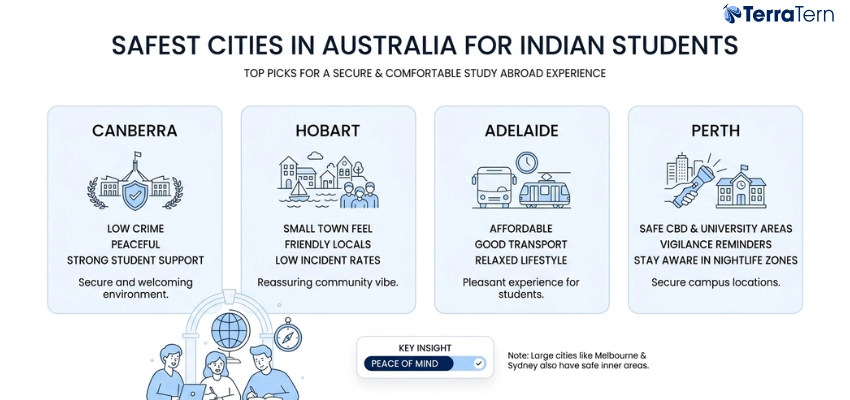
Canberra is considered one of the safest cities in Australia, it has low crime rates, is peaceful and has excellent student support systems, making it very comfortable for Indian students.
-
Many Indian students find Hobart, Tasmania, a reassuring city, ranked among the safest in Australia and boasting a small town atmosphere and friendly locals, whose low levels of crime and relatively low incident rates are reassuring.
-
Indian students find Adelaide to be safe, with friendly people, affordable, good public transport and a relaxed lifestyle, making it a very pleasant experience for them to study abroad.
-
Perth is safe for students, particularly in areas close to universities and the CBD, although students are urged to remain vigilant in nightlife and transport zones.
-
Inner city areas of the universities in Melbourne and Sydney (e.g. Carlton, Southbank, inner west suburbs) tend to be safe for students but poorly lit and isolated areas late at night are not advised.
How Safe Are Smaller Regional Cities and Towns for Indian Students?
Smaller cities and towns in Australia are generally safe from a crime perspective, they have low levels of crime, small communities and a relaxed lifestyle, but you should avoid areas where there are no other students present after dark and be aware of your surroundings when on campus and during travel.
-
These campuses are typically quieter and safer than in the big city, and the people are friendly, as are the campus‑support services.
-
Occasional incidents do happen, so it is advisable to travel in groups, let people know where you are and don't show off phones and money.
How Safe Is Australia for Indian Students Overall in 2026?
How safe is Australia for Indian students? Yes. Australia boasts of being among the safest nations in the world to have international students. Violent crime rates are extremely low in the country, student protection legislation is highly effective, and multicultural societies are very inclusive.
Is Australia safe for Indian students? The homicide rate in Australia is approximately 0.15 per 1,000 population, and this is one of the lowest in the world. The Education Services for Overseas Students (ESOS) Act protects international students by ensuring that safety is available to the students in their campuses, quality education, and student support.
It is also reported that 73 percent of the Indian students surveyed say that they feel safe in their day-to-day study and living conditions. Although there are no totally risk-free countries, Australia has always stood as one of the safest countries in terms of international education.
Also Read: How To Prepare For Australia Immigration Interview: Student Visa
What Are the Key Safety Laws Protecting Indian Students in Australia in 2026?
Is Australia safe for Indian students? The Indian students in Australia enjoy a good legal system. A number of laws safeguard their rights in education, employment, and accommodation.
The main laws involve the following.
1. ESOS Act (Education Services Overseas Students)
The ESOS Act safeguards international students by guaranteeing:
-
Colleges offer agreeable programs.
-
In case of cancellation of courses, students are refunded.
-
Welfare and support services are offered to the institutions.
-
Students are allowed dispute resolution.
2. Veritable Student Requirement (GS)
The GS requirement makes sure that only genuine students are given student visas. This guards the students against fake institutions and immigration fraud.
3. Fair Work Act
Students who work part-time are covered by this law.
Key rights include:
-
Minimum wage protection
-
Payslip requirements
-
Safe working conditions
-
Wage theft protection.
4. Anti-Discrimination Laws
The federal and state laws also prevent discrimination among the races, nations, or religions.
The students who have been discriminated against may complain to:
-
Universities
-
Police
-
Human rights commissions
5. Rental Tenancy Laws
Tenants are not exploited by housing laws.
Students cannot be:
-
Dispossessed without due forewarning.
-
Stampeded into unlawful rentals.
-
Charged unfair deposits
These safeguards ensure that the international students are safe.
How Safe Are Australian Cities for Indian Students: A Latest City-by-City Guide
Is Australia safe for Indian students? The large cities of Australia are generally considered safe. Nevertheless, the levels of safety and experience of students across places are slightly different.
An overview of cities is provided below.
Also Read: Benefits of Studying in Australia: Complete Guide for Indian Students
Is Melbourne Safe for Indian Students in 2026?
Is Australia safe for Indian students? Yes. Melbourne has been regarded as quite secure for Indian students.
Melbourne is often considered one of the liveliest cities in the world. It also has a huge Indian population.
Notable safety benefits would consist of:
-
Large Indian population
-
Properly patrolled transportation.
-
Security systems at Universities.
-
Multicultural neighbourhoods
Popular student suburbs include:
-
Box Hill
-
Clayton
-
Dandenong
Is Sydney Safe for Indian Students in 2026?
Is Australia safe for Indian students? Australia is the biggest city with a big education center in Sydney. It is also known to be safe in the case of international students.
The city offers:
-
Multicultural communities of large size.
-
Well-built infrastructural public safety.
-
Good network of transport.
The neighbourhoods common to students are:
-
Parramatta
-
Strathfield
-
Hurstville
Is Brisbane, Perth, and Adelaide Safe for Current Indian Students?
Is Australia safe for Indian students? Yes. These cities may even be regarded as safer than big cities.
Different cities provide different student environments.
Brisbane
Advantages include:
-
Reduced crime rates compared to most large cities.
-
Good university campuses.
-
An increasing number of international students.
Perth
Key features include:
-
Among the lowest Australian crime rates.
-
Popular, smaller communities.
-
Good quality of life
Adelaide
Adelaide is often called one of the safest cities in Australia.
Major advantages include:
-
Affordable living costs
-
Strong student communities
-
Safe neighbourhoods
What Are the Latest Most Common Safety Challenges Faced by Indian Students in Australia?
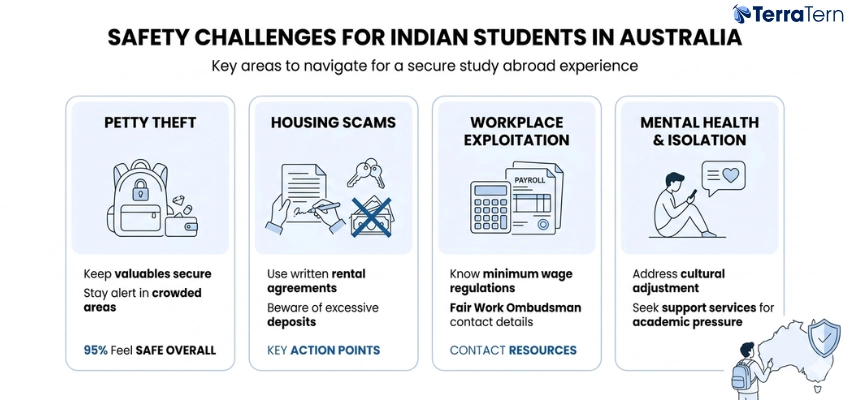
Is Australia safe for Indian students? Despite the safety of Australia, a few challenges can be encountered by the students. Students can be ready to stay safe by being aware of these risks.
Among the common problems are the following.
-
Petty Theft
Theft, as in any city, can be committed in crowded places.
Safety tips include:
-
Keep valuables secure
-
Do not exhibit high-end goods.
-
Stay alert in crowded areas.
-
Racial Discrimination
Far between occurrences serve but as an isolated case.
Students who are discriminated against should:
-
Make reports to university authorities.
-
Contact local police
-
Get the assistance of community organisations.
-
Housing Scams
These rental scams are sometimes targeted at foreign students.
Warning signs include:
-
Landlords are requesting huge deposits in advance.
-
No written rental agreement
-
Increasedly low prices.
-
Workplace Exploitation
Students are also underpaid in part-time employment.
To stay protected:
-
Retain payroll and labor documents.
-
Know the minimum wage regulations.
-
Direct the Fair Work Ombudsman in case.
-
Mental Health and Isolation
Adaptation in the new country may be stressful.
Common challenges include:
-
Homesickness
-
Academic pressure
-
Cultural adjustment
Also Read: Check Your Australia Visa Status Online Fast and Easy
What Laws and Government Policies Protect Indian Students in Australia?
-
Conditions of student visas, along with the ESOS Act 2000, provide legal protections for all international students, including Indians, to ensure that registered education providers are held to standards of quality assurance and that they provide clear information, support and fair treatment.
-
The National Code of Practice for Providers of Education and Training to Overseas Students (2018) require Universities and Colleges to provide orientation, academic support, counseling and fair processes for complaints and course changes to the Indian students.
-
Tuition Protection Scheme (TPS) covers the refund of tuition fees and/or the assistance of transferring to other valid institutions if your institution cannot offer your course.
-
If your college or university does not resolve your complaint about fees, academic decisions, or treatment, then Overseas Student Ombudsman (OSO) and state based Ombudsman offices can help you.
-
As an international student visa holder, workplace laws, which are protected by the Fair Work Ombudsman, safeguard you from workplace exploitation when you are working part-time, including issues like minimum wage, safe conditions, and protection against retribution for reporting workplace abuse.
-
You are an “Australian consumer” and you can assert your rights against unfair contracts, poor quality housing or misleading services and seek assistance from the local consumer‑protection agencies.
-
You are treated the same way as a local and can report any assault, harassment or discrimination to police or the Australian Human Rights Commission and you will not incur any penalty for doing so in good faith.
What Should an Indian Student Do If Their Rights Are Violated?
In case a student of Indian origin suffers any rights violations in Australia, then he/she should take timely action but in a calm manner through the official channels available to them.
-
Report any physical harm, harassment or threats to local police (000 if emergency) and save all messages, photos or documents as evidence.
-
Talk to your university's international student office/student-support services in order to make a formal complaint and request counselling or mediation services.
-
The National Student Ombudsman (NSO) or state Ombudsman will provide free assistance for unfair academic decisions, overcharging, or course delivery problems.
-
If your education provider closes or misbehaves, contact the Tuition Protection Service (TPS) to get tuition‑fee refunds or a transfer to another school.
-
If you are being under-paid, or working hours that are not safe, contact the Fair Work Ombudsman and you will not be facing any penalties for your visa.
-
Australian Human Rights Commission and the Indian High Commission/Consulate in Australia can also be contacted for advice and assistance if one feels unsafe or discriminated against.
💡 Expert Takeaway: Most Indian students in distress don't know their rights - and exploitation thrives in that gap. Save the Fair Work Ombudsman number (13 13 94) before you save the local takeaway's.
How Do Australian Universities Ensure Campus Safety for Indian Students?
Australian Universities have a series of layered safety measures that protect all students, including Indians, on and around campus.
-
Security staff work around the clock on campus, and there are signs and CCTV, as well as emergency call points at strategic points.
-
Students can go from campus to parking to a nearby hostel safely at night using night (escort) services and shuttle buses.
-
There are crisis hotlines and counselling services available for anyone experiencing harassment, bullying or mental health problems, and often with staff who have experience in supporting students from overseas.
-
Indian students are told about local laws, areas deemed safe and unsafe, and emergency apps and numbers such as 000 at orientation and safety workshops.
-
The Respect‑Now‑Always and anti‑harassment charters require that the university investigate sexual harassment promptly and provide assistance to students affected by harassment.
Which Apps and Helplines Should Indian Students Download Before Arrival?
Indian students are advised to download some important safety, health and support apps before coming to Australia, where they can be informed on what to do in case of an emergency or crisis.
-
MyAus App / SETU India AU / “What's On!” – Apps supported by the government for official information, services and alerts in simple language.
-
Emergency + and local police/state apps – For rapid access to 000 or the appropriate emergency telephone number and to provide your location in an emergency.
-
Campus-specific safety apps – Campus may offer an application to send an alert and give them your location (e.g., SafeZone, Becon).
-
Health apps and mental wellbeing apps (Headspace, Calm, healthdirect, Beyond Now) – For information on counselling, mental health support and symptom checking.
-
Helplinesâ€Australia or similar “helplines” apps – one-tap access to crisis, mental health and community-support numbers.
💡 Expert Takeaway: On-campus accommodation for the first six months is the single biggest safety hedge a new Indian student can buy - it bundles security, community, and orientation into one decision.
Is Australia Safe for Indian Female Students Specifically?
Australia is a safe country for Indian students, especially girls, but with a bit of awareness, caution and smart practice, it should remain safe for the students.
-
Cities in Australia tend to be among the more secure study-abroad locations and many female students say they feel safe walking around during the day, or on campus.
-
Campus security, emergency phones, escort services and shuttles are provided by universities to ensure the safe transportation of female students at night.
-
Petty offences and harassment are still possible, so try to stay in well-lighted, populated areas, refrain from using isolated areas at night-time, and do not use an area alone if you are feeling unsafe.
What Safety Tips Specifically Help Female Indian Students in Australia?
Women are covered by Australian laws against assault, harassment or stalking, and in case of emergency, can phone the police on 000.
-
Australia is comfortable for many Indian female students as they can travel alone; use public transportation; live in student-friendly housing with secured documents, money and personal boundaries.
-
Generally, the life of female Indian students in Australia is safe, but there are a few precautions that should be taken.
-
Walk in the parks and back streets of the campus only when it is lighted and in the company of a friend or on a campus shuttle or registered ride service; avoid walking alone.
-
Also make sure to keep your phone charged, add Campus Security and 000 to your contacts and share your live location with a trusted friend when going anywhere late at night.
-
Don't wander away from your bag or phone in public transport, libraries or cafés and don't openly display cash or expensive jewellery.
-
Stay at recommended homestays or student accommodations that are recommended by your university and report any feelings of being unsafe, harassed or followed to the police.
💡 Expert Takeaway: Female safety in Australia is not about avoiding risk - it's about smart choices. Choose university-managed housing in year one, use Sonder for late commutes, and you'll experience a level of personal freedom most Indian women find liberating.
What Past Incidents and Recent Attacks Should Indian Students Be Aware Of?
Indian students should be aware that Australia is a safe country in general, but there are a few cases of serious incidents which call for caution and awareness.
-
There have been isolated hate‑motivated attacks, as evidenced by a 2025 assault which seriously injured an Indian student (Charanpreet/Jaran Singh) in Adelaide.
-
During the 2025 Bondi Beach terrorist incident in Sydney, three Indian students were injured, to remind students that in big cities, public‑event spaces can be uncommon but high-profile risk locations.
-
Occurs in the context of earlier attacks on Indian students in Melbourne in 2009, which brought the issue to the attention of the international community and resulted in increased police and diplomatic measures against such racist or opportunist attacks.
-
In all such instances, Australian authorities arrested or charged suspects, and India's authorities argued for improved protection and confirmed that such events are not deemed to be ‘normal' ‘day-to-day' risks.
-
These events highlight for an Indian student today the need to avoid being in isolated areas after dark, to be in groups, to know about safe accommodation and to immediately report any harassment or threat to the campus security and police (000).
How Does the Australian Government Respond to Incidents Involving Indian Students?
Typically, the Australian Government will condemn the violence, call for police investigations and increase safety measures of international students when it comes to incidents involving Indian students.
-
Federal and state officials voice their condemnation of attacks and promise Indian students that violence and racism will not be tolerated.
-
Police swiftly investigate and arrest suspects, with many attackers charged and prosecuted under ordinary assault and hate‑crime laws.
-
There has been an upsurge in police and State Government patrols, review of “hot‑spot” areas and establishment of dedicated hotlines and safety task forces for students.
-
Forums are regularly held with the authorities, universities, police and the Indian diplomatic missions to help enhance safety on campus, sharing of data and protection of Indian students in the long run.
💡 Expert Takeaway: A country's safety isn't measured by whether bad things happen - they happen everywhere. It's measured by how the system responds. Australia's response infrastructure for Indian student incidents is faster, more transparent, and more diplomatic than almost any other destination.
What Are the Most Common Safety Risks Indian Students Face in Australia?
The overwhelming majority of threats Australian Indian students encounter are of the everyday variety and not extreme, but knowledge of these threats is a key to safety.
-
Petty theft and pickpocketing are the most common problems in overcrowded public transport or tourist hot areas, particularly when phones and wallets are left out of sight.
-
Late-night walking or walking in quiet streets should be avoided as isolated or poorly lit environments can be dangerous, especially in suburbs or near train stations.
-
Some pupils report that they are being bullied or bullied at school, although not typical; a few pupils report racist and/or sexist comments from others, but this is not typical; most cities are multicultural and are generally respectful.
-
For students who are anxious or not well informed, scams and exploitative work are significant non‑physical risk, as are fake jobs, overcrowded housing, or fake “agents.”
-
Awareness and planning are crucial because over-dependence on shared transport and lack of knowledge of emergency numbers and/or emergency apps (such as 000, campus security or police apps) can exacerbate a small incident.
How Common Is Racial Discrimination Against Indian Students in Australia?
Racial discrimination against Indian students in Australia is not the norm for most people, though there may be occasional racist comments and incidents, particularly in relation to political/anti-immigration rhetoric in the media.
-
While most Indian students feel safe and well integrated, some students experience racist comments, stares or microaggressions in public or on social media.
-
Anti-Indian attacks or harassment campaigns have occurred at times with a rise in racially charged incidents, which are tied to anti-immigration protests.
-
These are often publicised and condemned by the government and police and are usually investigated when they are significant, but awareness and robust support networks are important for any Indian student, and they can avoid high-tension areas to stay safe.
💡 Expert Takeaway: The single biggest financial threat to Indian students in Australia in 2026 is not a violent crime - it's a rental scam taking a four-week deposit they never recover. Treat housing security with the same seriousness as visa security.
How Is Financial Safety Addressed for Indian Students in Australia?
Numerous visa regulations, support measures, and pragmatic financial management tips ensure that Indian students are financially secure in Australia.
-
Stricter financial checks on documents for Indian students help to make sure you are able to afford your tuition and living expenses, lessening the chances of a financial crisis when you get to campus.
-
To prevent under-funded migration, clear “financial capacity” visa rules mandate that the government and students have proof of funds for tuition, health insurance and living expenses.
-
Government-funded budgeting and scholarships (Australia Awards, Destination Australia and university-specific grants) lighten the burden of personal loans and part-time work.
-
Ten-plus budgeting tips, best-deal apps, and discounts on transport, food and activities alerts are available in Studies‑Australia and university resources.
-
Guidance on part‑time work (48 hours/2 weeks on a visa) allows you to work without putting your education at risk, but also without risking entering into work that is illegal or exploitative.
What Should Indian Students Do If They Face Financial Exploitation in Australia?
In the event of an Indian student being exploited financially in their country of study, they need to act promptly, remain calm, utilise official avenues and protect their paperwork and visa status.
-
End all communication with the “agent” or exploiter right away and retain all WhatsApp messages, bank statements, contracts and receipts for proof.
-
Don't suffer from underpayment or from an employer asking you to work off the books – get in touch with the Fair Work Ombudsman (FWO). Your visa can't be cancelled for raising a genuine complaint, and the information you provide can be anonymous.
-
If you're a "money mule" (transmitting a lot of money through your account while not being aware of it), stop such transactions and report via AUSTRAC or your bank; it is a crime, and evidence that you didn't know what was going on will help protect you.
-
If you have a complaint about a “consultant” or visa agent that charges a large amount of money or produces fake paperwork, contact the OMARA (Office of the Migration Agents Registration Authority) and your university's international student office.
-
If you are feeling unsafe or threatened, dial local police (000) and the state police number, as well as your university counselling service and the Indian High Commission/Consulate in Australia for assistance and guidance.
💡 Expert Takeaway: Australia's financial safety net is robust if you use it. Most students who lose money do so because they bypassed regulated channels - unregistered agents, cash jobs, off-the-books housing. Use the system; it works.
How Can Indian Students Stay Safe in Australia? (Practical 2026 Guide)
Here is a safety checklist for students from India in Australia in the 2026 style:
-
Before arrival
-
Install emergency applications (000, campus-safety, transport apps) and store contacts for campus security, police (000) and embassy contacts.
-
Only bring copies of passport, visa and APEC‑IDEA/OSHC; leave originals at home or in bank lockers.
-
Transport and going out
-
Do not walk alone after dark; ride campus shuttles, Uber or registered taxis, and ride in well-lit areas of buses and trains.
-
Tell a trusted friend where you will be and where you are going if you are going out, particularly to an unknown place.
-
On campus and in housing
-
Utilise campus security, on-call guards and emergency phones; report any harassment, bullying or strange behaviour at once.
-
Opt for hostels or verified homestays recommended by the University and ensure that room doors and windows remain closed at all times – even during the day.
-
Documents, money, and scams
-
Store valuable papers and cash in a safe place; carry only essential cash and cards, and don't display large amounts of cash in public.
-
If exploited, report to the Fair Work Ombudsman or OMARA – be mindful of “agents” or “jobs” asking for large up-front fees, fake contracts or using your bank account.
-
Health, law, and instincts
-
Register with local police if necessary, know local laws and dial 000 (or 131 444 for non‑urgent police) in any unsafe or criminal situation.
-
Listen to your instincts: If it "does not feel right," leave, phone someone and contact the University Counselling or the Indian High Commission/Consulate for assistance.
What Emergency Numbers and Resources Should Every Indian Student Save?
It is important for all Indian students studying in Australia to store some vital emergency numbers and support services on their mobile phones and in a notebook.
-
Triple Zero 000 – Dial in case of any life-threatening emergency (police, fire, ambulance).
-
Secondary emergency number – 112 (is used by most mobile phones to call 000).
-
Campus security and student‑support office – Save your university’s 24/7 security and international‑student helpline.
-
Attendance of State Police (non-emergency): 131 444 (most states) and individual State Police numbers for non-urgent police issues.
-
Fair Work Ombudsman (13 13 94) – To complain about underpayment or exploitation in the workplace.
💡 Expert Takeaway: Print this table. Stick it inside your wallet. The students who use these numbers before a crisis are the ones who never need them in one.
What Do Indian Students and Parents Actually Say About Safety in Australia?
Mobile contacts of Indian High Commission/Consulate in your area – Save the emergency‑helpline or mobile number of Indian HC or Consulate in your area in case of a serious crisis or loss of documents.
-
Indian students and parents have shared their views about Australia's safety as a study destination, but have also emphasized being careful, being aware and the need to have good support systems.
-
Pupils frequently state that they feel safe when walking alone, taking to the bus and walking late to campus, particularly in large cities, and many pupils describe campuses as being clean, well organised and well policed.
-
The majority of Indian students report feeling safe in their study and work area, though a minority of students report that they are concerned about petty crime or harassment.
-
Parents often share a combination of concerns and worries, such as being raised by others about the low crime rate in Australia and / or the availability of student support services, while some are sceptical in the light of past media-reported attacks or racism incidents.
-
Parents and students keep repeating that safety is not inherent – they say locking doors, avoiding being in isolated places at night and keeping emergency contacts on hand are must‑do habits.
-
As a general rule, the majority of Indian students characterise Australia as “safe but not careless”, and recommend that new students plan ahead, be vigilant and utilize the resources available at the university and the embassy if they are unsure.
What Do Indian Students Wish They Had Known About Safety Before Coming to Australia?
Many Indian students comment they would have liked to have known that life in Australia is safe but there are a few minor mistakes which are easy to make and can cause issues if they do not take precautions.
-
They should have entered the 000, campus security and consulate numbers on their phone before landing instead of searching for them in panic.
-
They should not have been in solitary places at night and should have always have taken a well-lit, busy route and registered transport particularly during the first few weeks.
-
That they should have done proper research on the housing and agent they were looking for, as many go back on the house they were promised by a shady agent or owner under the guise of “cheap, safe”.
-
That they should have saved more and understood their rights at work, and, consequently, not had to take on risky work or low-paying jobs.
-
Australia is basically safe, but they wish they had listened to their instincts more: If a location, individual or circumstance felt "bad" they now say that they should have left and called for assistance right away.
What Current Safety Support Services Are Available for Indian Students in Australia?

Is Australia safe for Indian students? The Australian support systems are very wide and available to Indian students.
Some of the services offered in universities and government agencies are as follows.
The main sources of support are:
-
Welfare officers at the university.
-
24/7 campus security teams
-
Ombudsmen and International Students.
-
Organisations of the Indian community.
-
Mental health helplines
The most important emergency contacts should also be known by the students before the list below.
What Are the Best Practical Safety Tips for Indian Students Going to Australia in 2026?
Is Australia safe for Indian students? One of the ways through which students can enhance their safety is by planning what to do in advance and undertaking simple measures.
Also Read: Immigration Australia: Everything You Need To Know
What Should Latest Indian Students Do Before Arriving in Australia?
Is Australia safe for Indian students? Students must also undertake a number of safety preparations before travelling.
Important steps include:
-
Get yourself registered at the Indian embassy or consulate.
-
Accommodation of research and safety in the neighbourhood.
-
Save emergency numbers.
-
Purchase Overseas Student Health Cover (OSHC).
-
Belong to Indian student organizations via the internet.
-
Know about the rights in the place of work.
What Current Safety Precautions Should Indian Students Take in Australia Day-to-Day?
Is Australia safe for Indian students? Students can also remain safe because of their daily habits.
Key precautions include:
-
Do not go to lonely places at night.
-
Go travelling with friends as much as you can.
-
Spend on official transport services.
-
Store copies of valuable documents.
-
Track work hours and wages.
-
Report suspicious activity.
Is Australia Safe for Indian Students? - Key Takeaways for Families in 2026

Is Australia safe for Indian students? Yes, Australia can stay among the safest places where Indian students can study in 2026.
The secure environment of international education is achieved through strong legal protection, a low crime rate, and a multicultural society of the country.
The major facts that should be kept in mind are:
-
Violent crime is very low in Australia.
-
The international students are safeguarded by laws such as the ESOS Act.
-
Cities such as Melbourne, Sydney, Adelaide, and Perth are very safe.
-
The reclassification of the visa of 2026 does not concern the physical safety, but rather the documentation.
As an Indian family intending to educate abroad, Australia provides a good opportunity to be safe, have a good education, and a community.
Conclusion
Australia is considered relatively safe for students from India, as there is a low crime rate, especially violent crime, and high security on campuses. There are also high levels of support for international students in major cities such as Sydney, Melbourne, and Brisbane. While physical attack is rarely a serious issue, there can be incidents of petty theft, harassment or financial exploitation, especially when students are not particularly careful of where they place their possessions, agents or late-night outings. Australia, overall, is a relatively safe and advantageous country for students from India to study and pursue their careers in 2026, provided they are genuinely interested in India, abide by some safety measures, have emergency contacts to call and use official channels for support.
Contact TerraTern for more information on is Australia safe for Indian students?


 AI Summary