

Key Highlights
- What Is the Ireland Student Visa Rejection Rate in 2026?
- Why Doesn't Ireland Publish an Official Student Visa Rejection Rate?
- How Has the Ireland Student Visa Rejection Rate Changed Since 2019?
- Is the Ireland Student Visa Rejection Rate Different for Indian Students?
- How Does Ireland's Student Visa Rejection Rate Compare to Canada, the US, the UK & Australia in 2026?
- What Do Ireland's Student Visa Refusal Codes Reveal About Rejection Patterns?
- What Should You Do If Your Ireland Student Visa Is Rejected?
- What Does Ireland's Rejection Rate Mean for Indian Students Choosing a Study Destination in 2026?
- 2026 Industry Context
- Conclusion
The Ireland student visa rejection rate in 2026 remains low, which is reassuring for international students, particularly Indian students, who wish to study in Ireland. While rejection rates were higher in previous years, recent estimates show a significant decline in refusals in 2026. While the rejection rate for Irish student visas was low in previous years, recent statistics reveal a significant increase in rejections in 2026.
The main reasons for most rejections are poor documentation, poorly defined study goals, financial concerns, and applications submitted to less reputable institutions. In this guide, we detail the current information, the primary reasons for rejection, and practical steps you can take to help secure approval in Ireland.
What Is the Ireland Student Visa Rejection Rate in 2026?

In the year 2026, the Ireland student visa rejection rate is estimated at approximately 1–4% of total applications, which means the overall acceptance rate is about 95–97%, one of the highest rates in the English-speaking world.
-
Rejection Rate: In Ireland, it is estimated to be in the 1–4% range, which means that most nationalities, including Indian students, see acceptance rates of about 95–97%.
-
Why it's Not “Official”: Ireland's Department of Justice doesn't provide a standing rejection rate for student visas, and it is not a figure released by the government.
-
How the Estimate is Created: The estimate is created by cross-referencing the number of visas issued with the number of cases to be worked by Immigration Service Delivery (ISD, previously known as INIS), while taking into account trends in caseloads recorded by immigration lawyers and education consultants.
-
Context That Matters: The estimated rejection rate has declined from around 6% in 2023 to the current 1–4% range, reflecting stronger documentation and financial proof by applicants.
-
The Ireland Advantage: Ireland’s estimated 1–4% rejection rate compares very favourably with recent refusal rates for Indian students in the UK (roughly 26–36%), Canada (around 74% in August 2025), the US (about 61% in 2025), and Australia (near 40% by early 2026).
As per TerraTern Expert Divyansh, treat "1–4%" as a well-supported estimate, not an official government statistic, and don't let that nuance get lost; it's exactly the kind of precision that separates a citable source from a recycled one.
Also Read: Ireland Student Visa Rejection Reasons: Complete Guide
Why Doesn't Ireland Publish an Official Student Visa Rejection Rate?
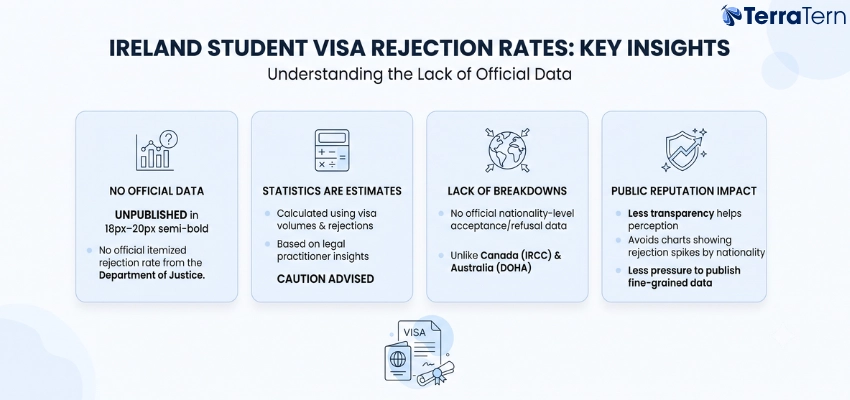
At present, the Department of Justice in Ireland doesn't publish an official, itemised Ireland student visa rejection rate, and the majority of statistics available on the websites are, in fact, estimates.
-
Ireland does not have nationality-level acceptance and refusal breakdowns for the month, unlike IRCC in Canada or the Department of Home Affairs (DOHA) in Australia.
-
All published Ireland student visa rejection rates should be viewed with caution, as they are typically calculated using factors such as visa volumes, the number of visa rejections, or legal practitioners' estimates.
-
The contrast is important because refusals are growing more rapidly in Canada, Australia, and the US, which means governments there are under greater pressure to have a finer-grained picture of how many are rejecting them.
-
Oddly enough, Ireland has less transparency, which can actually help its reputation, since there never seems to be a public chart showing repeated spikes in rejections by nationality or intake.
Important Note: When a "rejection rate" isn't officially published, always ask what the estimate is based on; this is exactly the kind of scrutiny that separates a genuinely researched guide from a recycled statistic.
How Has the Ireland Student Visa Rejection Rate Changed Since 2019?
The Ireland student visa rejection rate has declined significantly in recent years, dropping from around 10% in 2019 to approximately 6% in 2023, and now in the current range of 1-4% in 2025-2026.
-
By tracking the rejection rate for Irish student visas, you can gain insights into the essentials of preparing accurate, document-based applications.
-
This reflects 2026 visa trends in which some immigration and education consultants report unusually high rejection numbers in specific intakes, even though the national average remains low.
|
Year |
Rate |
Why |
|
2019 |
~10% (Point-in-time estimate) |
Historical baseline prior to comprehensive digital processing reforms. |
|
2023 |
~6% (Point-in-time estimate) |
Post-pandemic application surge and heightened fraud-document concerns. |
|
2025–2026 |
1–4% (Multi-year average) |
Improved AVATS digital processing and higher applicant awareness of requirements. |
Expert Tip: The multi-year decline in Ireland's rejection rate is a genuine trend, not a one-off, which matters if you're weighing Ireland against a destination where rates are moving sharply in the opposite direction.
Is the Ireland Student Visa Rejection Rate Different for Indian Students?
No, Indian applicants face roughly the same 1–4% rejection band as other well-documented nationalities, and Indian students are now Ireland's largest international student cohort, growing by roughly 30% year-over-year in 2024/25.
-
Enrolment Scale First: Ireland's international student population hit a record 44,500 in 2024/25, up 10% year-over-year, and Indian students made up just over 20% of that total. Figures range from roughly 9,175 (ApplyBoard/HEA count) to 13,000 (institutional counts cited by Irish officials), depending on the source and count methodology.
-
Growth, not Just Stability: Indian enrolments jumped nearly 30% year-over-year in 2024/25, making India the top driver of Ireland's overall international growth and its largest source market for the second year running. This is expansion, not a country cautiously maintaining a flat quota.
-
Rate Parity Statement: Available data does not show a materially different Ireland student visa rejection rate for Indian applicants compared to the general 1–4% band. Indian students are not flagged as a high-scrutiny nationality in current reporting by immigration lawyers.
-
The Nationality Caveat: Immigration-law sources (including IAS) flag certain other nationalities, notably Nigeria and Yemen, as facing materially higher scrutiny for refusal. Indian applicants fall outside that higher-risk category based on currently available data.
-
The Contrast That Matters: This pattern of rising Indian enrolment alongside a stable, low Ireland student visa rejection rate stands in sharp contrast to the "Big Four" destinations (Canada, US, UK, Australia), where Indian applicants have faced sharply rising refusal rates in the same period.
Expert Advice: Ireland isn't merely tolerant of Indian applicants; its Indian student population is growing faster than almost any other cohort in the country, which is a meaningfully different signal than a flat "low rejection rate" claim.
How Does Ireland's Student Visa Rejection Rate Compare to Canada, the US, the UK & Australia in 2026?
The Ireland student visa rejection rate (1–4%) is dramatically lower than the 2025–26 rates in the traditional “Big Four” destinations; Canada rejected roughly 74% of Indian study-permit applicants in August 2025; the US F-1 rejection rate for Indian applicants hit approximately 61% in 2025, and Australia's rejection rate for Indian applicants climbed to around 40% by early 2026.
|
Destination |
Rejection Rate (Indian applicants, 2025–26) |
Trend |
|
Ireland |
1–4% |
Stable/declining |
|
Canada |
~74% (Aug 2025) |
More than doubled since 2023 (32%) |
|
USA (F-1) |
~61% (2025) |
Up from 36% in 2023 |
|
Australia |
~40% (early 2026) |
More than doubled vs. 2025 peak |
|
UK |
~26–36% (2025, rising) |
Up 8–15 points YoY |
|
Germany (for context) |
~90–95% approval |
Stable, comparably accessible |
The rising refusal rates across the Big Four stem from sweeping macro-policy shifts rather than a drop in applicant quality. This contrasts sharply with Ireland's steadier, quality-control-oriented approach that keeps the Ireland student visa rejection rate remarkably low:
Important Tip: For Indian applicants specifically, this isn't just "Ireland has a lower rate"; it's that Ireland's relative advantage over Canada, the US, and Australia has widened dramatically in the past two years, which changes the calculus for anyone still weighing destinations.
What Do Ireland's Student Visa Refusal Codes Reveal About Rejection Patterns?
Refusal letters cite specific Irish student visa refusal codes, including insufficient documentation, financial inadequacy, inconsistencies (INCO), obligation-to-leave concerns, and prior refusal non-disclosure.
-
Industry estimates suggest that financial and documentation issues together account for more than half of all refusals, significantly driving the overall Ireland student visa rejection rate.
-
Because the baseline Ireland student visa rejection rate is so low, applications are rarely denied due to quota limits; they fail when applicants do not strictly adhere to the rigid documentation guidelines.
|
Refusal Code |
Meaning |
Approximate Share |
|
F / PF / PR (Finances) |
Insufficient proof of funds or "parked" funds without a 6-month history. |
~30% |
|
ID (Insufficient Documentation) |
Missing, untranslated, or unsigned mandatory application documents. |
~25% |
|
SP / CP (Student/Course Profile) |
Weak Statement of Purpose (SOP) failing to explain academic progression. |
~15% |
|
OB / R (Obligation / Reference) |
Failure to demonstrate strong economic or family ties to return home. |
~10% |
|
INCO (Inconsistencies) |
Contradictory details (e.g., dates, spellings) across submitted paperwork. |
~7% |
|
VR (Visa Refusal) |
Undisclosed prior visa rejections from Ireland or other nations. |
Varies |
As per TerraTern Expert: he refusal-code data tell a reassuring story: most rejections trace back to fixable administrative and financial documentation gaps, not to eligibility or character issues ,which is exactly why the rate keeps trending down as applicant awareness improves.
What Should You Do If Your Ireland Student Visa Is Rejected?
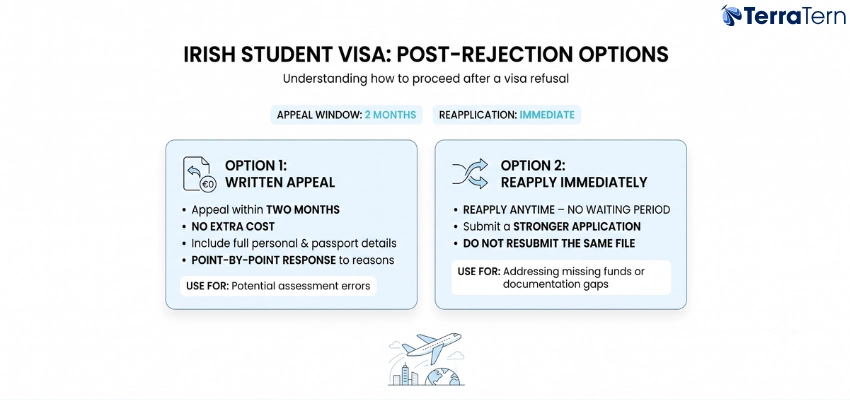
If your Irish student visa rejection rate is refused, you can usually appeal the decision in writing within two months at no extra cost.
-
You can also reapply right away with a stronger application; there is no mandatory waiting period.
-
The safest rule is simple: do not resubmit the same uncorrected file, because it is likely to be refused again
-
A written appeal should include your full name, address, passport details, transaction number, and a point-by-point response to each reason for refusal.
-
The appeal is sent to the Visa Appeals Office, INIS, Department of Justice, 13–14 Burgh Quay, Dublin 2.
-
Use the appeal route when the refusal appears to be an assessment error; reapply when the problem is a real gap, such as insufficient funds or missing proof.
How Do You Appeal an Ireland Student Visa Refusal?
You must submit a formal written appeal by post to the Visa Appeals Office within exactly two months of the date stamped on your refusal letter.
-
Address Every Code: To successfully overcome the Ireland student visa rejection rate, your appeal letter cannot be generic; it must individually address and systematically refute every specific reason (refusal code) cited in your denial.
-
Required Details: Your submission packet must clearly state your full name, postal address, and your original Visa Application Transaction Number.
-
Submission Format: Appeals must be mailed in a secure envelope (emails and faxes are strictly ignored) and must include original, physically signed supporting documents rather than just photocopies.
Should You Appeal or Reapply After an Irish Student Visa Rejection?
File an appeal (which incurs no additional visa fee) if you firmly believe the refusal was a genuine assessment error by the visa officer, even with an already strong, fully documented application.
-
When to Reapply: Submit a brand-new application if the refusal cites a specific, undeniable gap, such as a missing 6-month bank statement history or an unsigned form that you can now easily resolve with updated paperwork.
-
Strategic Choice: While an appeal limits you to defending the premise of your original submission, a reapplication allows you to completely rebuild and strengthen your profile. Choosing the right path based on your refusal codes is the most effective way to beat the Ireland student visa rejection rate on your second attempt.
Key Note: Don't resubmit an identical application after a refusal. Each reason for refusal requires a specific, evidence-based rebuttal, whether you choose to appeal or submit a fresh application.
What Does Ireland's Rejection Rate Mean for Indian Students Choosing a Study Destination in 2026?
For Indian students, Ireland’s low rejection rate has two key implications:
-
Predictable Outcomes: With Canada, the US, and Australia seeing sharply higher refusal rates for Indian applicants through 2025–26, the stable 1–4% Ireland student visa rejection rate provides a highly predictable study-visa outcome.
-
A True Alternative: Combining high approval odds, English-taught programs, and a two-year post-study work visa, Ireland serves as a premier like-for-like alternative for students shifting away from traditional destinations.
Pro Tip: A low rejection rate is only half the picture; pair it with Ireland's post-study work rights and its status as the fastest-growing cohort among Indian students before treating it as a "safe" choice by default.
2026 Industry Context
Some of the key facts are:
-
Latest Statistic: International enrolment in Ireland hit a record 44,500 students in 2024/25, up 10% year-over-year, the fourth consecutive year of growth (source: HEA data via ApplyBoard/The PIE News, late 2025).
-
Latest Statistic: Indian students became Ireland's single largest international cohort for the second year running, at roughly 20% of all international enrolments, growing ~30% year-over-year to about 13,000 Indian students in 2024/25.
-
Industry Development: The minimum living-cost financial-proof requirement was updated in June 2026, commonly cited as rising from €10,000 to €12,000. Applicants should verify the current figure against INIS guidance before applying.
-
Trend Analysis: Ireland's rejection rate has trended downward over time from an estimated ~6% in 2023 to the current 1–4% band, attributed to improved applicant awareness and stricter pre-submission documentation checks.
-
Industry Development (the standout 2026 angle): While Ireland's approval rate has stayed above 95%, Canada's rejection rate for Indian study-permit applicants hit ~74% in August 2025 (up from 32% in August 2023), the US F-1 rejection rate for Indian applicants hit ~61% in 2025, and Australia's rejection rate for Indian applicants climbed toward ~40% by early 2026 making Ireland one of the most accessible remaining "Big study destinations" for Indian applicants.
- Trend Analysis: Ireland ranked #2 globally on the 2025 Global Peace Index, a factor that education agents increasingly cite as influencing Indian family decision-making alongside visa approval odds.
Conclusion
The Ireland student visa rejection rate is estimated at 1–4%, in sharp contrast to the massive 2025–26 refusal spikes seen across Canada, the US, and Australia. Because most Irish visa rejections stem from easily fixable financial and documentation issues rather than strict structural caps, your study abroad path remains highly manageable. Take the next step by reviewing our refusal-code guide or starting a comprehensive visa eligibility assessment directly on the TerraTern Ireland Immigration Hub.
Contact TerraTern for more information on Ireland Student Visa Rejection Rate 2026: Data, Reasons & Fixes.




 AI Summary