


Key Highlights
- How to Settle in New Zealand from India?
- How Does the New Zealand PR Points System (SMC) Work for Indians in 2026?
- Am I Eligible to Settle in New Zealand from India?
- What Documents Are Required to Settle in New Zealand from India?
- What Is the Step-by-Step Process to Settle in New Zealand from India?
- How Much Does It Cost to Settle in New Zealand from India?
- How Do You Settle In After Arriving in New Zealand?
- What Should Indians Know About the 2026 India–New Zealand Immigration Relationship?
- What Are Common Mistakes to Avoid When Settling in New Zealand from India?
- Conclusion
In search of a brilliant quality of life, gorgeous scenery, and amazing job possibilities? Making a move to Aotearoa is a decision that makes a difference. This is the ultimate guide on how to settle in New Zealand from India in 2026. Whether it's navigating the latest visa channels, such as the Skilled Migrant Category, or coping with everyday life in New Zealand and getting yourself settled into the culture, we have got you covered for a smooth move to your stunning new Kiwi residence.
How to Settle in New Zealand from India?

There are four main pathways that Indians can follow to settle in New Zealand from India: skilled migrants, family sponsorship, business/investment, and the Temporary Employment Entry visa. New Zealand PR from India, on the other hand, is typically based on one of these three factors: skills, relations, or capital for long-term planning, and then the applications would qualify for residence under the relevant path for Indian immigrants.
|
Pathway |
Best For |
Approx. Timeline |
Key Requirement |
|
Skilled Migrant Category visa |
Skilled professionals |
6–12+ months |
6 points + skilled job or eligible qualification/registration/income |
|
Family/Partner visa |
Spouses, partners, eligible family |
12–24+ months |
Genuine relationship or eligible family sponsorship |
|
Business/Investment visa |
Entrepreneurs and investors |
12–36+ months |
Approved business plan or required investment funds |
|
Temporary Employment Entry Visa |
Indian workers using 2026 FTA-linked route |
Route-dependent |
Eligible job offer and compliance with visa conditions |
As per our TerraTern Expert Divyansh,Most Indian applicants default to the Skilled Migrant Category, but if you work in ICT, engineering, specialised health services, or as an AYUSH practitioner, chef, yoga instructor, or music teacher, the new FTA-linked TEE visa may be faster to secure than SMC; it's worth checking both.
What is the Skilled Migrant Category (SMC) Visa?
The Skilled Migrant Category Resident Visa is a residence visa category. For those who have a qualification, a job, or occupational registration, the SMC Resident Visa is New Zealand's main points-based visa pathway to permanent residence. To settle in New Zealand from India and obtain the NZ skilled migrant visa for Indians via Immigration New Zealand (INZ), specific conditions must be met to be eligible:
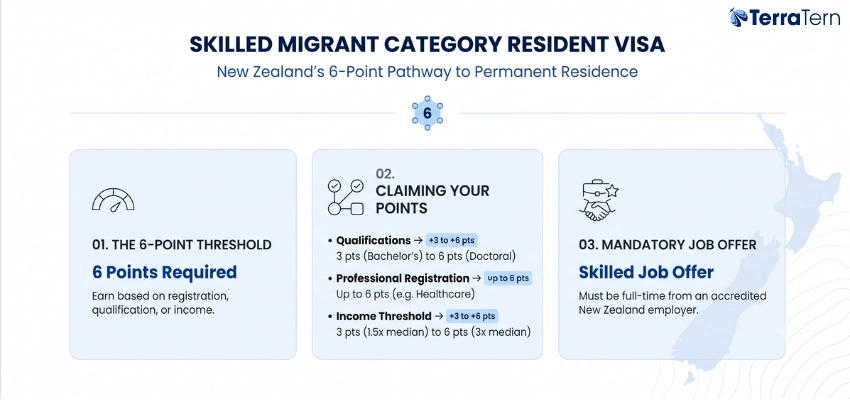
1. There are Minimum Requirements for earning 6 Points: you need to have a minimum of 6 points to earn based on professional registration, academic qualifications, or an income level.
2. There are Three Ways of Claiming Points:
-
Qualifications: up to 6 marks, depending on the field (registered healthcare practitioners, for example).
-
Qualifications: Bachelor's degree (3 points) & Doctoral degree (6 points).
-
Income: 3 points for earning 1.5x the median wage; up to 6 points = earning 3x the median wage.
3. Job Offer Requirement: All applicants will be required to have a skilled, full-time job offer from an accredited employer in New Zealand (irrespective of points).
Important Note: You can only claim points from one skill category at a time (registration, qualification, or income); combining them is a common and costly application mistake.
What Are the Family and Parent Child Visa Options?
Indian husbands, wives, or children of parents who hold New Zealand citizenship or have settled in NZ may apply under the following categories of visa: Partner, Dependent Child, Parent Resident Visa. Australia's NZ family visa from India is a straightforward route to visit Australia. The following are the members how to settle in New Zealand from India with their families
-
Partner Resident Visa: Partner visas require evidence that the relationship is genuine and stable; check the exact requirements of the relevant partner category.
-
Dependent Child Resident Visa: For kids who are under 24 years old, have been financially dependent on a New Zealand citizen or resident, and qualify for this visa.
-
Parent Resident Visa: No more than 2,500 visas of this type are allowed annually. The dual system for selection of applicants after the policy changes in October 2026: 90% are selected from a priority queue and 10% from a random ballot.
Expert Tip: Parent Resident Visa applicants no longer need to resubmit an expired Expression of Interest under the October 2026 changes, a meaningful relief for Indian families who've been waiting years in the queue.
Can Indians Settle in New Zealand Through Investment or Business?
Yes, the Investor Visa and Entrepreneur Work Visa are visas that permit Indian nationals to invest capital or establish a qualifying business in New Zealand, which leads to residency. This is a lower-volume pathway to temporary migration to New Zealand, but a New Zealand Investor visa route from India is by far the most stable for the successful applicant who meets the criteria for this pathway. How to settle in New Zealand from India for business is the following way
-
The Active Investor Plus Visa: is for those with substantial wealth who come with the understanding of making both passive and direct investments. The investment amount ranges from NZD 5 million to NZD 15 million, depending on the asset class of the fund. The amount is determined based on a weighted points system.
-
Entrepreneur Work Visa: suitable for experienced business owners or senior managers who aim to undertake a business in New Zealand that involves purchasing or founding a high-growth, innovative export business.
-
Note on Thresholds: Investment rules and financial thresholds vary. For high-growth, getting professional advice on the current investment requirements of the INZ is highly recommended.
Expert Advice: Business/investor pathways typically require deeper due diligence than SMC; budget extra time for a business plan review before filing an Expression of Interest.
What Is the New India-New Zealand FTA Temporary Employment Entry (TEE) Visa?
The historic India-New Zealand FTA-related capped Temporary Employment Entry visa route was signed in April 2026. This is a good stepping stone visa towards living in how to settle in New Zealand from India. The Temporary Employment Entry visa New Zealand program provides for key information such as:
-
Annual Quota: Approximately 1667 visas are available each year for a tenure of three years, and no more than 5000 visas are to be in effect simultaneously in-country at any given time.
-
Targeted Sector: Open to Indian professionals from ICT, engineering, some specialised health-related fields like AYUSH practitioners, chefs, yoga trainers, and musicians, etc., with traditional skills.
-
Working Holiday Scheme: In addition, another 1,000 places are provided to Indian citizens aged 18 to 29 per year.
-
Residence Connection: The TEE is a temporary visa, but it can help you gain local work experience and the network that is vital to qualify properly for the residency visa – the Skilled Migrant Category.
Important Tip: The TEE visa is capped and occupation-specific; it is not a general "move to NZ" visa, so confirm your occupation is on the eligible list before treating it as your primary pathway.
Also Read: How to Get a Job in New Zealand from India: Latest Guide
How Does the New Zealand PR Points System (SMC) Work for Indians in 2026?
If you are looking at how to settle in New Zealand from India , understanding the New Zealand PR points system 2026 is essential. Since October 2023, Immigration New Zealand has operated a simplified 6-point Skilled Migrant Category (SMC) system. However, starting 24 August 2026, two new residence pathways and simplified wage rules make it even more accessible for Indian applicants to secure residency. Here is how the points are structured under the New Zealand PR points system 2026:
|
Category |
Points |
Key Rule |
|
New Zealand occupational registration |
3–6 |
Depends on registration, training, and experience requirements. |
|
Recognised qualification |
3–6 |
Bachelor’s degree: 3; postgraduate qualification: 4; master’s degree: 5; PhD: 6. |
|
Income from a skilled job |
3 / 4 / 6 |
Based on earning 1.5×, 2×, or 3× the applicable median-wage level. |
|
Skilled work experience in New Zealand |
1–3 bonus points |
One point per year, up to three points. |
|
SMC threshold |
6 points |
Applicants also need a skilled job or job offer, plus health, character, and English-language eligibility requirements. |
As per our TerraTern Expert: The old 180-point system is obsolete if you see a blog or forum post citing a 100- or 160-point threshold, it's outdated; the current bar is 6 points.
What Changed in New Zealand's SMC Visa Rules from August 2026?
How to settle in New Zealand from India under the New Zealand PR points system 2026, INZ’s announced 24 August changes add the Skilled Work Experience Pathway and Trades and Technician Pathway, simplify wage thresholds, and add a five-month grace period. Verify current settings at immigration.govt.NZ before applying, because final pathway rules and occupation coverage may be updated by INZ.
|
2026 change |
Practical meaning |
Indicative eligibility to verify |
|
Skilled Work Experience Pathway |
Helps experienced, skilled workers qualify through their work history rather than relying mainly on qualifications. |
At least 5 years of relevant skilled experience, including New Zealand skilled work; commonly linked to ANZSCO skill levels 1–3. |
|
Trades and Technician Pathway |
Supports trade and technician applicants who may not fit degree-focused residence routes. |
A relevant trade or technical occupation, suitable qualification or experience, and qualifying skilled work experience in New Zealand. |
|
Simplified wage-threshold rule |
The wage test may use the rate that applied when the applicant began their qualifying skilled work experience. |
Useful where the median-wage threshold increases after the applicant’s employment starts. |
|
Five-month grace period |
Gives eligible applicants time to secure another qualifying role if their employment ends. |
The applicant must regain eligible skilled employment within the applicable five-month grace period. |
Pro Tip: If you're currently accruing skilled work experience in New Zealand, the new grace period means a wage-threshold increase announced after you started work won't retroactively disqualify you but you must begin skilled employment within five months of your work visa being granted to lock it in.
How Many Points Do I Need to Settle in New Zealand from India?
How to settle in New Zealand from India and meet the 6-point minimum under the New Zealand PR points system 2026.
-
Claim core points from exactly one category: occupational registration, Bachelor’s+ qualification, or income at 1.5x the median wage or above.
-
Add up to 3 bonus points for skilled work experience in New Zealand.
-
Example: Indian IT professional with a Master’s 5 points 2 years of NZ skilled work 2 points total 7 points.
-
Common mistake: you cannot combine qualification, income, and registration points together.
Key Note: A skilled job offer with an accredited employer is mandatory regardless of how many points you've banked. Points alone do not guarantee an Invitation to Apply.
Am I Eligible to Settle in New Zealand from India?
How to settle in New Zealand from India first check basic New Zealand visa eligibility for Indian citizens.
- Age: most residence routes, especially SMC, generally require applicants to be 55 or under.
- Health: medical and chest X-ray from an INZ-approved panel physician may be required.
- Character: Indian PCC and overseas police certificates may be needed.
- English: IELTS/PTE or an approved equivalent is commonly required.
Important Tip: A pre-existing health condition doesn't automatically disqualify you. Immigration New Zealand assesses the cost to the health system on a case-by-case basis, so get a medical assessment early rather than assuming ineligibility.
What Are the Age, Health, and Character Requirements?
Here are the requirements before lodging your visa to settle in New Zealand from India:
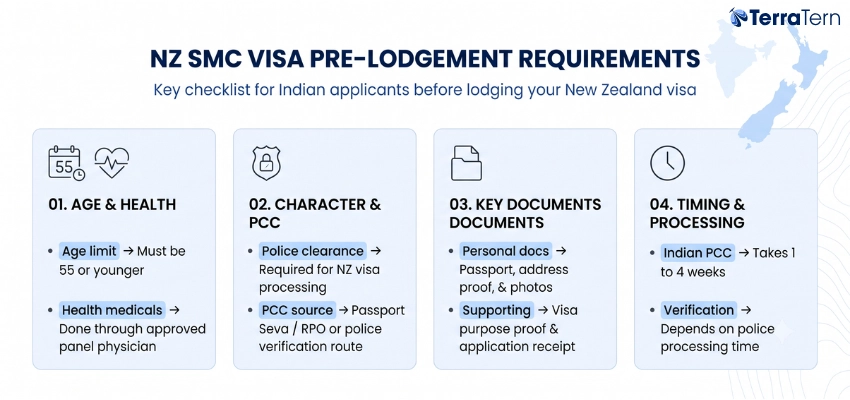
- Age: SMC applicants generally must be 55 or younger.
- Health: Complete medicals through an approved panel physician.
- Character: Provide a police clearance certificate for New Zealand visa processing.
- Indian PCC: Apply via Passport Seva/Regional Passport Office or the police verification route.
- Documents: passport, address proof, visa purpose proof, photos, and application receipt.
- Timing: Indian PCCs often take 1–4 weeks, depending on police verification.
Expert Advice: Start your police clearance certificate and medical exam early; both have limited validity windows (PCC and medicals typically must be recent relative to your visa application date), and delays here are among the most common causes of avoidable application hold-ups.
What English Language Score Do I Need IELTS/PTE?
How to settle in New Zealand from India and meet the English score required for your visa category.
-
Most SMC applicants need IELTS 6.5 overall or an approved equivalent such as PTE Academic.
-
Some family applicants may show English ability, qualify for exemptions, or pay ESOL tuition.
-
Expert takeaway: if you hold recognised NZ occupational registration, 2026 SMC settings may allow longer English-test validity confirmation before re-sitting.
|
Visa Type |
Minimum Score |
Test Validity |
|
Skilled Migrant Category Resident Visa |
IELTS 6.5 overall or an approved equivalent |
Usually 2 years; may extend to 5 years for applicants with recognised occupational registration under the 2026 settings. |
|
Partner or family residence categories |
Varies by category |
Check Immigration New Zealand rules; exemptions or ESOL options may apply. |
|
Work-to-residence and skilled routes |
Often, an IELTS 6.5 overall or an approved equivalent, where English is required |
Usually 2 years, unless Immigration New Zealand confirms a different validity period. |
Key Note: If your profession has New Zealand occupational registration (e.g., nursing, engineering), your English test result may now stay valid for 5 years under the 2026 rules. Confirm this before re-sitting an exam unnecessarily.
What Documents Are Required to Settle in New Zealand from India?
Core documentation needed to support how to settle in New Zealand from India includes a valid passport, IELTS/PTE score reports, educational and qualification evaluations, an official job offer letter, medical clearances, police certificates, and proof of funds.
|
Document |
Purpose |
Where Indian Applicants Obtain It |
|
Valid Passport & Identity Photos |
Establishes legal identity and citizenship |
Regional Passport Offices in India / Indian Government |
|
International Qualification Assessment (IQA) |
Verifies overseas degrees match New Zealand standards (required for Level 8/9+ qualifications under 2026 SMC updates) |
New Zealand Qualifications Authority (NZQA) |
|
English Language Test Report |
Proves standard English proficiency (e.g., IELTS, PTE Academic) |
Authorized testing centers across India (British Council, IDP, Pearson) |
|
Accredited Employment Agreement |
Confirms full-time skilled job offer and compliance with median wage rules |
Provided by your vetted New Zealand employer |
|
Police Clearance Certificates (PCC) |
Proves good character requirements for applicants aged 17 and older |
Passport Seva Kendra / Regional Passport Office / Local Police in India |
|
Medical & Chest X-ray Certificates |
Demonstrates an acceptable standard of health via an eMedical reference code |
INZ-approved panel physicians and designated clinics in India |
As per our TerraTern Expert Shreya, if your Master's or PhD isn't on New Zealand's qualification exemption list, budget both time and cost for an International Qualification Assessment (IQA). This is one of the most underestimated steps by first-time applicants.
Also Read: New Zealand Work Visa: Complete Guide for Indian Professionals
What Is the Step-by-Step Process to Settle in New Zealand from India?
Successfully mastering how to settle in New Zealand from India follows a clear sequence: check your eligibility, submit an Expression of Interest (EOI), receive your Invitation to Apply (ITA), lodge your official resident visa application, secure approval, and plan your relocation.
Important Tip: An Expression of Interest is provisional, not a guarantee. A competitive EOI (strong points + a genuine skilled job offer) meaningfully shortens the wait for an Invitation to Apply.
Step 1: Check Your Eligibility and Points
Conduct a thorough self-assessment covering age, health, character, English language proficiency, and core points before investing in formal documentation.
-
Verify that your qualifications and professional profile meet the baseline criteria required to settle in New Zealand from India under current immigration structures
-
Take advantage of professional resources, such as TerraTern's free eligibility check tool, to accurately gauge your standing before officially applying.
Expert Advice: Don't order paid document translations or medicals until you've confirmed your points category sequencing saves applicants real money.
Step 2: Submit Your Expression of Interest (EOI)
Lodge your online Expression of Interest through Immigration New Zealand’s digital portal to formally register your intent and qualifications.
-
Provide comprehensive details regarding your work experience, qualifications, and job offer to ensure your profile is accurately evaluated when learning how to settle in New Zealand from India
-
Your profile remains active in the EOI pool until it is selected during the next regular draw cycle or expires according to system rules.
Expert Tip: Draft EOIs are not saved indefinitely. Immigration New Zealand has flagged draft-EOI expiry around rule-change dates (as with the 24 August 2026 update), so submit promptly once ready.
Step 3: Receive Your Invitation to Apply (ITA)
Watch for pool selection; once your EOI meets the required thresholds, Immigration New Zealand will issue an official Invitation to Apply (ITA).
-
Review the specific timeline and instructions included in your invitation, as applicants must submit their full residency package within a strict, non-negotiable window.
-
Securing an ITA is a vital milestone when figuring out confirming that your initial profile metrics have passed government screening.
Important Note: Missing the ITA response window can mean re-entering the EOI pool from scratch. Calendar the deadline the moment you're invited.
Step 4: Submit Your Resident Visa Application
Compile and upload your complete document bundle, including qualification assessments, police certificates, medical reports, and employment proof, alongside the required government visa fees.
-
Monitor your status closely and utilise interim visa protections if any existing temporary work visa expires while your permanent resident application is actively processed.
-
Ensure every uploaded file matches the exact specifications to avoid administrative delays in your journey on how to settle in New Zealand from India
As per TerraTern Expert: If your existing work visa expires while your Resident Visa is being processed, apply for the SMC Interim Visa in advance; don't let your legal status lapse.
Step 5: Get Your Visa Approved and Plan Your Move
Receive your official residency approval notice and finalise your transition preparations, including booking flights and arranging temporary accommodation.
-
Handle crucial pre-departure tasks such as setting up international banking, sorting out insurance, and organising shipping for personal belongings.
-
Complete your final checklist steps to smoothly transition your life and career as you how to settle in New Zealand from India permanently.
Pro Tip: Book at least a short-term (4-week) accommodation before you land. Trying to secure long-term housing without a local reference or bank account is one of the top frustrations new arrivals report.
How Much Does It Cost to Settle in New Zealand from India?
Budget roughly NZD 6,450+ in core SMC government fees per family (approximately INR 3.6–4 lakh at current exchange rates), alongside mandatory outlays for English testing, medical examinations, police clearance certificates, qualification assessments (IQA), and proof of 3–6 months of living-cost funds.
|
Expense Category |
Cost in NZD |
Indicative Cost in INR (INR ) |
|
Skilled Migrant Category (SMC) Resident Visa |
From NZD $6,450 |
~INR 3,30,000 – INR 3,60,000 |
|
Accredited Employer Work Visa (AEWV) (Stepping-stone route) |
NZD $1,540 |
~INR 78,000 – INR 85,000 |
|
International Qualification Assessment (IQA via NZQA) |
Approx. NZD $750 – $1,200 |
~INR 38,000 – INR 65,000 |
|
English Language Testing (IELTS / PTE Academic) |
Approx. NZD $300 – $350 |
~INR 16,000 – INR 18,500 |
|
Medical Examination & Chest X-ray |
Approx. NZD $350 – $500 |
~INR 18,000 – INR 26,000 |
|
Police Clearance Certificates (PCC) |
Nominal fee |
~INR 1,000 – INR 2,500 |
Key Note: Government fees are only part of the budget relocation costs (flights, initial accommodation, shipping), and 3–6 months of NZD living-cost evidence of funds to support often exceed the visa fees themselves.
How Do You Settle In After Arriving in New Zealand?
Successfully navigating how to settle in New Zealand from India requires mastering your initial 90 days through essential logistical, financial, and cultural steps.
As per our TerraTern Expert Divyansh, apply for your IRD number before your first paycheck. Without one, employers must tax you at the highest non-declaration rate until it's issued.
How Do I Open a Bank Account and Get an IRD Number?
Major New Zealand banks (such as ANZ, ASB, and Westpac) allow you to open deposit-only accounts up to 180–365 days before you land.
-
Your account remains in deposit-only mode until you verify your physical identity and New Zealand address at a local branch during your first week.
-
Apply online for your Inland Revenue Department (IRD) number immediately upon arrival to prevent employers or banks from withholding tax at the highest non-declaration rate.
Important Note: Several NZ banks let you start account opening from India online. Doing this before departure means you can receive your salary and pay a deposit on housing immediately on arrival.
How Do I Find Accommodation and a Job in New Zealand?
Navigate the competitive rental market by familiarizing yourself with standard tenancy agreements, bond rules, and Healthy Homes rental standards.
-
Leverage professional local channels including TradeMe Jobs, Seek, LinkedIn, and specialized recruitment agencies to secure or advance your employment.
-
Explore resources such as TerraTern's professional career portals for curated job-search strategies tailored to international migrants.
Expert Tip: Short-term serviced/Airbnb accommodation for your first 2–4 weeks gives you a local address and time to view rentals in person. Most landlords are reluctant to lease sight-unseen to newly arrived migrants.
How Do I Access Healthcare and Enrol My Children in School?
Register with a local General Practitioner (GP) early to access subsidised healthcare services available to permanent residents.
-
Enrol dependent school-aged children into your local educational zone by contacting nearby public or integrated schools directly with your residency paperwork.
-
Utilise free government settlement support networks, such as the Citizens Advice Bureau (CAB), to guide your family through community integration.
Expert Advice: Enrol with a local GP practice as soon as you have an address. Some practices in high-demand areas have waitlists, and GP enrolment is usually required to access subsidised (non-emergency) healthcare.
How Can I Adjust to Life and Culture in New Zealand?
Ease your transition by connecting with local cultural groups, exploring festival calendars (such as Diwali celebrations across Auckland), and adapting to Kiwi workplace norms.
-
Access multilingual support and settlement assistance programs offered through official government channels if you require language guidance.
-
Explore TerraTern's specialised guides on managing cultural adjustment and overcoming migration stress to maintain long-term stability.
Important Tip: New Zealand's Indian community is now its third-largest ethnic group and growing fast. Joining a local cultural or professional association (many Indian associations exist in Auckland, Wellington, and Hamilton) is consistently cited by new migrants as the single fastest way to feel settled.
Also Read: New Zealand Permanent Residency Application: Your Complete Guide
What Should Indians Know About the 2026 India–New Zealand Immigration Relationship?
How to settle in New Zealand from India , track official New Zealand-India visa news 2026 before choosing a route.
-
The India-New Zealand FTA immigration update reportedly adds TEE visas, Working Holiday places, and student work-right benefits.
- Verify every update with INZ/MFAT; this section should be refreshed as policy develops.
What Are Common Mistakes to Avoid When Settling in New Zealand from India?
Some of the common mistakes to avoid are:
-
Combining SMC Points Wrongly: use only one core skill category.
-
Weak Job Offer: confirm wage, hours, employer accreditation, and skill level.
-
Expired Documents: track medicals, PCCs, and English scores.
-
Under-Budgeting: plan for rent, deposits, fees, and emergency funds.
-
Misreading TEE: it is capped and occupation-specific.
Conclusion
How to settle in New Zealand from India: settling in New Zealand from India in 2026 comes down to choosing the right pathway, meeting SMC points or India-specific FTA visa criteria, and budgeting realistically. Check eligibility, prepare PCC, medicals, English scores, job documents, and proof of funds early. Compare skilled, family, business, and temporary routes carefully. For personalised planning and document support, book a TerraTern consultation before applying.
Contact TerraTern for more information on How to Settle in New Zealand from India: Complete 2026 Guide.




 AI Summary