

Key Highlights
- How to Get a PR in Ireland?
- What's New for Ireland PR in 2026? (Latest Rules & Statistics)
- What Is PR in Ireland and How Does It Actually Work?
- Who Is Eligible to Get PR in Ireland?
- What Are the Different Pathways to Get PR in Ireland?
- How to Get PR in Ireland: Step-by-Step Application Process
- What Documents Are Required for the Ireland PR Application?
- How Much Does It Cost to Get PR in Ireland?
- How Long Does It Take to Get PR in Ireland?
- What Are the Benefits of Getting PR in Ireland?
- What Are Common Mistakes That Lead to Ireland PR Rejection?
- How Does TerraTern Help You Get PR in Ireland from India?
- Conclusion
For many Indian professionals, it is an attractive proposition to take advantage of the opportunity to work in Ireland's strong economy and friendly culture. Understanding Ireland’s long-term residence options is an important part of planning your move.. There are pathways in the country, usually through express entry visa (ETV) programs, eventually leading to Stamp 4.
This is a step-by-step guide for 2026, including key requirements, timelines, and the documentation needed to make Ireland your permanent home. Indian applicants should understand the relevant employment-permit rules, residence requirements, and documentation before planning long-term settlement. towards work and settlement in Europe.
How to Get a PR in Ireland?

Ireland does not have one universal immigration status officially called “PR.” For employment-based applicants, Long-Term Residency is a five-year permission generally available after 60 months of qualifying residence. Stamp 4 is a broader immigration permission that may also be granted through the Critical Skills, family and other routes.
-
To apply for Long-Term Residency, eligible applicants generally need 60 months of qualifying residence on the relevant employment-based permissions.
-
Critical Skills Employment Permit holders may become eligible to apply for a Stamp 4 upgrade after 21 months of employment in Ireland.
-
Complete the official Long-Term Residency application form and submit it using the method specified by Immigration Service Delivery.
As per TerraTern Expert Shreya, Ireland has no single "PR visa" to apply for. Ireland does not use a universal status called ‘PR’. Depending on the route, applicants may obtain a Stamp 4 permission or apply for Long-Term Residency after meeting the relevant requirements.
Also Read: Ireland Work Visa Requirements for Indian Citizens
What's New for Ireland PR in 2026? (Latest Rules & Statistics)
The latest about how to get PR in Ireland in 2026 is:
- Long-Term Residency applicants generally need 60 months of legal residence based on qualifying employment-permit conditions.
-
From 1 March 2026, the standard Critical Skills Employment Permit salary threshold increased to €40,904. Verify the applicable General Employment Permit threshold directly on the DETE website before applying.
-
Ireland issued 31,044 employment permits in 2025, down from 39,390 in 2024. Officials and reports linked part of the drop to a new processing
-
India remained the top source country for Irish work permits in 2024, with 13,566 permits. It has led the ranking every year since 2014
-
Sector demand shifted in 2025. Health and Social Work permits fell sharply, and ICT permits also declined.
-
Ireland does not use the EU Blue Card system. Indians comparing Ireland with Germany or France should plan around Ireland’s own permit route.
-
Immigration Service Delivery has reported high volumes of Long-Term Residency applications and delays in processing. Build extra time into your relocation plan.
Important Note: Don't rely on salary figures from articles published before March 2026. Several ranking guides still quote the outdated €38,000 Critical Skills threshold, which will cause a valid application to be under-salaried on paper.
What Is PR in Ireland and How Does It Actually Work?
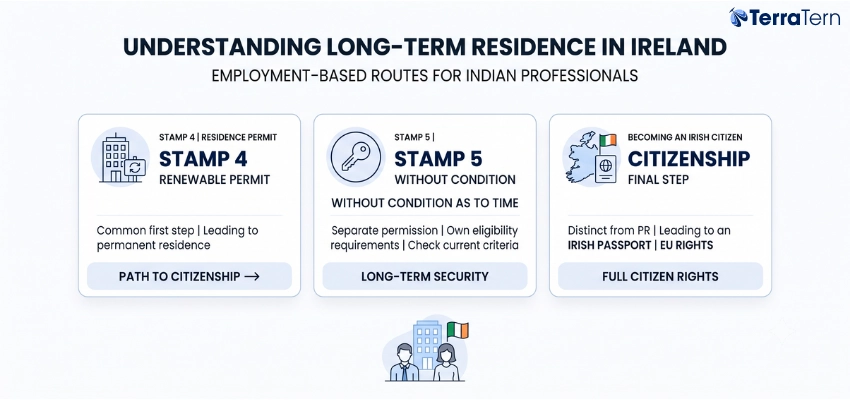
This guide focuses on employment-based routes relevant to Indian professionals seeking long-term residence in Ireland.
-
Stamp 4 usually comes first. It is a renewable residence permit, and time on Stamp 4 can count toward citizenship by naturalisation.
-
Stamp 5, also known as ‘Without Condition as to Time,’ is a separate permission with its own eligibility requirements. Confirm current criteria with Immigration Service Delivery before applying.
-
Citizenship is the final step. It is separate from PR and can lead to an Irish passport and EU rights.
-
Stamp 4 can also be issued on other bases, like family or protection routes.
What Is the Difference Between Stamp 4, Stamp 5, and Irish Citizenship?
The table below outlines the key differences between Stamp 4, Stamp 5, and Irish citizenship.
|
Status |
Ireland Term |
Qualifying Period |
Renewal Needed? |
Can vote / hold EU Passport? |
|
Permanent Residency |
Stamp 4 / Long-Term Residency |
Stamp 4 upgrade for eligible CSEP holders: 21 months of employment. Long-Term Residency: 60 months of qualifying residence. |
Yes, usually every 5 years |
No |
|
Indefinite Residency |
Stamp 5 / Without Condition as to Time |
5 years on qualifying stamps |
No |
No |
|
Citizenship |
Naturalisation |
5 years of reckonable residence |
N/A |
Yes |
Expert Tip: If your end goal is an Irish/EU passport, PR (Stamp 4) is a milestone, not the destination. Most applicants will want to plan toward naturalisation from day one rather than stopping at Stamp 4.
Who Is Eligible to Get PR in Ireland?
Long-Term Residency generally requires 60 months of qualifying residence. Separately, eligible CSEP holders may apply for a Stamp 4 upgrade after 21 months of employment, provided they remain employed and meet Ireland's "good character" and financial self-sufficiency requirements. Here is how to get PR in Ireland based on your specific immigration stamp.
What Are the Residency and Stamp Requirements for Ireland PR Eligibility?
To qualify for Long-Term Residency, your time spent in Ireland must be on a qualifying permission. Applicants should use their passport stamps and expired IRP cards to evidence qualifying periods of residence.
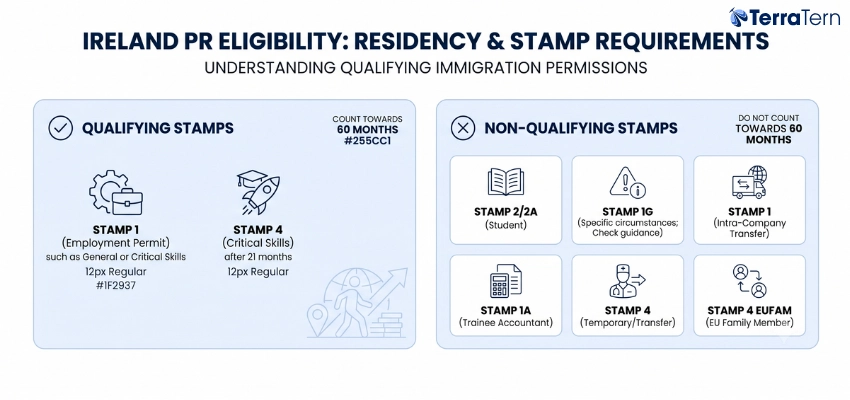
Qualifying Stamps (Count towards the 60 months):
-
Stamp 1: Issued on the basis of a qualifying employment permit, such as a General Employment Permit or Critical Skills Employment Permit.
-
Stamp 4: Issued after completing the initial 21 months on a Critical Skills Employment Permit (or Hosting Agreement).
Non-Qualifying Stamps (Do NOT count towards the 60 months):
-
Stamp 2 / Stamp 2A: Student permissions.
-
Stamp 1G: Do not assume that every period on Stamp 1G counts towards Long-Term Residency. Check the official Long-Term Residency eligibility guidance for your specific immigration history.
-
Stamp 1: If issued for an Intra-Company Transfer.
-
Stamp 1A: Trainee Accountants.
-
Stamp 4: If issued based on an Intra-Company Transfer or as a Temporary Registered Doctor.
-
Stamp 4 EUFAM: Permission based on being a family member of an EU citizen.
-
Stamp 3: Break this into separate, sourced bullet points or remove it until each category is verified.
What Other Conditions Must You Meet Beyond Residency?
Meeting the time requirement is the first step in knowing how to get PR in Ireland. Your application will also be assessed against several other mandatory conditions:
-
Continuous Employment: You must be gainfully employed at the time of your application, during the processing period, and after approval (self-employment does not qualify for this route).
-
Good Character: You must have a clean record and be of "good character" (no adverse Garda/police record or criminal charges).
-
Financial Independence: You must not be an "undue burden on the State" (meaning you cannot be reliant on non-PRSI-linked social welfare funds).
-
Immigration Compliance: You must have kept your immigration permission valid and in date throughout your stay, and not have breached the conditions of any previous Irish immigration permission.
-
Physical Presence: Should generally not exceed 90 days per calendar year.
Expert Advice: Time spent in Ireland on a student visa (Stamp 2) does not count toward your 5-year PR clock. The clock only starts once you move onto a qualifying work permit, which is why students often assume they're closer to PR than they actually are.
Also Read: Ireland's Long-Term Residency Program: Gateway to European PR
What Are the Different Pathways to Get PR in Ireland?
There are several routes to longer-term residence permissions in Ireland, including Critical Skills, General Employment Permit, family, and student-to-work pathways: the 2-year Critical Skills Employment Permit route, the 5-year General Employment Permit route, the spouse/dependent route, and the indirect student-to-work-permit route. If you are researching how to get PR in Ireland, understanding which pathway applies to your situation is the vital first step.
|
PR Pathway |
Required Residency |
Outcome |
|
Critical Skills (CSEP) |
21 Months |
Stamp 4 |
|
General Employment (GEP) |
60 Months (5 Years) |
Stamp 4 |
|
Spouses & Dependants |
60 Months (5 Years) |
Stamp 3 or Stamp 1G |
|
International Students |
Indirect (Requires Work Visa) |
Varies |
How Can Critical Skills Employment Permit Holders Get PR Faster?
The CSEP is the fastest route when navigating how to get PR in Ireland
-
The 21-Month Rule: Eligible CSEP holders can apply directly to the Department of Justice for a Stamp 4 permission after completing the required employment period. If approved, the Stamp 4 permission is generally issued for two years and may be renewed if the criteria continue to be met.
-
2026 Salary Thresholds: €40,904 for eligible roles with a relevant degree, or €36,848 for eligible recent graduates whose relevant qualification was completed within the previous 12 months.
-
Eligible Sectors: Examples include ICT, engineering, healthcare/nursing, and natural and social sciences.
How Can General Employment Permit Holders Get PR?
Understanding how to get PR in Ireland via the standard route takes longer but covers a broader range of occupations:
-
The 60-Month Route: After 5 years of continuous, legal residence on GEP or qualifying Stamp 1 or Stamp 4 conditions, you can apply directly for Long-Term Residency.
-
2026 Salary Minimum: The current minimum salary for a General Employment Permit is €36,605/year.
How Can Spouses and Dependants Apply for PR in Ireland?
For families researching how to get PR in Ireland, dependants can apply once the primary applicant has obtained Long Term Residency (Stamp 4) and the dependant has completed 60 months of legal residence. The granted stamp crucially depends on the primary permit:
-
Stamp 1G: Eligible family members may receive permission that allows employment, but the stamp and conditions depend on the sponsor’s route and the individual application.
-
Stamp 3: Dependants on the 5-year General Employment route receive this stamp, which carries no work rights.
Can International Students in Ireland Get PR?
Student time (Stamp 2) does not count toward the PR clock. To master how to get PR in Ireland as a student, you must follow this indirect pathway:
-
Complete Study: Graduate from an eligible Irish higher-education programme and meet the Third Level Graduate Programme requirements.
-
Third Level Graduate Programme permission (Stamp 1G): Obtain a Stamp 1G (up to a 24-month job-search window).
-
Work Permit: Secure a qualifying employment permit (ideally a Critical Skills permit).
-
Start the Clock: Begin your 21-month or 60-month PR clock from that permit's start date, not your arrival date as a student.
Important Tip: The Critical Skills route isn't just faster on paper because years on Stamp 4 also count toward Irish citizenship; choosing a Critical Skills-eligible role over a general one can shave nearly 3 years off your total path to an Irish passport.
How to Get PR in Ireland: Step-by-Step Application Process
Knowing how to get PR in Ireland requires following the official procedure laid out by the Department of Justice:
-
Confirm Eligibility: Ensure you have completed the required 60 (or 21–24 for CSEP) months of legal, reckonable residence on qualifying stamps.
-
Gather Documents: Collect all necessary paperwork as outlined in the next section.
-
Complete the Form: Fill out the official Long-Term Residency Application Form accurately.
-
Submit the Application: Post the completed form and all supporting documents to the Long Term Residence Section.
-
Wait for Processing: Processing times can vary. Immigration Service Delivery has reported delays because of high application volumes.
-
Pay the Fee: If your application is approved, you must pay the €500 fee by electronic funds transfer within 28 days.
-
Register your Permission: Register the granted permission via the ISD Online Registration Portal (or by appointment at the Registration Office in Burgh Quay if it is your first time registering in Dublin) to receive your physical Stamp 4/IRP card.
As per TerraTern Expert: Incomplete applications are returned unprocessed, not queried. Double-check every document against the checklist before mailing, because a rejected-for-incompleteness application means restarting the 6–8-month clock from zero.
What Documents Are Required for the Ireland PR Application?
A key part of obtaining PR in Ireland is submitting a complete and accurate document bundle. You will need:
-
Completed Long-Term Residency Application Form.
-
Full-colour copies of your past and current passports, showing all immigration stamps.
-
A copy of your current Irish Residence Permit (IRP) card.
-
Your current employment contract or an official employer letter confirming your role and dates of employment.
-
Full-colour copies of all employment permits you have held (issued by DETE).
-
Proof of continuous residence in Ireland (such as tenancy agreements, utility bills, or bank statements).
Pro Tip: Provide clear, legible colour copies of all relevant passport pages, immigration stamps, IRP cards, and employment permits, even ones you think are irrelevant. Immigration Service Delivery explicitly states that it will not accept poor-quality documentation, and partial black-and-white scans are a common, avoidable reason for rejection.
Also Read: Ireland Visa for Indians: Types, Fees & How to Apply
How Much Does It Cost to Get PR in Ireland?
When calculating how to get PR in Ireland, you must factor in the costs. The Long-Term Residency fee is payable only after your application is approved.
|
Fee Type |
Amount |
When to Pay |
|
Long-Term Residency Fee |
€500 |
Within 28 days of receiving your approval letter. Note: Not charged if refused. |
|
IRP Registration Fee |
€300 |
Paid separately when you register your new Stamp 4. |
|
Employment Permit Fee |
~€1,000 |
Paid previously when securing your CSEP or GEP. |
Key Note: The €500 fee is charged only after your application is approved. You won't lose this fee if your application is refused, but you will still have spent 6–8 months waiting.
How Long Does It Take to Get PR in Ireland?
Understanding the realistic timeline is critical when planning how to get PR in Ireland, as the calculation begins from your entry on a qualifying permit, not the day you arrived as a student or tourist.
-
Critical Skills route to Stamp 4: Eligible applicants may apply after 21 months of employment. Long-Term Residency generally requires 60 months of qualifying residence.
-
General Employment Route (~5.5 to 5.7 Years Total): 60 months (5 years) of qualifying residence → Submit Long-Term Residency application → 6–8 months processing → Stamp 4 granted.
-
2026 Processing Delays: As of mid-2026, the Immigration Services Registration Office is dealing with a significant backlog. Processing times for some renewals exceed weeks, and Long-Term Residency applications remain slow. You must factor this buffer time into your timeline.
Important Note: Build in a 2-3-month buffer beyond the official "6–8 months" processing estimate. The Department has publicly acknowledged high application volumes and delays as of 2026.
What Are the Benefits of Getting PR in Ireland?
Securing Stamp 4 fundamentally changes your immigration experience. The core benefits of how to get PR in Ireland include:
-
Work Freedom: Work for any employer in any sector without needing an employment permit.
-
Entrepreneurship: Full freedom to start your own business or work as a self-employed contractor.
-
State Services: Access to public services depends on the eligibility rules for each service, including residence, contribution, and ordinary-residence requirements.
-
Family Rights: Enhanced rights to sponsor family members to join you in Ireland.
-
Citizenship Pathway: Recognisable residence counts directly toward naturalisation (Irish/EU citizenship).
-
Stability: A Stamp 4 permission can reduce reliance on employer-sponsored work permits and may be renewable if the relevant conditions are met.
Expert Advice: The biggest practical benefit for most Indian professionals isn't the status itself; it's no longer being tied to a single sponsoring employer, which materially changes your negotiating position for salary and roles.
Also Read: Ireland Visa Processing Time in India: Full Guide
What Are Common Mistakes That Lead to Ireland PR Rejection?
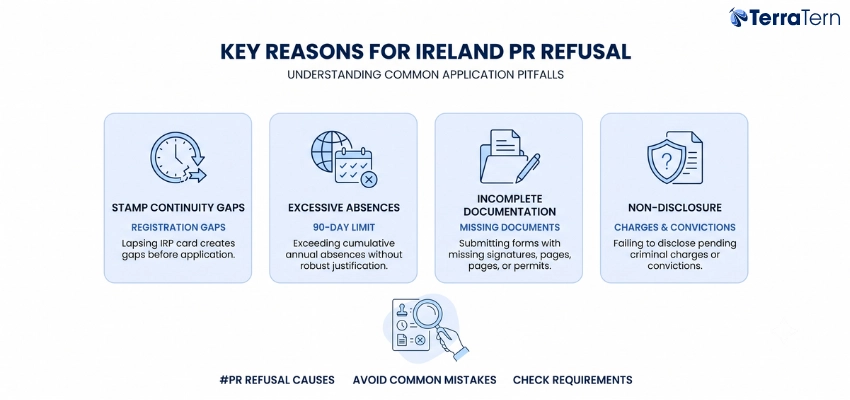
The most common reasons Ireland PR applications are refused are gaps in stamp continuity, exceeding the 90-day annual absence guideline, incomplete or poor-quality documentation, and undisclosed criminal charges or convictions.
-
Counting Non-Qualifying Stamps: Mistakenly including time spent on a student visa (Stamp 2/2A), graduate visa (Stamp 1G), or intra-company transfer towards the 60-month requirement.
-
Lapsing Registration: Letting your IRP card expire and having gaps in your immigration registration before applying.
-
Excessive Absences: Exceeding cumulative absences from Ireland (generally over 90 days a year) without robust documented justification, like a severe family emergency or mandated work travel.
-
Incomplete Documentation: Submitting forms with missing signatures, missing pages of passports, or failing to include all previous employment permits. (Incomplete applications may be delayed or returned. Check the current document checklist carefully before submission.
-
Non-Disclosure: Failing to disclose pending criminal charges or convictions. The application may be paused while charges are pending, but hiding them is grounds for outright refusal.
-
State Burden: Relying on non-PRSI (Pay Related Social Insurance) social welfare payments, which flags the applicant as an "undue burden on the State."
Pro Tip: If you're charged with a criminal offence while your application is pending, notify Immigration Service Delivery yourself. The application is placed on hold until the case is resolved, but failing to disclose it proactively is treated as a refusal-worthy omission, not a paperwork gap.
How Does TerraTern Help You Get PR in Ireland from India?
Learning how to get PR in Ireland requires meticulous planning and flawless execution. TerraTern acts as your end-to-end guidance partner, starting with a 2026 eligibility assessment against the latest salary thresholds.
-
Eligibility Assessment: Match your profile against the latest 2026 PR criteria and salary thresholds.
-
Permit Application Support: Comprehensive assistance with Critical Skills and General Employment permit applications.
-
Documentation Review: Rigorous checks to ensure your application bundle is complete and error-free, preventing avoidable rejections.
-
Long-Term Strategy: We map your pathway from Stamp 4 to citizenship, providing clarity on the entire timeline.
Key Note: Because eligibility hinges on exact stamp types and salary thresholds that change annually, a pre-application eligibility check is the single highest-leverage step most applicants skip and the most common point where preventable rejections occur.
Conclusion
Learning how to get PR in Ireland comes down to one core fact: you're building toward Stamp 4 or Long-Term Residency, depending on the applicant’s route and eligibility through 21–60 months of qualifying employment, not applying for a standalone 'PR visa'.
The Critical Skills route can provide a faster route to Stamp 4, while Long-Term Residency generally requires 60 months of qualifying residence, and the General Employment route requires around 5.5 years. With a €500 Long Term Residency fee (plus initial permit costs), securing PR is a crucial milestone, but remember it is a stage toward, not the same as Irish citizenship
Contact TerraTern for more information on how to get PR in Ireland: a complete guide for Indians.




 AI Summary