Key Highlights
- Do Indians Need a Visa to Travel to Ireland?
- What Are the Different Types of Ireland Visa for Indians?
- What Are the Ireland Visa Requirements for Indians?
- How Much Does an Ireland Visa Cost for Indians?
- How to Apply for an Ireland Visa from India — Step-by-Step Process
- Can Indians Travel to Ireland with a UK Visa? (Short-Stay Visa Waiver Programme)
- What Is the Processing Time for Ireland Visa for Indians?
- What Are the Common Reasons for Ireland Visa Rejection for Indians?
- What Happens After Your Ireland Visa Is Approved? (Post-Arrival Requirements)
- Why Apply for Your Ireland Visa Through TerraTern?
- Conclusion
If you are travelling to Ireland mostly for tourist visits, short student or work visits, then you need to get a visa to enter Ireland for Indians, as a tourist/student/worker, and the purpose of the visa must reflect the purpose of the visit. The list of Ireland visa requirements for Indians typically includes a valid passport, the online visa application form, photos, proof of income, hotel reservations, and additional supporting documents, such as an invitation or admission letter or employment paperwork.
Do Indians Need a Visa to Travel to Ireland?
Yes, an Ireland visa for Indians is mandatory for coming to Ireland for various purposes like tourism, business, study and transit.
-
A Schengen visa cannot be used to enter Ireland, as Ireland is not part of the Schengen Area.
-
Ireland's e-Visa application website will enable you to submit your visa application before sending supporting documents.
-
The Irish visa system is managed by the Department of Justice's immigration authorities, which make visa decisions.
Pro Tip: Unlike Schengen countries, Ireland operates a completely independent immigration system; even a valid EU travel history does not substitute for a proper Irish visa application.
Also Read: Ireland Visa Processing Time in India: Full Guide
What Are the Different Types of Ireland Visa for Indians?
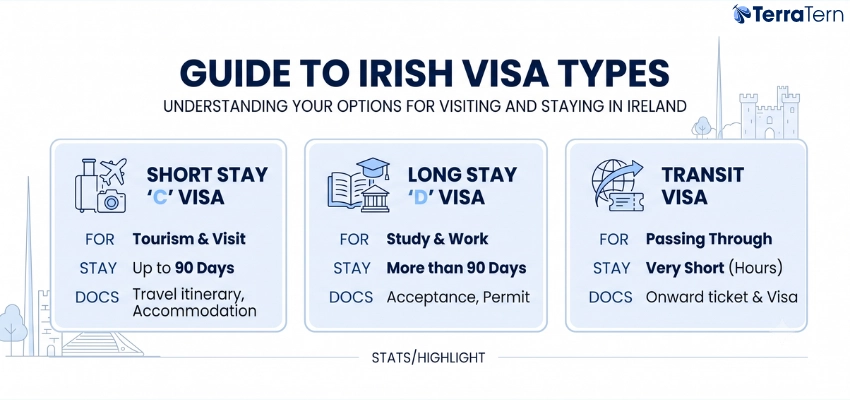
There are two broad types of Ireland visa for Indians: the Single Entry C-Ireland visa, which is valid for working in Ireland for up to 90 days, and the Multiple Entry D-Ireland visa, which can be sought by somebody looking to work in Ireland for an extended period of time, for over 90 days. Each visa type has a key supporting document that justifies your travel, and the right visa will require you to have these documents to secure it.
|
Visa Type |
Purpose / Who it is for |
Stay Duration |
Key Document |
|
Short Stay C |
Tourism, sightseeing, visiting family/friends, short business trips |
Up to 90 days |
Travel itinerary, invitation letter, or proof of accommodation |
|
Long Stay D |
Study, work, family reunion, long-term stays |
More than 90 days |
Acceptance letter, employment permit, or family sponsor documents |
|
Transit Visa |
Passing through Ireland en route to another country |
Very short, usually hours |
Onward ticket and visa for final destination if required |
Short Stay 'C' Visa for Tourist & Business Visits
This visa is conditional on specific purposes, such as holidays, family visits, meetings or conferences and may be granted for a maximum period of 90 days in Ireland. This visa is non-renewable and must be used before its expiration date. Single entry is most likely to be available; multiple entry is usually issued only when good compliance with previous visas is demonstrated.
|
Short Stay C Type |
For |
Stay |
Key Distinguishing Document |
|
Tourist / Visitor Visa |
Tourism, sightseeing, visiting relatives or friends |
Up to 90 days |
Hotel booking, itinerary, and invitation letter |
|
Business Visa |
Meetings, conferences, and short-term professional visits |
Up to 90 days |
Company invitation letter |
|
Single-entry |
One trip only |
Up to 90 days |
Standard supporting documents |
|
Multiple-entry |
Repeated short visits |
Up to 90 days per visit |
Prior visa compliance and strong travel history |
Long Stay 'D' Visa for Study, Work & Family
Long Stay D visas are for people aged 18 and over who are staying in Ireland for more than 90 days, including students, workers, and family members accompanying residents in Ireland. When you arrive, most holders must register for the Irish Residence Permit (IRP). The important document will depend on the purpose, e.g., a letter of admission for students or an employment permit for workers
|
Long Stay D type |
For |
Stay |
Key distinguishing document |
|
Study Visa |
Students enrolled in Irish institutions |
More than 90 days |
Offer/acceptance letter |
|
Critical Skills Employment Visa |
Skilled workers in high-demand jobs |
More than 90 days |
Critical Skills Employment Permit |
|
General Employment Visa |
Other approved foreign workers |
More than 90 days |
General Employment Permit |
|
Join Family Visa |
Family members joining a sponsor in Ireland |
More than 90 days |
Sponsor proof and relationship documents |
Transit Visa for Passing Through Ireland
A Transit Visa allows Indian nationals to enter the country through the airport when travelling to another country. It won't be required if you don't go outside the international transit zone, and its validity is very short, mainly for layover time. There is no requirement to register transit travellers with IRP.
|
Transit visa type |
For |
Duration |
Key document |
|
Airport Transit Visa |
Passing through Ireland to another destination |
Hours, not days |
Onward ticket and final destination visa if needed |
Key Note: Choosing the wrong visa category is the #1 avoidable error; a tourist 'C' visa strictly prohibits employment, and applying on a tourist visa for work-related purposes is grounds for immediate refusal.
What Are the Ireland Visa Requirements for Indians?
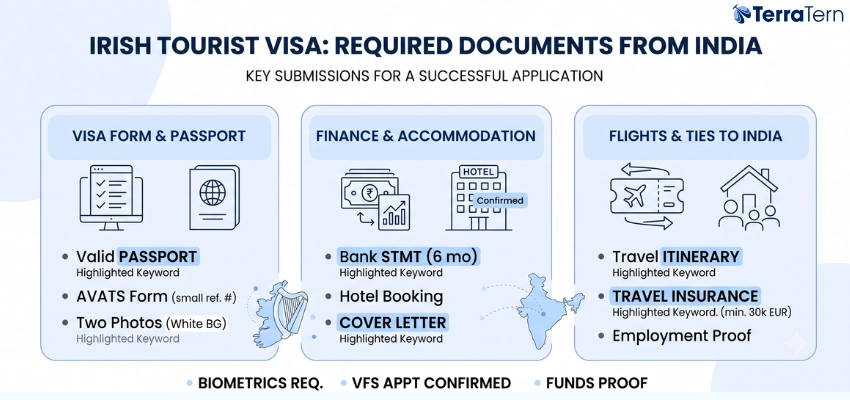
To meet Ireland visa requirements for Indians applicants, they must submit a valid passport, a completed AVATS application form, proof of funds, travel insurance with at least EUR 30,000 in coverage, confirmed accommodation, a travel itinerary, and a personal cover letter.
Mandatory Documents for an Ireland Tourist Visa from India
The mandatory documents for an Ireland tourist visa for Indians are:
-
Valid Passport: Minimum 6 months' validity beyond intended stay with at least 2 blank pages.
-
AVATS Online Application Form: Completed, printed, and signed summary sheet with reference number.
-
Passport Photographs: Two recent colour photos against a white background.
-
Personal Cover Letter: Outlining full travel dates, accommodation details, reason for visit, and funding source.
-
Bank Statements: Signed and stamped original statements from the last 6 months showing sufficient funds.
-
Proof of Accommodation: Confirmed hotel booking or a formal invitation letter from a host in Ireland.
-
Travel Itinerary: Return flight bookings and an outline of planned activities.
-
Travel Insurance: Comprehensive medical coverage of at least EUR 30,000 valid for the entire stay.
-
Proof of Ties to India: Current salary slips, employment letter, or Income Tax Returns (ITR) if self-employed.
-
VFS Appointment Confirmation: Printed confirmation letter for document submission and biometrics.
Additional Documents for Business Visa Applicants
Additional documents for the Ireland visa requirements for Indians business applicants are
-
Invitation Letter: An official letter from the host Irish organisation stating the purpose and duration of the visit.
-
Company Support Letter: Documentation from the Indian employer confirming employment status and covering trip expenses.
-
Business Registration: Official proof of company incorporation or commercial registration in India.
Additional Documents for Study Visa Applicants
The additional documents for the Ireland visa requirements for Indians for a study visa
-
Letter of Acceptance: An unconditional offer letter from an approved, ILEP-listed Irish academic institution.
-
Tuition Fee Receipt: Proof of payment showing at least $\text{EUR }6,000$ (or full fees if the total is less) has been paid.
-
Financial Proof: Stamped bank statements or educational loan documents showing access to a minimum of $\text{EUR }10,000$ per year for living expenses.
As per our Terra Tern Expert: Bank statements showing irregular large deposits just before applying raise red flags for officers; consistent, organic account activity over 6 months is far more convincing than a last-minute top-up.
How Much Does an Ireland Visa Cost for Indians?
The Ireland visa for Indians fee is EUR 60 (~INR 5,400) for a single-entry Short Stay 'C' visa or student visa, and EUR 100 (~INR 9,000) for a Multiple-Entry visa. These consular fees are non-refundable and are paid during the application process.
Ireland Visa Fee Breakdown (2026)
|
Visa Type |
Fee (EUR) |
Approx. INR |
|
Short Stay 'C' – Single Entry (Tourist/Business) |
EUR 60 |
~INR 5,400 |
|
Short Stay 'C' – Multiple Entry |
EUR 100 |
~INR 9,000 |
|
Long Stay 'D' – Study / Employment (Single Entry) |
EUR 60 |
~INR 5,400 |
|
Long Stay 'D' – Multiple Entry |
EUR 100 |
~INR 9,000 |
|
Transit Visa |
EUR 25 |
~INR 2,250 |
|
VFS Global Service Charge (Mandatory) |
~EUR 25–35 |
~INR 2,200–INR 3,150 |
Important Tip: The VFS Check and Verify service, while optional, significantly reduces the risk of a return or rejection due to documentation errors. Consider it a low-cost insurance against losing your EUR 60 visa fee.
How to Apply for an Ireland Visa from India — Step-by-Step Process
Applying for an Ireland visa for Indians is straightforward when you follow the official process. Complete the AVATS online application, gather all required documents, book a VFS Global appointment, submit your application with biometrics, pay the applicable visa fee, and wait for a decision. Most applications are processed within 4–8 weeks.
Step 1: Complete the AVATS Online Application
Visit the official AVATS portal and begin your Ireland visa for Indians application.
-
Select the correct visa category and travel purpose before filling out the form.
-
Enter accurate information throughout, as inconsistencies can lead to delays or refusal.
-
Print the completed application form and keep your application reference number for future tracking.
Step 2: Gather and Organise Your Documents
Prepare all mandatory documents required for your Ireland visa for Indians application.
-
Ensure every document is in English or accompanied by a certified English translation.
-
Arrange documents in the order specified by VFS Global or the Irish Embassy/Consulate.
-
Double-check that all photocopies and originals are complete before your appointment.
Step 3: Book Your VFS Global Appointment
Visit the official VFS Global Ireland India portal to schedule your appointment for an Ireland visa for Indians.
-
Appointments are available in Delhi, Mumbai, Bengaluru, Chennai, Hyderabad, Kolkata, Pune, Ahmedabad, Chandigarh, Kochi, Jaipur, Lucknow, and Surat.
-
Reserve your slot early, especially during the busy travel season from April to September.
-
Carry your appointment confirmation on the day of submission.
Step 4: Submit Documents and Provide Biometrics
Attend your VFS appointment with all original documents and photocopies for your Ireland visa for Indians.
-
Submit your fingerprints and photograph as part of the mandatory biometric process.
-
Biometrics must be provided for every new Ireland visa application and cannot be reused.
-
Pay the applicable visa fee (approximately EUR 60 for a single-entry visa or EUR 100 for a multiple-entry visa, payable in INR at prevailing exchange rates).
Step 5: Track Your Application and Receive a Decision
Use your application reference number to track your Ireland visa for Indians application online.
-
Standard processing usually takes 4–8 weeks, while study or family reunification visas may require 8–12 weeks.
-
Apply at least 8 weeks before your planned travel date to avoid delays.
-
Once approved, an Ireland visa sticker will be affixed to your passport before it is returned.
Expert Note: Apply no later than 8 weeks before travel, but for peak summer travel (June–August), 12 weeks is safer. Visa decisions are not expedited for flight dates, so plan well ahead.
Also Read: Nurse Salary in Ireland: Latest Complete Pay Guide
Can Indians Travel to Ireland with a UK Visa? (Short-Stay Visa Waiver Programme)
Yes. Under Ireland's Short-Stay Visa Waiver Programme, eligible Indian citizens holding a valid UK short-stay visa may enter Ireland without obtaining a separate Irish visa for visits of up to 90 days, provided they meet all programme conditions.
-
An Ireland visa for Indians may not be required if you hold an eligible UK short-stay visa under the Short-Stay Visa Waiver Programme.
-
The scheme applies to Indian and Chinese nationals with a valid UK short-stay visa; transit and most long-stay UK visas are not eligible.
-
You can stay in Ireland for up to 90 days or until your UK immigration permission expires, whichever is shorter.
-
Your UK visa must be valid on arrival, and you must enter Ireland through an Irish port of entry after lawfully entering the UK. The waiver does not permit employment in Ireland.
Expert Tip: The UK visa waiver is an excellent travel hack for Indian tourists already visiting the UK, but verify that your specific UK visa type qualifies before banking on it, as transit visas and certain long-stay visas are excluded.
What Is the Processing Time for Ireland Visa for Indians?
The typical processing time for the Ireland visa for Indians is 4–8 weeks for short-stay visas. Long-stay, study, employment, and family reunification visas generally take 8–12 weeks. Apply at least 8 weeks before your intended travel date.
-
Standard processing for a (tourist or business) visa is usually 4–8 weeks.
-
Study, employment, and family reunification visa applications commonly require 8–12 weeks.
-
Apply at least 8 weeks before travel, or 12 weeks during peak application periods (April–September).
-
Processing may be delayed by incomplete documents, additional background checks, or high application volumes. There is no official priority or fast-track service for Indian applicants.
-
Track your application online using your application reference number on the official Irish immigration tracking system.
Important Tip: Processing times are not paused for your flight date. If your application is still pending on the day of departure, you cannot board. Always build in buffer time and avoid booking non-refundable flights before your visa is approved.
What Are the Common Reasons for Ireland Visa Rejection for Indians?
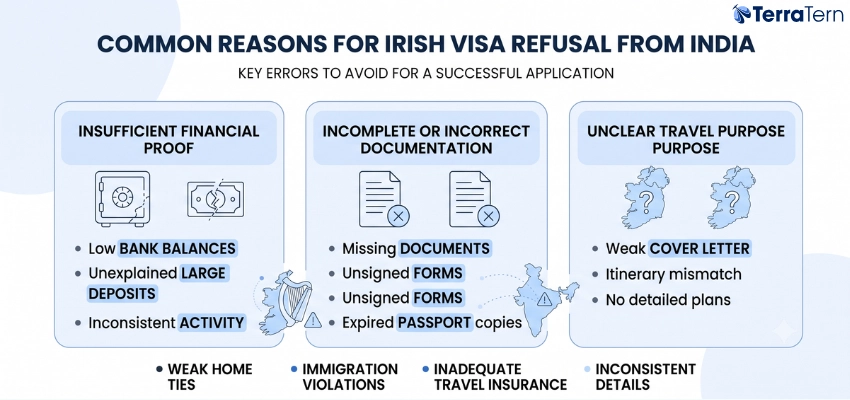
The estimated visa rejection rate for Indians in Ireland is around 15–20%. The most frequent reasons include insufficient financial evidence, incomplete documentation, unclear travel purpose, weak ties to India, and previous immigration issues.
-
Insufficient Financial Proof: Bank statements showing low balances, unexplained large deposits, or inconsistent financial activity can affect your Ireland visa for Indians application.
-
Incomplete or Incorrect Documentation: Missing documents, unsigned forms, or expired passport copies are common reasons for refusal.
-
Unclear Travel Purpose: A weak cover letter or itinerary that does not match the visa category may raise concerns.
-
Weak Ties to India: Lack of evidence of employment, business, property, or family commitments can make officers doubt your intention to return.
-
Previous Immigration Violations: Past overstays, deportations, or visa refusals in Ireland or other countries may negatively impact your application.
-
Inadequate Travel Insurance: Submitting a policy with insufficient coverage or one that does not cover Ireland may lead to complications where insurance is required.
-
Inconsistent Application Details: Differences in names, dates, employment history, travel plans, or financial information across documents can result in your application being rejected.
As per our TerraTern Expert, Divyansh, a rejection isn't permanent, but it creates a negative record. Before reapplying, address the exact reason for refusal stated in the rejection letter, ideally with professional immigration guidance.
What Happens After Your Ireland Visa Is Approved? (Post-Arrival Requirements)
After arriving in Ireland on a Long Stay 'D' visa, you must register with Immigration Service Delivery (ISD) within 90 days to obtain an Irish Residence Permit (IRP). Short-stay 'C' visa holders do not need IRP registration and must simply comply with the conditions of their permitted stay.
-
If your Ireland visa for Indians is a Short Stay 'C' visa, no post-arrival registration is required. Simply leave Ireland before your permitted stay expires.
-
If you hold a Long Stay 'D' visa, register with Immigration Service Delivery (ISD) (or the relevant immigration registration office) within 90 days of arrival to receive your Irish Residence Permit (IRP).
-
Pay the EUR 300 IRP registration fee and bring your passport, visa, proof of address, and supporting documents, such as an employment offer or a university enrolment letter.
-
Your IRP card is proof of your legal residence in Ireland. The permission granted will be reflected by a Stamp category (e.g., Stamp 1 for work, Stamp 2 for study, Stamp 4 for eligible residence permissions).
-
Once you have a valid IRP, you can generally re-enter Ireland during its validity without applying for a separate re-entry visa, provided you continue to meet your immigration conditions.
Pro Tip: Missing the 90-day IRP registration deadline after arriving on a D visa can jeopardise your legal status in Ireland. Set a calendar reminder before you board your flight.
Why Apply for Your Ireland Visa Through TerraTern?
TerraTern's immigration specialists provide end-to-end support for Irish visas for Indians, including document verification, AVATS application guidance, interview preparation, and post-arrival assistance, helping applicants submit accurate, well-prepared visa applications.
-
Receive a comprehensive document review to minimise errors and strengthen your Ireland visa for Indians application before submission.
-
Get personalised guidance based on your visa category, whether you're applying as a tourist, student, skilled professional, or family member.
-
Access assistance for applicants submitting through all 13 VFS Global centres across India, with support throughout the application process.
-
Benefit from post-approval guidance, including IRP registration, accommodation advice, and essential settlement support such as opening a bank account.
-
Book a free consultation with TerraTern's Ireland visa experts to receive tailored advice and practical support for your Ireland visa journey.
Key Note: A professional immigration review costs a fraction of the visa fee and far less than a rejected application, rebooking flights, or missing a planned trip.
Conclusion
Obtaining an Ireland visa for Indians is a straightforward process when you understand the correct visa category, prepare complete documentation, and apply well before your travel date. Whether you're visiting for tourism, study, work, or business, careful planning significantly improves your chances of approval. Follow the official application steps, meet all eligibility requirements, and stay up to date on immigration rules to ensure a smooth and successful journey to Ireland.
Contact TerraTern for more information on the Ireland Visa for Indians: Types, Fees & How to Apply in 2026.




 AI Summary