



Key Highlights
- How to Get PR in Canada from India?
- What Is Canada PR and Why Do Indians Want It?
- What Are the Eligibility Requirements to Get Canada PR from India?
- What Are the Different Pathways to Get PR in Canada from India?
- How Can You Get Direct PR in Canada from India Without a Job Offer?
- How Does the Express Entry Process Work Step by Step?
- What Is the CRS Score and How Can You Improve It?
- How Do Provincial Nominee Programs (PNP) Help You Get PR Faster?
- What Documents Are Required for Canada PR from India?
- How Much Does Canada PR Cost from India?
- How Long Does Canada PR Processing Take from India?
- What Common Mistakes Delay or Reject Canada PR Applications from India?
- Which Pathway Should You Choose: Express Entry, PNP, or Direct Application?
- 2026 Industry Context Section
- Conclusion
How to get PR in Canada from India in 2026? Canada's changing immigration policies mean that to make a successful move, you'll need to go where the jobs are in high-demand fields such as healthcare, tech, and skilled trades. The Express Entry system and Provincial Nominee Programs are still the quickest ways to obtain PR from India, including options for direct PR in Canada from India without first working or studying in Canada. This is a complete guide to the new changes, eligibility and step-by-step process for success.
How to Get PR in Canada from India?

To know how to get PR in Canada from india, the federal Express Entry system is the quickest points-based way. Submit your full application, including medical exams, police clearance, and proof of funds, within the 60-day window! This is how it works:
-
Eligibility Check: Make sure you meet the minimum requirements to be eligible for a points-based program such as the Federal Skilled Worker Class Program. Assess Education (ECA): Get an Educational Credential Assessment to make sure your educational qualification is equivalent to a Canadian education.
-
Pass Language Tests: Take an approved English (IELTS General Training or CELPIP) or French exam and achieve a competitive score.
-
Submit Profile: Create and submit your Express Entry profile online so you are added to the candidate pool and assigned a Comprehensive Ranking System (CRS) score.
-
Wait for an IRCC Draw: If your CRS score meets or exceeds the cut‑off in a draw, you will receive an Invitation to Apply (ITA) for permanent residence.
-
Within 60 Days: Complete your application, including medical examinations, police check and proof of funds within 60 days!
-
Become a Permanent Resident: Approx. 6-8 months after processing, you will receive your Confirmation of Permanent Residence (COPR), which will officially make you a permanent resident of Canada.
Also Read: Canada PR Process: Experts' Latest Fast Track Guide
What Is Canada PR and Why Do Indians Want It?
Canada Permanent Residence (PR) is an immigration category that allows an overseas citizen to reside, work and study in Canada as long as they keep their PR status, receive public health care and free education and eventually become a Canadian citizen. For many Indians researching how to get PR in Canada from India, it offers a sense of stability, the possibility of family sponsorship, and the freedom of being able to change jobs or locations in Canada without limitations or restrictions, which is not granted with a temporary work permit that is only valid for one employer.
-
PR means you have an unlimited right to reside, work and study in Canada.
-
Free access to public healthcare and government-funded education for PR holders
-
Unlike work permit holders, PR holders have no ties to their jobs or province.
-
Path to Canadian citizenship for 1,095 days in a 5-year period.
-
PR does not give the right to vote or access to some high-security government positions
|
Feature |
Work Permit |
Permanent Resident (PR) |
Canadian Citizen |
|
Duration |
Temporary (1–3 years) |
Indefinite (Renew card every 5 years) |
Lifelong |
|
Work Freedom |
Often employer-specific |
Work anywhere, for any employer |
Work anywhere |
|
Voting Rights |
No |
No |
Yes |
|
Hold Public Office |
No |
No (some high-security jobs restricted) |
Yes |
As per our TerraTern Expert Shreya, PR is not the same as citizenship; don't let anyone tell you PR "expires" after 5 years; only the physical card does, and renewal is straightforward if you meet the residency obligation.
What Are the Eligibility Requirements to Get Canada PR from India?
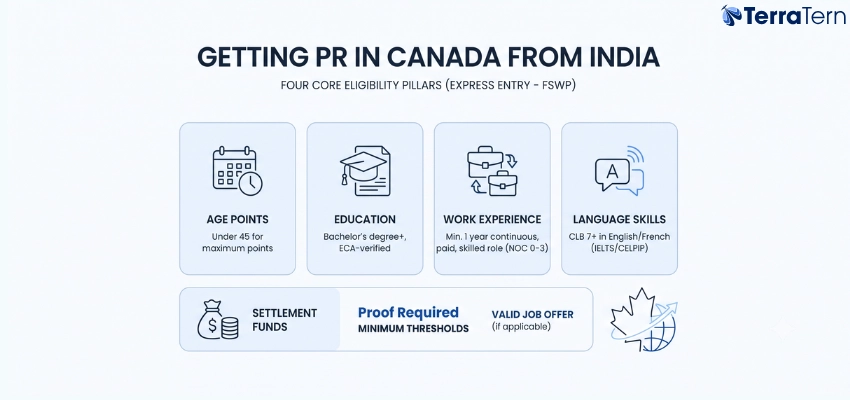
Eligibility depends on the pathway, but for the most common route (Federal Skilled Worker Program via Express Entry), Indian applicants generally need to be under 45 for maximum age points, hold a Bachelor's degree or higher (ECA-verified), have at least 1 year of continuous skilled work experience, and score CLB 7+ (IELTS/CELPIP), plus meet minimum settlement-fund thresholds. Understanding how to get PR in Canada from India starts with meeting these four core pillars before applying through Express Entry.
-
Age under 45 for maximum CRS points (no hard cutoff, but points drop sharply after)
-
Bachelor's degree or higher, verified through an Educational Credential Assessment (ECA)
-
Minimum 1 year continuous, paid, skilled work experience (NOC TEER 0–3) in the last 10 years
-
CLB 7 or higher in English or French (IELTS, CELPIP, or TEF)
-
Proof of settlement funds unless you have a valid Canadian job offer or are already working in Canada
What Is the Age Requirement for Canada PR from India?
There's no strict age cap for Express Entry, but CRS age points peak between 20–29 and drop to zero at 45+; PNP and family sponsorship routes are not age-restricted in the same way.
-
Being eligible means you meet the minimum criteria to apply, while maximising points determines if you actually receive an invitation for how to get PR in Canada from india.
-
CRS age points peak at 20–29 years and decline steadily after 30
-
Age points drop to zero once an applicant turns 45
-
Provincial Nominee Programs (PNP) and family sponsorship are not tied to CRS age scoring
Expert Advice: Applicants over 45 aren't excluded; they're just relying more heavily on language, education, and PNP nomination to offset zero age points.
What Education Level Do You Need for Canada PR?
A minimum of secondary education is technically eligible for some streams, but a Bachelor's degree or higher (ECA-verified) is needed to be competitive under Express Entry.
-
Secondary school education meets the minimum eligibility for some PNP and other streams
-
A bachelor's degree or higher is strongly recommended for a competitive Express Entry profile
-
To secure enough CRS points for PR in Canada from India, a Bachelor’s, Master’s or PhD is highly recommended.
-
Foreign credentials must be verified through an Educational Credential Assessment (ECA)
-
Designated ECA bodies include WES, IQAS, ICAS, and ICES
Important Tip: Only your highest credential typically needs an ECA; don't pay for multiple assessments unless you're claiming points for two or more credentials.
What Language Score Do You Need for Canada PR?
Most Express Entry applicants need a minimum CLB 7 (IELTS General Training ~6.0 in each band), higher scores meaningfully increase CRS points.
-
CLB 7 is the baseline threshold for most Express Entry programs under the skill transferability factors for how to get PR in Canada from india.
-
IELTS General Training band of approximately 6.0 in each skill maps to CLB 7
-
Higher CLB levels (9–10) unlock significantly more CRS points
-
Accepted tests include IELTS, CELPIP, and TEF (for French)
How Much Work Experience Do You Need?
At least 1 year of continuous, paid, skilled work experience (NOC TEER 0–3) within the last 10 years is the baseline requirement for FSWP. This applies whether you're pursuing Express Entry or applying for direct PR from India without a Canadian job offer.
-
Minimum 1 year of continuous, paid, skilled experience is required under FSWP
-
Experience must fall under NOC TEER 0, 1, 2, or 3 categories
-
The work experience window looks back over the last 10 years
-
While 1 year makes you eligible, 3 or more years of skilled foreign work experience maximise your CRS points for how to get PR in Canada from india.
-
This baseline holds true for both Express Entry and applicants seeking direct PR from India without a Canadian job offer
Expert Tip: Meeting minimum eligibility gets you into the pool ,it doesn't guarantee an ITA. Treat eligibility as the entry ticket, not the finish line.
What Are the Different Pathways to Get PR in Canada from India?
Indian nationals can get Canada PR through Express Entry (the fastest route for skilled workers), Provincial Nominee Programs, family sponsorship, the Quebec Skilled Worker Program, the Atlantic Immigration Program, or the Start-Up Visa, with Express Entry and PNP together accounting for the large majority of Indian PR admissions. Whether you are searching for how to get PR in Canada from India generally, or specifically how to get direct PR in Canada from india, selecting the right pathway is critical.
|
Pathway |
Best For |
Job Offer Needed? |
|
Express Entry (FSWP/FSTP/CEC) |
Skilled workers, no Canada ties |
No |
|
Provincial Nominee Program (PNP) |
Moderate CRS scores, specific occupations |
Sometimes |
|
Family Sponsorship |
Applicants with a PR/citizen relative in Canada |
No |
|
Quebec Skilled Worker Program |
French speakers wanting to settle in Quebec |
No |
|
Atlantic Immigration Program |
Employer-driven, Atlantic provinces |
Yes |
|
Start-Up Visa |
Entrepreneurs with a qualifying business idea |
N/A (investor route) |
Important Note: Don't fixate on one pathway; many successful Indian applicants qualify for Express Entry and a PNP simultaneously, and a PNP nomination adds 600 CRS points, which can turn a borderline profile into a guaranteed ITA.
How Can You Get Direct PR in Canada from India Without a Job Offer?
Getting direct PR in Canada from India means applying for and receiving permanent residence entirely from India without first travelling, studying, or working in Canada, and without a Canadian job offer through Express Entry's FSWP stream or a job-offer-exempt PNP, since Canada's points system evaluates potential (skills, education, age, language) rather than location or prior connection.
-
Clarifying "Direct PR": In this guide, direct PR in Canada from India means qualifying for permanent residence entirely from India, without first holding a Canadian study permit or work permit. It does not refer to investor or Start‑Up Visa routes, which are capital‑driven rather than points‑driven.
-
What You Don't Need: You do not need a visitor visa, study permit, prior Canadian work permit, or a Canadian job offer to apply for most FSWP or PNP streams.
-
What You Do Need: You must secure an Educational Credential Assessment (ECA), high language test scores, an Express Entry profile, and either a highly competitive CRS score or a provincial nomination.
-
The 2026 Trade-Off: As highlighted by immigration.ca's 2026 analysis, candidates with Canadian education or work experience often have measurably stronger profiles. While the direct route for how to get PR in Canada from India is entirely possible, it is not automatically the fastest-scoring path for every profile; your overseas experience, education, and language skills must do the heavy lifting.
As per TerraTern Expert: Direct" doesn't mean "guaranteed" or "faster" , it means you skip an intermediate Canadian visa. Your CRS score still has to clear the draw cut-off, so strengthen your profile (language, ECA, PNP) rather than assuming "direct" applications get special treatment.
How Does the Express Entry Process Work Step by Step?
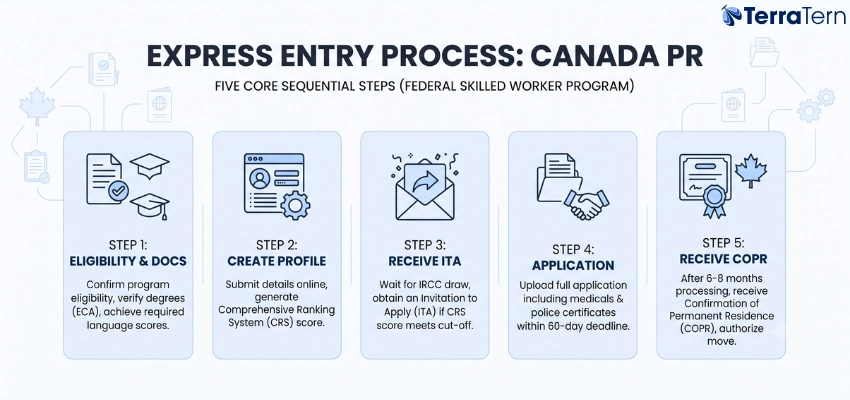
The Express Entry process has seven core steps. For those planning exactly how to get PR in Canada from India or how to get direct PR in Canada from india, here is how those steps flow sequentially:
-
Confirm Eligibility & Prep Documents: Determine your eligibility for a federal program, verify your Indian degrees with an ECA, and achieve required scores on an approved language test.
-
Create Your Express Entry Profile: Submit your details into the online pool to generate your Comprehensive Ranking System (CRS) score based on your credentials.
-
Receive an Invitation to Apply (ITA): Wait for an IRCC draw. If your CRS score meets or exceeds the minimum cut-off, you will receive an official ITA.
-
Submit Your Full Application: Upload your complete application, including medical exams, police certificates, and proof of funds, within the strict 60-day deadline.
-
Receive COPR: After 6–8 months of processing time, receive your Confirmation of Permanent Residence to officially authorise your move.
Pro Tip: The 60-day window after your ITA is non-negotiable. Start gathering your medical exam and police clearance certificate before you get the ITA if your CRS score is trending near a recent cut-off, so you're not scrambling.
What Is the CRS Score and How Can You Improve It?
The Comprehensive Ranking System (CRS) scores Express Entry candidates out of 1,200 points across core human capital factors (age, education, language, work experience), skill transferability, and additional factors (provincial nomination, sibling in Canada, French proficiency, arranged employment) and in 2026, cut-offs have ranged from 379 (category-based trades draws) to 500+ (all-program draws). Knowing your CRS breakdown is essential to figuring out how to get PR in Canada from India efficiently rather than waiting on chance.
|
Factor Category |
Maximum Points |
|
Core Human Capital (Age, education, language, experience) |
500 |
|
Skill Transferability |
100 |
|
Provincial Nomination (PNP) |
600 |
|
Arranged Employment (Valid job offer) |
Up to 200 |
|
Sibling in Canada |
15 |
|
French Language Proficiency |
50 |
Key Note: A provincial nomination is the single most reliable CRS lever available; it adds 600 points outright, which effectively guarantees an ITA in the next draw, regardless of your base score.
How Do Provincial Nominee Programs (PNP) Help You Get PR Faster?
PNPs let individual Canadian provinces nominate candidates who match their local labour-market needs; a provincial nomination adds 600 CRS points, which virtually guarantees an Invitation to Apply in the next Express Entry draw, making PNPs the strongest secondary pathway for Indian applicants whose CRS score falls short of general draw cut-offs. For anyone exploring how to get PR in Canada from India without a top CRS score, PNP is often the fastest realistic route.
Key Points:
-
Express Entry-linked PNP streams or applying directly to a province
-
Popular provinces for Indian applicants include Ontario, British Columbia, Alberta, Saskatchewan, and Manitoba
-
Some PNP streams require no prior connection to the province at all
-
Other streams require a prior job offer or study history in that province
-
The plan has increased the overall PNP allocation, signalling continued growth in this pathway
As per our TerraTern Expert Divyansh, if your CRS score has been stuck below recent cut-offs for two or more draws, actively applying to 2–3 relevant PNP streams is usually a better use of time than waiting for scores to change.
What Documents Are Required for Canada PR from India?
Core documents include a valid passport, ECA report, language test results (IELTS/CELPIP), work reference letters, proof of settlement funds, a police clearance certificate from India (and any other country lived in for 6+ months), and a medical exam report from an IRCC-approved panel physician. Organising these correctly is a practical first step in how to get PR in Canada from India smoothly.
-
Documents are best organised into six categories: identity, education, language, work, financial, and health/character
-
Police clearance is needed from India and any other country where you have lived for 6+ months
-
Language test results are valid for only 2 years. Timing matters
-
Medical exams must come from an IRCC-approved panel physician
-
Mismatched name spellings between passport and PCC are a common, avoidable rejection reason
Important Note: Language test results and medical exams both expire close to your ITA, not at the very start of your journey, or you may need to redo them mid-process.
How Much Does Canada PR Cost from India?
Total costs for a single applicant typically run CAD 2,300–2,500 in direct government fees, plus IELTS (~INR 16,000–17,000), ECA (~CAD 200–260), medical exam, and police clearance costs, bringing the realistic all-in total closer to INR 1.5–2.5 lakhs per principal applicant before settlement funds. Budgeting correctly is one of the most important steps when planning how to get PR in Canada from india.
Here is a breakdown of the estimated costs (updated for IRCC's 2026 fee increases):
|
Item |
Approx. Cost |
|
Application fee (principal applicant) |
~990 CAD |
|
Right of Permanent Residence Fee (RPRF) |
~600 CAD |
|
Spouse/partner processing fee |
~990 CAD |
|
Dependent child fee |
~270 CAD |
|
ECA report (e.g., WES) |
~200–260 CAD |
|
Language Test (IELTS/CELPIP) |
~INR 16,000–17,000 |
|
Medical Exam & Police Clearance |
~INR 5,000–8,000 |
Expert Advice: Budget separately for settlement/proof-of-funds; this money isn't a "fee" you pay to IRCC, but you must show it's available and unencumbered, and the required amount rises with family size.
How Long Does Canada PR Processing Take from India?
Most Express Entry applications from India are processed within IRCC's 6-month service standard after a complete application is submitted, though Canadian Experience Class applications can be faster (3–4 months) and PNP-linked applications sometimes take longer depending on provincial processing. For anyone asking how to get PR in Canada from india, it helps to break the timeline into fixed and variable stages:
|
Process Stage |
Estimated Timeline |
Fixed or Variable? |
|
Profile Creation (ECA & Language Test) |
1–2 months |
Variable (depends on your prep speed) |
|
Time in Express Entry Pool |
Days to months |
Variable (depends on your CRS score and draws) |
|
Application Submission Window |
Exactly 60 days |
Fixed (strict deadline post-ITA) |
|
IRCC Final Processing |
6–8 months |
Variable (based on IRCC service standards) |
Expert Tip: The most unpredictable part of your timeline isn't IRCC processing; it's how long you spend in the CRS pool before an ITA. Strengthening your profile before you enter the pool shortens this variable far more than anything you can do after applying.
What Common Mistakes Delay or Reject Canada PR Applications from India?
The most common causes of delay or refusal are mismatched documentation (name/date discrepancies across passport, ECA, and PCC), expired language test results, incomplete proof-of-funds documentation, misrepresentation (even unintentional), and missing the 60-day post-ITA submission deadline. To ensure your application for how to get PR in Canada from India goes smoothly, avoid these pitfalls:
-
Mismatched Documentation: Fix discrepancies across your passport, degree, and ECA immediately; use a legal affidavit if your name formats differ.
-
Expired Language Tests: Verify your IELTS/CELPIP results will remain valid (under two years old) on the exact day you submit your final post-ITA application.
-
Incomplete Proof of Funds: Provide six months of official bank statements on bank letterhead that explicitly demonstrate the funds are unencumbered and immediately accessible.
-
Misrepresentation: Disclose all past visa refusals for any country; omitting them, even unintentionally, can trigger a 5-year ban.
-
Missing the Deadline: Gather your Police Clearance Certificates (PCCs) and complete your medical exams before receiving your ITA so you don't run out of time in the 60-day window.
Pro Tip: Misrepresentation, even an honest mistake like an outdated employer letter, can trigger a 5-year inadmissibility bar. When in doubt, disclose rather than omit.
Which Pathway Should You Choose: Express Entry, PNP, or Direct Application?
Choose Express Entry if your CRS score is competitive without a nomination; choose a PNP if your score is borderline, but you match a specific in-demand occupation or provincial priority; choose family sponsorship if you have an eligible relative in Canada — and note that "direct application without a job offer" is simply the FSWP stream of Express Entry, not a separate program.
To determine the best approach for how to get PR in Canada from india, use this simple decision framework:
-
If your CRS is above the last 3 draw cut-offs → Express Entry alone may suffice.
-
If your CRS is below recent cut-offs → Look at PNP streams matching your specific occupation or language skills.
-
If you have close family already in Canada, → Compare family sponsorship timelines against economic pathways.
-
If you want a ‘direct application’ without prior Canadian experience, focus on maximising your Federal Skilled Worker Program eligibility, as this is the primary route that does not require existing Canadian study or work history.
Key Note: Don't choose based on speed alone; choose the program you can actually qualify for today. The fastest program on paper is irrelevant if your profile doesn't clear its draws.
2026 Industry Context Section
Some of the facts are:
-
IRCC's 2026–2028 Immigration Levels Plan sets permanent resident admissions at 380,000 per year, down slightly from 395,000 in 2025, correcting outdated "500,000+" figures still circulating on competitor sites
-
Economic-class immigration will reach 63–64% of all PR admissions by 2027–2028, the highest share in decades, meaning skilled-worker pathways like Express Entry and PNP are getting relatively more space, even as overall numbers hold steady.
-
CRS cut-offs in 2026 have ranged from 379 (trades-focused category draws) to over 500 (all-program draws). Category-based draws (healthcare, French-language proficiency, trades) have been consistently clearer at lower scores than general draws.
-
A one-time initiative will transition up to 33,000 temporary workers to PR status in 2026–2027, reflecting IRCC's shift toward converting people already established in Canada rather than only inviting new applicants abroad.
-
Provincial Nominee Program allocations are increasing under the 2026–2028 plan, giving Indian applicants with moderate CRS scores a stronger secondary route.
-
India remains Canada's largest source country for new permanent residents, even as overall admission volumes have been recalibrated downward due to housing/infrastructure constraints.
-
Study-permit and temporary-resident caps introduced since 2024 have tightened the "study-then-PR" route, making direct economic-class applications from India more attractive for applicants who don't want to study in Canada first.
Conclusion
Understanding how to get PR in Canada from India in 2026 means matching your profile to the right pathway. Express Entry and PNPs remain the top routes. With IRCC targets at 380,000 admissions, the process is selective. A strong CRS score and flawless documentation are decisive. For personalised guidance on how to get direct PR in Canada from india, explore TerraTern’s consultation services to map out your best immigration path
Contact TerraTern for more information on How to Get PR in Canada from India: Complete 2026 Guide.




 AI Summary