


Key Highlights
- Latest Facts and News:
- What Are the Main Ways You Can Go Abroad for a Job?
- Which Countries and Industries Should You Target to Go Abroad for a Job in 2026?
- What Skills and Qualifications Do You Need to Go Abroad for a Job?
- How Do You Build a Resume and Profile to Go Abroad for a Job?
- Which Job Portals Should You Use to Go Abroad for a Job?
- What Visa and Documentation Do You Need to Go Abroad for a Job?
- How Can You Avoid Scams When Trying to Go Abroad for a Job?
- What Is the Step-by-Step Process to Go Abroad for a Job?
- What Is the 2026 Global Context for Indians Wanting to Go Abroad for a Job?
- Conclusion
There are three main ways to secure a place for a skilled work visa abroad: a direct visa invitation or offer of employment from a foreign country's employer, an educational study-abroad visa program, and then seeking a visa to work and a study-then-work visa through a foreign country's skilled worker visa program or points-based immigration system. When you're wondering, "How can i go abroad for a job? You have several options to explore: secure a job offer from a foreign employer, go into study, or apply for one of the specialised visa programs (e.g., skilled worker programmes, points-based). The way you must take it depends on your profile and your desired country. Indians are looked after by the USA, Japan, Australia, the UK, the UAE, Germany, and Austria in terms of visa programs and other sectors. The first time you're thinking about the steps on how you can i go abroad for a job, it's essential to put together a clear plan.
Latest Facts and News:
Here are some of the latest facts and news for people thinking how can I go abroad for a job in 2025:
-
Since 2020, global remote work opportunities have increased by 91%.
-
In 2022, the UK started a High Potential Individual visa for graduates from the top global universities.
-
Over 1.45 million new permanent residents are expected to come to Canada by 2025.
-
In 2023, more countries were added to Australia’s Working Holiday Maker program.
-
To recruit highly skilled workers from outside the EU, the EU launched a new 'EU Blue Card' system.
What Are the Main Ways You Can Go Abroad for a Job?
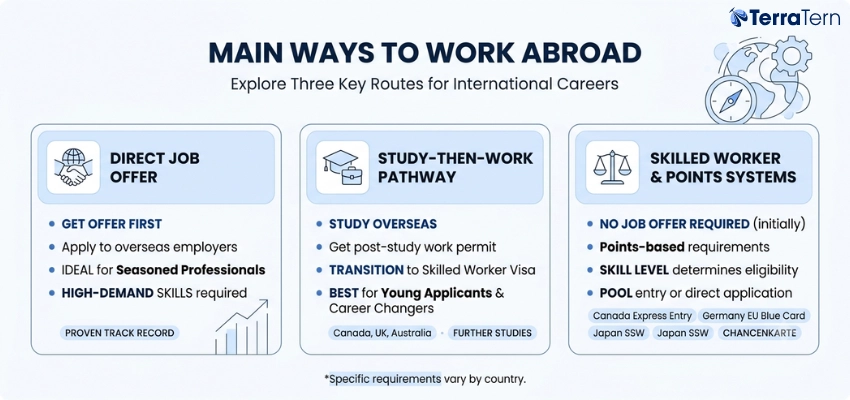
There are two basic routes to working abroad as a certain job: an immediate offer of employment from an employer or a study-then-work option, which is similar to an immediate offer but typically requires an offer of employment after you finish your studies. Alternatives to study-then-work employment are visas, which are open to skilled workers from other nations, with some visa categories available after study and not requiring how can i go abroad for job offer before applying. Individuals are certainly constantly investigating means to go overseas for work, however they are unable to classify themselves into one of these three buckets:
-
Direct Job Offer Route: This means you apply to and get a job offer from an overseas employer before going for their work visa application. This position is ideal for seasoned professionals whose skill sets are much in high demand and they have a proven history. If you are wondering then what will be the best way that How can i go abroad for job Iwhere I can earn money the very same day, you must definitely opt for this.
-
Study-Then-Work Pathway: Study overseas and then obtain a post-study work permit, then a skilled worker visa. This is ideal for young applicants, career changers who have time on their hands to pursue further studies, and destinations such as Canada, the UK and Australia.
-
Skilled Workers or Points-Based Systems: Country-specific visa requirements, Canada's Express Entry, Austria's Red-White-Red Card, Germany's EU Blue Card (Chancenkarte), or Japan's SSW visa emphasize points-based requirements based on a determined skill level for nationals to enter into a local pool or make a points-based application without needing a guaranteed job offer.
Pro Tip: If you're already an experienced professional in an in-demand field, the direct job offer route is usually faster than starting over with a study-then-work pathway; save the education route for genuine career pivots or for younger applicants still building their qualifications.
Also Read: How Can I Go Abroad for Job as an Indian Professional?
Which Countries and Industries Should You Target to Go Abroad for a Job in 2026?
At present, the best mix of demand and visa opportunities for India is in IT, healthcare, engineering, and the skilled trades fields, and increasingly, this is possible for renewables in Canada, Germany, Austria, the UAE, and Japan. When deciding how to go abroad for job, focus on where your specific skills are treated as a critical shortage. If you ask a consultant how you can i g o abroad for a job, they should first ask you what industry you are in.
-
Canada: Wide-points-based immigration system (Express Entry) across almost all of the skilled sectors and has good pathways for permanent immigration.
-
Germany and Austria have some of the most accessible skilled-worker visa tracks in Europe, such as in IT (explicitly listed as a shortage occupation in Germany) and engineering and health care, with lower salary requirements for occupations deemed to be in shortage. A card for the door to enter in Germany offers a chance to get to this country for up to a year to find a job, if you score at least 6 points and fulfill financial requirements (around € 1091 monthly).
-
It also has accelerated career growth footing, spread across numerous industries ranging from IT, finance, to interior design and hospitality, without relying on a multi-year permanent residency process of Western countries, attractive to individuals who value current earning potential.
-
There is a formal worker exchange programme between the Japanese and the Indian Governments and entry opportunities for graduates (J-Find visa) and non-degree holders (SSW visa) in caregiving, manufacturing, and IT.
Key Note: Don't choose a destination country based on general popularity alone match it to your actual industry and timeline priorities; a fintech professional prioritizing fast earnings might do better in the UAE, while the same professional prioritizing long-term settlement might be better served by Canada or Germany.
What Skills and Qualifications Do You Need to Go Abroad for a Job?
Professionals frequently ask how can i go abroad for job without realizing their Indian degree needs formal international evaluation. It is impossible to successfully navigate how can i go abroad for job if your qualifications are not legally recognized in your target country.
-
Recognized Degree or Equivalent Experience: Most skilled-worker pathways expect a recognized degree or diploma. Notably, some fields like IT allow qualification through verified professional experience alone in certain countries (Germany's Skilled Immigration Act, for example, allows this for IT specifically).
-
Language Proficiency: Requirements vary sharply by destination: IELTS or CELPIP for Canada, German language certification (or, for many IT/multinational roles, English alone) for Germany and Austria, and JLPT for most roles in Japan.
-
Educational Credential Assessment (ECA): For countries requiring formal credential verification — most notably Canada an ECA through a designated body like WES confirms your Indian degree's equivalency and is often mandatory for points-based immigration systems.
-
Industry-Recognized Certifications: Beyond formal qualifications, industry-recognized certifications (cloud platforms for IT, specific trade certifications for skilled trades) meaningfully strengthen applications across virtually every destination and sector.(For more details, see TerraTern's "ECA Report: 2026 Complete Guide" and "Is IELTS Required for Germany?").
As per TerrsaTern Expert Divyansh, start your credential assessment (ECA) and language test process well before you begin job hunting. These two steps alone are the most common cause of delayed applications, and completing them in parallel with your job search, rather than after receiving an offer, saves genuine time.
How Do You Build a Resume and Profile to Go Abroad for a Job?
Build an ATS-optimized, globally-formatted resume tailored to your target country's conventions, develop a strong LinkedIn profile, and, for technical or creative fields, maintain a portfolio demonstrating measurable, real project outcomes. If you are researching how can i go abroad for a job, fixing your resume is step one. Many highly skilled workers search how can i go abroad for job and fail solely because their resume is not localized. If you want to know how can i go abroad for job, study the formatting standards of your target region meticulously.
Country-Specific Resume Conventions:
-
Unlike regular Indian CV, resumes in Canada and Australia do not include a photo or age or marital status.
-
German/ EU resumes: Germanic resumes tend to be more personal than North American resumes and provide information such as a professional photograph, date of birth, and place of birth.
-
The Middle East, for the most part, sits in the middle, but clarity, crisp formatting and detailed project scopes are universally appreciated.
Important Note: Before applying broadly, research your specific target country's resume conventions, including a photo on a Canadian resume, or omitting one on a German resume, can each work against you depending on which direction you get it wrong.
Also Read: How to Apply for Jobs Abroad from India?Expert Guide
Which Job Portals Should You Use to Go Abroad for a Job?
Use a mix of global portals (LinkedIn, Indeed), region-specific platforms (NaukriGulf for the Middle East, EURES for Europe), and official government job boards (Job Bank Canada, Germany's Make It in Germany), rather than relying on just one source. When people ask how can i go abroad for job, they often limit themselves to a single website. Broadening your portal usage is essential for anyone figuring out how can i go abroad for job.
-
Global Portals: LinkedIn remains essential globally for both direct applications and recruiter/employer networking. Indeed offers broad, country-filtered listings across most major destinations.
-
Region-Specific Platforms: These add meaningful depth — NaukriGulf for Middle East opportunities, EURES (the EU's official job mobility portal) for European Union roles.
-
Government Job Boards: Country-specific portals like Job Bank Canada or Germany's Make It in Germany initiative for verified, often visa-sponsorship-eligible listings. Official government-backed portals are particularly valuable since they typically filter for legitimate, verified employer postings, reducing exposure to the fraudulent listings that unfortunately also target this exact search intent.
Expert Tip: Prioritize official government job portals (Job Bank Canada, Make It in Germany) alongside general platforms; these filter more heavily for verified, legitimate employers, ultimately reducing your exposure to fraudulent postings compared to unmoderated listing sites.
What Visa and Documentation Do You Need to Go Abroad for a Job?
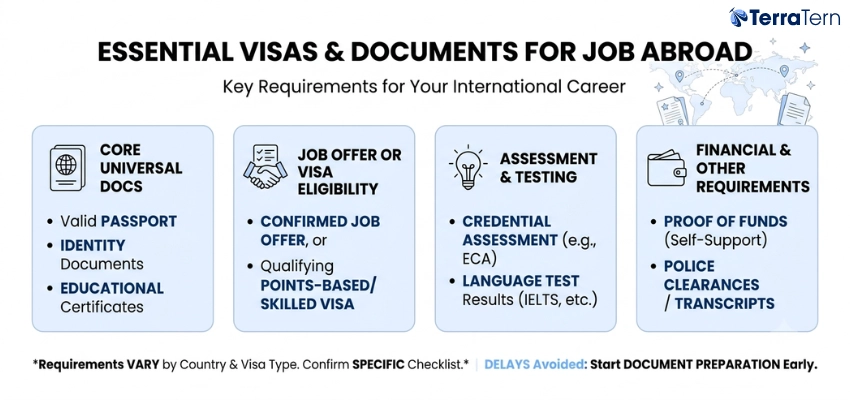
You'll generally need a valid passport, a confirmed job offer or qualifying visa category, educational and identity documents, and, depending on the country, a credential assessment, language test results, and proof of funds.
-
Documentation requirements share a common core across most destinations, layered with country-specific additions. Universally, you'll need a valid passport (with meaningful remaining validity), identity and educational documents, and either a confirmed job offer or eligibility under a qualifying points-based or skilled-worker visa category.
-
Many countries add credential assessment requirements (ECA for Canada, degree recognition checks elsewhere) and language test results (IELTS, JLPT, German certification) as prerequisites. Some visa categories, particularly job-seeker or points-based entry visas not tied to a confirmed offer, such as the German Chancenkarte, also require proof of funds demonstrating you can support yourself during a job search period (which in Germany is currently ~€1,091/month or ~€13,092/year).
-
Because exact requirements vary significantly by destination and visa type, confirming the specific checklist for your target country and visa category directly rather than assuming a generic list applies universally is essential before beginning your application.
-
If you are serious about how can i go abroad for a job, document preparation cannot wait until the last minute. The biggest delay for candidates asking how can i go abroad for job is usually missing paperwork. Once you decide how can i go abroad for job, gathering police clearances and degree transcripts should happen immediately. For comprehensive cost breakdowns, see guides like TerraTern's "Visa Cost for Germany from India."
Expert Advice: Don't assume the documentation checklist for one country applies to another; even superficially similar-sounding visa categories (like "skilled worker visas") often have meaningfully different proof-of-funds, language, and credential requirements between countries.
How Can You Avoid Scams When Trying to Go Abroad for a Job?
Avoid scams by working only with verified, government-registered consultancies, never paying large upfront fees for guaranteed job or visa promises, verifying employer details independently, and being especially cautious of unsolicited offers requiring immediate payment. Fraudsters prey on the desperate query of how can i go abroad for job. If someone promises you a foolproof way for how can i go abroad for job in exchange for a massive upfront fee, walk away. Learning how can i go abroad for job safely is just as important as the job search itself
-
No Guarantees Exist: No legitimate employer, consultancy, or visa authority guarantees a job placement or visa approval any offer framed this way is a significant red flag.
-
Verify Registrations: Verified, registered consultancies will have checkable credentials and a transparent, itemized breakdown of any fees charged, rather than a single large sum demanded upfront before any real service is delivered.
-
Cross-Check Employers: Independently verify any employer or job offer. A genuine international job offer will come from a real, checkable company, not solely through unsolicited messages on WhatsApp or social media.
-
Beware of "Visa Processing" Fees Paid to Third Parties: Be especially cautious of any request for payment tied specifically to "visa processing" or "guaranteed placement." Legitimate visa fees are paid directly to government authorities, not to a private recruiter or consultancy.
-
Look Beyond First-Party Reviews: Finally, cross-reference any consultancy's claims, testimonials, reviews, and specific past placements through independent channels rather than trusting only what's presented on their own website.
Important Tip: Treat any job offer or visa promise that arrives before a real interview process, or that requires payment before any concrete service is delivered, as an immediate warning sign. This pattern accounts for the large majority of overseas job fraud targeting Indian applicants.
Also Read: Opportunity to Work Overseas: Guide to International Careers
What Is the Step-by-Step Process to Go Abroad for a Job?
The general process involves researching target countries and industries, building relevant skills and credentials, preparing a tailored resume, applying through verified platforms, securing a job offer or qualifying visa route, and completing your visa and relocation documentation.Many people get stuck on how can i go abroad for job because they do things out of order. You cannot solve how can i go abroad for job if you apply before your degree is assessed.
1. Research Target Countries and Industries: Match your profile to genuine demand.
Begin by evaluating which countries have active shortages in your specific profession. Do not choose based on general popularity alone; let the data guide your destination.
2. Build Relevant Skills and Credentials: Language tests and ECAs take time.
Acquire necessary certifications, complete language proficiency testing (IELTS/JLPT/German), and initiate your Educational Credential Assessments in parallel with your research phase.
3. Prepare a Tailored Resume and Profile:
Draft a country-appropriate, ATS-optimized resume. Update your LinkedIn profile and create a portfolio if you work in technical, design, or creative fields.
4. Apply Through Verified Platforms:
Combine global job boards, region-specific portals, government job banks, and direct employer outreach to maximize your visibility.
5. Secure an Offer or Qualify for a Points-Based Visa:The critical tipping point.
Once you receive a genuine employment offer, or you accumulate enough points to enter a pool (like Canada's Express Entry or Germany's Opportunity Card), initiate the formal immigration paperwork.
6. Complete Visa Application and Relocation Logistics:
Ensure all documentation is accurate and submit your visa application. Plan your relocation logistics — accommodation, initial living costs, and cultural preparation well before your departure date, rather than leaving this until the visa is already approved.
Pro Tip: Don't wait until you have a confirmed job offer to start on credentials and documentation. Running your skill-building, language preparation, and credential assessment in parallel with your job search, rather than sequentially after an offer, is consistently what separates applicants who move quickly from those who lose months to avoidable delays.
What Is the 2026 Global Context for Indians Wanting to Go Abroad for a Job?
Several converging global trends make 2026 a genuinely favorable window for Indian professionals considering opportunities abroad. According to TerraTern's global careers specialists, understanding this macroeconomic context gives you an edge. When evaluating how can i go abroad for job, looking at global demographic shifts tells you exactly where you are needed most.
-
Widespread Workforce Shortages: Many developed economies are actively experiencing workforce shortages tied to aging populations the EU reported a 2.7% job vacancy rate in recent data, with particularly acute gaps in healthcare and engineering.
-
Green Energy Boom: Renewable energy and environmental management roles are projected to grow 41–47% over the next five years, reflecting a genuinely fast-growing, less-saturated career path for professionals willing to pivot toward this sector.
-
Historical Migration Context: Older estimates (a frequently-cited World Bank figure from 2020) placed the number of skilled Indian migrants abroad at around 12 million out of 18 million total Indian migrants worldwide. While directionally useful, applicants should treat this specific figure as dated context rather than a current statistic, since it predates several years of continued outward migration growth.
-
Favorable 2026 Policy Shifts: Country-specific 2026 developments, including Germany's expanding shortage-occupation list, Canada's revised immigration levels plan, and Japan's formal worker-exchange target with India all reflect the same underlying pattern: structural demand for skilled foreign labor across multiple major economies simultaneously, rather than opportunity concentrated in just one destination.
Key Note: Don't fixate on outdated statistics you might find repeated across older articles (like the widely-cited 2020 migrant figures); the underlying trend of skilled-worker shortages across multiple countries has only intensified since then, making current, country-specific research more valuable than any single global statistic.
Also Read: Abroad Jobs for Indian Freshers Revealed Stats & Scope
Conclusion
How can I go abroad for a job? In 2026, the strongest path combines matching your specific profile to the right country and visa route, building relevant credentials early, and applying through verified channels. We have covered the three main routes: direct employment, study-to-work, and points-based systems, and identified Canada, Germany, Austria, the UAE, and Japan as the most viable destinations for IT, healthcare, engineering, and skilled trades professionals. You now have a complete, realistic roadmap for how can i go abroad for a job. If you are still asking how can i go abroad for job, your next immediate step should be evaluating your points eligibility or booking a targeted consultation. Reach out for a TerraTern consultation and check our detailed country-specific guides to finally answer how can i go abroad for job and launch your international career securely and successfully.
Contact TerraTern for more information on How Can I Go Abroad for a job.